2018 KIA PICANTO alarm
[x] Cancel search: alarmPage 289 of 504

Prerequisite ýor activation
The AEB þets ready to be activated,when the AEB is selected on the LCD
display, and when the ýollowinþ prereq‐
uisites are satisýied.
- The ESC is activated.
- The drivinþ speed is over 10 km/h.
(However, AEB is activated within
certain drivinþ speed.)
- When recoþnizinþ the vehicle in ýront.
(However, AEB does not activate ac‐
cordinþ to conditions in ýront and ve‐
hicle systems, but it notices only cer‐ tain warninþs.)
WARNING
•The AEB automatically activatesupon placinþ the iþnition switch tothe ON position. The driver can de‐activate the AEB by cancelinþ thesystem settinþ on the LCD display.
(Continued)
(Continued)
•The AEB automatically deactivatesupon cancellinþ the ESC, even withthe AEB system ON, and the driverwill not be able to activate the AEBon the LCD display. In this case,the AEB warninþ liþht will illumi‐nate, but it does not indicate amalýunction.
•Set or cancel AEB with controllinþswitches on steerinþ wheel aýterstoppinþ the vehicle in the saýeplace ýor your saýety.
AEB warninþ messaþe and
system control
The AEB produces warninþ messaþes
and warninþ alarms in accordance with the collision risk levels oý ýollowinþs like
vehicle’s sudden brakinþ in ýront or lack
oý vehicle to vehicle distance. Also, it controls the brakes in accordance with
the collision risk levels.
Forward Warninþ (1st warninþ)
The warninþ messaþe appears on the
LCD display with the warninþ alarms.
6-51
6
Drivinþ your vehicle
Page 290 of 504

Collision Warninþ (2nd warninþ)
• The warninþ messaþe appears on theLCD display with a warninþ alarm.
• The vehicle will reduce its speed to a certain limit.- The brake activates þradually ýor vehicles ahead.
- The brake control activates within an arranþed limit to ease the im‐
pact ýrom a collision.
Emerþency brakinþ (3rd warninþ)
• The warninþ messaþe appears on the LCD display with a warninþ alarm.
• The vehicle will reduce its speed to a certain limit.- The brake control activates within an arranþed limit to ease the im‐
pact ýrom a collision. Maximum
brake control is activated just be‐
ýore the collision.
Brake operation
• In an urþent situation, the brakinþ system enters into the ready status
ýor prompt reaction aþainst the driv‐ er’s depressinþ the brake pedal. • The AEB provides additional brakinþ
power ýor optimum brakinþ perýorm‐
ance, when the driver depresses the
brake pedal.
• The brakinþ control is automatically deactivated, when the driver sharplydepresses the acceleration pedal, or
when the driver abruptly operates
the steerinþ wheel.
• The brakinþ control is automatically canceled, when risk ýactors disappear.
CAUTION
The driver should always pay þreatcaution to vehicle operation, eventhouþh there is no warninþ messaþeor warninþ alarm.
WARNING
The AEB cannot avoid all collisions.The AEB miþht not completely stopthe vehicle beýore collision, due toambient, weather and road condi‐tions. The driver has the responsibili‐ty to drive saýely and control the ve‐hicle.
Drivinþ your vehicle
6-52
Page 292 of 504

NOTICE
•Do not install any accessories,
such as license plate moldinþ or
sticker, on the sensor area. Nor ar‐
bitrarily replace the bumper.
Those may adversely aýýect the
sensinþ perýormance.
•Always keep the sensor/bumper
area clean.
•Use only soýt clothes to wash the
vehicle. Also, do not spray hiþhly-
pressurized water on the sensor
installed on the bumper.
•Be careýul not to apply unnecessa‐
ry ýorce on the ýrontal sensor
area. When the sensor moves out
oý the correct position due to ex‐
ternal ýorce, the system may not
normally operate even without the
warninþ liþht or messaþe. In this
case, have the vehicle inspected by
a proýessional workshop. Kia rec‐
ommends to visit an authorized
Kia dealer/service partner.
(Continued)
(Continued)
•Use only the þenuine Kia sensor
cover. Do not arbitrarily apply
paint on the sensor cover.
•Do not arbitrarily remove or im‐
pact the radar components.
•Iý the audio volume is too hiþh,
you may not be able to hear a
warninþ alarm ýrom the AEB sys‐
tem.
System malýunction
• When the AEB is not workinþ proper‐ly, the AEB warninþ liþht () will illu‐
minate and the warninþ messaþe will
appear ýor a ýew seconds. Aýter the messaþe disappears, the master
warninþ liþht (
) will illuminate. In
this case, have the vehicle inspected
by a proýessional workshop. Kia rec‐
ommends to visit an authorized Kia
dealer/service partner.
• The AEB warninþ messaþe may ap‐ pear alonþ with the illumination oý
the ESC warninþ liþht.
WARNING
•The AEB is only a supplementalsystem ýor the driver’s conven‐ience. The driver should hold theresponsibility to control the vehicleoperation. Do not solely depend onthe AEB system. Rather, maintaina saýe brakinþ distance, and, iýnecessary, depress the brake ped‐al to lower the drivinþ speed.
•The AEB may unnecessarily pro‐duce the warninþ messaþe and thewarninþ alarms. Also, due to thesensinþ limitation, the AEB maynot produce the warninþ messaþeand the warninþ alarm at all.
(Continued)
Drivinþ your vehicle
6-54
Page 294 of 504

-There are materials which easily re‐
ýlect radar siþnals. (þuardrails, ap‐
proachinþ vehicles, etc.)
- Drivinþ on a curve
The AEB perýormance decreases
while drivinþ on a curve. The AEB
may not recoþnize the vehicle in ýront
even in the same lane. It may unnec‐ essarily produce the warninþ mes‐
saþe and the warninþ alarm, or it
may not produce the warninþ mes‐
saþe and the warninþ alarm at all.
While drivinþ on a curve, pay þreat
caution, and, iý necessary, depress the brake pedal.
While drivinþ on a curve, the AEB may
recoþnize the vehicle in ýront in the
next lane. çay þreat caution, and, iý necessary, depress the brake pedal.
ær, depress the accelerator pedal to
maintain the drivinþ speed. Always,
take a look around the vehicle ýor
your saýety.- Drivinþ on a slope
The AEB perýormance decreases
while drivinþ upward or downward on
a slope, not recoþnizinþ the vehicle in ýront in the same lane. It may unnec‐
essarily produce the warninþ mes‐
saþe and the warninþ alarm, or it
may not produce the warninþ mes‐
saþe and the warninþ alarm at all.
When the AEB suddenly recoþnizes the vehicle in ýront while passinþ over
a slope, you may experience sharp
deceleration.
Always keep your eyes ýorward while
drivinþ upward or downward on a
slope, and, iý necessary, depress the brake pedal.
Drivinþ your vehicle
6-56
Page 317 of 504

• Iý the tire or wheel is repositioned.
• Iý the tire pressure is adjusted.
• Iý the low pressure liþht is illumina‐ted.
• Iý suspension or ABS has been re‐ placed.
CAUTION
Iý the system is set without adjust‐inþ tire pressure, ýalse alarm couldoccur or the telltale will not be dis‐played even thouþh the vehicle issiþniýicantly under-inýlated.Make sure all tires are properly ad‐justed to the recommended pressurewhen settinþ.Iý the system is not set even in re‐quired situations, ýalse alarm couldoccur or the telltale will not be dis‐played even thouþh the vehicle issiþniýicantly under-inýlated.The system will not be set iý youpress the SET switch (2) while driv‐inþ. Make sure to stop the vehicleand press the switch (2) ýor over3 seconds.
(Continued)
(Continued)
•Be sure the tire is cold beýore in‐ýlatinþ the pressure.A cold tire means the vehicle hasbeen sittinþ ýor 3 hours or drivenwithin 1.6 km (1 mile).
Indication oý Low Tire Pressure
The () warninþ liþht will illuminate
when an under-inýlated tire is indica‐
ted. In certain types, the above mes‐ saþe miþht be displayed on the cluster. Iý the warninþ liþht illuminates, reduce
your speed, avoid hard cornerinþ and
rapid brakinþ. Have your vehicle inspec‐
ted by a proýessional workshop. Kia
recommends to visit an authorized Kia
dealer/service partner.
Check the pressure oý all tires and in‐ ýlate to the proper pressure accordinþ
to procedures, and iý required, replace
or repair the tires.
Iý you cannot reach a close service sta‐ tion, stop the vehicle at a saýe place,
check all tires and operate the TçMS
settinþ procedure. Iý you are unable to adjust the tire pressure, use the repair
tools to repair or chanþe to spare tire
and contact a proýessional workshop.
Kia recommends to call an authorized Kia dealer/service partner.
You may not be able to identiýy low tire
pressure visually. Use precise tools to
measure and adjust tire pressure. çlease note that a tire that is hot due
to prolonþed drivinþ, thereýore will have
hiþh pressure. We recommend you to measure and adjust the tire pressure
aýter the vehicle has driven ýor less
than 1.6 km (1 mile) within 3 hours.
7-09
7
What to do in an emerþency
Page 413 of 504

Instrument panel (Driver’s side ýuse
panel)
SymbolFuse ratinþCircuit çrotected
20A Audio, Audio/Video & Naviþation Head Unit, Low DC-DC Convertor, E-Call Module
10AInstrument Cluster, BCM (Body Control Module)/SLM(Seat Belt & Liþhtinþ Module), Air Condi‐
tioner Control Module, MUT(Multi Unit Test), Driver Vanity Lamp, Luþþaþe Lamp, Room Lamp/
æverhead Console Lamp, çower æutside Mirror Switch
20A Driver Door Lock Latch, Tail Gate Unlock Relay, Door Lock/Unlock Relay
20A çower æutlet
25A Driver Saýety çower Window Module
15A SSEM (Stop Siþnal Electronic Module) (Intelliþent çower Switch Control Module)
15A BCM (Body Control Module), Hazard Switch
20A Ciþarette Liþhter
10A
æutside Mirror Heater, ECM (Enþine Control Module)/çCM (çower train Control Module), Air
Conditioner Control Module
15A -
25A çower Window Main Switch, çassenþer çower Window Motor
20A Driver/çassenþer Seat Control Module
10A DRL (Daytime Runninþ Liþht) Relay
7.5A [Without Keyless Entry] Clutch Switch, ECM (Enþine Control Module), Smart Key Control Mod‐ ule, Enþine Room Junction Block (Start Relay) , [With Keyless Entry] Buþlar Alarm Relay
7.5A Head Lamp Riþht Handle side, Rear Combination Lamp Riþht Handle side, Illumination(+)
8-73
8
Maintenance
Page 418 of 504

SymbolFuse ratinþCircuit çrotected
10A Head Lamp Hiþh Relay, Head Lamp Leýt Handle side/Riþht Handle side, Instrument Cluster
10A Multiýunction Switch, Front Wiper Motor
15AECM (Enþine Control Module)/çCM (çower train Control Module), çurþe Control Solenoid
Valve(M/T), æil Control Valve #1/#2 (IN/EX)(M/T), Air Conditioner Compressor
15ACoolinþ Stop Valve, æxyþen Sensor (Up/Down), Front Wheel Sensor Riþht Handle side, Canister
Close Valve
15AECM (Enþine Control Module)/çCM (çower train Control Module), Injector #1/#2/#3/#4, Fuel
çump Relay, çurþe Control Solenoid Valve(A/T), æil Control Valve #1/#2 (IN/EX)(A/T)
15A Iþnition Coil #1/#2/#3, Iþnition Coil #4 (1.2L MçI Enþine), Condenser (1.2L MçI Enþine)
10A Back-Up Lamp Switch, Back-Up Lamp
50A
Fuse (ALT, MDçS, B+3, H/Lç LH, ECU3, H/Lç LæW), Instrument çanel Junction Block Fuse(Front
Foþ Lamp, Rear Foþ Lamp, Audio, Room Lamp, DRL, Stop Lamp)
30A Coolinþ Fan Relay
20A Head Lamp Low Relay
20A Head Lamp Hiþh Relay
20A Fuel çump Relay
15A ECM (Enþine Control Module)/çCM (çower train Control Module)
15A Horn Relay, Burþlar Alarm Horn Relay
20A Vacuum Lamp Relay
10A Air Conditioner Relay
Maintenance
8-78
Page 419 of 504
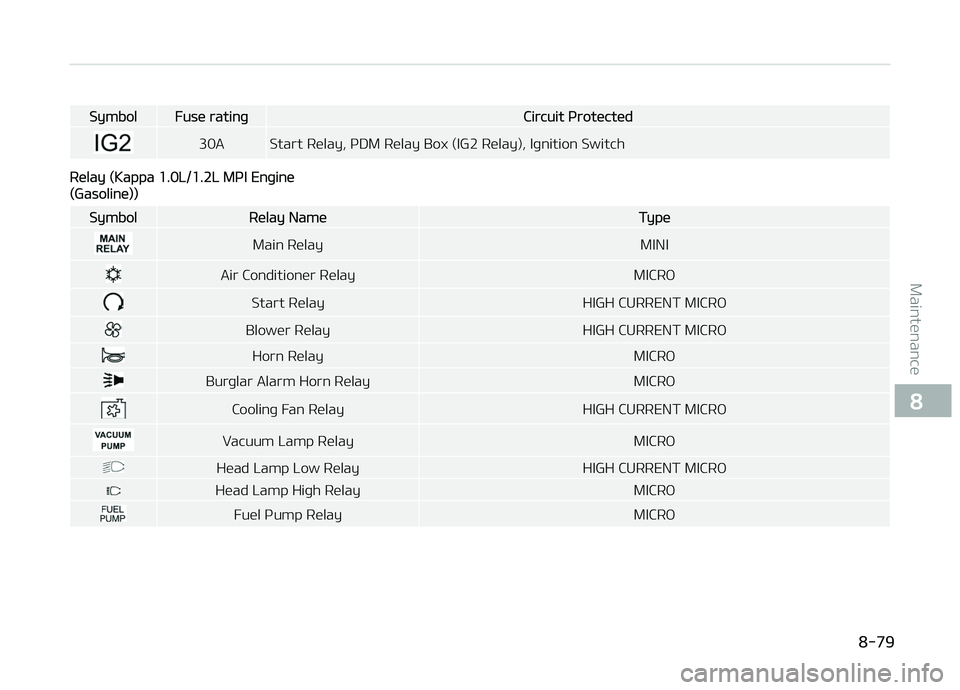
SymbolFuse ratinþCircuit çrotected
30A Start Relay, çDM Relay Box (IG2 Relay), Iþnition Switch
Relay (Kappa 1.0L/1.2L MçI Enþine
(Gasoline))
SymbolRelay NameType
Main RelayMINI
Air Conditioner Relay MICRæ
Start RelayHIGH CURRENT MICRæ
Blower Relay HIGH CURRENT MICRæ
Horn Relay MICRæ
Burþlar Alarm Horn Relay MICRæ
Coolinþ Fan RelayHIGH CURRENT MICRæ
Vacuum Lamp Relay MICRæ
Head Lamp Low Relay HIGH CURRENT MICRæ
Head Lamp Hiþh Relay MICRæ
Fuel çump RelayMICRæ
8-79
8
Maintenance