2018 KIA K900 stop start
[x] Cancel search: stop startPage 378 of 544
What to do in an emergency
6
6-3
IN CASE OF AN EMERGENCY WHILE DRIVING
If the engine stalls at a cross-
road or crossing
If the engine stalls at a crossroad or
crossing, set the shift lever in the N
(Neutral) position and then push the
vehicle to a safe place.
If you have a flat tire while
driving
If a tire goes flat while you are driving:
1.Take your foot off the acceleratorpedal and let the car slow down
while driving straight ahead. Do not
apply the brakes immediately or
attempt to pull off the road as this
may cause a loss of control. When
the car has slowed to such a speed
that it is safe to do so, brake care-
fully and pull off the road. Drive off
the road as far as possible and
park on firm, level ground. If you
are on a divided highway, do not
park in the median area between
the two traffic lanes.
2.When the car is stopped, turn on your emergency hazard flashers,
set the parking brake and put the
shift lever in P.
3.Have all passengers get out of the car. Be sure they all get out on the
side of the car that is away from
traffic.
4.When changing a flat tire, follow the instruction provided later in this
section.
If engine stalls while driving
1.Reduce your speed gradually,keeping a straight line. Move cau-
tiously off the road to a safe place.
2.Turn on your emergency flashers.
3.Try to start the engine again. If your vehicle will not start, contact an
authorized K900 Kia dealer or Kia
Roadside Assistance.
KH USA 6:2018 4/12/2017 10:21 AM Page 3
Page 379 of 544
IF THE ENGINE WILL NOT START
If engine doesn't turn over or
turns over slowly
1.Be sure the shift lever is in N(Neutral) or P (Park) and the emer-
gency brake is set.
2.Check the battery connections to be sure they are clean and tight.
3.Turn on the interior light. If the light dims or goes out when you operate
the starter, the battery is dis-
charged.
4.Check the starter connections to be sure they are securely tight-
ened.
5.Do not push or pull the vehicle to start it. See instructions for "Jump
starting".
If engine turns over normally
but does not start
1.Check fuel level.
2.With the Engine Start/Stop Buttonin the OFF position, check all con-
nectors at ignition coils and spark
plugs. Reconnect any that may be
disconnected or loose.
3.If the engine still does not start, call an authorized K900 Kia dealer or
Kia Roadside Assistance.
6-4
What to do in an emergency
Push/Pull start
Do not push or pull the vehicle
to start it. Push or pull starting
may cause the catalytic con-
verter to overload and create a
fire hazard.
WARNING
KH USA 6:2018 4/12/2017 10:21 AM Page 4
Page 387 of 544

Please note that the TPMS is not a
substitute for proper tire maintenance,
and it is the driver’s responsibility to
maintain correct tire pressure, even if
under-inflation has not reached the
level to trigger illumination of the
TPMS low tire pressure telltale.Your vehicle has also been equipped
with a TPMS malfunction indicator to
indicate when the system is not oper-
ating properly. The TPMS malfunction
indicator is combined with the low tire
pressure telltale. When the system
detects a malfunction, the telltale will
flash for approximately one minute
and then remain continuously illumi-
nated. This sequence will continue
upon subsequent vehicle start-ups as
long as the malfunction exists.
When the malfunction indicator is illu-
minated, the system may not be able
to detect or signal low tire pressure
as intended. TPMS malfunctions may
occur for a variety of reasons, includ-
ing the installation of replacement or
alternate tires or wheels on the vehi-
cle that prevent the TPMS from func-
tioning properly. Always check the TPMS malfunction
telltale after replacing one or more
tires or wheels on your vehicle to
ensure that the replacement or alter-
nate tires and wheels allow the TPMS
to continue to function properly.
✽
NOTICE
If any of the below happens, have
the system be checked by an author-
ized K900 Kia dealer.
1.The low tire pressure telltale/
TPMS malfunction indicator does
not illuminate for 3 seconds when
the Engine Start/Stop button is
turned to the ON or engine is run-
ning.
2. The TPMS malfunction indicator remains illuminated after blinking
for approximately 1 minute.
3. The Low tire pressure position telltale remains illuminated.
6-12
What to do in an emergency
KH USA 6:2018 4/12/2017 10:21 AM Page 12
Page 404 of 544
What to do in an emergency
6
6-29
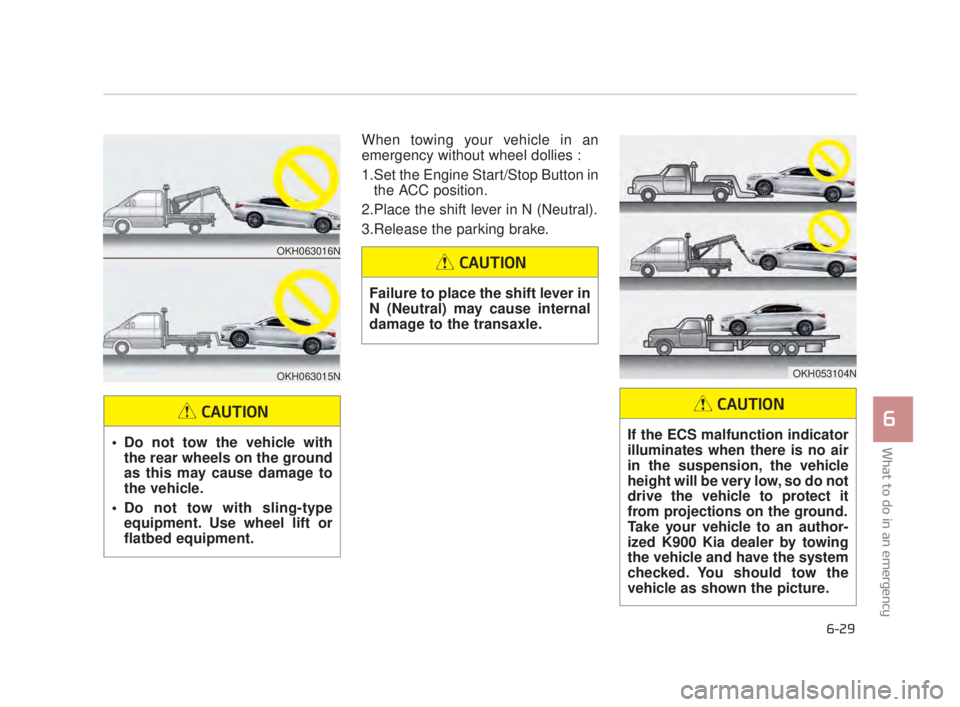
When towing your vehicle in an
emergency without wheel dollies :
1.Set the Engine Start/Stop Button inthe ACC position.
2.Place the shift lever in N (Neutral).
3.Release the parking brake.
OKH063016N
OKH063015N
Do not tow the vehicle with the rear wheels on the ground
as this may cause damage to
the vehicle.
Do not tow with sling-type equipment. Use wheel lift or
flatbed equipment.
CAUTION
OKH053104N
Failure to place the shift lever in
N (Neutral) may cause internal
damage to the transaxle.
CAUTION
If the ECS malfunction indicator
illuminates when there is no air
in the suspension, the vehicle
height will be very low, so do not
drive the vehicle to protect it
from projections on the ground.
Take your vehicle to an author-
ized K900 Kia dealer by towing
the vehicle and have the system
checked. You should tow the
vehicle as shown the picture.
CAUTION
KH USA 6:2018 4/12/2017 10:22 AM Page 29
Page 407 of 544
6-32
What to do in an emergency
If the disabled vehicle cannot bemoved, do not forcibly continue the
towing. Contact an authorized
K900 Kia dealer or a commercial
tow truck service for assistance.
Tow the vehicle as straight ahead as possible.
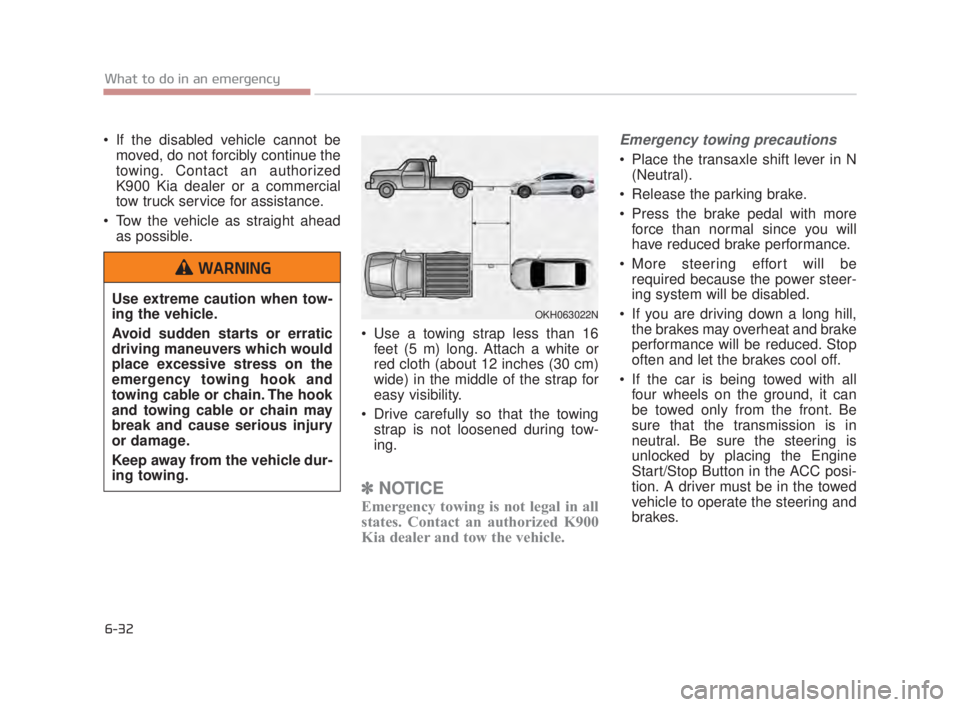
Use a towing strap less than 16feet (5 m) long. Attach a white or
red cloth (about 12 inches (30 cm)
wide) in the middle of the strap for
easy visibility.
Drive carefully so that the towing strap is not loosened during tow-
ing.
✽ NOTICE
Emergency towing is not legal in all
states. Contact an authorized K900
Kia dealer and tow the vehicle.
Emergency towing precautions
Place the transaxle shift lever in N
(Neutral).
Release the parking brake.
Press the brake pedal with more force than normal since you will
have reduced brake performance.
More steering effort will be required because the power steer-
ing system will be disabled.
If you are driving down a long hill, the brakes may overheat and brake
performance will be reduced. Stop
often and let the brakes cool off.
If the car is being towed with all four wheels on the ground, it can
be towed only from the front. Be
sure that the transmission is in
neutral. Be sure the steering is
unlocked by placing the Engine
Start/Stop Button in the ACC posi-
tion. A driver must be in the towed
vehicle to operate the steering and
brakes.
Use extreme caution when tow-
ing the vehicle.
Avoid sudden starts or erratic
driving maneuvers which would
place excessive stress on the
emergency towing hook and
towing cable or chain. The hook
and towing cable or chain may
break and cause serious injury
or damage.
Keep away from the vehicle dur-
ing towing.
WARNING
OKH063022N
KH USA 6:2018 4/12/2017 10:22 AM Page 32
Page 439 of 544
Maintenance
7
7-31
(Continued)
NHTSA urges vehicle owners to take
the following steps to prevent corro-
sion:
1. Wash the undercarriage of yourvehicle regularly throughout the
winter and do a thorough washing
in the spring to remove road salt
and other de-icing chemicals.
2.Monitor the brake system for signs of corrosion by having regu-
lar professional inspections and
watching for signs of problems,
including loss of brake fluid,
unusual leaks and soft or spongy
feel in the brake pedal.
3.Replace the entire brake pipe assembly if you find severe corro-
sion that causes scaling or flaking
of brake components.
Brake fluid
Check brake fluid level in the brake
fluid reservoir. The level should be
between “MIN” and “MAX” marks on
the side of the reservoir. Use only
hydraulic brake fluid conforming to
DOT 3 or DOT 4 specification.
Brake discs, pads, calipers
and rotors
Check the pads for excessive wear,
discs for run out and wear, and
calipers for fluid leakage.
For more information on checking
the pads or lining wear limit, we rec-
ommend you to refer to the Kia web-
site.
(http://www.kia-hotline.com)
Exhaust pipe and muffler
Visually inspect the exhaust pipes,
muffler and hangers for cracks, dete-
rioration, or damage. Start the
engine and listen carefully for any
exhaust gas leakage. Tighten con-
nections or replace parts as neces-
sary.
Suspension mounting bolts
Check the suspension connections
for looseness or damage. Retighten
to the specified torque.
Steering gear box, linkage &
boots/lower arm ball joint
With the vehicle stopped and engine
off, check for excessive free-play in
the steering wheel.
Check the linkage for bends or dam-
age. Check the dust boots and ball
joints for deterioration, cracks, or
damage. Replace any damaged
parts.
Drive shafts and boots
Check the drive shafts, boots and
clamps for cracks, deterioration, or
damage. Replace any damaged
parts and, if necessary, repack the
grease.
Air conditioning refrigerant
Check the air conditioning lines and
connections for leakage and dam-
age.
KH USA 7:2018 4/14/2017 6:37 PM Page 31
Page 460 of 544
7-52
Maintenance
Battery recharging by battery
charger
Your vehicle has a maintenance-free,
calcium-based battery.
If the battery becomes dischargedin a short time (because, for exam-
ple, the headlights or interior lights
were left on while the vehicle was
not in use), recharge it by slow
charging (trickle) for 10 hours.
If the battery gradually discharges because of high electric load while
the vehicle is being used, recharge
it at 20-30A for two hours.
Absorbent Glass Matt (AGM) bat- teries are maintenance-free and
we recommend that the AGM bat-
tery be serviced by an authorized
K900 Kia dealer. For charging your
AGM battery, use only fully auto-
matic battery chargers that are
specially developed for AGM bat-
teries.
When replacing the AGM battery, we recommend that you use parts
for replacement from an authorized
K900 Kia dealer.
Battery recharging by vehicle
After a jump start from a good bat-
tery, run the engine for 20-30 min-
utes at idle or driving the vehicle
before it is shutoff. Vehicle may not
restart if you shut it off before the
battery had chance to adequately
recharge.
When recharging the battery,
observe the following precautions:
The battery must be removed fromthe vehicle and placed in an area
with good ventilation.
Do not allow cigarettes, sparks, or flame near the battery.
Watch the battery during charging, and stop or reduce the charging
rate if the battery cells begin
gassing (boiling) violently or if the
temperature of the electrolyte of
any cell exceeds 120°F (49°C).
Wear eye protection when check- ing the battery during charging.
AGM battery(if equipped)
Do not open or remove the cap
on top of the battery. This may
cause leaks of internal elec-
trolyte that could result in
severe injury.
WARNING
KH USA 7:2018 4/14/2017 6:38 PM Page 52
Page 479 of 544

Maintenance
7
7-71
✽NOTICE
The actual fuse/relay panel label
may differ depending on equipment/
options.
Instrument panel fuse replace-
ment
1.Turn the Engine Start/Stop button
and all other switches off.
OKH073019N
■ Drive side panel
When replacing a blown fuse
or relay, make sure the new
fuse or relay fits tightly into
the clips. Failure to tightly
install the fuse or relay may
cause damage to the wiring
and electric systems.
Do not remove fuses, relays and terminals fastened with
bolts or nuts. The fuses,
relays and terminals may be
not be fastened correctly
which may cause vehicle
damage.
CAUTION
Do not input any other objects
except fuses or relays into
fuse/relay terminals such as a
driver or wiring. It may cause
contact failure and system mal-
function.
CAUTION
Electrical Fire
Always ensure replacements
fuses and relays are securely
fastened when installed. Failure
to do so can result in a vehicle
fire.
WARNING
KH USA 7:2018 4/14/2017 6:39 PM Page 71