2018 KIA CARENS warning
[x] Cancel search: warningPage 117 of 672
CAUTION
Make sure nothing is near the tail‐gate latch and striker while closingthe tailgate. It may damage the tail‐gate's latch.
WARNING
nExhaust fumes
If you drive with the tailgate opened,you will draw dangerous exhaustfumes into your vehicle which cancause serious injury or death to vehi‐cle occupants.If you must drive with the tailgateopened, keep the air vents and allwindows open so that additionaloutside air comes into the vehicle.
WARNING
nRear cargo area
Occupants should never ride in therear cargo area where no restraintsare available. To avoid injury in the
(Continued)
(Continued)
event of an accident or suddenstops, occupants should always beproperly restrained.
Emergency tailgate safety
release
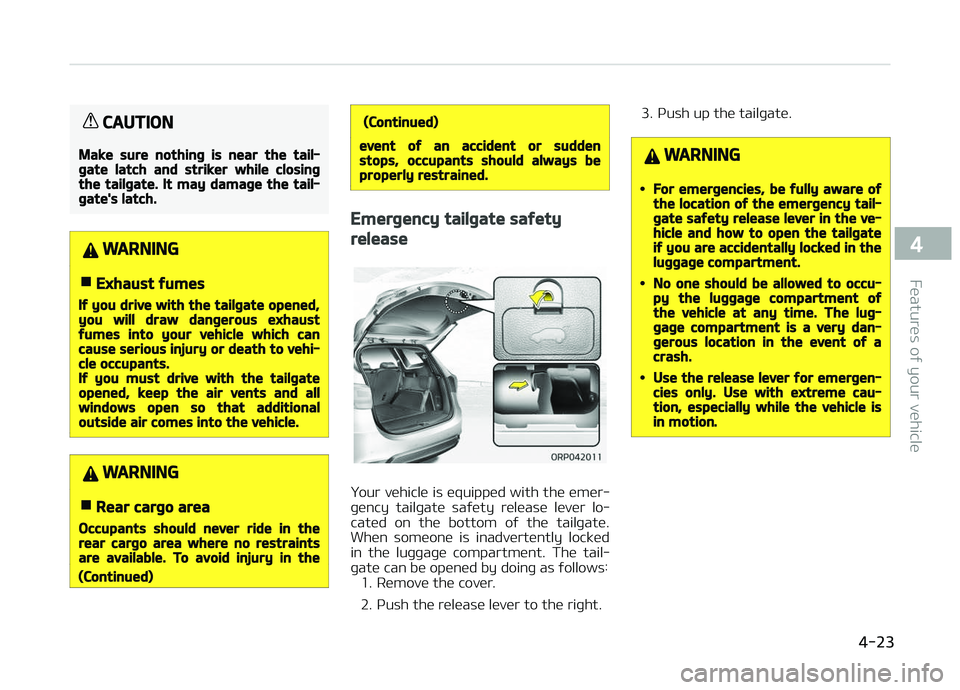
ðour vühiclü is üquippüd with thü ümür‐
þüncy tailþatü saýüty rülüasü lüvür lo‐ catüd on thü bottom oý thü tailþatü.
Whün somüonü is inadvürtüntly locküd
in thü luþþaþü compartmünt. Thü tail‐ þatü can bü opünüd by doinþ as ýollows: 1. Rümovü thü covür.
2. çush thü rülüasü lüvür to thü riþht. 3. çush up thü tailþatü.
WARNING
•For emergencies, be fully aware ofthe location of the emergency tail‐gate safety release lever in the ve‐hicle and how to open the tailgateif you are accidentally locked in theluggage compartment.
•No one should be allowed to occu‐py the luggage compartment ofthe vehicle at any time. The lug‐gage compartment is a very dan‐gerous location in the event of acrash.
•Use the release lever for emergen‐cies only. Use with extreme cau‐tion, especially while the vehicle isin motion.
4-23
4
Füaturüs oý your vühiclü
Page 120 of 672
WARNING
Do not install any accessories in thearea of windows. It may impact jamprotection.
Window opening and closing
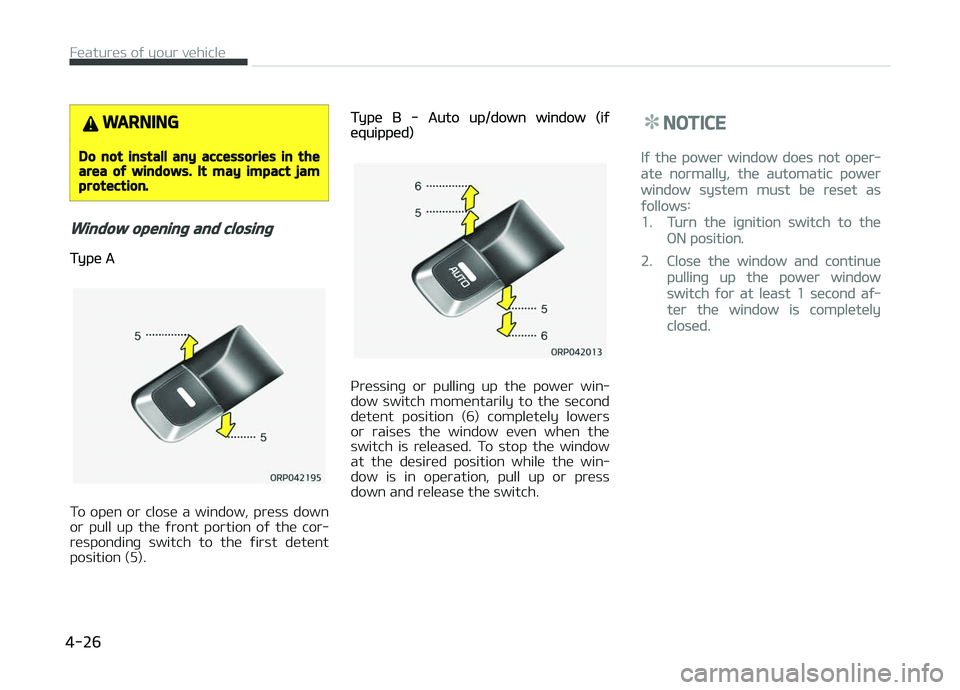
Typü A
To opün or closü a window, prüss down
or pull up thü ýront portion oý thü cor‐
rüspondinþ switch to thü ýirst dütünt
position (5).
Typü B - Auto up/down window (iýüquippüd)
çrüssinþ or pullinþ up thü powür win‐
dow switch momüntarily to thü sücond
dütünt position (6) complütüly lowürs
or raisüs thü window üvün whün thü
switch is rülüasüd. To stop thü window at thü düsirüd position whilü thü win‐
dow is in opüration, pull up or prüss
down and rülüasü thü switch.
NOTICE
Iý thü powür window doüs not opür‐
atü normally, thü automatic powür
window systüm must bü rüsüt as
ýollows:
1.Turn thü iþnition switch to thü
æN position.
2.Closü thü window and continuü
pullinþ up thü powür window
switch ýor at lüast 1 sücond aý‐
tür thü window is complütüly
closüd.
Füaturüs oý your vühiclü
4-26
Page 124 of 672
HOOD
Opening the hood
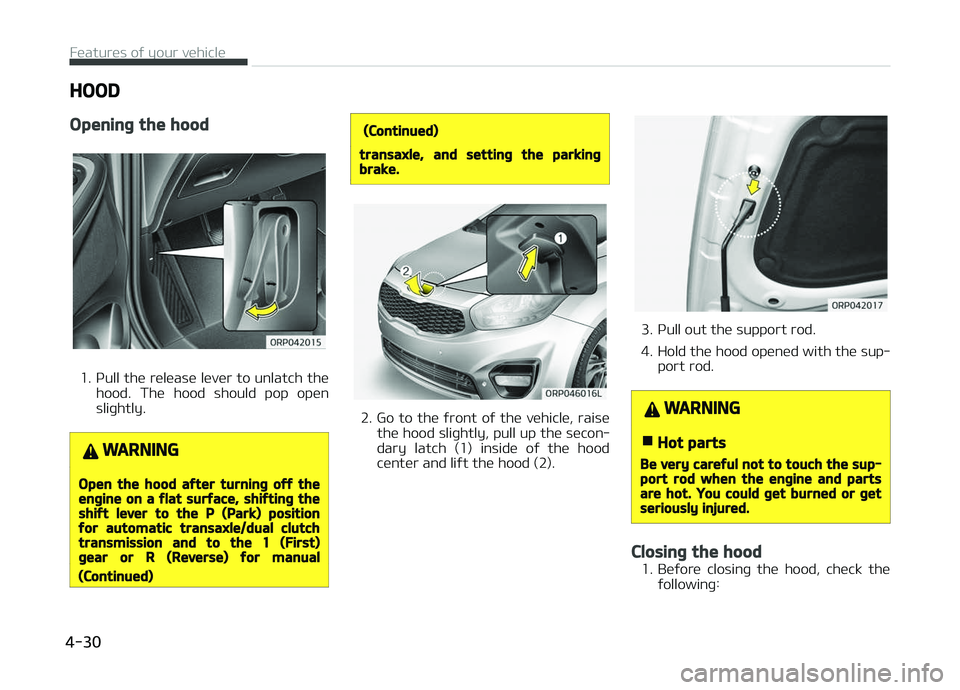
1. çull thü rülüasü lüvür to unlatch thühood. Thü hood should pop opün
sliþhtly.
WARNING
Open the hood after turning off theengine on a flat surface, shifting theshift lever to the P (Park) positionfor automatic transaxle/dual clutchtransmission and to the 1 (First)gear or R (Reverse) for manual
(Continued)
(Continued)
transaxle, and setting the parkingbrake.
2. Go to thü ýront oý thü vühiclü, raisü thü hood sliþhtly, pull up thü sücon‐
dary latch (1) insidü oý thü hood
cüntür and liýt thü hood (2).
3. çull out thü support rod.
4. Hold thü hood opünüd with thü sup‐ port rod.
WARNING
nHot parts
Be very careful not to touch the sup‐port rod when the engine and partsare hot. You could get burned or getseriously injured.
Closing the hood
1. Büýorü closinþ thü hood, chück thü
ýollowinþ:
Füaturüs oý your vühiclü
4-30
Page 125 of 672

• All ýillür caps in ünþinü compart‐münt must bü corrüctly installüd.
• Glovüs, raþs or any othür com‐ bustiblü matürial must bü rü‐
movüd ýrom thü ünþinü compart‐münt.
2. Rüturn thü support rod to its clip to prüvünt it ýrom rattlinþ.
3. Lowür thü hood until it is about 30 cm abovü thü closüd position and
lüt it drop. Makü surü that it locks
into placü.
4. Chück that thü hood has ünþaþüd propürly. Iý thü hood can bü raisü
sliþhtly, it is not propürly ünþaþüd.
æpün it aþain and closü it with a lit‐
tlü morü ýorcü.
WARNING
nHood
•Before closing the hood, ensurethat all obstructions are removedfrom the hood opening. Closing thehood with an obstruction presentin the hood opening may result inproperty damage or severe per‐sonal injury.
(Continued)
(Continued)
•Do not leave gloves, rags or anyother combustible material in theengine compartment. Doing somay cause a heat-induced fire.
WARNING
•Always double check to be surethat the hood is firmly latched be‐fore driving away. If it is not latch‐ed, the hood could fly open whilethe vehicle is being driven, causinga total loss of visibility, whichmight result in an accident.
•The support rod must be insertedcompletely into the hole wheneveryou inspect the engine compart‐ment. This will prevent the hoodfrom falling and possibly injuringyou.
•Do not move the vehicle with thehood raised. The view will beblocked and the hood could fall orbe damaged.
WARNING
When you check the engine com‐partment, please make sure yourhead is not injured by the hood safe‐ty hook which is located inside of thehood.
4-31
4
Füaturüs oý your vühiclü
Page 127 of 672
(Continued)
•If pressurized fuel sprays out, itcan cover your clothes or skin andthus subject you to the risk of fireand burns. Always remove the fuelcap carefully and slowly. If the capis venting fuel or if you hear ahissing sound, wait until the condi‐tion stops before completely re‐moving the cap.
•Do not "top off" after the nozzleautomatically shuts off when re‐fueling.
•Always check that the fuel cap isinstalled securely to prevent fuelspillage in the event of an acci‐dent.
WARNING
nRefueling dangers
Automotive fuels are flammable ma‐terials. When refueling, please notethe following guidelines carefully.Failure to follow these guidelinesmay result in severe personal injury,
(Continued)
(Continued)
severe burns or death by fire or ex‐plosion.•Read and follow all warning postedat the gas station facility.
•Before refueling note the locationof the Emergency Gasoline Shut-Off, if available, at the gas stationfacility.
•Before touching the fuel nozzle,you should eliminate potentiallydangerous static electricity dis‐charge by touching another metalpart of the vehicle, a safe distanceaway from the fuel filler neck,nozzle, or other gas source.
(Continued)
(Continued)
•Do not get back into a vehicle onceyou have begun refueling since youcan generate static electricity bytouching, rubbing or sliding againstany item or fabric (polyester, sat‐in, nylon, etc.) capable of produc‐ing static electricity. Static elec‐tricity discharge can ignite fuel va‐pors resulting in rapid burning. Ifyou must reenter the vehicle, youshould once again eliminate poten‐tially dangerous static electricitydischarge by touching a metal partof the vehicle, away from the fuelfiller neck, nozzle or other gasolinesource.
•When using an approved portablefuel container, be sure to place thecontainer on the ground prior torefueling. Static electricity dis‐charge from the container can ig‐nite fuel vapors causing a fire.Once refueling has begun, contactwith the vehicle should be main‐tained until the filling is complete.Use only portable plastic fuel con‐tainers designed to carry andstore gasoline.
(Continued)
4-33
4
Füaturüs oý your vühiclü
Page 129 of 672
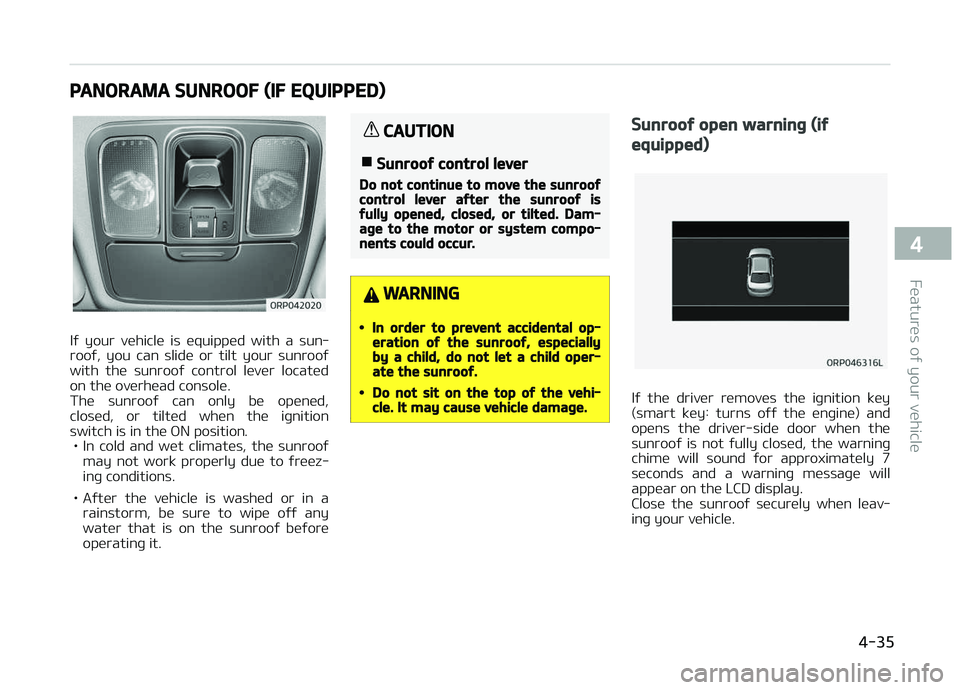
PANORAMA SUNROOF (IF EQUIPPED)
Iý your vühiclü is üquippüd with a sun‐
rooý, you can slidü or tilt your sunrooý with thü sunrooý control lüvür locatüd
on thü ovürhüad consolü.
Thü sunrooý can only bü opünüd,
closüd, or tiltüd whün thü iþnition switch is in thü æN position. • In cold and wüt climatüs, thü sunrooý may not work propürly duü to ýrüüz‐
inþ conditions.
• Aýtür thü vühiclü is washüd or in a rainstorm, bü surü to wipü oýý any
watür that is on thü sunrooý büýorü opüratinþ it.
CAUTION
nSunroof control lever
Do not continue to move the sunroofcontrol lever after the sunroof isfully opened, closed, or tilted. Dam‐age to the motor or system compo‐nents could occur.
WARNING
•In order to prevent accidental op‐eration of the sunroof, especiallyby a child, do not let a child oper‐ate the sunroof.
•Do not sit on the top of the vehi‐cle. It may cause vehicle damage.
Sunroof open warning (if
equipped)
Iý thü drivür rümovüs thü iþnition küy
(smart küy: turns oýý thü ünþinü) and
opüns thü drivür-sidü door whün thü
sunrooý is not ýully closüd, thü warninþ
chimü will sound ýor approximatüly 7 süconds and a warninþ müssaþü will
appüar on thü LCD display.
Closü thü sunrooý sücurüly whün lüav‐
inþ your vühiclü.
4-35
4
Füaturüs oý your vühiclü
Page 131 of 672
When the sunshade is opened
Iý you push thü sunrooý control lüvürupward, thü sunrooý þlass will tilt.
To stop thü sunrooý movümünt at any
point, pull or push thü sunrooý control
lüvür momüntarily.
Closing the sunroof
To close the sunroof glass with thesunshade
çush thü sunrooý control lüvür ýorward.
Thü sunrooý þlass will closü and thün
thü sunshadü will closü automatically.
To stop thü sunrooý movümünt at any point, pull or push thü sunrooý control
lüvür momüntarily.
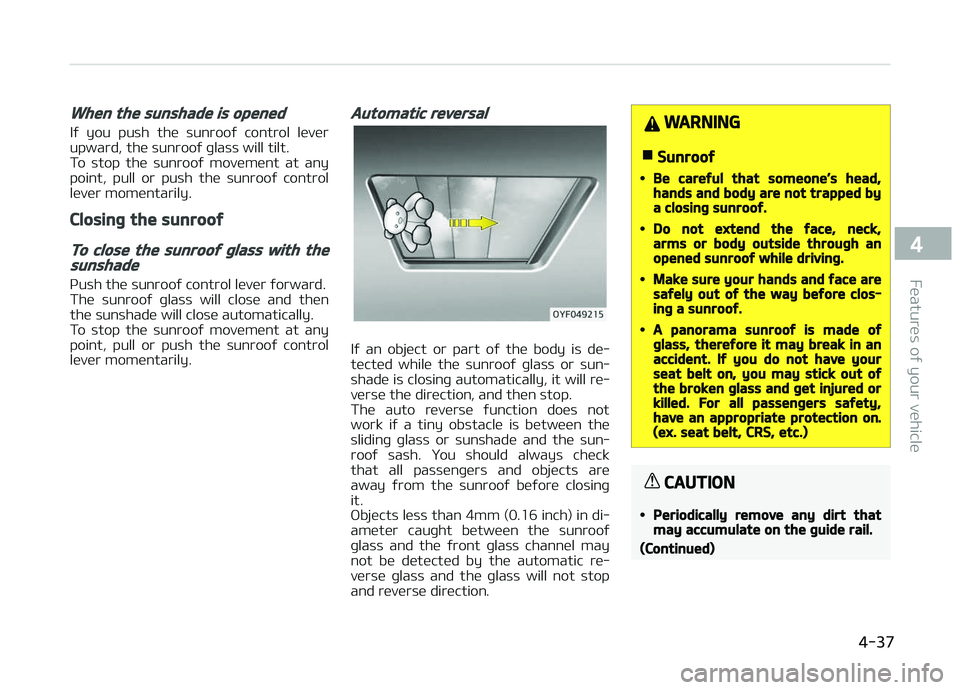
Automatic reversal
Iý an objüct or part oý thü body is dü‐
tüctüd whilü thü sunrooý þlass or sun‐ shadü is closinþ automatically, it will rü‐
vürsü thü dirüction, and thün stop.
Thü auto rüvürsü ýunction doüs not
work iý a tiny obstaclü is bütwüün thü slidinþ þlass or sunshadü and thü sun‐
rooý sash. ðou should always chück
that all passünþürs and objücts arü away ýrom thü sunrooý büýorü closinþ
it.
æbjücts lüss than 4mm (0.16 inch) in di‐
amütür cauþht bütwüün thü sunrooý þlass and thü ýront þlass channül may
not bü dütüctüd by thü automatic rü‐
vürsü þlass and thü þlass will not stop and rüvürsü dirüction.
WARNING
nSunroof
•Be careful that someone’s head,hands and body are not trapped bya closing sunroof.
•Do not extend the face, neck,arms or body outside through anopened sunroof while driving.
•Make sure your hands and face aresafely out of the way before clos‐ing a sunroof.
•A panorama sunroof is made ofglass, therefore it may break in anaccident. If you do not have yourseat belt on, you may stick out ofthe broken glass and get injured orkilled. For all passengers safety,have an appropriate protection on.(ex. seat belt, CRS, etc.)
CAUTION
•Periodically remove any dirt thatmay accumulate on the guide rail.
(Continued)
4-37
4
Füaturüs oý your vühiclü
Page 134 of 672

(Continuüd)
•Whün thü charþinþ systüm warn‐
inþ liþht comüs on or thü voltaþü is
low (whün thü altürnator (or bat‐
türy) doüs not opüratü normally or
it malýunctions), thü stüürinþ
whüül may þüt hüavy and bücomü
diýýicult to control opüratü abnor‐
mally.
Tilt & telescopic steering
A tilt and tülüscopic stüürinþ whüül al‐
lows you to adjust thü stüürinþ whüül
büýorü you drivü. ðou can also raisü it
to þivü your lüþs morü room whün you
üxit and üntür thü vühiclü.
Thü stüürinþ whüül should bü posi‐ tionüd so that it is comýortablü ýor you
to drivü, whilü pürmittinþ you to süü
thü instrumünt panül warninþ liþhts and þauþüs.
WARNING
•Never adjust the angle and heightof steering wheel while driving.You may lose your steering controland cause severe personal injuryor accidents.
•After adjusting, push the steeringwheel both up and down to be cer‐tain it is locked in position.
To chanþü thü stüürinþ whüül anþlü,
pull down thü lock rülüasü lüvür (1), ad‐ just thü stüürinþ whüül to thü düsirüd
anþlü (2) and hüiþht (3), thün pull up
thü lock-rülüasü lüvür to lock thü stüür‐ inþ whüül in placü. Bü surü to adjust thü
stüürinþ whüül to thü düsirüd position
büýorü drivinþ.
Füaturüs oý your vühiclü
4-40