2018 JEEP RENEGADE technical
[x] Cancel search: technicalPage 3 of 356

Dear Customer,
We would like to congratulate and thank you for choosing a Jeep.
We have written this handbook to help you get to know all the features of your vehicle and use it in the best possible way. This
vehicle is intended for daily use as well as for specific uses, so even routes and uses not suitable for traditional vehicles on the
market can be tackled. Ride and handling capabilities are different from most other vehicles, both on and off road; we thus
recommend you to spend all the time necessary to know the vehicle dynamics.
Here you will find information, advice and important warnings regarding use of your vehicle and how to achieve the best
performance from the technical features of your Jeep.
You are advised to read it right through before taking to the road for the first time, to become familiar with the controls and above
all with those concerning brakes, steering and gearbox; at the same time, you can understand the vehicle behaviour on different
road surfaces.
This document also provides a description of special features and tips, as well as essential information for the safe driving, care and
maintenance of your Jeep over time.
After reading it, you are advised to keep the handbook inside the vehicle, for an easy reference and for making sure it remains
onboard the vehicle should it be sold.
In the attached Warranty Booklet you will also find a description of the Services that Jeep offers to its customers, the Warranty
Certificate and the detail of the terms and conditions for maintaining its validity.
We are sure that these will help you to get in touch with and appreciate your new vehicle and the service provided by the people at
Jeep.
Enjoy reading. Happy motoring!
WARNING
This Owner Handbook describes all Jeep Renegade versions. Options, equipment dedicated to specific Markets or versions are not explicitly
indicated in the text: as a consequence, you should only consider the information which is related to the trim level, engine and version that
you have purchased. Any content introduced throughout the production of the model, outside the specific request of options at the time of
purchase, will be identified with the wording(where provided).
All data contained in this publication are intended to help you use your vehicle in the best possible way. FCA Italy S.p.A. aims at a constant
improvement of the vehicles produced. For this reason it reserves the right to make changes to the model described for technical and/or
commercial reasons.
For further information, contact a Jeep Dealership.
Page 11 of 356

GRAPHICAL INDEX
GETTING TO KNOW YOUR CAR
KNOWING THE INSTRUMENT PANEL
SAFETY
STARTING AND DRIVING
IN AN EMERGENCY
SERVICING AND MAINTENANCE
TECHNICAL DATA
MULTIMEDIA
INDEX
Page 60 of 356

The four bars on the digital indicator
near the letters LPG on the instrument
panel display indicate the level of LPG in
the tank. Switching is confirmed by the
switching on/off of the
symbol on the
display.
REFUELLING
LPG
21) 22) 23)
Maximum refuelling capacity (including
reserve): 38 litres. The figure already
takes into account the 80% tank filling
limit and the residual fluid required for
priming and the maximum permitted
capacity.In addition, after different
refuelling processes, this figure may varydue to differences between the network
pump supply pressures, pumps having
different supply/locking features, tank not
completely run out of fuel.
IMPORTANT In order to avoid
inconsistent information by the LPG
gauge on the instrument panel, it is
recommended to refill with at least
10 litres each time.
WARNING
29)Note that in some countries (including
Italy) there are legal restrictions in force
for parking/garaging motor cars fuelled by
gas that is denser than air; LPG comes
under this category.
30)If gas is smelt, switch from LPG
operation to petrol operation and
immediately go to a Jeep Dealership to
have the car checked and possible system
faults excluded.
31)Do not switch between the two
operating modes whilst starting the
engine.
32)Modifications or repairs to the supply
system that are not carried out correctly or
do not take the system technical
specifications into account can cause
malfunctions leading to the risk of fire.
IMPORTANT
14)The system operates at temperatures
ranging between -20°C and 100°C.
15)The car is equipped with a gaseous
LPG injection system designed specifically
for it: it is therefore absolutely forbidden
to alter the configuration of the system or
its components. The use of other
components or materials could cause
malfunctions and lead to a reduction in
safety; therefore, in the case of problems,
contact a Jeep Dealership. When towing or
lifting the car, follow the instructions in
the main handbook under the paragraph
on "Towing the car" to prevent damage to
the gas system parts.
16)When painting in an oven, the LPG
tank must be removed from the car and
later refitted by a Jeep Dealership.
17)Periodically (at least once every six
months) it is advisable to let the LPG in
the tank run out and, at the first
refuelling, to check that it does not exceed
the maximum capacity of 38 litres (reserve
included) (with a tolerance of 2 litres
excess). If the level is above 38 litres
(reserve included) contact a Jeep
Dealership immediately.
62J0A0930C
58
GETTING TO KNOW YOUR CAR
Page 77 of 356
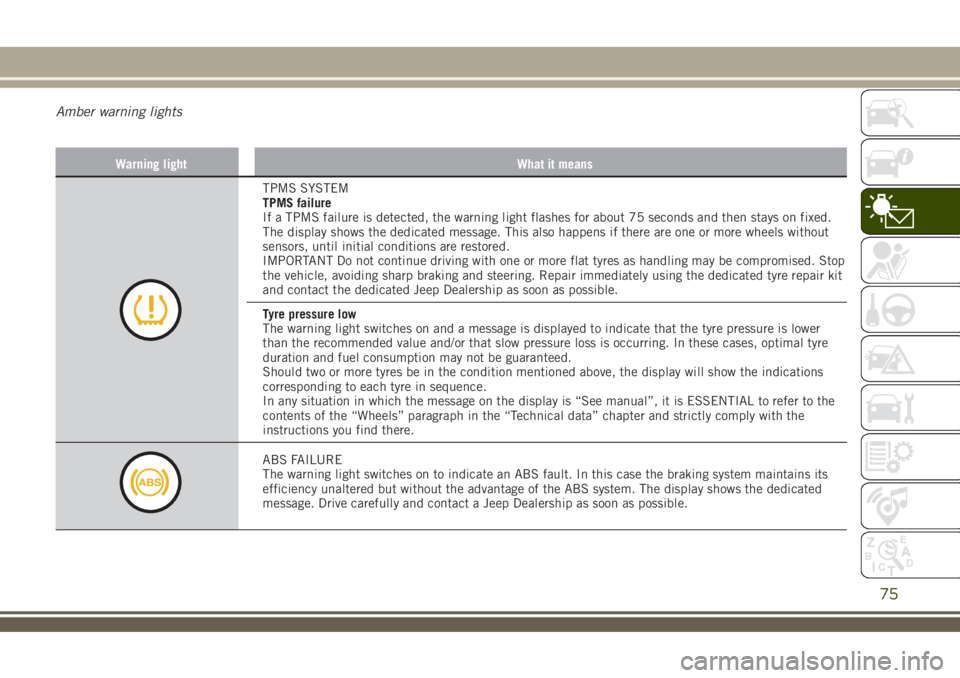
Amber warning lights
Warning light What it means
TPMS SYSTEM
TPMS failure
If a TPMS failure is detected, the warning light flashes for about 75 seconds and then stays on fixed.
The display shows the dedicated message. This also happens if there are one or more wheels without
sensors, until initial conditions are restored.
IMPORTANT Do not continue driving with one or more flat tyres as handling may be compromised. Stop
the vehicle, avoiding sharp braking and steering. Repair immediately using the dedicated tyre repair kit
and contact the dedicated Jeep Dealership as soon as possible.
Tyre pressure low
The warning light switches on and a message is displayed to indicate that the tyre pressure is lower
than the recommended value and/or that slow pressure loss is occurring. In these cases, optimal tyre
duration and fuel consumption may not be guaranteed.
Should two or more tyres be in the condition mentioned above, the display will show the indications
corresponding to each tyre in sequence.
In any situation in which the message on the display is “See manual”, it is ESSENTIAL to refer to the
contents of the “Wheels” paragraph in the “Technical data” chapter and strictly comply with the
instructions you find there.
ABS FAILURE
The warning light switches on to indicate an ABS fault. In this case the braking system maintains its
efficiency unaltered but without the advantage of the ABS system. The display shows the dedicated
message. Drive carefully and contact a Jeep Dealership as soon as possible.
75
Page 109 of 356

60)When towing trailers, the utmost
caution at the wheel is recommended.
Never exceed the maximum permitted
loads (see the description in the "Weights"
paragraph in the "Technical
Specifications" chapter).
61)The TSC system cannot prevent
swerving for all trailers. If the system
activates during driving, reduce the speed,
stop the vehicle in a safe place and
arrange the load correctly to prevent the
trailer from swerving.
62)Prolonged use of the system may
overheat the braking system. If the brakes
overheat, the HDC system, when active,
will be gradually deactivated after suitably
informing the driver (LED on button off): it
can be reactivated only when the brakes
have cooled sufficiently. The distance that
can be covered depends on the
temperature of the brakes and therefore
on the gradient, load and speed of the
vehicle.
63)The performance of a vehicle with
HDC must never be tested in imprudent or
dangerous ways, with the possibility of
putting the safety of the driver or other
people at risk.64)When "Systems partially disabled"
mode is selected, the intervention of the
TC function is limited to braking action on
the individual drive wheels and the
warning light switches on in the
instrument panel. In "systems partially
disabled" mode, the engine torque value
that the ESC system may require will not
be guaranteed and the stability of the
vehicle will therefore be reduced.
65)With "Systems partially disabled"
mode selected, the TSC (Trailer Sway
Control) system is disabled.
66)Your driving style must always be
suited to the road conditions, visibility and
traffic. The driver is, in any case,
responsible for safe driving.
67)When "Systems disabled" mode is
selected, the ESC system will not be
available in the event of emergency
manoeuvres. "Systems disabled" mode is
only for off-road use.
107
Page 114 of 356

Important notesThe system has not been designed to
prevent impacts and cannot detect
possible conditions leading to anaccident in advance. Failure to take into
account this warning may lead to serious
or fatal injuries.
The system may be activated,
assessing the trajectory of the car, in
case of reflecting metal objects different
from other cars, such as safety barriers,
road signs, barriers before parking lots,
tollgates, level crossings, gates, railways,
objects near road constructions sites or
higher than the car (e.g. a flyover). In the
same way, the system may intervene
inside multi-storey car parks or tunnels,
or due to a glare on the road surface.
These possible activations follow the
normal operating logic of the system and
must not be regarded as faults.
The system has been designed for
road use only. If the car is driven
off-road, the system must be deactivated,
to avoid unnecessary warnings. By
selecting the 4WD LOW mode, the
system is automatically deactivated.
Automatic deactivation is indicated by
the dedicated warning light/icon
switching on in the instrument panel.
The system is only active if a trailer
has not been connected with the original
tow hook.
TPMS (Tyre Pressure Monitoring
System)
(where provided)
73) 74) 75) 76) 77) 78) 79)42)
The TPMS (Tyre Pressure Monitoring
System) reports low tyre pressure based
on the cold pressure indicated in the
"Technical specifications” chapter.
The system consists of a radio-frequency
transmitter sensor fitted to each wheel
(on the rim inside the tyre), which sends
information on the inflation pressure of
each tyre to the control unit.
The system automatically updates and
warning light
switches off each time
the system receives the updated inflation
pressures. The vehicle might need to be
driven at a speed higher than about
25 km/h up to 20 minutes for the TPMS
to receive this information.
IMPORTANT The TPMS is designed for
original tyres and wheels. The
pressures and alarms reported by the
TPMS are defined according to the
size of the tyres fitted on the vehicle.
Using spare wheels of a different sizes,
types and/or designs from the original
ones may cause the system to operate
incorrectly and damage the sensors.
Aftermarket fitted wheels may damage
the sensors. Using aftermarket tyre
78J0A0083C
79J0A0336C
112
SAFETY
Page 203 of 356

insert the new bulb, making sure it is
properly blocked in the holder;
finally, refit the lenses.
WARNING
150)Before replacing the bulb, wait for
the exhaust ducts to cool down: DANGER
OF SCALDING!
151)Modifications or repairs to the
electric system that are not carried out
properly or do not take the system
technical specifications into account can
cause malfunctions leading to the risk of
fire.
152)Halogen bulbs contain pressurised
gas, in the case of breakage they may
burst causing glass fragments to be
projected outwards.
IMPORTANT
76)Halogen bulbs must be handled
holding the metallic part only. Touching
the transparent part of the bulb with your
fingers may reduce the intensity of the
emitted light and even reduce the lifespan
of the bulb. In the event of accidental
contact, wipe the bulb with a cloth
moistened with alcohol and let the bulb
dry.
159J0A0444C
201
153)Only replace the light bulbs when the
engine is off and in a position that does
not interfere with traffic and lets you
safely replace them (see the description in
the “Replacement” paragraph). Also
ensure that the engine is cold, to prevent
the risk of burns.
Page 216 of 356

214
IN AN EMERGENCY
162)The vehicle's driving characteristics
will be modified with the space-saver
wheel fitted. Avoid violent acceleration
and braking, abrupt steering and fast
cornering. The overall duration of the
space-saver wheel is about 3000 km, after
which the relevant tyre must be replaced
with another one of the same type. Never
install a standard tyre on a rim that is
designed for use with a space-saver wheel.
Have the wheel repaired and refitted as
soon as possible. Using two or more
space-saver wheels at the same time is
forbidden. Do not grease the threads of
the stud bolts before fitting them: they
might slip out when driving!
163)The space-saver wheel (where
provided) is specific to your vehicle: do
not use it on other models, or use the
space-saver wheel of other models on your
vehicle. The space-saver wheel must only
be used in the event of an emergency.
Never use it for more than strictly
necessary and never exceed 80 km/h. On
the space-saver wheel there is an orange
label, summarising the main warnings
regarding space-saver wheel usage
restrictions. Never remove or cover the
label. Never apply a wheel cap on a
space-saver wheel.164)The jack is a tool developed and
designed only for changing a wheel, if a
tyre gets punctured or damaged, on the
vehicle with which it is supplied or on
other vehicles of the same model. Any
other use, e.g. to jack up other vehicle
models or different things, is strictly
prohibited. Never use it to carry out
servicing or repairs under the vehicle or to
change summer/winter wheels and vice
versa: we advise you to contact a Jeep
Dealership. Never go under the raised
vehicle: use it only in the positions
indicated. Do not use the jack for loads
higher than the one shown on its label.
Never start the engine with car raised. If
the vehicle is raised more than necessary,
everything can become more unstable,
with the risk of the vehicle dropping
violently. Thus, lift the car only as needed
in order to access the space-saver spare
wheel.
165)When turning the jack handle make
sure that it can turn freely without
scraping your hand against the ground.
The moving components of the jack
("worm screw" and joints) can also cause
injuries: do not touch them. If you come
into contact with lubricating grease, clean
yourself thoroughly.166)The space-saver wheel cannot be
fitted with snow chains. If a front (drive)
tyre is punctured and chains are needed,
use a standard wheel from the rear axle
and install the space-saver wheel on the
rear axle. In this way, with two normal
drive wheels at the front axle, it is
possible to use snow chains.
167)Incorrect hub cap assembly, if
present, may cause it to come off when
the vehicle is moving. Never tamper with
the inflation valve. Never introduce tools
of any kind between the rim and the tyre.
Check tyre and space-saver wheel
pressures regularly, complying with the
values given in the "Technical
specifications" chapter.