2018 Hyundai Ioniq Hybrid oil
[x] Cancel search: oilPage 575 of 642

7-68
Maintenance
Headlamp, position lamp,
turn signal lamp bulb replace-
ment
Type A
(1) Headlamp (Low)
(2) Headlamp (High)
(3) Turn signal lamp
(4) Position lamp• Always handle them carefully, and
avoid scratches and abrasions. If
the bulbs are lit, avoid contact with
liquids.
• Never touch the glass with bare
hands. Residual oil may cause the
bulb to overheat and burst when lit.
• A bulb should be operated only
when installed in a headlamp.
• If a bulb becomes damaged or
cracked, replace it immediately
and carefully dispose of it.
Information
Traffic Change (For Europe)
The low beam light distribution is
asymmetric. If you go abroad to a
country with opposite traffic direc-
tion, this asymmetric part will dazzle
oncoming car driver. To prevent daz-
zle, ECE regulation demand several
technical solutions (ex. automatic
change system, adhesive sheet, down
aiming). This headlamps are designed
not to dazzle opposite drivers. So, you
need not change your headlamps in a
country with opposite traffic direc-
tion.
i
OAE076028
•Handle halogen bulbs with
care. Halogen bulbs contain
pressurized gas that will pro-
duce flying pieces of glass
that could cause injuries if
broken.
•Wear eye protection when
changing a bulb. Allow the
bulb to cool down before han-
dling it.
WARNING
OAE076052
Page 592 of 642

7-85
7
Maintenance
• Water washing in the engine
compartment including high
pressure water washing may
cause the failure of electrical cir-
cuits located in the engine com-
partment.
• Never allow water or other liq-
uids to come in contact with
electrical/electronic compo-
nents inside the vehicle as this
may damage them.
Waxing
A good coat of wax is a barrier
between your paint and contaminate.
Keeping a good coat of wax on your
vehicle will help protect it.
Wax the vehicle when water will no
longer bead on the paint.
Always wash and dry the vehicle
before waxing. Use a good quality
liquid or paste wax, and follow the
manufacturer’s instructions. Wax all
metal trim to protect it and to main-
tain its luster.
Removing oil, tar, and similar materi-
als with a spot remover will usually
strip the wax from the finish. Be sure
to re-wax these areas even if the rest
of the vehicle does not yet need wax-
ing.• Wiping dust or dirt off the body
with a dry cloth will scratch the
finish.
• Do not use steel wool, abrasive
cleaners, or strong detergents
containing highly alkaline or
caustic agents on chrome-plat-
ed or anodized aluminum parts.
This may result in damage to the
protective coating and cause
discoloration or paint deteriora-
tion.
NOTICE
NOTICE
OAE076051
Page 596 of 642

7-89
7
Maintenance
Keep your garage dry
Don’t park your vehicle in a damp,
poorly ventilated garage. This cre-
ates a favorable environment for cor-
rosion. This is particularly true if you
wash your vehicle in the garage or
drive it into the garage when it is still
wet or covered with snow, ice or
mud. Even a heated garage can con-
tribute to corrosion unless it is well
ventilated so moisture is dispersed.
Keep paint and trim in good condition
Scratches or chips in the finish
should be covered with "touch-up"
paint as soon as possible to reduce
the possibility of corrosion. If bare
metal is showing through, the atten-
tion of a qualified body and paint
shop is recommended.
Bird droppings are highly corrosive
and may damage painted surfaces in
just a few hours. Always remove bird
droppings as soon as possible.
Interior care
Interior general precautions
Prevent caustic solutions such as
perfume and cosmetic oil, from con-
tacting the interior parts because
they may cause damage or discol-
oration. If they do contact the interior
parts, wipe them off immediately.
See the instructions for the proper
way to clean vinyl.
• Never allow water or other liq-
uids to come in contact with
electrical/electronic compo-
nents inside the vehicle as this
may damage them.
• When cleaning leather products
(steering wheel, seats etc.), use
neutral detergents or low alco-
hol content solutions. If you use
high alcohol content solutions
or acid/ alkaline detergents, the
color of the leather may fade or
the surface may get stripped off.
Cleaning the upholstery and
interior trim
Vinyl (if equipped)
Remove dust and loose dirt from
vinyl with a whisk broom or vacuum
cleaner. Clean vinyl surfaces with a
vinyl cleaner.
Fabric (if equipped)
Remove dust and loose dirt from fabric
with a whisk broom or vacuum cleaner.
Clean with a mild soap solution recom-
mended for upholstery or carpets.
Remove fresh spots immediately with
a fabric spot cleaner. If fresh spots do
not receive immediate attention, the
fabric can be stained and its color can
be affected. Also, its fire-resistant prop-
erties can be reduced if the material is
not properly maintained.
Using anything but recommended
cleaners and procedures may
affect the fabric’s appearance and
fire-resistant properties.
NOTICE
NOTICE
Page 598 of 642

7-91
7
Maintenance
EMISSION CONTROL SYSTEM
• Cleaning the leather seats
- Remove all contaminations instant-
ly. Refer to instructions below for
removal of each contaminant.
- Cosmetic products (sunscreen,
foundation, etc.)
Apply cleansing cream on a cloth
and wipe the contaminated spot.
Wipe off the cream with a wet cloth
and remove water with a dry cloth.
- Beverages (coffee, soft drink, etc.)
Apply a small amount of neutral
detergent and wipe until contami-
nations do not smear.
- Oil
Remove oil instantly with
absorbable cloth and wipe with
stain remover used only for natu-
ral leather.
- Chewing gum
Harden the gum with ice and
remove gradually.Cleaning the seat belt webbing
Clean the belt webbing with any mild
soap solution recommended for
cleaning upholstery or carpet. Follow
the instructions provided with the
soap. Do not bleach or re-dye the
webbing because this may weaken
the seat belt.
Cleaning the interior window
glass
If the interior glass surfaces of the
vehicle become fogged (that is, cov-
ered with an oily, greasy or waxy
film), they should be cleaned with
glass cleaner. Follow the directions
on the glass cleaner container.
Do not scrape or scratch the
inside of the rear window. This
may result in damage to the rear
window defroster grid.The emission control system of your
vehicle is covered by a written limited
warranty. Please see the warranty
information contained in the Owner’s
Handbook & Warranty Information
booklet in your vehicle.
Your vehicle is equipped with an
emission control system to meet all
applicable emission regulations.
There are three emission control
systems, as follows.
(1) Crankcase emission control sys-
tem
(2) Evaporative emission control sys-
tem
(3) Exhaust emission control system
In order to ensure the proper func-
tion of the emission control systems,
it is recommended that you have
your vehicle inspected and main-
tained by an authorized HYUNDAI
dealer in accordance with the main-
tenance schedule in this manual.
NOTICE
Page 608 of 642

8-6
Specifications & Consumer information
RECOMMENDED LUBRICANTS AND CAPACITIES
To help achieve proper engine and powertrain performance and durability, use only lubricants of the proper quality.
The correct lubricants also help promote engine efficiency that results in improved fuel economy.
These lubricants and fluids are recommended for use in your vehicle.
Lubricant Volume Classification
Engine oil *
1*2Recommends
(drain and refill)3.8 l
(4.0 US qt.)5W-30
ACEA A5/B5
Dual clutch transmission fluid1.6 ~ 1.7 l
(1.69 ~ 1.79 US qt.)SAE 70W, API GL-4
HK SYN DCTF 70W (SK)
SPIRAX S6 GHME 70W DCTF (H.K.SHELL)
GS DCTF HD 70W (GS CALTEX)
Engine clutch actuator fluid100 ± 20 cc
(0.105 ± 0.021 US qt.)DOT 3
Engine coolant6.7 l(7.07 US qt.)
Mixture of antifreeze and water
(Phosphate-based Ethylene glycol coolant for aluminum radiator)
Inverter coolant3.2 l(3.38 US qt.)
Brake fluid0.7~0.8 l
(0.74~0.85 US qt.)FMVSS116 DOT-3 or DOT-4
FuelHybrid vehicle45 l(47.5 US qt.)
Refer to “Fuel requirements” in the Introduction chapter.
Plug-in hybrid vehicle43 l(45.4 US qt.)
*1: Refer to the recommended SAE viscosity numbers on the next page.
*2: Engine oils labeled Energy Conserving Oil are now available. Along with other additional benefits, they contribute to fuel economy by reducing
the amount of fuel necessary to overcome engine friction. Often, these improvements are difficult to measure in everyday driving, but in a year’s
time, they can offer significant cost and energy savings.
Page 609 of 642

8-7
8
Specifications & Consumer information
Recommended SAE viscosity
number
Always be sure to clean the area
around any filler plug, drain
plug, or dipstick before check-
ing or draining any lubricant.
This is especially important in
dusty or sandy areas and when
the vehicle is used on unpaved
roads. Cleaning the plug and
dipstick areas will prevent dirt
and grit from entering the
engine and other mechanisms
that could be damaged.
CAUTION
Engine oil viscosity (thickness) has an effect on fuel economy and cold
weather operating (engine start and engine oil flowability). Lower viscosity
engine oils can provide better fuel economy and cold weather performance,
however, higher viscosity engine oils are required for satisfactory lubrication
in hot weather. Using oils of any viscosity other than those recommended
could result in engine damage.
When choosing an oil, consider the range of temperature your vehicle will be
operated in before the next oil change. Proceed to select the recommended
oil viscosity from the chart.
Temperature Range for SAE Viscosity Numbers
Temperature
Gasoline Engine Oil
°C
(°F)-30 -20 -10 0 10 20 30 40 50
-10 0 20 40 60 80 100 120
20W-50
15W-40
10W-30
0/5W-30, 5W-40
Page 611 of 642
8-9
8
Specifications & Consumer information
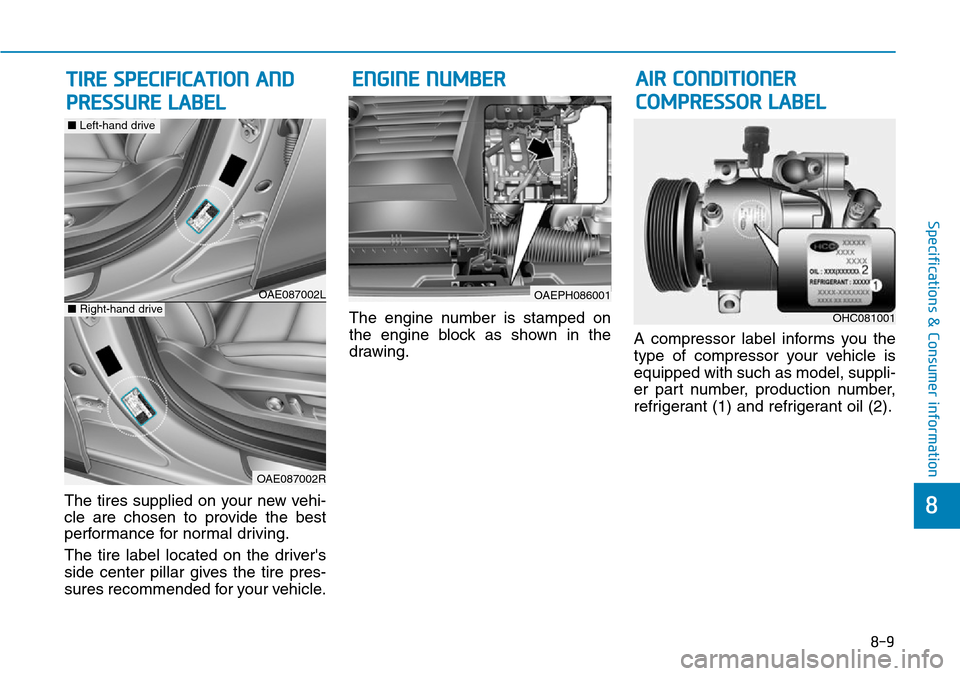
The tires supplied on your new vehi-
cle are chosen to provide the best
performance for normal driving.
The tire label located on the driver's
side center pillar gives the tire pres-
sures recommended for your vehicle.The engine number is stamped on
the engine block as shown in the
drawing.A compressor label informs you the
type of compressor your vehicle is
equipped with such as model, suppli-
er part number, production number,
refrigerant (1) and refrigerant oil (2).
TIRE SPECIFICATION AND
PRESSURE LABELENGINE NUMBER
OHC081001
AIR CONDITIONER
COMPRESSOR LABEL
OAEPH086001OAE087002L
OAE087002R
■Right-hand drive
■Left-hand drive
Page 634 of 642

I-5
Dual clutch transmission ..............................................5-15
DCT warning messages .............................................5-17
Good driving practices...............................................5-24
Manual shift mode .....................................................5-21
Paddle shifter .............................................................5-23
Shift lever position.....................................................5-19
Shift lock system .......................................................5-22
Shift-lock release .......................................................5-22
Dual clutch transmission shift indicator .......................3-53
Easy access function .....................................................3-19
ECO mode ....................................................................5-20
Electric chromic mirror (ECM) ....................................3-23
Electric power steering (EPS) ......................................3-20
Electronic stability control (ESC) ................................5-33
Emergency commodity .................................................6-47
Emergency stop signal (ESS) .......................................5-38
Emergency towing ........................................................6-45
Emission control system ...............................................7-91
Crankcase emission control system ...........................7-92
Evaporative emission control System .......................7-92
Exhaust emission control system...............................7-92
Engine compartment .......................................................1-8
Hybrid vehicle .............................................................7-3
Plug-in hybrid vehicle .................................................7-4
Engine compartment panel fuse replacement...............7-55
Engine coolant ..............................................................7-25Engine coolant temperature guage ...............................3-46
Engine number................................................................8-9
Engine oil......................................................................7-23
Engine specification .......................................................8-2
Engine Start/Stop button.................................................5-9
Evaporative emission control System ..........................7-92
Exhaust emission control system .................................7-92
Explanation of scheduled maintenance items ..............7-21
Exterior care .................................................................7-84
Exterior overview
Front view ....................................................................1-2
Rear view .....................................................................1-3
Flat tire
Changing tires ............................................................6-21
EC Declaration of conformity for Jack .....................6-27
Jack and tools.............................................................6-20
Jack label ...................................................................6-26
Tire Mobility Kit (TMK) ...........................................6-28
Use of compact spare tires.........................................6-24
Floor mat anchor(s) ....................................................3-153
Fluid
Brake fluid .................................................................7-29
Washer fluid ...............................................................7-30
Forced engine activation mode.....................................7-95
I
Index
E
F