Page 530 of 642
7-23
7
Maintenance
ENGINE OIL
Checking the engine oil level
1. Follow all of the oil manufacturer’s
precautions.
2. Be sure the vehicle is on level
ground in P (Park) with the parking
brake set and the wheels blocked.
3. Turn the engine on and allow the
engine to reach normal operating
temperature.
4. Turn the hybrid system off and
wait about five minutes for the oil
to return to the oil pan.
5. Pull the dipstick out, wipe it clean,
and re-insert it fully.6. Pull the dipstick out again and
check the level. The level should
be between F (Full) and L (Low).
7. If it is near or at L, add enough oil
to bring the level to F.To prevent damage to your engine:
• Do not overfill with engine oil.
Add oil in small quantities and
recheck level to ensure engine
is not overfilled.
• Do not spill engine oil when
adding or changing engine oil.
Use a funnel to help prevent oil
from being spilled on engine
components. Wipe off spilled oil
immediately.
NOTICE
OAE076002
Page 531 of 642
7-24
Maintenance
Use only the specified engine oil
(Refer to “Recommended Lubricants
and Capacities” in chapter 8).
Checking the engine oil and
filter
We recommend that the engine oil
and filter be changed by an author-
ized HYUNDAI dealer according to
the Maintenance Schedule at the
beginning of this chapter.
NOTICE
OAEPH076003
Page 537 of 642

7-30
Maintenance
If the level is low, add the specified
brake fluid to the MAX level. The level
will fall with accumulated mileage.
This is a normal condition associated
with the wear of the brake linings. If
the fluid level is excessively low, we
recommend that the brake system
be checked by an authorized
HYUNDAI dealer.• Do not allow brake fluid to con-
tact the vehicle’s body paint, as
paint damage will result.
• Brake fluid, which has been
exposed to open air for an
extended time should NEVER be
used as its quality cannot be
guaranteed. It should be dis-
posed of properly.
• Do not use the wrong kind of
brake fluid. A few drops of miner-
al based oil, such as engine oil, in
your brake system can damage
brake system parts.
Information
Use only the specified brake fluid
Refer to “Recommended Lubricants
and Capacities” in chapter 8.
Checking the washer fluid
level
Check the fluid level in the washer
fluid reservoir and add fluid if neces-
sary. Plain water may be used if
washer fluid is not available.
However, use washer solvent with
antifreeze characteristics in cold cli-
mates to prevent freezing.
i
NOTICE
If the brake system requires fre-
quent additions of fluid this
could indicate a leak in the
brake system. We recommend
that the vehicle be inspected by
an authorized HYUNDAI dealer.
WARNING
Do not allow brake fluid to come
in contact with your eyes. If
brake fluid comes in contact
with your eyes, flush your eyes
with clean water for at least 15
minutes and get immediate
medical attention.
WARNING
WASHER FLUID
OAE076009
Page 538 of 642

7-31
7
Maintenance
Checking the parking brake
Foot type (if equipped)
Check whether the stroke is within
specification when the parking brake
pedal is depressed with 20 kg (44 lb,
196 N) of force. Also, the parking
brake alone should securely hold the
vehicle on a fairly steep grade. If the
stroke is more or less than specified,
have the parking brake adjusted by
an authorized HYUNDAI dealer.
Stroke : 4~5 notch
Filter replacement
The air cleaner filter can be cleaned
for inspection using compressed air.
Do not attempt to wash or to rinse it,
as water will damage the filter.
If soiled, the air cleaner filter must be
replaced.OAE056014
PARKING BRAKE
To prevent serious injury or
death, take the following safety
precautions when using washer
fluid:
•Do not use engine coolant or
antifreeze in the washer fluid
reservoir. Engine coolant can
severely obscure visibility
when sprayed on the wind-
shield and may cause loss of
vehicle control resulting in an
accident or damage to paint
and body trim.
•Do not allow sparks or flames
to contact the washer fluid or
the washer fluid reservoir.
Washer fluid may contain
alcohol and can be flamma-
ble.
•Do not drink washer fluid and
avoid contact with skin.
Washer fluid is poisonous to
humans and animals.
•Keep washer fluid away from
children and animals.
WARNING
AIR CLEANER
OAEPH076010
Page 548 of 642

7-41
7
Maintenance
By jump starting
After a jump start from a good bat-
tery, drive the vehicle for 20-30 min-
utes before it is shutoff. The vehicle
may not restart if you shut it off
before the battery had a chance to
adequately recharge. See “Jump
Starting” in chapter 6 for more infor-
mation on jump starting procedures.
Information
An inappropriately disposed
battery can be harmful to
the environment and human
health. Dispose of the bat-
tery according to your local
law(s) or regulations.
Reset features
The following items may need to be
reset after the battery has been dis-
charged or the battery has been dis-
connected.
See chapter 3 or 4 for:
• Power Windows
• Trip Computer
• Climate Control System
• Clock
• Audio System
• Sunroof
• Driver Position Memory System
i
(Continued)
•Watch the battery during
charging, and stop or reduce
the charging rate if the battery
cells begin boiling violently.
•The negative battery cable
must be removed first and
installed last when the battery
is disconnected. Disconnect
the battery charger in the fol-
lowing order:
(1) Turn off the battery charger
main switch.
(2) Unhook the negative
clamp from the negative
battery terminal.
(3) Unhook the positive clamp
from the positive battery
terminal.
•Always use a genuine HYUNDAI
approved battery when you
replace the battery.
Page 560 of 642

7-53
7
Maintenance
FUSES
A vehicle’s electrical system is pro-
tected from electrical overload dam-
age by fuses.
This vehicle has 2 (or 3) fuse panels,
one located in the driver’s side panel
bolster, the other in the engine com-
partment.
If any of your vehicle’s lights, acces-
sories, or controls do not work, check
the appropriate circuit fuse. If a fuse
has blown, the element inside the
fuse will be melted or broken.
If the electrical system does not
work, first check the driver’s side
fuse panel. Before replacing a blown
fuse, turn the engine and all switches
off, and then disconnect the negative
battery cable. Always replace a
blown fuse with one of the same rat-
ing.
If the replacement fuse blows, this indi-
cates an electrical problem. Avoid
using the system involved and immedi-
ately consult an authorized HYUNDAI
dealer.Information
Three kinds of fuses are used: blade
type for lower amperage rating, car-
tridge type, and multi fuse for higher
amperage ratings.
i
Normal ■Blade type
■Cartridge typeBlown
NormalBlown
NormalBlown
OLF074075
Do not use a screwdriver or any
other metal object to remove
fuses because it may cause a
short circuit and damage the
system.
CAUTION
NEVER replace a fuse with any-
thing but another fuse of the
same rating.
•A higher capacity fuse could
cause damage and possibly
cause a fire.
•Do not install a wire or alu-
minum foil instead of the
proper fuse - even as a tem-
porary repair. It may cause
extensive wiring damage and
possibly a fire.
WARNING
Normal
Blown
■Multi fuse
Page 572 of 642
7-65
7
Maintenance
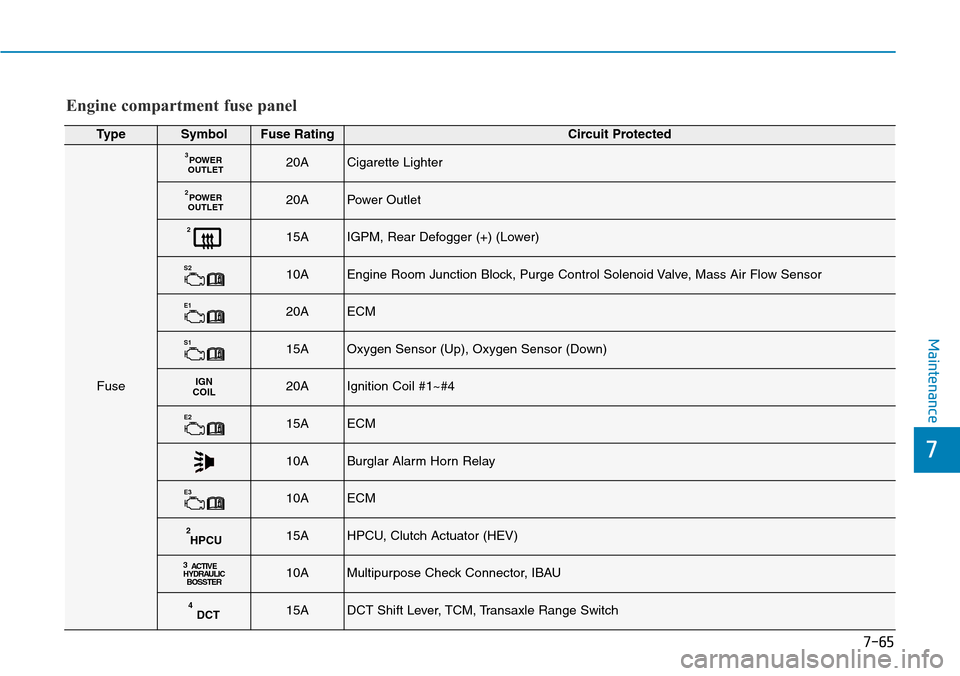
TypeSymbolFuse RatingCircuit Protected
Fuse
POWER
OUTLET320ACigarette Lighter
POWER
OUTLET220APower Outlet
215AIGPM, Rear Defogger (+) (Lower)
S210AEngine Room Junction Block, Purge Control Solenoid Valve, Mass Air Flow Sensor
E120AECM
S115AOxygen Sensor (Up), Oxygen Sensor (Down)
IGN
COIL20AIgnition Coil #1~#4
E215AECM
10ABurglar Alarm Horn Relay
E310AECM
HPCU215AHPCU, Clutch Actuator (HEV)
3
ACTIVE
HYDRAULIC
BOSSTER10AMultipurpose Check Connector, IBAU
DCT415ADCT Shift Lever, TCM, Transaxle Range Switch
Engine compartment fuse panel
Page 573 of 642
7-66
Maintenance
TypeSymbolFuse RatingCircuit Protected
Fuse
S310AFuel Pump Relay, Camshaft Position Sensor #1 (Intake), Camshaft Position Sensor #2
(Exhaust), Oil Control Valve #1 (Intake), Oil Control Valve #2 (Exhaust)
BATTERY
C/FAN15AEngine Room Junction Block
FUEL
PUMP20AFuel Pump Relay
20AHorn Relay
Engine compartment fuse panel