2018 Hyundai Elantra remove
[x] Cancel search: removePage 29 of 526

2-12
Safety system of your vehicle
Armrest (if equipped)
The armrest is located in the center of
the rear seat. Pull the armrest down by
using the strap from the seatback to use
it.
If your car is not equipped with a rear
armrest, the rear cup holders are located
at the back of the center console.
Head Restraints
The vehicle's front and rear seats have
adjustable head restraints. The head
restraints provide comfort for passen-
gers, but more importantly they are
designed to help protect passengers
from whiplash and other neck and spinal
injuries during an accident, especially in
a rear impact collision.
OAD035023
Be careful when loading cargo
through the rear passenger seats
to prevent damage to the vehicle
interior.
When cargo is loaded through
the rear passenger seats, ensure
the cargo is properly secured to
prevent it from moving while driv-
ing.
Unsecured cargo in the passen-
ger compartment can cause dam-
age to the vehicle or injury to it's
occupants.
CAUTION
To reduce the risk of serious injury
or death in an accident, take the fol-
lowing precautions when adjusting
your head restraints:
Always properly adjust the head
restraints for all passengers
BEFORE starting the vehicle.
NEVER let anyone ride in a seat
with the head restraints removed.(Continued)
WARNING
Page 31 of 526
2-14
Safety system of your vehicle
If you recline the seatback towards the
front with the head restraint and seat
cushion raised, the head restraint may
come in contact with the sunvisor or
other parts of the vehicle.
Removal/Reinstallation
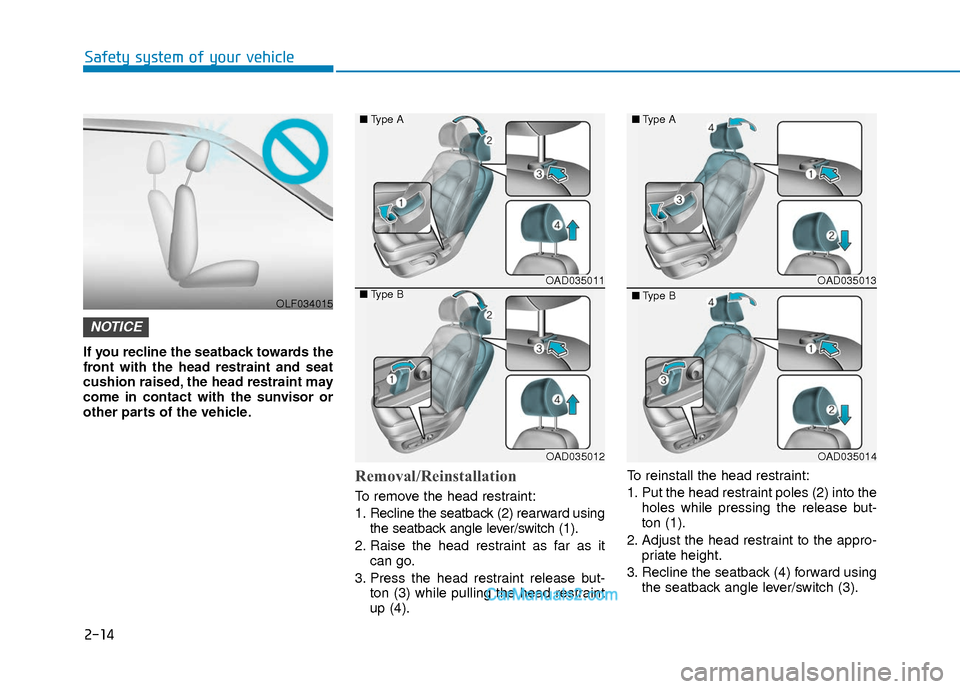
To remove the head restraint:
1. Recline the seatback (2) rearward usingthe seatback angle lever/switch (1).
2. Raise the head restraint as far as it can go.
3. Press the head restraint release but- ton (3) while pulling the head restraint
up (4). To reinstall the head restraint:
1. Put the head restraint poles (2) into the
holes while pressing the release but-
ton (1).
2. Adjust the head restraint to the appro- priate height.
3. Recline the seatback (4) forward using the seatback angle lever/switch (3).
NOTICE
OLF034015
OAD035011
OAD035012
■Type A
■Type BOAD035013
OAD035014
■Type A
■Type B
Page 32 of 526
2-15
Safety system of your vehicle
2
Rear seat head restraints
The rear seats are equipped with head
restraints in all the seating positions for
the passenger's safety and comfort.
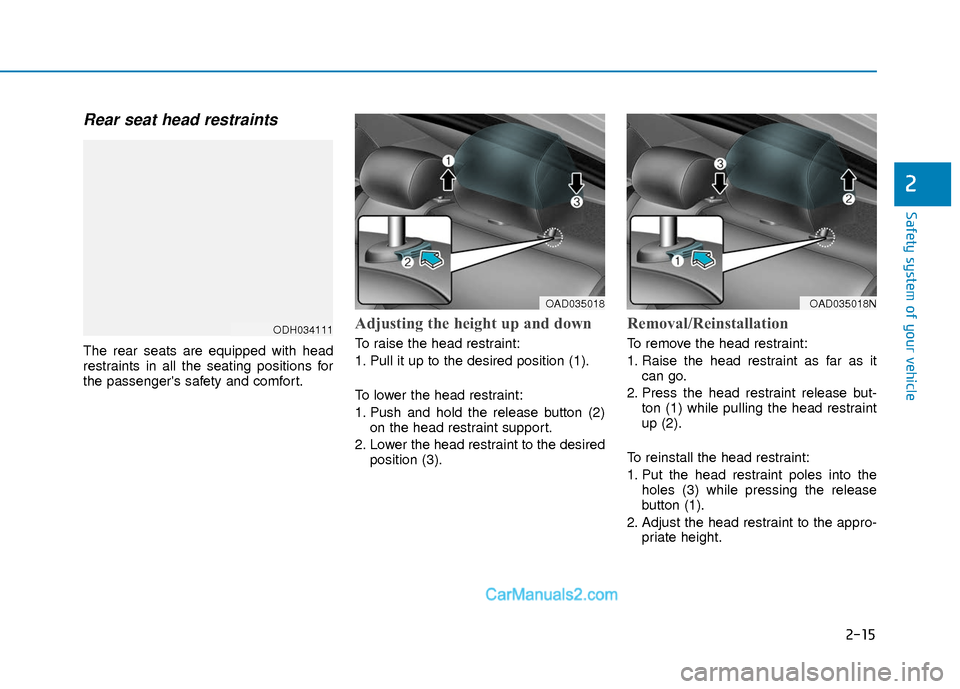
Adjusting the height up and down
To raise the head restraint:
1. Pull it up to the desired position (1).
To lower the head restraint:
1. Push and hold the release button (2)on the head restraint support.
2. Lower the head restraint to the desired position (3).
Removal/Reinstallation
To remove the head restraint:
1. Raise the head restraint as far as itcan go.
2. Press the head restraint release but- ton (1) while pulling the head restraint
up (2).
To reinstall the head restraint:
1. Put the head restraint poles into the holes (3) while pressing the release
button (1).
2. Adjust the head restraint to the appro- priate height.ODH034111
OAD035018OAD035018N
Page 35 of 526
2-18
Safety system of your vehicle
This section describes how to use the
seat belts properly. It also describes
some of the things not to do when using
seat belts.
Seat Belt Safety Precautions
Always fasten your seat belt and make
sure all passengers have fastened their
seat belts before starting any trip. Air
bags are designed to supplement the
seat belt as an additional safety device,
but they are not a substitute. Most states
require all occupants of a vehicle to wear
seat belts.
S SE
E A
A T
T
B
B E
EL
LT
T S
S
Seat belts must be used by ALL
passengers whenever the vehicle is
moving. Take the following precau-
tions when adjusting and wearing
seat belts:
ALWAYS properly restrain chil-
dren under age 13 in the rear
seats.
NEVER allow children to ride in
the front passenger seat. If a child
age 13 or older must be seated in
the front seat, move the seat as
far back as possible and properly
restrain them in the seat.
(Continued)
WARNING
(Continued)
NEVER allow an infant or child to
be carried on an occupant’s lap.
NEVER ride with the seatback
reclined when the vehicle is mov-
ing.
Do not allow children to share a
seat or seat belt.
Do not wear the shoulder belt
under your arm or behind your
back.
Always wear both the shoulder
portion and lap portion of the
lap/shoulder belt.
Do not use the seat belt if it is
twisted. A twisted seat belt will
not protect you properly in an
accident.
Do not use a seat belt if the web-
bing or hardware is damaged.
Do not latch the seat belt into the
buckles of other seats.
NEVER unfasten the seat belt
while driving. This may cause
loss of vehicle control resulting
in an accident.
Make sure there is nothing in the
buckle interfering with the seat
belt latch mechanism. This may
prevent the seat belt from fasten-
ing securely.(Continued)
(Continued)
No modifications or additions
should be made by the user
which will either prevent the seat
belt adjusting devices from oper-
ating to remove slack, or prevent
the seat belt assembly from being
adjusted to remove slack.
Damaged seat belts and seat belt
assemblies will not operate proper-
ly. Always replace:
Frayed, contaminated, or dam-
aged webbing
Damaged hardware
The entire seat belt assembly
after it has been worn in an acci-
dent, even if damage to webbing
or assembly is not apparent
WARNING
Page 46 of 526

2-29
Safety system of your vehicle
2
Selecting a Child Restraint
System (CRS)
When selecting a CRS for your child,
always:
Make sure the CRS has a label certify-ing that it meets applicable Federal
Motor Vehicle Safety Standards
(FMVSS 213).
Select a child restraint based on your child’s height and weight. The required
label or the instructions for use typical-
ly provide this information.
Select a child restraint that fits the vehicle seating position where it will be
used.
Read and comply with the warnings and instructions for installation and use
provided with the child restraint sys-
tem.
Child restraint system types
There are three main types of child
restraint systems: rear-facing seats, for-
ward-facing seats, and booster seats.
They are classified according to the
child’s age, height and weight.
Rear-facing child seats
(Continued)
If the vehicle head restraint pre-
vents proper installation of a
child seat (as described in the
child restraint system manual),
the head restraint of the respec-
tive seating position shall be
readjusted or entirely removed.
Do not use an infant carrier or a
child safety seat that "hooks"
over a seatback, it may not pro-
vide adequate protection in an
accident.
After an accident, have a
HYUNDAI dealer check the child
restraint system, seat belts, teth-
er anchors and lower anchors.
NEVER install a child or infant
restraint in the front passenger’s
seat.
Placing a rear-facing child restraint
in the front seat can result in SERI-
OUS INJURY or DEATH if the child
restraint is struck by an inflating air
bag.
WARNING
Page 48 of 526
2-31
Safety system of your vehicle
2
Booster seats
A booster seat is a restraint designed to
improve the fit of the vehicle’s seat belt
system. A booster seat positions the seat
belt so that it fits properly over the lap of
your child.
Keep your child in a booster seat until
they are big enough to sit in the seat
without a booster and still have the seat
belt fit properly. For a seat belt to fit prop-
erly, the lap belt must lie snugly across
the upper thighs, not the stomach. The
shoulder belt should lie snug across the
shoulder and chest and not across the
neck or face. Children under age 13 must
always ride in the rear seats and must
always be properly restrained to mini-
mize the risk of injury.
Installing a Child Restraint
System (CRS)After selecting a proper child seat for
your child, check to make sure it fits prop-
erly in your vehicle. Follow the instruc-
tions provided by the manufacturer when
installing the child seat. Note these gen-
eral steps when installing the seat to your
vehicle:
Properly secure the child restraint to
the vehicle.All child restraints must be
secured to the vehicle with the lap part
of a lap/shoulder belt or with the LATCH
system.
Make sure the child restraint is firm-
ly secured. After installing a child
restraint to the vehicle, push and pull
the seat forward-and-back and side-to-
side to verify that it is securely
attached to the seat. A child restraint
secured with a seat belt should be
installed as firmly as possible.
However, some side-to- side move-
ment can be expected.
Secure the child in the child
restraint. Make sure the child is prop-
erly strapped in the child restraint
according to the manufacturer instruc-
tions.
Before installing your child
restraint system always:Read and follow the instructions
provided by the manufacturer of
the child restraint.
Read and follow the instructions
regarding child restraint systems
in this manual.
Failure to follow all warnings and
instructions could increase the risk
of the SERIOUS INJURY or DEATH
if an accident occurs.
WARNING
If the vehicle headrest prevents
proper installation of a child seat
(as described in the child seat sys-
tem manual, the headrest of the
respective seating position shall be
readjusted or entirely removed.
WARNING
Page 54 of 526
2-37
Safety system of your vehicle
2
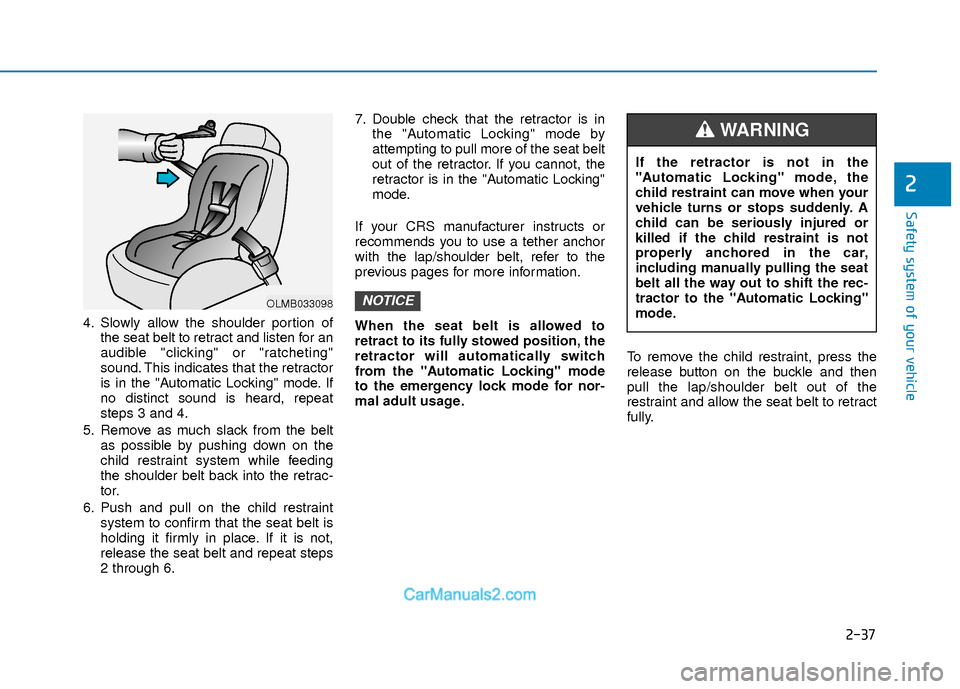
4. Slowly allow the shoulder portion ofthe seat belt to retract and listen for an
audible "clicking" or "ratcheting"
sound. This indicates that the retractor
is in the "Automatic Locking" mode. If
no distinct sound is heard, repeat
steps 3 and 4.
5. Remove as much slack from the belt as possible by pushing down on the
child restraint system while feeding
the shoulder belt back into the retrac-
tor.
6. Push and pull on the child restraint system to confirm that the seat belt is
holding it firmly in place. If it is not,
release the seat belt and repeat steps
2 through 6. 7. Double check that the retractor is in
the "Automatic Locking" mode by
attempting to pull more of the seat belt
out of the retractor. If you cannot, the
retractor is in the "Automatic Locking"
mode.
If your CRS manufacturer instructs or
recommends you to use a tether anchor
with the lap/shoulder belt, refer to the
previous pages for more information.
When the seat belt is allowed to
retract to its fully stowed position, the
retractor will automatically switch
from the "Automatic Locking" mode
to the emergency lock mode for nor-
mal adult usage. To remove the child restraint, press the
release button on the buckle and then
pull the lap/shoulder belt out of the
restraint and allow the seat belt to retract
fully.
NOTICEOLMB033098
If the retractor is not in the
"Automatic Locking" mode, the
child restraint can move when your
vehicle turns or stops suddenly. A
child can be seriously injured or
killed if the child restraint is not
properly anchored in the car,
including manually pulling the seat
belt all the way out to shift the rec-
tractor to the "Automatic Locking"
mode.
WARNING
Page 82 of 526

3-5
Convenient features of your vehicle
3
Remote key precautions
The remote key will not work if any of the
following occur:
The key is in the ignition switch.
You exceed the operating distance limit(about 90 feet [30 m]).
The remote key battery is weak.
Other vehicles or objects may be blocking the signal.
The weather is extremely cold.
The remote key is close to a radio transmitter such as a radio station or
an airport which can interfere with nor-
mal operation of the remote key.
When the remote key does not work cor-
rectly, open and close the door with the
mechanical key. If you have a problem
with the remote key contact an author-
ized HYUNDAI dealer.
If the remote key is in close proximity to
your mobile phone, the signal could be
blocked by your mobile phones normal
operational signals. This is especially
important when the phone is active such
as making and receiving calls, text mes-
saging, and/or sending/receiving emails.
Avoid placing the remote key and your
mobile phone in the same pants or jack-
et pocket and always try to maintain an
adequate distance between the two
devices.Information
This device complies with Part 15 of the
FCC rules.
Operation is subject to the following three
conditions:
1. This device may not cause harmful interference, and
2. This device must accept any interfer- ence received, including interference
that may cause undesired operation.
3. Changes or modifications not expressly approved by the party responsible for
compliance could void the user’s
authority to operate the device.
Keep the remote key away from elec-
tromagnetic materials that blocks
electromagnetic waves to the key sur-
face.
Battery replacement
If the remote key is not working properly,
try replacing the battery with a new one.
Battery Type: CR2032
To replace the battery:
1. Pry open the rear cover of the remote key.
2. Remove the old battery and insert the new battery. Make sure the battery
position is correct.
3. Reinstall the rear cover of the remote key.
NOTICE
i
OLMB043011