2018 Hyundai Elantra Warning
[x] Cancel search: WarningPage 64 of 526

2-47
Safety system of your vehicle
2
What to Expect After an Air
Bag Inflates
After a frontal or side air bag inflates, it
will deflate very quickly. Air bag inflation
will not prevent the driver from seeing out
of the windshield or being able to steer.
Curtain air bags may remain partially
inflated for some time after they deploy.
Noise and smoke from inflatingair bag
When the air bags inflate, they make a
loud noise and may produce smoke and
powder in the air inside of the vehicle.
This is normal and is a result of the igni-
tion of the air bag inflator. After the air
bag inflates, you may feel substantial dis-
comfort in breathing because of the con-
tact of your chest with both the seat belt
and the air bag, as well as from breathing
the smoke and powder. The powder may
aggravate asthma for some people. If you
experience breathing problems after an
air bag deployment, seek medical atten-
tion immediately.
Though the smoke and powder are non-
toxic, they may cause irritation to the
skin, eyes, nose, throat, etc. If this is the
case, wash and rinse with cold water
immediately and seek medical attention
if the symptoms persist.
To prevent objects from becoming
dangerous projectiles when the
passenger's air bag inflates:
Do not install or place any
objects (drink holder, CD holder,
stickers, etc.) on the front pas-
senger's panel above the glove
box where the passenger's air
bag is located.
Do not install a container of liquid
air freshener near the instrument
cluster or on the instrument
panel surface.
WARNING
After an air bag inflates, take the
following precautions:
Open your windows and doors as
soon as possible after impact to
reduce prolonged exposure to
the smoke and powder released
by the inflating air bag.
Do not touch the air bag storage
area's internal components
immediately after an air bag has
inflated. The parts that come into
contact with an inflating air bag
may be very hot.
Always wash exposed skin areas
thoroughly with cold and mild
soap.
(Continued)
WARNING
(Continued)
Always have an authorized
HYUNDAI dealer replace the air
bag immediately after deploy-
ment. Air bags are designed to be
used only once.
Page 66 of 526

2-49
Safety system of your vehicle
2
Always be sure that you and all vehicle
occupants are seated properly and wear-
ing the seat belt properly for the most
effective protection by the air bag and the
seat belt.
The OCS may not function properly if the
passenger takes actions which can affect
the classification system. These include:
Failing to sit in an upright position.
Leaning against the door or centerconsole.
Sitting towards the sides of the front of the seat.
Putting their legs on the dashboard or resting them on other locations which
reduce the passenger weight on the
front seat.
Wearing the seat belt improperly.
Reclining the seatback.
Wearing a thick cloth like ski wear or hip protection wear.
Putting an additional thick cushion on the seat.
Putting electrical devices (e.g. note- book, satellite radio) on the seat with
inverter charging.Condition and operation in the front passenger Occupant Classification
System
Condition detected by the
occupant classification system
Indicator/Warning lightDevices
"PASSENGER
AIR BAG OFF" indicator lightSRS
warning lightFront passenger
air bag
1. Adult *1OffOffActivated
2. Infant *2or child restraint
system with 12 months old *3*4 OnOffDeactivated
3. Unoccupied OnOffDeactivated
4. Malfunction in the systemOffOnActivated
*1The system judges a person of adult size as an adult. When a smaller adult sits in the front
passenger seat, the system may recognize him/her as a child depending on his/her physique
and posture.
*
2Do not allow children to ride in the front passenger seat. When a larger child who has out- grown a child restraint system sits in the front passenger seat, the system may recognize
him/her as an adult depending upon his/her physique or sitting position.
*
3Never install a child restraint system on the front passenger seat.
*4The PASSENGER AIR BAG "OFF" indicator may turn on or off when a child above 12 months
to 12 years old (with or without child restraint system) sits in the front passenger seat. This is
a normal condition.
Page 67 of 526

2-50
Safety system of your vehicle
Riding in an improper position or placing weight on the front passenger’s seat when it is unoccupied by a passenger
adversely affects the OCS. To reduce the risk of serious injury or death:
WARNING
OVQ036013NB
OLMB033100
OLMB033101
OLMB033103
OLMB033102
OLMB033104
NEVER put a heavy load in
the front seat or seatback
pocket, or hang any items on
the front passenger seat.
NEVER place your feet on
the front passenger seat-
back.
NEVER sit with your hips
shifted towards the front of
the seat.
NEVER ride with the seat-
back reclined when the vehi-
cle is moving.
NEVER place your feet or
legs on the dashboard.
NEVER lean on the door or
center console or sit on one
side of the front passenger
seat.(Continued)
Page 68 of 526

2-51
Safety system of your vehicle
2
ODH035900K
ODH035901K
ODH035902K
ODH035903K
Do not sit on the passenger
seat wearing heavily padded
clothes such as ski wear and
hip protector.
Do not use car seat acces-
sories such as thick blan-
kets and cushions which
cover up the car seat sur-
face.
Do not place electronic
devices such as laptops,
DVD player, or conductive
materials such as water bot-
tles on the passenger seat.
Do not use electronic
devices such as laptops and
satellite radios which use
inverter chargers.
If large quantity of liquid has
been spilled on the passen-
ger seat, the air bag warning
light may illuminate or mal-
function.
Therefore, make sure the
seat has been completely
dried before driving the vehi-
cle.
Do not place sharp objects on the front passenger seat. These may damage the occupant detection system, if they
puncture the seat cushion.
Do not place any items under the front passenger seat.
When changing or replacing the seat or seat cover, use original items only. The OCS has been developed based on
using original HYUNDAI car seats only. Altering or changing the authentic parts may result in system malfunction
and increase risk of injury when in collision. Any of the above could interfere with the proper operation of the OCS
sensor thereby increasing the risk of an injury in an accident.
(Continued)
Page 69 of 526

2-52
Safety system of your vehicle
Proper seated position for OCS
If the "PASSENGER AIR BAG OFF" indi-
cator is on when an adult is seated in the
front passenger seat, place the ignition
switch in the LOCK/OFF position and
ask the passenger to sit properly (sitting
upright with the seat back in an upright
position, centered on the seat cushion
with their seat belt on, legs comfortably
extended and their feet on the floor).
Restart the engine and have the person
remain in that position. This will allow the
system to detect the person and to
enable the passenger air bag. If the
"PASSENGER AIR BAG OFF" indicator
is still on, ask the passenger to move to
the rear seat.The "PASSENGER AIR BAG OFF"
indicator illuminates for approximate-
ly 4 seconds after the ignition switch
is in the ON position or after the
engine is started. If the front passen-
ger seat is occupied, the OCS will
then classify the front passenger after
several more seconds.
Do Not Install a Child Restraint
in the Front Passenger's Seat
Even though your vehicle is equipped
with the OCS, never install a child
restraint in the front passenger's seat. An
inflating air bag can forcefully strike a
child or child restraint resulting in serious
or fatal injury.
NOTICE
B990A01O
Never allow an adult passenger to
ride in the front passenger seat
when the "PASSENGER AIR BAG
OFF" indicator is illuminated.
During a collision, the air bag will
not inflate if the indicator is illumi-
nated. Have your passenger reposi-
tion himself in the seat. If the "PAS-
SENGER AIR BAG OFF" indicator
remains illuminated after the pas-
senger repositions himself proper-
ly and the vehicle is restarted, have
the passenger move to the rear
seat because the air bag will not
inflate.
WARNING
1JBH3051
Page 70 of 526

2-53
Safety system of your vehicle
2
Why Didn't My Air Bag Go Off
in a Collision?
Air bags are not designed to inflate in
every collision. There are certain types of
accidents in which the air bag would not
be expected to provide additional protec-
tion. These include rear impacts, second
or third collisions in multiple impact acci-
dents, as well as low speed impacts.
Damage to the vehicle indicates a colli-
sion energy absorption, and is not an
indicator of whether or not an air bag
should have inflated.
Air bag collision sensors
NEVER place a rear-facing or
front-facing child restraint in the
front passenger’s seat of the
vehicle.
An inflating frontal air bag could
forcefully strike a child resulting
in serious injury or death.
Always properly restrain children
in an appropriate child restraint
in the rear seat of the vehicle.
WARNING
To reduce the risk of an air bag
deploying unexpectedly and caus-
ing serious injury or death:
Do not hit or allow any objects to
impact the locations where air
bags or sensors are installed.
Do not perform maintenance on
or around the air bag sensors. If
the location or angle of the sen-
sors is altered, the air bags may
deploy when they should not or
may not deploy when they
should.
Do not install bumper guards or
replace the bumper with a non-
genuine HYUNDAI parts. This
may adversely affect the collision
and air bag deployment perform-
ance.
Place the ignition switch in the
LOCK/OFF or ACC position when
the vehicle is being towed to pre-
vent inadvertent air bag deploy-
ment.
Have all air bag repairs conduct-
ed by an authorized HYUNDAI
dealer.
WARNING
Page 75 of 526

2-58
Safety system of your vehicle
Air bags may not inflate if the vehicle col-
lides with objects such as utility poles or
trees, where the point of impact is con-
centrated and the collision energy is
absorbed by the vehicle structure.
SRS Care
The SRS is virtually maintenance-free
and there are no parts you can safely
service by yourself. If the SRS air bag
warning light does not illuminate when
the ignition switch is in the ON position,
or continuously remains on, have your
vehicle immediately inspected by an
authorized HYUNDAI dealer.
Any work on the SRS system, such as
removing, installing, repairing, or any
work on the steering wheel, the front
passenger's panel, front seats and roof
rails must be performed by an authorized
HYUNDAI dealer. Improper handling of
the SRS system may result in serious
personal injury.To reduce the risk of serious injury
or death, take the following precau-
tions:
Do not attempt to modify or dis-
connect the SRS components or
wiring, including the addition of
any kind of badges to the pad
covers or modifications to the
body structure.
Do not place objects over or near
the air bag modules on the steer-
ing wheel, instrument panel, or
the front passenger’s panel
above the glove box.
Clean the air bag pad covers with
a soft cloth moistened with plain
water. Solvents or cleaners could
adversely affect the air bag cov-
ers and proper deployment of the
system.
Always have inflated air bags
replaced by an authorized
HYUNDAI dealer.
(Continued)
WARNING
OLF034058
Page 77 of 526
2-60
Safety system of your vehicle
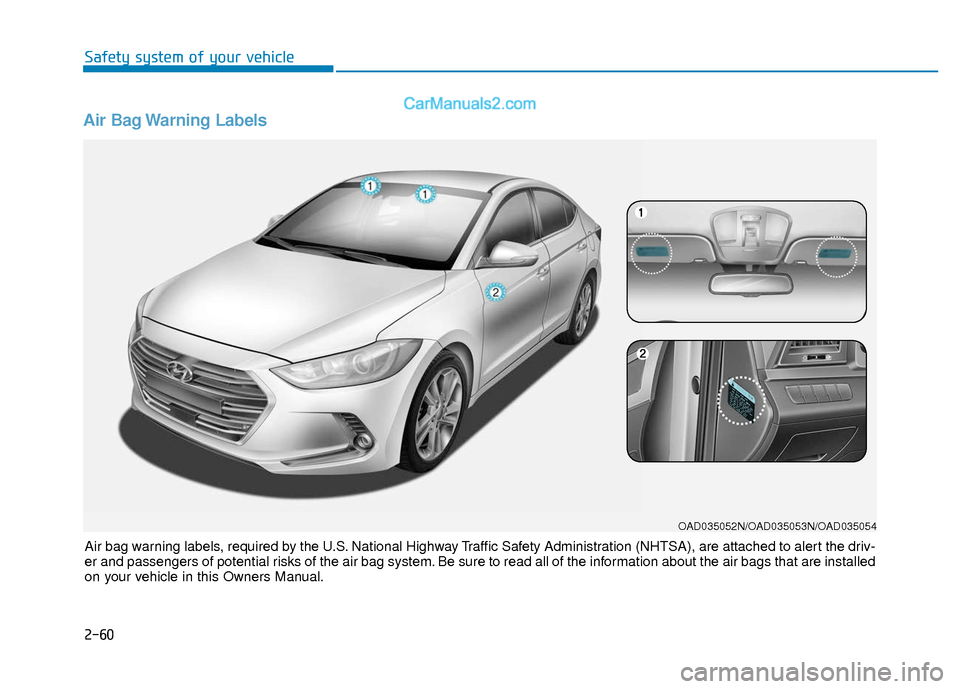
Air Bag Warning Labels
OAD035052N/OAD035053N/OAD035054
Air bag warning labels, required by the U.S. National Highway Traffic Safety Administration (NHTSA), are attached to alert the driv-
er and passengers of potential risks of the air bag system. Be sure to read all of the information about the air bags that are i nstalled
on your vehicle in this Owners Manual.