2018 HONDA CLARITY PLUG IN HYBRID maintenance
[x] Cancel search: maintenancePage 2 of 591
Event Data Recorders This vehicle is equipped with an event data recorder (EDR).
The main purpose of an EDR is to record, in certain crash or near
crash-like situations, such as an air bag deployment or hitting a
road obstacle, data that will assist in understanding how a vehicle’s
systems performed. The EDR is designed to record data related
to vehicle dynamics and safety systems for a short period of
time, typically 30 seconds or le ss. The EDR in this vehicle is
designed to record such data as:
• How various systems in your vehicle were operating;
• Whether or not the driver and passenger safety belts were
buckled/fastened; 3
WARNING California Proposition 65 Warning
Operating, servicing and maintaining a
passenger vehicle or off-road vehicle can
expose you to chemicals including engine
exhaust, carbon monoxide, phthalates, and
lead, which are known to the State of
California to cause cancer and birth defects or
other reproductive harm. To minimize
exposure, avoid breathing exhaust, do not
idle the engine except as necessary, service
your vehicle in a well-ventilated area and
wear gloves or wash your hands frequently
when servicing your vehicle. For more
information go to
www.P65Warnings.ca.gov/
passenger-vehicle . • How far (if at all) the driver was depressing the accelerator
and/or brake pedal; and,
• How fast the vehicle was traveling.
These data can help provide a better understanding of the
circumstances in which crashes and injuries occur. NOTE: EDR data
are recorded by your vehicle only if a non-trivial crash situation
occurs; no data are recorded by the EDR under normal driving
conditions and no personal data (e.g., name, gender, age, and
crash location) are recorded. Howeve r, other parties, such as law
enforcement, could co mbine the EDR data with the type of
personally identifying data rout inely acquired during a crash
investigation.
To read data recorded by an ED R, special equipment is required,
and access to the vehicle or the EDR is needed. In addition to the
vehicle manufacturer, other parties, such as law enforcement, that
have the special equipment, can re ad the informatio n if they have
access to the vehicle or the EDR.
The data belongs to the vehicle ow ner and may not be accessed by
anyone else except as legally requir ed or with the permission of the
vehicle owner.
Service Diagnostic Recorders This vehicle is equipped with se rvice-related devices that record
information about powertrain perfo rmance. The data can be used
to verify emissions law requirem ents and/or help technicians
diagnose and solve service problems. It may also be combined with
data from other sources for res earch purposes, but it remains
confidential. Some diagnostic and maintenance information is
uploaded to Honda upon vehicle start up.18 CLARITY PHEV CSS-31TRW6000.book 0 ページ 2017年8月31日 木曜日 午後2時4 9分
Page 4 of 591
High-Voltage Battery Monitoring System This vehicle is equipped with a monitoring system that compiles
data about your vehicle and drivin g conditions and transmits that
data to Honda at regular intervals as determined at the discretion
of Honda. This data includes information on but not limited to the
following:
● Vehicle location, distance dr iven, warning indicators and
messages, and vehicle speed
● High-Voltage Battery system control and power generation
The system does not record audio or images.
Data collected is used for the sole purposes of technical diagnoses,
preventive maintenance, resear ch and vehicle development.
Neither Honda nor any third party receiving data will use the data
for any other purpose withou t first obtaining customer
authorization. 18 CLARITY PHEV CSS-31TRW6000.book 2 ページ 2017年8月31日 木曜日 午後2時4 9分
Page 6 of 591
Contents
This owner’s manual should be co nsidered a permanent part of the
vehicle and should remain with the vehicle when it is sold.
This owner’s manual covers all models of your vehicle. You may find
descriptions of equipment and features that are not on your
particular model.
Images throughout this owner’s manu al (including the front cover)
represent features and equipment that are available on some, but
not all, models. Your particular mo del may not have some of these
features.
This owner’s manual is for vehicles sold in the United States and
Canada.
The information and specifications in cluded in this publication were
in effect at the time of approval for printing. Honda Motor Co., Ltd.
reserves the right, however, to discontinue or change specifications
or design at any time without notice and without incurring any
obligation. 2 Safe Driving P. 41For Safe Driving P. 42 Seat Belts P. 47 Airbags P. 54
2 Instrument Panel P. 85Indicators P. 86 Gauges and Driver Information Interface P. 121
2 Controls P. 135 Clock P. 136 Locking and Unlocking the Doors P. 137
Operating the Switches Ar ound the Steering Wheel P. 158
Interior Lights/Interior Convenience Items P. 183
2 Features P. 203 Audio System P. 204 Audio System Basic Operation P. 210
Customized Features P. 306 HomeLink ® Universal Transceiver *
P. 332
2 Driving P. 369 Before Driving P. 370 Towing a Trailer P. 375
Multi-View Rear Camera P. 449 Refueling P. 451
2 Maintenance P. 471Before Performing Maintenance P. 472 Maintenance Minder TM
P. 475
Checking and Maintaining Wiper Blades P. 496
Climate Control System Main tenance P. 511 Cleaning P. 513
2 Handling the Unexpected P. 521If a Tire Goes Flat P. 522 Handling of the Jack P. 534
Indicator, Coming On/Blinking P. 545
When You Cannot Unlock the Fuel Fill Door P. 562
2 Information P. 565Specifications P. 566 Identi fication Numbers P. 568
Emissions Testing P. 572 Warranty Coverages P. 57318 CLARITY PHEV CSS-31TRW6000.book 6 ページ 2017年8月31日 木曜日 午後2時4 9分
Page 7 of 591
ContentsChild Safety P. 69 Safety Labels P. 83
Opening and Closing the Trunk P. 150 Security System P. 153 Opening and Closing the Windows P. 156
Adjusting the Mirrors P. 173 Adjusting the Seats P. 175
Climate Control System P. 193
Audio Error Messages P. 284 General Information on the Audio System P. 288
Bluetooth ® HandsFreeLink ® P. 335
When Driving P. 376 Braking P. 431 Parking Your Vehicle P. 447
Charging P. 454 Fuel Economy and CO 2
Emissions P. 469
Maintenance Under the Hood P. 480 Replacing Light Bulbs P. 494
Checking and Maintaining Tires P. 499 12-Volt Battery P. 508 Remote Transmitter Care P. 510
Accessories and Modifications P. 519
Power System Won’t Start P. 535 Jump Starting P. 539 Overheating P. 542
Fuses P. 553 Emergency Towing P. 561
When You Cannot Open the Charge Lid P. 563 When You Cannot Open the Trunk P. 564
Devices that Emit Radio Waves P. 569 Reporting Safety Defects P. 571
Authorized Manuals P. 576 Customer Service Information P. 577 Quick Reference Guide
P. 6 Safe Driving
P. 41 Instrument Panel
P. 85 Controls
P. 135 Features
P. 203 Driving
P. 369 Maintenance
P. 471 Handling the Unexpected
P. 521 Information
P. 565
Index
P. 57918 CLARITY PHEV CSS-31TRW6000.book 7 ページ 2017年8月31日 木曜日 午後2時4 9分
Page 12 of 591
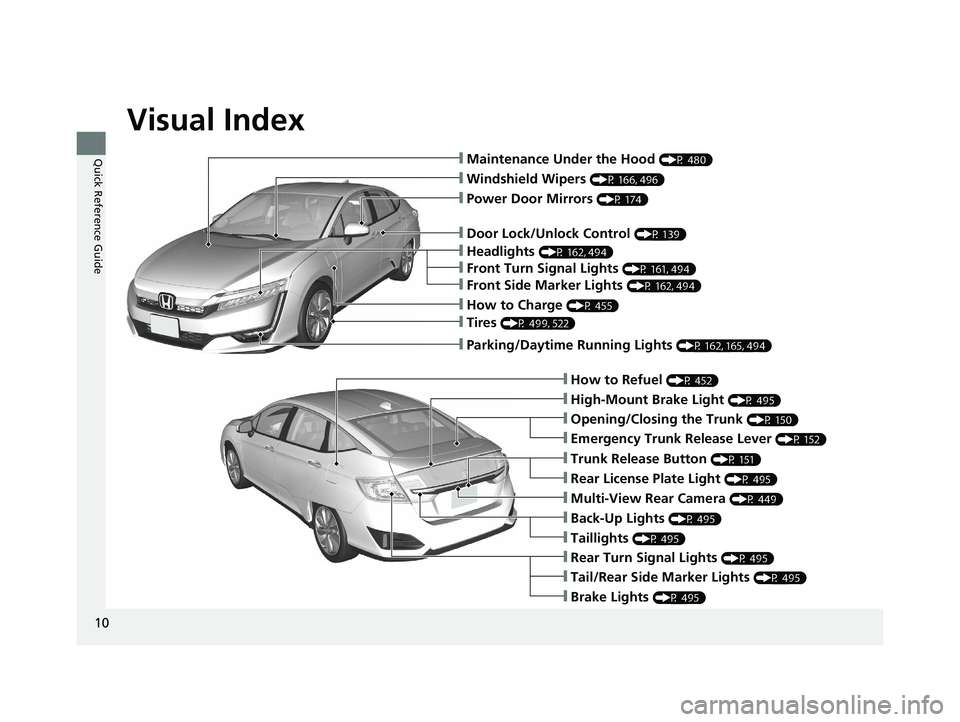
Visual Index
10
Quick Reference Guide ❙ Maintenance Under the Hood (P 480)
❙ Windshield Wipers (P 166, 496)
❙ Tires (P 499, 522)
❙ Door Lock/Unlock Control (P 139)
❙ Power Door Mirrors (P 174)
❙ Headlights (P 162, 494)
❙ Front Turn Signal Lights (P 161, 494)
❙ How to Refuel (P 452)
❙ High-Mount Brake Light (P 495)
❙ Emergency Trunk Release Lever (P 152)
❙ Opening/Closing the Trunk (P 150)
❙ Tail/Rear Side Marker Lights (P 495)
❙ Brake Lights (P 495)
❙ Rear Turn Signal Lights (P 495)
❙ Back-Up Lights (P 495)
❙ Taillights (P 495)
❙ Trunk Release Button (P 151)
❙ Rear License Plate Light (P 495)
❙ Multi-View Rear Camera (P 449)❙ Parking/Daytime Running Lights (P 162, 165, 494)
❙ Front Side Marker Lights (P 162, 494)
❙ How to Charge (P 455)18 CLARITY PHEV CSS-31TRW6000.book 10 ページ 2017年8月31日 木曜日 午後2時 49分
Page 21 of 591
19
Quick Reference Guide
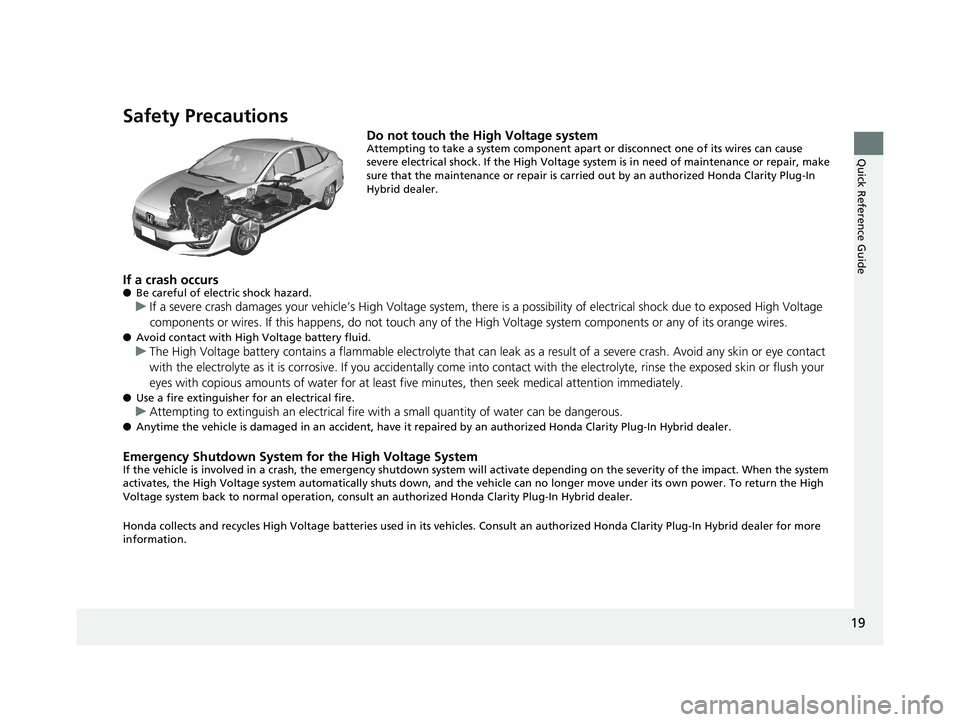
Safety Precautions Do not touch the High Voltage system Attempting to take a system component apart or disconnect one of its wires can cause
severe electrical shock. If the High Voltage system is in need of maintenance or repair, make
sure that the maintenance or repair is carried out by an authorized Honda Clarity Plug-In
Hybrid dealer.
If a crash occurs ● Be careful of electric shock hazard.
u If a severe crash damages your vehicle’s Hi gh Voltage system, there is a possibility of electrical shock due to exposed High Vo ltage
components or wires. If this happens, do not touch any of the High Voltage system components or any of its orange wires.● Avoid contact with High Voltage battery fluid.
u The High Voltage battery contains a flammabl e electrolyte that can leak as a result of a severe crash. Avoid any skin or eye co ntact
with the electrolyte as it is corrosive. If you accidentally come into contact with the electrolyte, rins e the exposed skin or flush your
eyes with copious amounts of water for at least fi ve minutes, then seek medi cal attention immediately.● Use a fire extinguisher for an electrical fire.
u Attempting to extinguish an el ectrical fire with a small quantity of water can be dangerous.● Anytime the vehicle is damaged in an accident, have it repa ired by an authorized Honda Clarity Plug-In Hybrid dealer.
Emergency Shutdown System for the High Voltage SystemIf the vehicle is involved in a crash, the emergency shutdown sy stem will activate depending on the severity of the impact. Whe n the system
activates, the High Voltage system automatica lly shuts down, and the vehicle can no long er move under its own power. To return the High
Voltage system back to normal operation, consult an authorized Honda Clarity Plug-In Hybrid dealer.
Honda collects and recycles High Voltage batteries used in its ve hicles. Consult an authorized Honda Clarity Plug-In Hybrid dea ler for more
information. 18 CLARITY PHEV CSS-31TRW6000.book 19 ページ 2017年8月31日 木曜日 午後2時 49分
Page 37 of 591
35
Quick Reference Guide
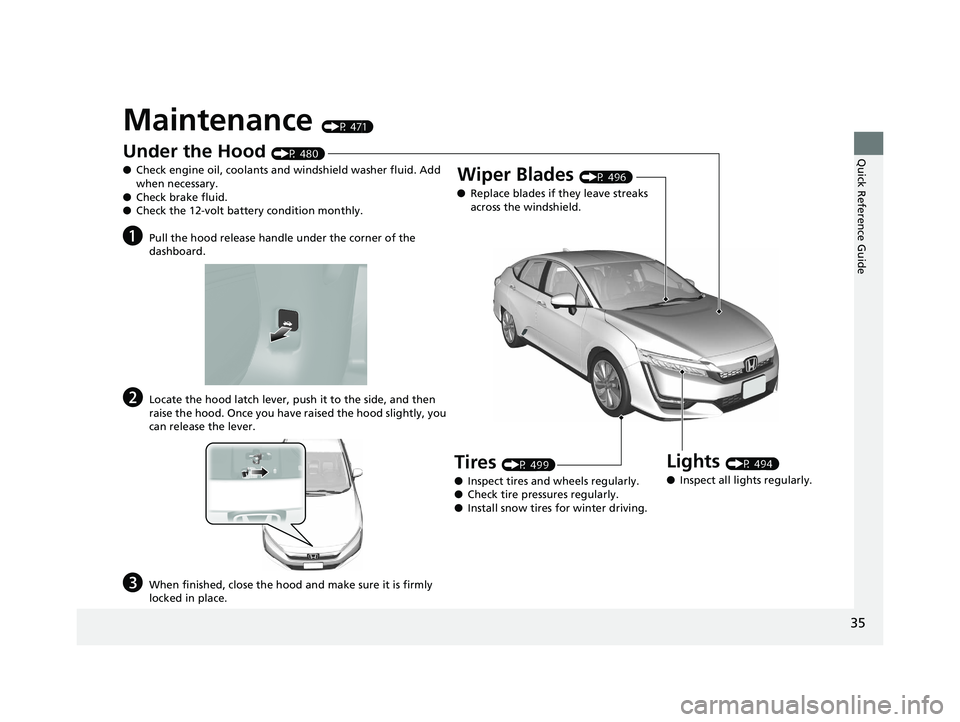
Maintenance (P 471)
Under the Hood (P 480)
● Check engine oil, coolants and windshield washer fluid. Add
when necessary.
● Check brake fluid.
● Check the 12-volt battery condition monthly.
a Pull the hood release handle under the corner of the
dashboard.
b Locate the hood latch lever, push it to the side, and then
raise the hood. Once you have raised the hood slightly, you
can release the lever.
c When finished, close the hood and make sure it is firmly
locked in place. Lights (P 494)
● Inspect all lights regularly.Wiper Blades (P 496)
● Replace blades if they leave streaks
across the windshield.
Tires (P 499)
● Inspect tires and wheels regularly.
● Check tire pressures regularly.
● Install snow tires for winter driving.18 CLARITY PHEV CSS-31TRW6000.book 35 ページ 2017年8月31日 木曜日 午後2時 49分
Page 45 of 591
43uu For Safe Driving u Important Safety Precautions
Continued
Safe Driving
■ Pay appropriate attention to the task of driving safely
Engaging in cell phone conversation or other activities that keep you from paying
close attention to the road, other vehicles , and pedestrians could lead to a crash.
Remember, situations can change quickly, and only you can decide when it is safe to
divert some attention away from driving.
■ Control your speed
Excessive speed is a major factor in crash injuries and deaths. Generally, the higher
the speed, the greater the risk, but serious injuries can also occur at lower speeds.
Never drive faster than is safe for current conditions, regardless of the maximum
speed posted.
■ Keep your vehicle in safe condition
Having a tire blowout or a mechanical failure can be extremely hazardous.
To reduce the possibility of such problems, check your tire pressures and condition
frequently, and perform all re gularly scheduled maintenance.
■ Do not leave children unattended in the vehicle
Children left unattended in the vehicle may be injured if they activate one or more
of the vehicle controls. They may also cause the vehicle to move, resulting in a crash
in which the children and/or another pers on(s) can be injured or killed. Also,
depending on the ambient temperature, th e temperature of the interior may reach
extreme levels, which can re sult in injury or death.
Even if the climate control system is on, never leave children in the vehicle
unattended as the climate control system can shut off at any time. 18 CLARITY PHEV CSS-31TRW6000.book 43 ページ 2017年8月31日 木曜日 午後2時 49分