2018 FORD TRANSIT lock
[x] Cancel search: lockPage 24 of 521
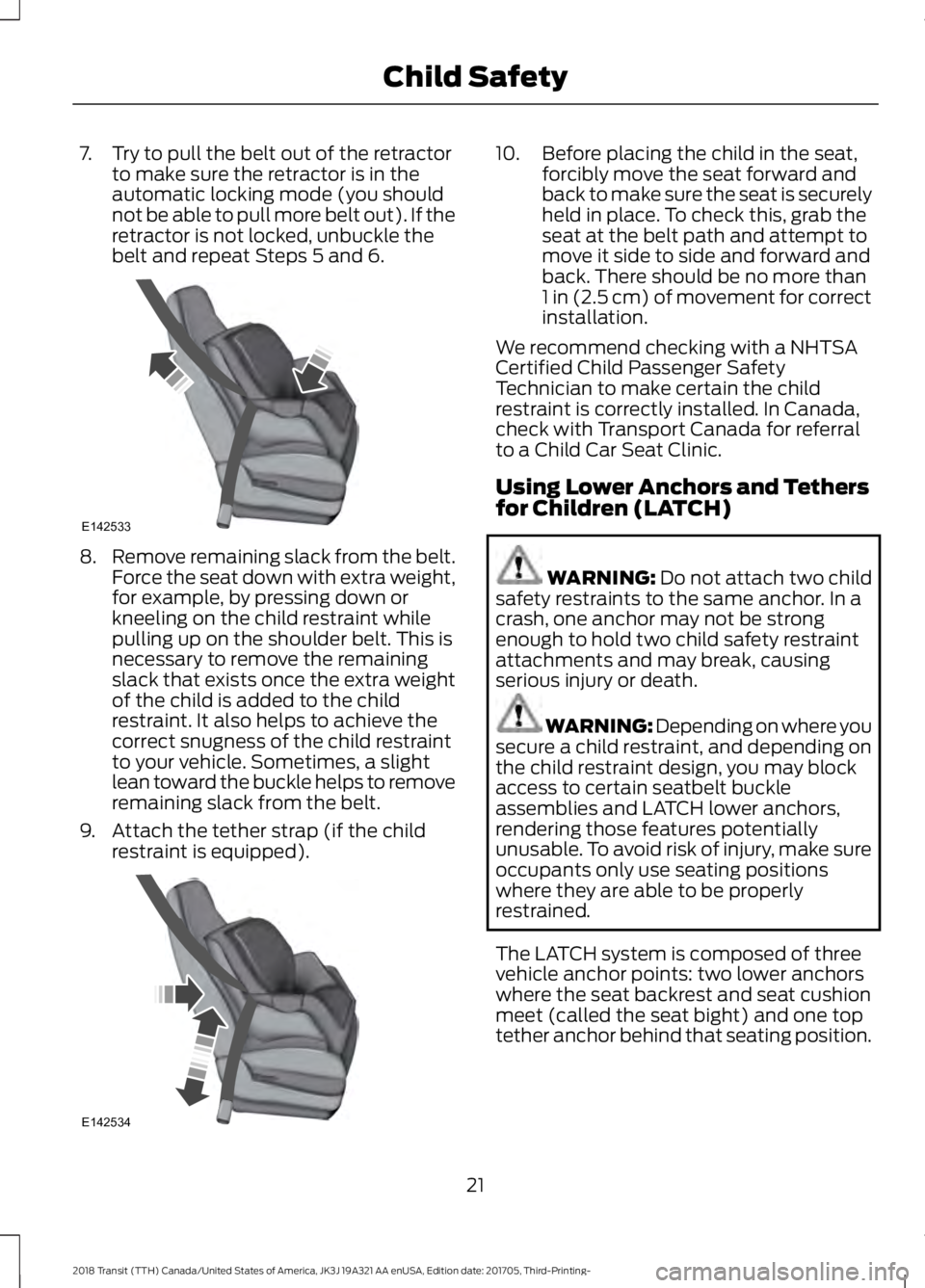
7. Try to pull the belt out of the retractor
to make sure the retractor is in the
automatic locking mode (you should
not be able to pull more belt out). If the
retractor is not locked, unbuckle the
belt and repeat Steps 5 and 6. 8.
Remove remaining slack from the belt.
Force the seat down with extra weight,
for example, by pressing down or
kneeling on the child restraint while
pulling up on the shoulder belt. This is
necessary to remove the remaining
slack that exists once the extra weight
of the child is added to the child
restraint. It also helps to achieve the
correct snugness of the child restraint
to your vehicle. Sometimes, a slight
lean toward the buckle helps to remove
remaining slack from the belt.
9. Attach the tether strap (if the child restraint is equipped). 10. Before placing the child in the seat,
forcibly move the seat forward and
back to make sure the seat is securely
held in place. To check this, grab the
seat at the belt path and attempt to
move it side to side and forward and
back. There should be no more than
1 in (2.5 cm) of movement for correct
installation.
We recommend checking with a NHTSA
Certified Child Passenger Safety
Technician to make certain the child
restraint is correctly installed. In Canada,
check with Transport Canada for referral
to a Child Car Seat Clinic.
Using Lower Anchors and Tethers
for Children (LATCH) WARNING: Do not attach two child
safety restraints to the same anchor. In a
crash, one anchor may not be strong
enough to hold two child safety restraint
attachments and may break, causing
serious injury or death. WARNING: Depending on where you
secure a child restraint, and depending on
the child restraint design, you may block
access to certain seatbelt buckle
assemblies and LATCH lower anchors,
rendering those features potentially
unusable. To avoid risk of injury, make sure
occupants only use seating positions
where they are able to be properly
restrained.
The LATCH system is composed of three
vehicle anchor points: two lower anchors
where the seat backrest and seat cushion
meet (called the seat bight) and one top
tether anchor behind that seating position.
21
2018 Transit (TTH) Canada/United States of America, JK3J 19A321 AA enUSA, Edition date: 201705, Third-Printing- Child SafetyE142533 E142534
Page 40 of 521
Recommendations for Attaching Child Safety Restraints for Children
Use Any Attachment Method as Indicated Below by X
Combined Weight ofChild and Child
Restraint
Restraint
Type Seatbelt
Only
Seatbelt
and LATCH (Lower
Anchors and Top Tether
Anchor)
Seatbelt
and Top Tether
Anchor
LATCH
(Lower
Anchors Only)
LATCH
(Lower
Anchors and Top Tether
Anchor)
X
X
Up to 65 lb
(29.5 kg)
Rear facing
child
restraint
X
Over
65 lb
(29.5 kg)
Rear facing
child
restraint
X
X
X
Up to
65 lb
(29.5 kg)
Forward
facingchild
restraint
X
X
Over
65 lb
(29.5 kg)
Forward
facingchild
restraint
Note: The child restraint must rest tightly
against the vehicle seat upon which it is
installed. It may be necessary to lift or
remove the head restraint. See Seats (page
113
).
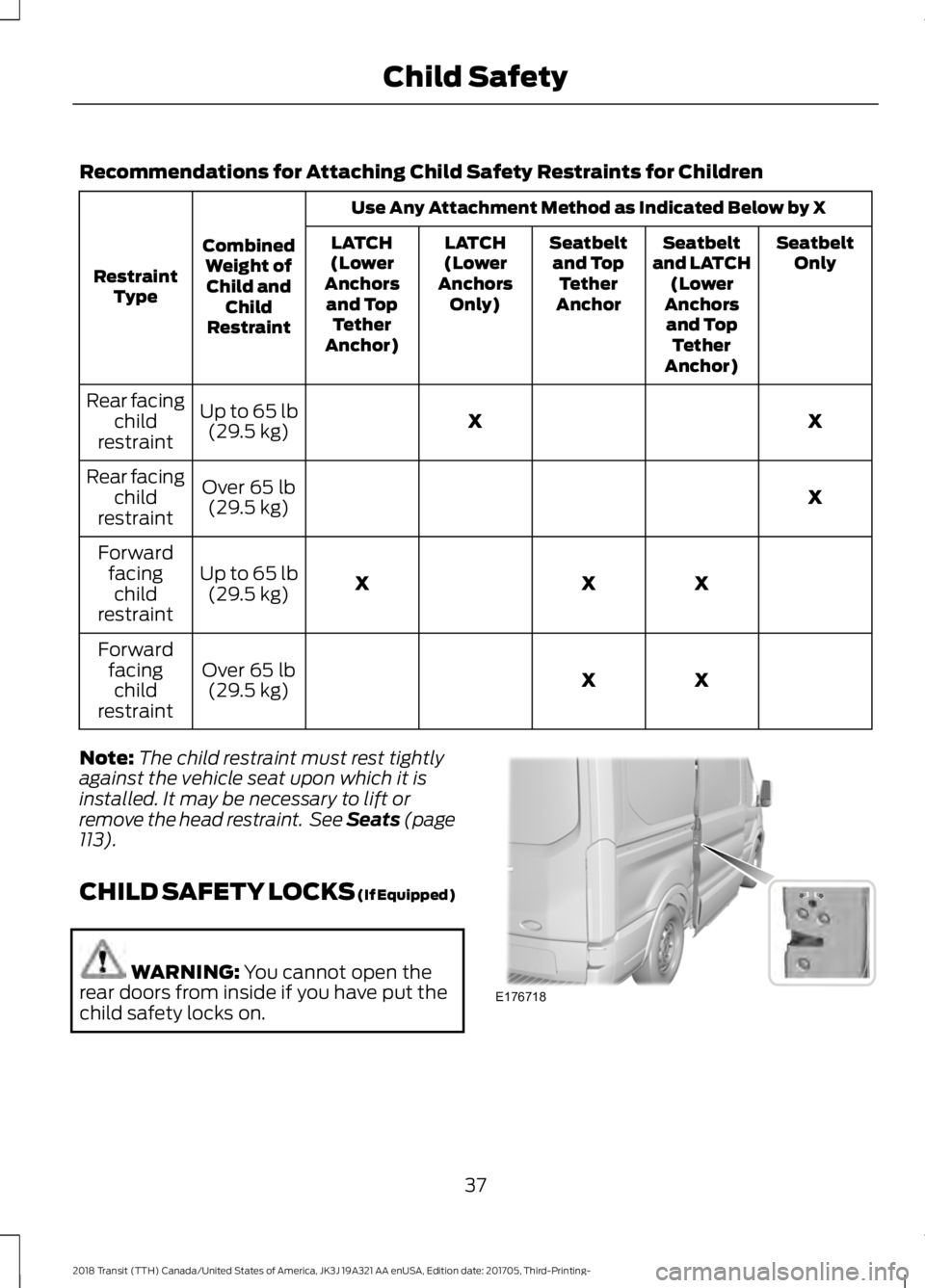
CHILD SAFETY LOCKS (If Equipped) WARNING:
You cannot open the
rear doors from inside if you have put the
child safety locks on. 37
2018 Transit (TTH) Canada/United States of America, JK3J 19A321 AA enUSA, Edition date: 201705, Third-Printing- Child SafetyE176718
Page 41 of 521

The child safety lock is on the rear side
door.
Left-Hand Side
Turn the key counterclockwise to lock and
clockwise to unlock.
Right-Hand Side
Turn the key clockwise to lock and
counterclockwise to unlock.
38
2018 Transit (TTH) Canada/United States of America, JK3J 19A321 AA enUSA, Edition date: 201705, Third-Printing- Child SafetyE259284
Page 42 of 521
PRINCIPLE OF OPERATION
WARNING: Always drive and ride
with the seatback upright and the lap belt
snug and low across the hips. WARNING:
To reduce the risk of
injury, make sure children sit where they
can be properly restrained. WARNING:
Never let a passenger
hold a child on his or her lap while your
vehicle is moving. The passenger cannot
protect the child from injury in a crash
which may result in serious injury or death. WARNING:
All occupants of the
vehicle, including the driver, should always
properly wear their seatbelts, even when
an airbag supplemental restraint system
is provided. Failure to properly wear your
seatbelt could seriously increase the risk
of injury or death. WARNING: It is extremely dangerous
to ride in a cargo area, inside or outside of
a vehicle. In a crash, people riding in these
areas are more likely to be seriously injured
or killed. Do not allow people to ride in any
area of your vehicle that is not equipped
with seats and seatbelts. Be sure everyone
in your vehicle is in a seat and using a
seatbelt properly. WARNING:
In a rollover crash, an
unbelted person is significantly more likely
to die than a person wearing a seatbelt. WARNING:
Each seating position in
your vehicle has a specific seatbelt
assembly which is made up of one buckle
and one tongue that are designed to be
used as a pair. 1) Use the shoulder belt on
the outside shoulder only. Never wear the
shoulder belt under the arm. 2) Never
swing the seatbelt around your neck over
the inside shoulder. 3) Never use a single
belt for more than one person. WARNING:
When possible, all
children 12 years old and under should be
properly restrained in a rear seating
position. Failure to follow this could
seriously increase the risk of injury or death. WARNING:
Seatbelts and seats can
become hot in a vehicle that has been
closed up in sunny weather; they could
burn a small child. Check seat covers and
buckles before you place a child anywhere
near them. WARNING:
Front and rear seat
occupants, including pregnant women,
should wear seatbelts for optimum
protection in an accident.
All seating positions in this vehicle have
lap and shoulder belts. All occupants of
the vehicle should always properly wear
their seatbelts, even when an airbag
supplemental restraint system is provided.
The seatbelt system consists of:
• Lap and shoulder seatbelts.
• Shoulder seatbelt with automatic
locking mode, (except driver seatbelt).
• Height adjuster at the front outboard
seating positions.
• Seatbelt pretensioner at the front
outboard seating positions.
39
2018 Transit (TTH) Canada/United States of America, JK3J 19A321 AA enUSA, Edition date: 201705, Third-Printing- Seatbelts
Page 44 of 521
Pregnant women should always wear their
seatbelt. The lap belt portion of a
combination lap and shoulder belt should
be positioned low across the hips below
the belly and worn as tight as comfort
allows. The shoulder belt should be
positioned to cross the middle of the
shoulder and the center of the chest.
Seatbelt Locking Modes
WARNING: After a crash, have a
qualified technician check all the seatbelts
to make sure the seatbelts including the
automatic locking retractor feature for
child restraints operate properly. We
recommend replacing any system that has
damage or does not operate properly.
Failure to do so can result in personal injury
or death in the event of a sudden stop or
another crash. WARNING:
You must replace the
seatbelt if the automatic locking retractor
or any other seatbelt function is not
operating correctly. Failure to replace the
seatbelt and retractor assembly could
increase the risk of injury in a crash.
All seatbelts in your vehicle are
combination lap and shoulder belts. The
driver seatbelt has the first type of locking
mode, and the front outermost passenger
and rear seat seatbelts have both types of
locking modes described as follows: Vehicle Sensitive Mode
This is the normal retractor mode which
allows free shoulder belt length
adjustment to your movements and
locking in response to vehicle movement.
For example, if you brake suddenly or turn
a corner sharply, or your vehicle receives
an impact of approximately
5 mph
(8 km/h) or more, the combination
seatbelts lock to help reduce forward
movement of the driver and passengers.
In addition, the retractor is designed to lock
if you pull the webbing out too quickly. If
the seatbelt retractor locks, slowly lower
the height adjuster to allow the seatbelt
to retract. If the retractor does not unlock,
pull the seatbelt out slowly then feed a
small length of webbing back toward the
stowed position. For rear seatbelts, recline
the rear seat backrest or push the seat
backrest cushion away from the seatbelt.
Feed a small length of webbing back
toward the stowed position.
Automatic Locking Mode
In this mode, the shoulder belt
automatically pre-locks. The seatbelt still
retracts to remove any slack in the
shoulder belt. The automatic locking mode
is not available on the driver seatbelt.
Using Automatic Locking Mode
You should use automatic locking mode
when a child safety seat, except a booster,
is on the front passenger seat or rear seat.
Children 12 years old and under should be
correctly restrained in a rear seating
position whenever possible. See
Child
Safety (page 17).
41
2018 Transit (TTH) Canada/United States of America, JK3J 19A321 AA enUSA, Edition date: 201705, Third-Printing- Seatbelts
Page 45 of 521
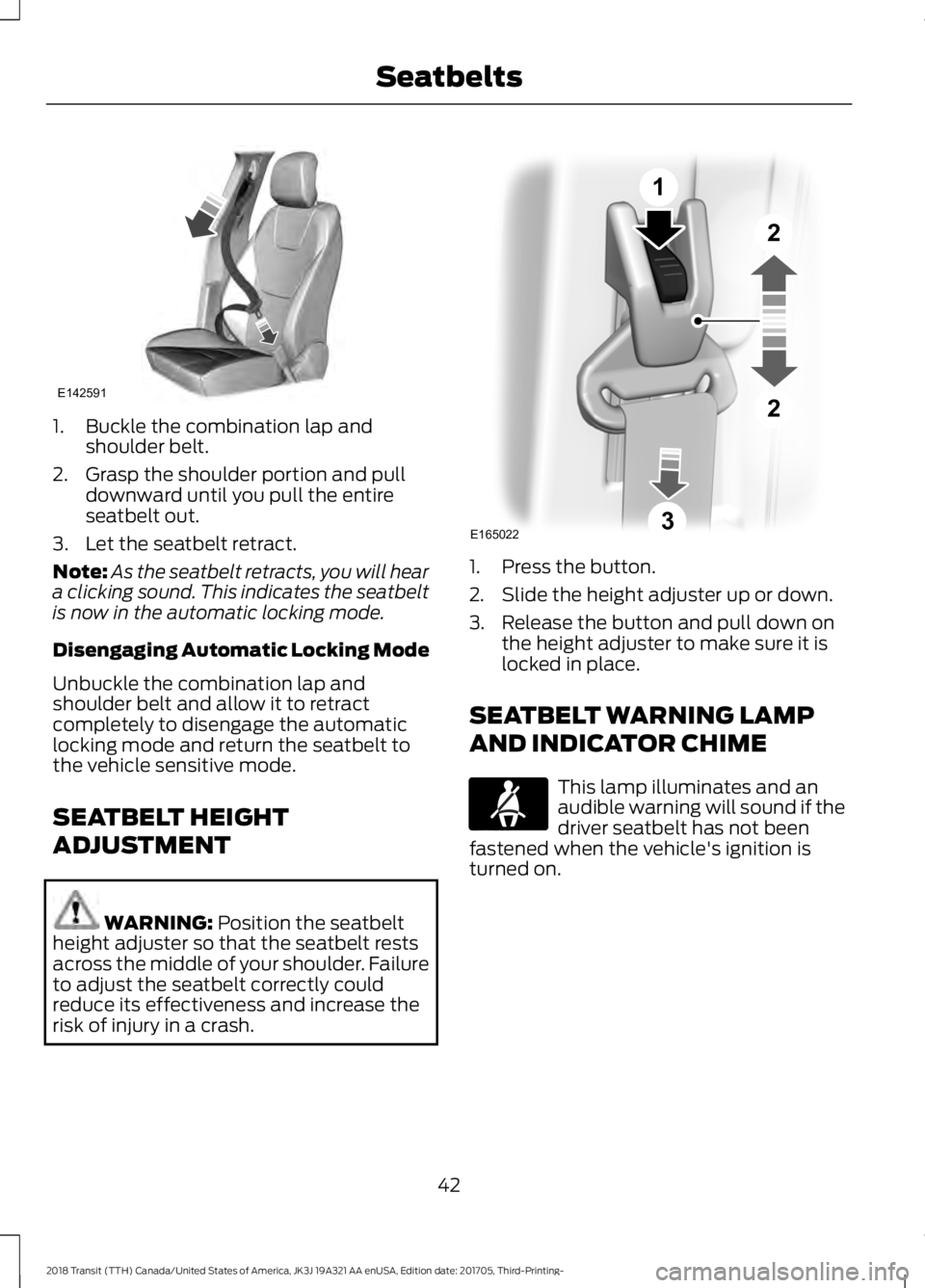
1. Buckle the combination lap and
shoulder belt.
2. Grasp the shoulder portion and pull downward until you pull the entire
seatbelt out.
3. Let the seatbelt retract.
Note: As the seatbelt retracts, you will hear
a clicking sound. This indicates the seatbelt
is now in the automatic locking mode.
Disengaging Automatic Locking Mode
Unbuckle the combination lap and
shoulder belt and allow it to retract
completely to disengage the automatic
locking mode and return the seatbelt to
the vehicle sensitive mode.
SEATBELT HEIGHT
ADJUSTMENT WARNING: Position the seatbelt
height adjuster so that the seatbelt rests
across the middle of your shoulder. Failure
to adjust the seatbelt correctly could
reduce its effectiveness and increase the
risk of injury in a crash. 1. Press the button.
2. Slide the height adjuster up or down.
3. Release the button and pull down on
the height adjuster to make sure it is
locked in place.
SEATBELT WARNING LAMP
AND INDICATOR CHIME This lamp illuminates and an
audible warning will sound if the
driver seatbelt has not been
fastened when the vehicle's ignition is
turned on.
42
2018 Transit (TTH) Canada/United States of America, JK3J 19A321 AA enUSA, Edition date: 201705, Third-Printing- SeatbeltsE142591 E165022
1
2
2
3 E71880
Page 62 of 521

PRINCIPLE OF OPERATION
The remote control allows you to:
•
remotely lock or unlock the vehicle
doors
• unlock the doors without actively using
a key or remote control (intelligent
access only)
• remotely open the power liftgate (if
equipped)
• remotely start or stop the engine (if
equipped)
• arm and disarm the anti-theft system
• activate the panic alarm.
GENERAL INFORMATION ON
RADIO FREQUENCIES
This device complies with Part 15 of the
FCC Rules and with Licence exempt RSS
Standards of Industry Canada. Operation
is subject to the following two conditions:
• This device may not cause harmful
interference, and
• This device must accept any
interference received, including
interference that may cause undesired
operation. WARNING: Changes or
modifications not expressively approved
by the party responsible for compliance
could void the user's authority to operate
the equipment. The term "IC:" before the
radio certification number only signifies
that Industry Canada technical
specifications were met. The typical operating range for your
transmitter is approximately
33 ft (10 m).
Vehicles with the remote start feature will
have a greater range. One of the following
could cause a decrease in operating range:
• Weather conditions.
• Nearby radio towers.
• Structures around the vehicle.
• Other vehicles parked next to your
vehicle.
Other short distance radio transmissions,
for example amateur radios, medical
equipment, wireless headphones, remote
controls and alarm systems can also use
the radio frequency used by your remote
control. If the frequencies are jammed, you
will not be able to use your remote control.
You can lock and unlock the doors with the
key.
Note: Make sure to lock your vehicle before
leaving it unattended.
Note: If you are in range, the remote control
will operate if you press any button
unintentionally.
Note: The remote control contains sensitive
electrical components. Exposure to moisture
or impact may cause permanent damage.
59
2018 Transit (TTH) Canada/United States of America, JK3J 19A321 AA enUSA, Edition date: 201705, Third-Printing- Keys and Remote Controls
Page 63 of 521

REMOTE CONTROL - VEHICLES
WITHOUT: PASSIVE ANTI-
THEFT SYSTEM (PATS)
Integrated Keyhead Transmitter (If
Equipped)
Use the key blade to start your vehicle and
unlock or lock the driver door from outside
your vehicle.
Note:
Your vehicle keys came with a
security label that provides important key
cut information. Keep the label in a safe
place for future reference.
Programming a New Remote
Control
Read and understand the entire procedure
before you begin. Make sure all new and existing remote
controls are present before beginning this
procedure. This procedure erases all
existing programmed remote controls.
Reprogram all the existing remote controls
during this procedure.
1.
Unlock the vehicle with the power door
unlock control.
2. Switch the ignition from off to on eight
times within six seconds, finishing in
the off position. A tone sounds to
indicate that it is now possible to
program a remote control.
3. Press and hold any button on the remote control within 10 seconds. A
tone sounds as confirmation.
4. Repeat step 3 within 10 seconds for each remote control.
Note: Programming ends when you switch
the ignition on, or after 10 seconds.
If you have successfully programmed the
remote control, it operates the remote
entry system.
If programming was unsuccessful, wait 10
seconds and repeat the process.
Note: You can program a maximum of eight
remote controls to your vehicle.
Changing the Remote Control
Battery
The remote control uses one coin-type
three-volt lithium battery CR2032 or
equivalent.
Note: Refer to local regulations when
disposing of remote control batteries.
Note: Do not wipe off any grease on the
battery terminals or on the back surface of
the circuit board.
Note: Replacing the battery does not erase
the programmed remote control from your
vehicle. The remote control should operate
normally.
60
2018 Transit (TTH) Canada/United States of America, JK3J 19A321 AA enUSA, Edition date: 201705, Third-Printing- Keys and Remote ControlsE177585 E138615