Page 312 of 696

ENGINE START/STOP Button Functions — With Driv-
er ’s Foot OFF The Brake Pedal (In PARK Or NEUTRAL
Position)
The ENGINE START/STOP button operates similar to an
ignition switch. It has three positions, OFF, ACC, and RUN.
To change the ignition positions without starting the ve-
hicle and use the accessories follow these steps:
•Starting with the ignition in the OFF position,
• Push the ENGINE START/STOP button once to place
the ignition to the ACC position (instrument cluster will
display “ACC”),
• Push the ENGINE START/STOP button a second time to
place the ignition to the RUN position (instrument
cluster will display “ON/RUN”),
• Push the ENGINE START/STOP button a third time to
return the ignition to the OFF position (instrument
cluster will display “OFF”).
Cold Weather Operation (Below –22°F Or 30°C)
To ensure reliable starting at these temperatures, use of an
externally powered electric engine block heater (available
from your authorized dealer) is recommended.
After Starting — Warming Up The Engine
The idle speed is controlled automatically and it will
decrease as the engine warms up.
If Engine Fails To Start
WARNING!
•Never pour fuel or other flammable liquid into the
throttle body air inlet opening in an attempt to start
the vehicle. This could result in flash fire causing
serious personal injury.
• Do not attempt to push or tow your vehicle to get it
started. Vehicles equipped with an automatic trans-
mission cannot be started this way. Unburned fuel
could enter the catalytic converter and once the
engine has started, ignite and damage the converter
and vehicle.
• If the vehicle has a discharged battery, booster cables
may be used to obtain a start from a booster battery
or the battery in another vehicle. This type of start
can be dangerous if done improperly. Refer to “Jump
Starting Procedure” in “In Case Of Emergency” for
further information.
310 STARTING AND OPERATING
Page 530 of 696

Fuel Economy
Underinflated tires will increase tire rolling resistance
resulting in higher fuel consumption.
Tread Wear
Improper cold tire inflation pressures can cause abnormal
wear patterns and reduced tread life, resulting in the need
for earlier tire replacement.
Ride Comfort And Vehicle Stability
Proper tire inflation contributes to a comfortable ride.
Over-inflation produces a jarring and uncomfortable ride.
Tire Inflation Pressures
The proper cold tire inflation pressure is listed on the
driver’s side B-Pillar or rear edge of the driver’s side door.
At least once a month:
•Check and adjust tire pressure with a good quality
pocket-type pressure gauge. Do not make a visual
judgement when determining proper inflation. Tires
may look properly inflated even when they are under-
inflated.
• Inspect tires for signs of tire wear or visible damage.
CAUTION!
After inspecting or adjusting the tire pressure, always
reinstall the valve stem cap. This will prevent moisture
and dirt from entering the valve stem, which could
damage the valve stem.
Inflation pressures specified on the placard are always
“cold tire inflation pressure”. Cold tire inflation pressure is
defined as the tire pressure after the vehicle has not been
driven for at least three hours, or driven less than 1 mile
(1.6 km) after sitting for a minimum of three hours. The
cold tire inflation pressure must not exceed the maximum
inflation pressure molded into the tire sidewall.
Check tire pressures more often if subject to a wide range
of outdoor temperatures, as tire pressures vary with tem-
perature changes.
Tire pressures change by approximately 1 psi (7 kPa) per
12°F (7°C) of air temperature change. Keep this in mind
when checking tire pressure inside a garage, especially in
the Winter.
Example: If garage temperature = 68°F (20°C) and the
outside temperature = 32°F (0°C) then the cold tire inflation
528 SERVICING AND MAINTENANCE
Page 681 of 696
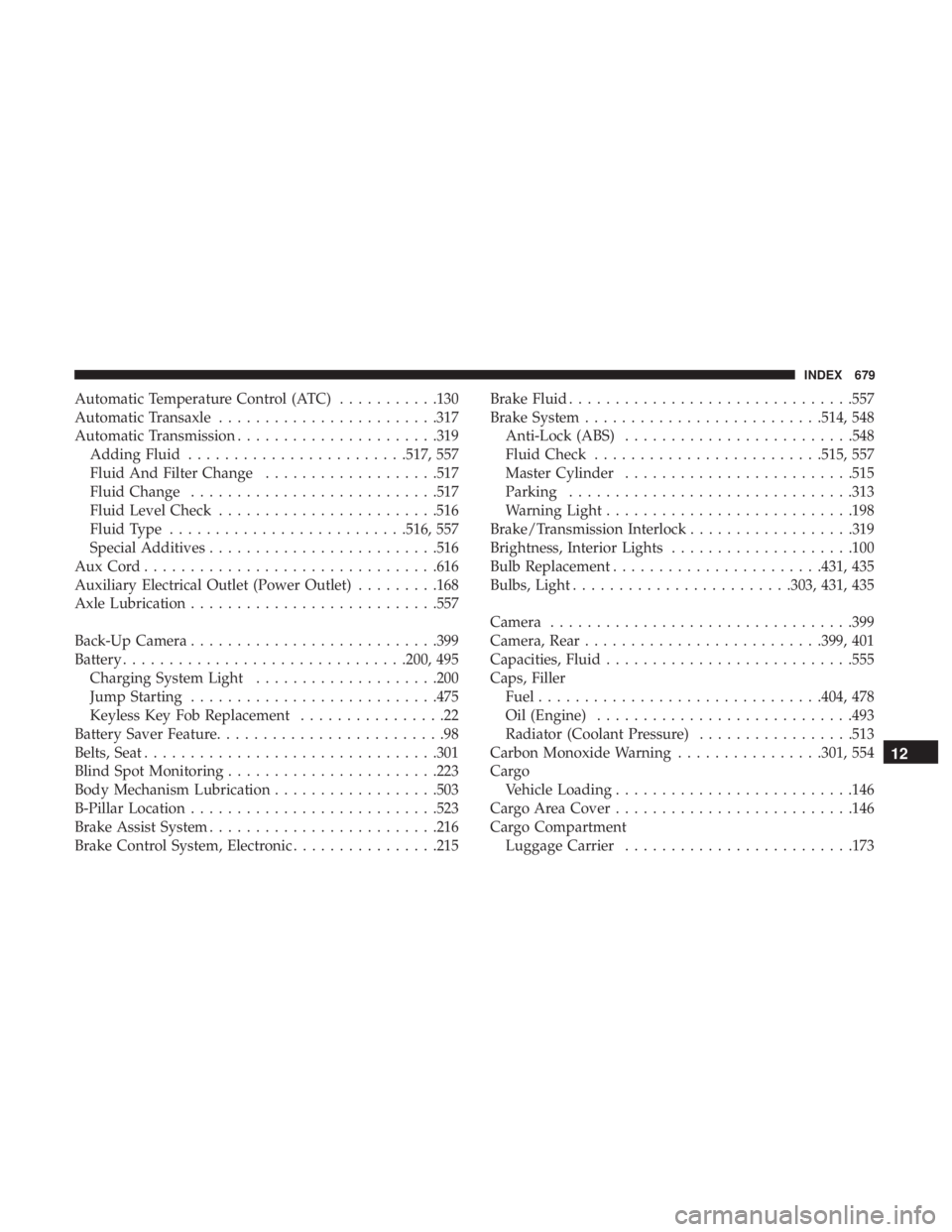
Automatic Temperature Control (ATC)...........130
Automatic Transaxle ........................317
Automatic Transmission ..................... .319
Adding Fluid ........................517, 557
Fluid And Filter Change ...................517
Fluid Change .......................... .517
Fluid Level Check ........................516
Fluid Type ..........................516, 557
Special Additives ........................ .516
AuxCord............................... .616
Auxiliary Electrical Outlet (Power Outlet) .........168
Axle Lubrication .......................... .557
Back-Up Camera .......................... .399
Battery ...............................200, 495
Charging System Light ....................200
Jump Starting .......................... .475
Keyless Key Fob Replacement ................22
Battery Saver Feature .........................98
Belts, Seat ............................... .301
Blind Spot Monitoring .......................223
Body Mechanism Lubrication ..................503
B-Pillar Location .......................... .523
Brake Assist System ........................ .216
Brake Control System, Electronic ................215Brake Fluid
...............................557
Brake System ..........................514, 548
Anti-Lock (ABS) ........................ .548
Fluid Check ........................ .515, 557
Master Cylinder ........................ .515
Parking ...............................313
Warning Light .......................... .198
Brake/Transmission Interlock ..................319
Brightness, Interior Lights ....................100
Bulb Replacement .......................431, 435
Bulbs, Light ....................... .303, 431, 435
Camera .................................399
Camera, Rear..........................399,
401
Capacities, Fluid .......................... .555
Caps, Filler Fuel ...............................404, 478
Oil (Engine) ............................493
Radiator (Coolant Pressure) .................513
Carbon Monoxide Warning ................301, 554
Cargo Vehicle Loading ..........................146
Cargo Area Cover ..........................146
Cargo Compartment Luggage Carrier ........................ .173
12
INDEX 679