Page 380 of 614
HAZARD WARNING FLASHERS
The Hazard Warning flasher switch is located in the lower
center area of the instrument panel.Push the switch to turn on the Hazard Warning
flasher. When the switch is activated, all direc-
tional turn signals will flash on and off to warn
oncoming traffic of an emergency. Push the
switch a second time to turn off the Hazard Warning
flashers.
This is an emergency warning system and it should not be
used when the vehicle is in motion. Use it when your
vehicle is disabled and it is creating a safety hazard for
other motorists.
When you must leave the vehicle to seek assistance, the
Hazard Warning flashers will continue to operate even
though the ignition is placed in the OFF position.
NOTE: With extended use, the Hazard Warning flashers
may wear down your battery.
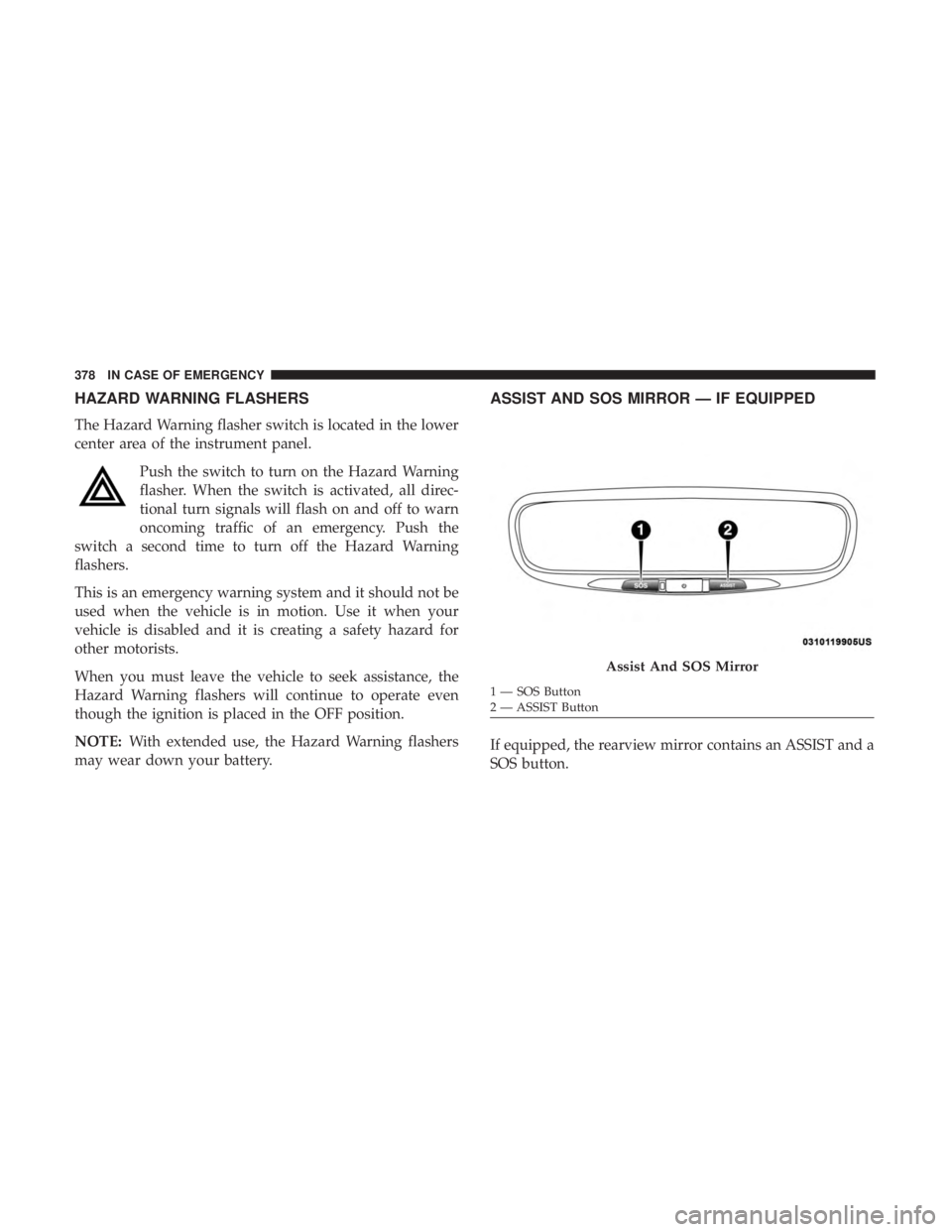
ASSIST AND SOS MIRROR — IF EQUIPPED
If equipped, the rearview mirror contains an ASSIST and a
SOS button.
Assist And SOS Mirror
1 — SOS Button
2 — ASSIST Button
378 IN CASE OF EMERGENCY
Page 383 of 614
WARNING!(Continued)
Emergency Services Agent. All occupants should exit
the vehicle immediately and move to a safe location.
•
Never place anything on or near the vehicle’s operable
network and GPS antennas. You could prevent oper-
able network and GPS signal reception, which can
prevent your vehicle from placing an emergency call.
An operable network and GPS signal reception is
required for the SOS Call system to function properly.
• The SOS Call system is embedded into the vehicle’s
electrical system. Do not add aftermarket electrical
equipment to the vehicle’s electrical system. This
may prevent your vehicle from sending a signal to
initiate an emergency call. To avoid interference that
can cause the SOS Call system to fail, never add
aftermarket equipment (e.g., two-way mobile radio,
CB radio, data recorder, etc.) to your vehicle’s electri-
cal system or modify the antennas on your vehicle. IF
YOUR VEHICLE LOSES BATTERY POWER FOR
ANY REASON (INCLUDING DURING OR AFTER
AN ACCIDENT), THE UCONNECT FEATURES,
APPS AND SERVICES, AMONG OTHERS, WILL
NOT OPERATE.
(Continued)
WARNING! (Continued)
•Modifications to any part of the SOS Call system
could cause the air bag system to fail when you need
it. You could be injured if the air bag system is not
there to help protect you.
SOS Call System Limitations
Vehicles sold in Mexico DO NOThave SOS Call system
capabilities.
SOS or other emergency line operators in Mexico may not
answer or respond to SOS system calls.
If the SOS Call system detects a malfunction, any of the
following may occur at the time the malfunction is de-
tected, and at the beginning of each ignition cycle:
• The Rearview Mirror light located between the ASSIST
and SOS buttons will continuously be illuminated red.
• The Device Screen will display the following message
“Vehicle device requires service. Please contact your
dealer.”
• An In-Vehicle Audio message will state “Vehicle device
requires service. Please contact your dealer.”
7
IN CASE OF EMERGENCY 381
Page 384 of 614
WARNING!
•Ignoring the Rearview Mirror light could mean you
will not have SOS Call services. If the Rearview
Mirror light is illuminated, have your authorized
dealer service the SOS Call system immediately.
• The Occupant Restraint Control module turns on the
air bag Warning Light on the instrument panel if a
malfunction in any part of the system is detected. If
the Air Bag Warning Light is illuminated, have your
authorized dealer service the Occupant Restraint
Control system immediately.
Even if the SOS Call system is fully functional, factors
beyond FCA US LLC’s control may prevent or stop the SOS
Call system operation. These include, but are not limited
to, the following factors:
• Delayed accessories mode is active.
• The ignition is in the OFF position.
• The vehicle’s electrical systems are not intact.
• The SOS Call system software and/or hardware are
damaged during a crash. •
The vehicle battery loses power or becomes discon-
nected during a vehicle crash.
• LTE (voice/data) or 4G (data) network and/or Global
Positioning Satellite signals are unavailable or ob-
structed.
• Equipment malfunction at the SOS operator facility.
• Operator error by the SOS operator.
• LTE (voice/data) or 4G (data) network congestion.
• Weather.
• Buildings, structures, geographic terrain, or tunnels.
WARNING!
ALWAYS obey traffic laws and pay attention to the
road. ALWAYS drive safely with your hands on the
steering wheel. You have full responsibility and as-
sume all risks related to the use of the features and
applications in this vehicle. Only use the features and
applications when it is safe to do so. Failure to do so
may result in an accident involving serious injury or
death.
382 IN CASE OF EMERGENCY
Page 393 of 614
General Information
The fuses protect electrical systems against excessive cur-
rent.
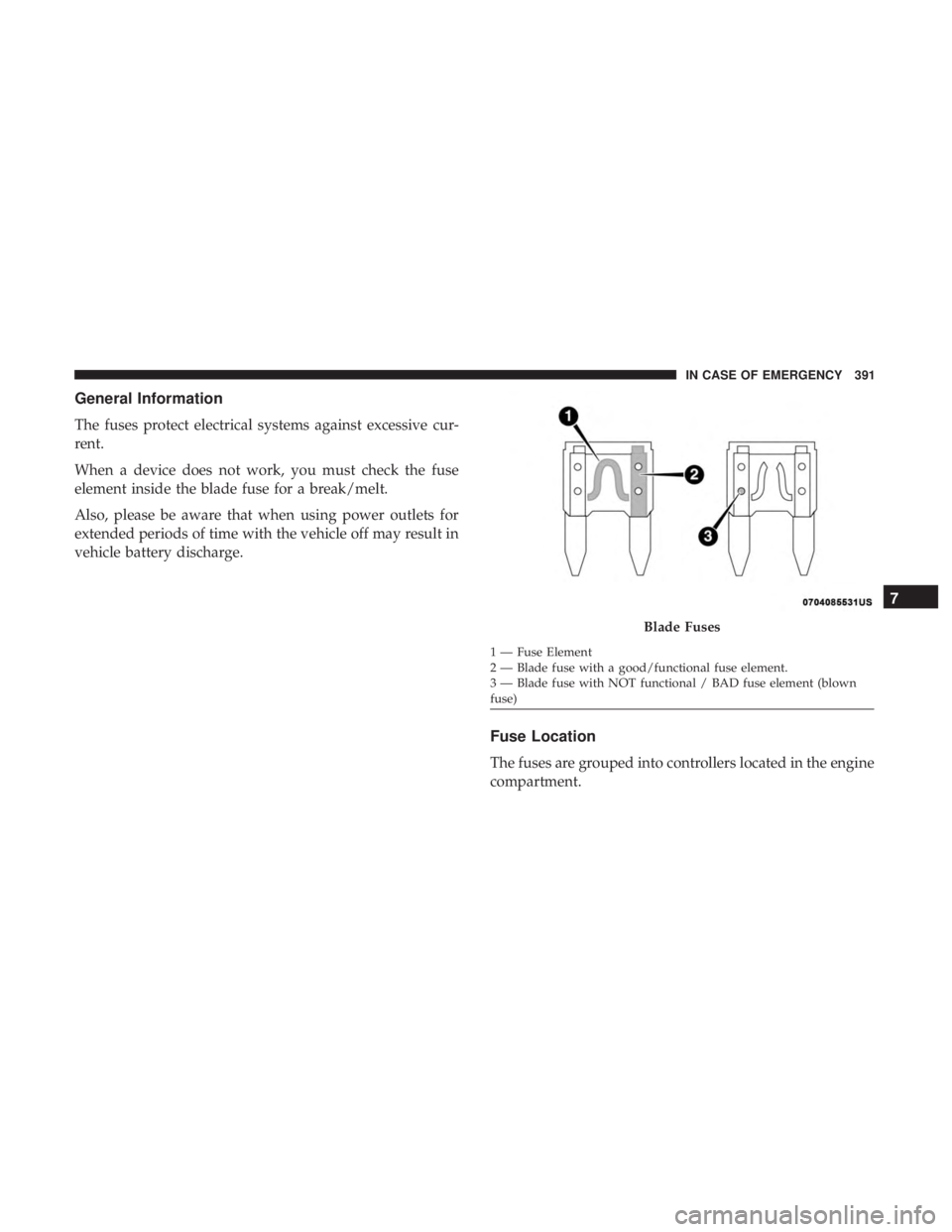
When a device does not work, you must check the fuse
element inside the blade fuse for a break/melt.
Also, please be aware that when using power outlets for
extended periods of time with the vehicle off may result in
vehicle battery discharge.
Fuse Location
The fuses are grouped into controllers located in the engine
compartment.
Blade Fuses
1 — Fuse Element
2 — Blade fuse with a good/functional fuse element.
3 — Blade fuse with NOT functional / BAD fuse element (blown
fuse)
7
IN CASE OF EMERGENCY 391
Page 394 of 614
Underhood Fuses
The Power Distribution Center is located in the engine
compartment near the battery. This center contains car-
tridge fuses, mini-fuses, micro-fuses, circuit breakers and
relays. A label that identifies each component is printed on
the inside of the cover.
Before any procedure is done on the PDC, make sure
engine is turned off.
Remove the cover by unlatching the two locks located at
each side of the PDC cover, avoid the usage of screw
drivers or any other tool to remove the cover, since they
may apply excessive force and result on a broken/
damaged part.After service is done, secure the cover with its two locks.
Cavity
Cartridge Fuse Blade FuseDescription
F06 –15 Amp Blue Low Temp Active Pump
F07 –25 Amp Clear Ignition Coil/Fuel Injector
F08 –25 Amp Clear Amplifier / ANC
F09 ––Not Used
F10 –15 Amp Blue High Temp Aux Pump &
HV Electric Coolant Htr Enable
Power Distribution Center
392 IN CASE OF EMERGENCY
Page 395 of 614
CavityCartridge Fuse Blade FuseDescription
F11 –15 Amp Blue ELCM / FTIV
F12 –5 Amp Tan Battery Sensor (IBS)
F13 ––Not Used
F14A –10 Amp Red Media Hub 1, 2, 3
F14B – Pwr Lumbar Switch
F15 40 Amp Green –CBC / Power Locks
F16 –20 Amp Yellow ECM
F17 ––Not Used
F18 40 Amp Green –CBC Feed #4 (Exterior
Lights #1)
F19 ––Not Used
F20 –10 Amp RedLow Temp Passive Pump
F21 20 Amp Blue –PIM - Park PAWL Motor
F22 ––Not Used
F23 ––Not used
F24 –20 Amp Yellow RR Wiper
F25A –10 Amp Red Handsfree (Lt & Rt Rear
Door Release Module)
F25B – Active Grill Shutter
F26 40 Amp Green –Front HVAC Blower Motor
7
IN CASE OF EMERGENCY 393
Page 420 of 614

5. Pull the bottle away from the Compressor.
NOTE:
•For sealant bottle installation, follow these steps reverse
order.
• Replacement sealant bottles are available at authorized
service centers.JUMP STARTING
The vehicle requires its 12V battery power to �turn-on�the
vehicle’s high voltage battery. The high voltage battery is
used to charge the 12V battery, provide electric vehicle
operation, and to start the vehicle’s gas engine. If the 12V
battery has been discharged, the vehicle can be �jump
started� using a set of jumper cables and a battery in
another vehicle or by using a portable battery booster pack.
If the vehicle’s high voltage battery has also been dis-
charged, it will need to be recharged before the vehicle can
be started:
• If the vehicle can be connected to a Level 1 or Level 2
charger where it is currently parked, the vehicle will still
require a �jump start� to allow the vehicle to begin the
battery charging process. Once the vehicle charging has
begun (indicated by the charge status indicator on top
the vehicle’s instrument panel), the jumper cables can be
removed from the vehicle jump posts.
• If the vehicle cannot be connected to a Level 1 or Level
2 charger where it is currently parked, the vehicle can be
moved by connecting 12V power to the vehicle’s �jump
posts� and then shifting the transmission from PARK
into NEUTRAL. Power provided by the jumper cables
will also allow the electric park brake to be released.
Remove The Bottle
418 IN CASE OF EMERGENCY
Page 421 of 614

Carefully move the vehicle to a Level 1 or Level 2 charge
location. While the vehicle is being moved, the external
12V power must remained connected to the vehicle
jump posts.
NOTE: Be careful when moving the vehicle - ensure that
control of the vehicle is maintained. Also, ensure that
vehicle is secured to prevent unintentional movement
during and after moving the vehicle. If the external 12V
power becomes disconnected from the vehicle jump posts
or there is an interruption of the 12V power while moving
the vehicle, the vehicle’s transmission may engage PARK.
When the vehicle is at the charging location, shift the
transmission back to PARK, apply the electric park brake,
and start the high voltage battery charging. Once the
vehicle has been secured against unintentional movement
and high voltage battery charging has been initiated, the
jumper cables can be removed from the vehicle jump posts. Jump starting can be dangerous if done improperly so
please follow the procedures in this section carefully.
NOTE:
When using a portable battery booster pack, follow
the manufacturer ’s operating instructions and precautions.
WARNING!
Do not attempt jump starting if the battery is frozen. It
could rupture or explode and cause personal injury.
CAUTION!
Do not use a portable battery booster pack or any other
booster source with a system voltage greater than 12
Volts or damage to the battery, alternator or electrical
system may occur.
7
IN CASE OF EMERGENCY 419