2018 CHRYSLER PACIFICA HYBRID flat tire
[x] Cancel search: flat tirePage 477 of 614

These indicators are molded into the bottom of the tread
grooves. They will appear as bands when the tread depth
becomes a 1/16 of an inch (1.6 mm). When the tread is
worn to the tread wear indicators, the tire should be
replaced. Refer to “Replacement Tires” in this section for
further information.
Life Of Tire
The service life of a tire is dependent upon varying factors
including, but not limited to:
•Driving style.
• Tire pressure - Improper cold tire inflation pressures can
cause uneven wear patterns to develop across the tire
tread. These abnormal wear patterns will reduce tread
life, resulting in the need for earlier tire replacement.
• Distance driven.
• Performance tires, tires with a speed rating of V or
higher, and Summer tires typically have a reduced tread
life. Rotation of these tires per the vehicle scheduled
maintenance is highly recommended.
WARNING!
Tires and the spare tire should be replaced after six
years, regardless of the remaining tread. Failure to
follow this warning can result in sudden tire failure.
You could lose control and have a collision resulting in
serious injury or death.
Tire Tread
1—WornTire
2—NewTire
8
SERVICING AND MAINTENANCE 475
Page 478 of 614
Keep dismounted tires in a cool, dry place with as little
exposure to light as possible. Protect tires from contact with
oil, grease, and gasoline.
Replacement Tires
The tires on your new vehicle provide a balance of many
characteristics. They should be inspected regularly for
wear and correct cold tire inflation pressures. The manu-
facturer strongly recommends that you use tires equivalent
to the originals in size, quality and performance when
replacement is needed. Refer to the paragraph on “Tread
Wear Indicators” in this section. Refer to the Tire and
Loading Information placard or the Vehicle Certification
Label for the size designation of your tire. The Load Index
and Speed Symbol for your tire will be found on the
original equipment tire sidewall.
See the Tire Sizing Chart example found in the “Tire Safety
Information” section of this manual for more information
relating to the Load Index and Speed Symbol of a tire.
It is recommended to replace the two front tires or two rear
tires as a pair. Replacing just one tire can seriously affect
your vehicle’s handling. If you ever replace a wheel, make
sure that the wheel’s specifications match those of the
original wheels.It is recommended you contact an authorized tire dealer or
original equipment dealer with any questions you may
have on tire specifications or capability. Failure to use
equivalent replacement tires may adversely affect the
safety, handling, and ride of your vehicle.
WARNING!
•
Do not use a tire, wheel size, load rating, or speed
rating other than that specified for your vehicle.
Some combinations of unapproved tires and wheels
may change suspension dimensions and perfor-
mance characteristics, resulting in changes to steer-
ing, handling, and braking of your vehicle. This can
cause unpredictable handling and stress to steering
and suspension components. You could lose control
and have a collision resulting in serious injury or
death. Use only the tire and wheel sizes with load
ratings approved for your vehicle.
• Never use a tire with a smaller load index or capacity,
other than what was originally equipped on your
vehicle. Using a tire with a smaller load index could
result in tire overloading and failure. You could lose
control and have a collision.
(Continued)
476 SERVICING AND MAINTENANCE
Page 480 of 614
Snow Tires
Some areas of the country require the use of snow tires
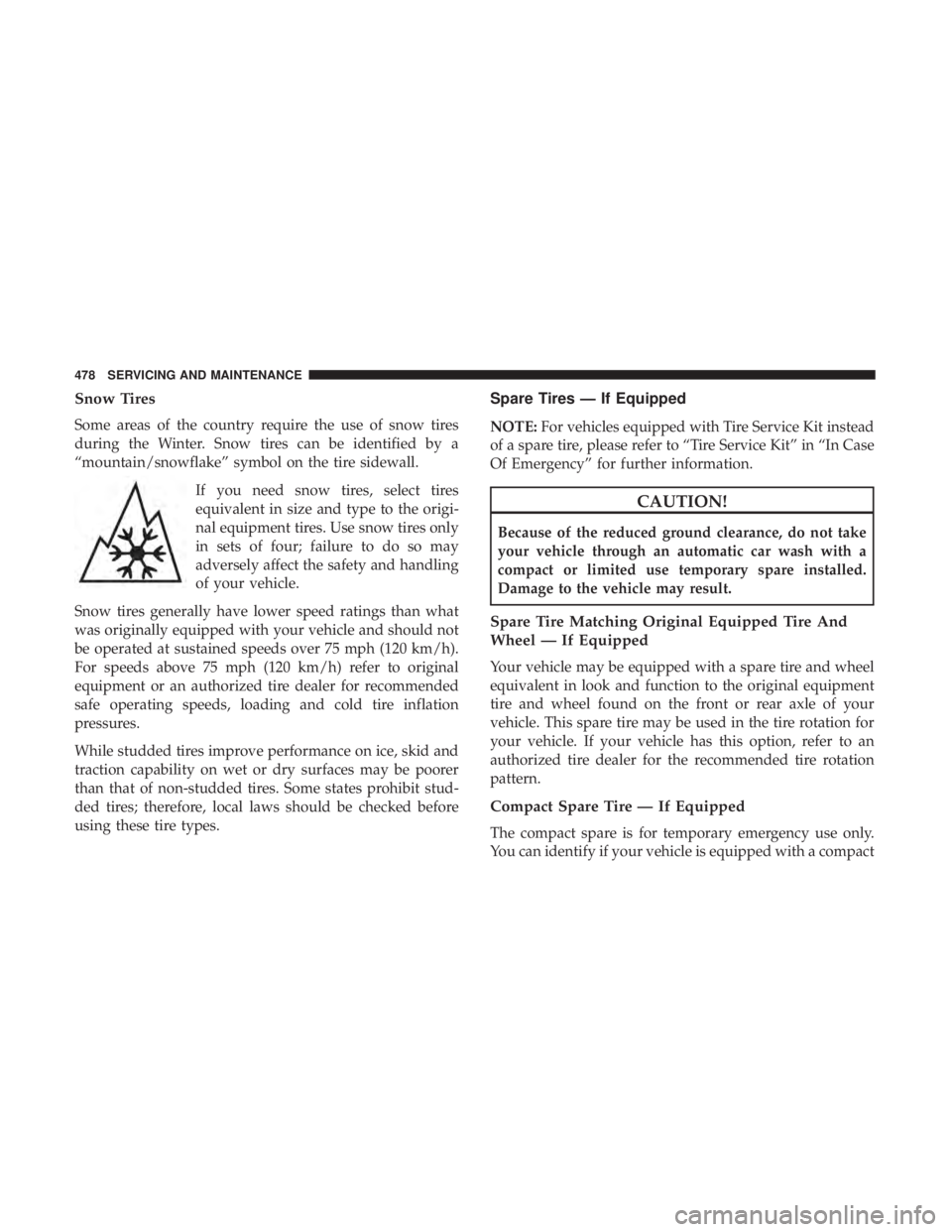
during the Winter. Snow tires can be identified by a
“mountain/snowflake” symbol on the tire sidewall.If you need snow tires, select tires
equivalent in size and type to the origi-
nal equipment tires. Use snow tires only
in sets of four; failure to do so may
adversely affect the safety and handling
of your vehicle.
Snow tires generally have lower speed ratings than what
was originally equipped with your vehicle and should not
be operated at sustained speeds over 75 mph (120 km/h).
For speeds above 75 mph (120 km/h) refer to original
equipment or an authorized tire dealer for recommended
safe operating speeds, loading and cold tire inflation
pressures.
While studded tires improve performance on ice, skid and
traction capability on wet or dry surfaces may be poorer
than that of non-studded tires. Some states prohibit stud-
ded tires; therefore, local laws should be checked before
using these tire types.
Spare Tires — If Equipped
NOTE: For vehicles equipped with Tire Service Kit instead
of a spare tire, please refer to “Tire Service Kit” in “In Case
Of Emergency” for further information.
CAUTION!
Because of the reduced ground clearance, do not take
your vehicle through an automatic car wash with a
compact or limited use temporary spare installed.
Damage to the vehicle may result.
Spare Tire Matching Original Equipped Tire And
Wheel — If Equipped
Your vehicle may be equipped with a spare tire and wheel
equivalent in look and function to the original equipment
tire and wheel found on the front or rear axle of your
vehicle. This spare tire may be used in the tire rotation for
your vehicle. If your vehicle has this option, refer to an
authorized tire dealer for the recommended tire rotation
pattern.
Compact Spare Tire — If Equipped
The compact spare is for temporary emergency use only.
You can identify if your vehicle is equipped with a compact
478 SERVICING AND MAINTENANCE
Page 481 of 614
spare by looking at the spare tire description on the Tire
and Loading Information Placard located on the driver ’s
side door opening or on the sidewall of the tire. Compact
spare tire descriptions begin with the letter “T” or “S”
preceding the size designation. Example: T145/80D18
103M.
T, S = Temporary Spare Tire
Since this tire has limited tread life, the original equipment
tire should be repaired (or replaced) and reinstalled on
your vehicle at the first opportunity.
Do not install a wheel cover or attempt to mount a
conventional tire on the compact spare wheel, since the
wheel is designed specifically for the compact spare tire.
Do not install more than one compact spare tire and wheel
on the vehicle at any given time.
WARNING!
Compact and collapsible spares are for temporary
emergency use only. With these spares, do not drive
more than 50 mph (80 km/h). Temporary use spares
have limited tread life. When the tread is worn to the
tread wear indicators, the temporary use spare tire
(Continued)
WARNING!(Continued)
needs to be replaced. Be sure to follow the warnings,
which apply to your spare. Failure to do so could result
in spare tire failure and loss of vehicle control.
Collapsible Spare Tire — If Equipped
The collapsible spare is for temporary emergency use only.
You can identify if your vehicle is equipped with a collaps-
ible spare by looking at the spare tire description on the
Tire and Loading Information Placard located on the
driver ’s side door opening or on the sidewall of the tire.
Collapsible spare tire description example: 165/80-17 101P.
Since this tire has limited tread life, the original equipment
tire should be repaired (or replaced) and reinstalled on
your vehicle at the first opportunity.
Inflate collapsible tire only after the wheel is properly
installed to the vehicle. Inflate the collapsible tire using the
electric air pump before lowering the vehicle.
Do not install a wheel cover or attempt to mount a
conventional tire on the collapsible spare wheel, since the
wheel is designed specifically for the collapsible spare tire.
8
SERVICING AND MAINTENANCE 479
Page 482 of 614
WARNING!
Compact and Collapsible spares are for temporary
emergency use only. With these spares, do not drive
more than 50 mph (80 km/h). Temporary use spares
have limited tread life. When the tread is worn to the
tread wear indicators, the temporary use spare tire
needs to be replaced. Be sure to follow the warnings,
which apply to your spare. Failure to do so could result
in spare tire failure and loss of vehicle control.
Full Size Spare — If Equipped
The full size spare is for temporary emergency use only.
This tire may look like the originally equipped tire on the
front or rear axle of your vehicle, but it is not. This spare
tire may have limited tread life. When the tread is worn to
the tread wear indicators, the temporary use full size spare
tire needs to be replaced. Since it is not the same as your
original equipment tire, replace (or repair) the original
equipment tire and reinstall on the vehicle at the first
opportunity.
Limited Use Spare — If Equipped
The limited use spare tire is for temporary emergency use
only. This tire is identified by a label located on the limiteduse spare wheel. This label contains the driving limitations
for this spare. This tire may look like the original equipped
tire on the front or rear axle of your vehicle, but it is not.
Installation of this limited use spare tire affects vehicle
handling. Since it is not the same as your original equip-
ment tire, replace (or repair) the original equipment tire
and reinstall on the vehicle at the first opportunity.
WARNING!
Limited use spares are for emergency use only. Instal-
lation of this limited use spare tire affects vehicle
handling. With this tire, do not drive more than the
speed listed on the limited use spare wheel. Keep
inflated to the cold tire inflation pressures listed on
your Tire and Loading Information Placard located on
the driver ’s side B-Pillar or the rear edge of the driver ’s
side door. Replace (or repair) the original equipment
tire at the first opportunity and reinstall it on your
vehicle. Failure to do so could result in loss of vehicle
control.
Wheel And Wheel Trim Care
All wheels and wheel trim, especially aluminum and
chrome plated wheels, should be cleaned regularly using
mild (neutral Ph) soap and water to maintain their luster
480 SERVICING AND MAINTENANCE
Page 487 of 614
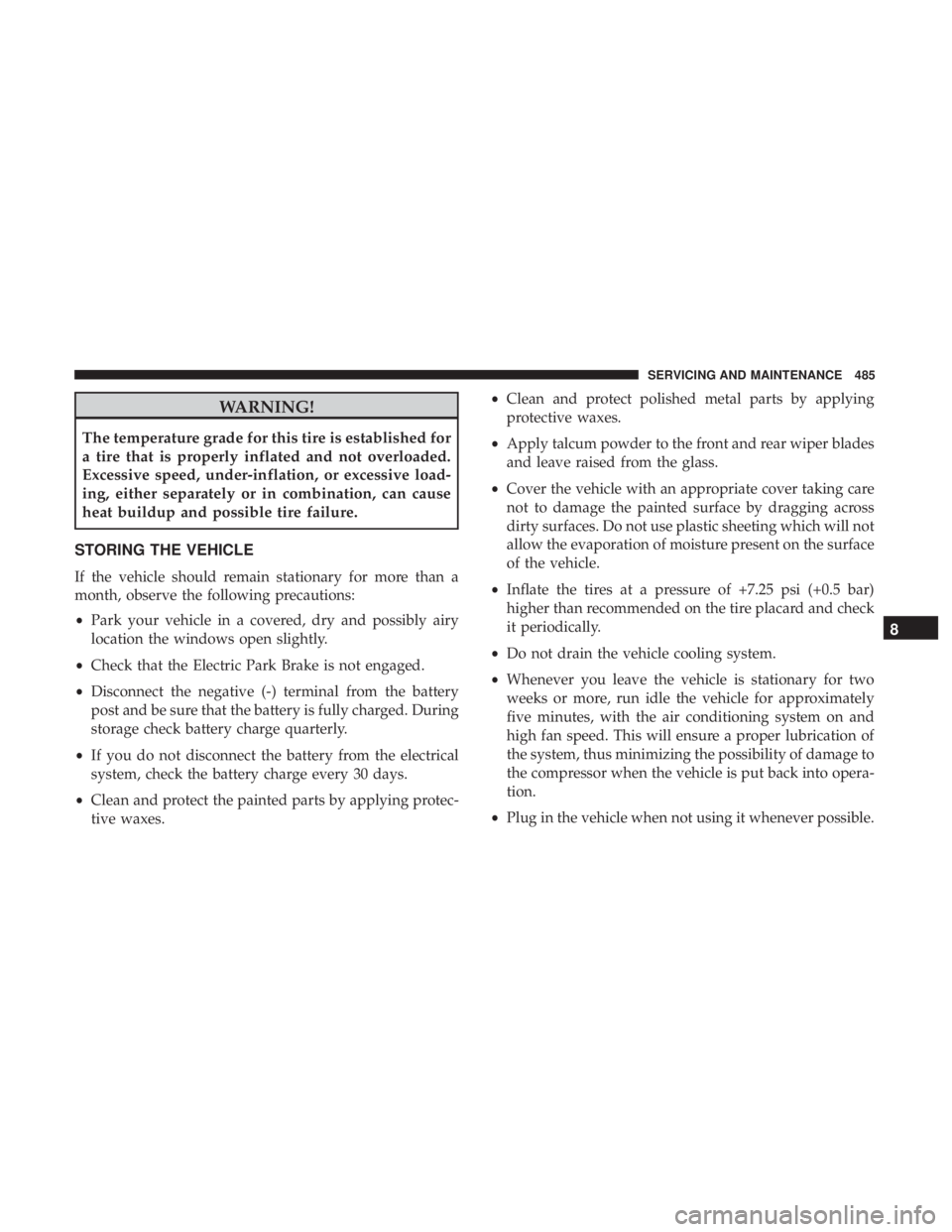
WARNING!
The temperature grade for this tire is established for
a tire that is properly inflated and not overloaded.
Excessive speed, under-inflation, or excessive load-
ing, either separately or in combination, can cause
heat buildup and possible tire failure.
STORING THE VEHICLE
If the vehicle should remain stationary for more than a
month, observe the following precautions:
• Park your vehicle in a covered, dry and possibly airy
location the windows open slightly.
• Check that the Electric Park Brake is not engaged.
• Disconnect the negative (-) terminal from the battery
post and be sure that the battery is fully charged. During
storage check battery charge quarterly.
• If you do not disconnect the battery from the electrical
system, check the battery charge every 30 days.
• Clean and protect the painted parts by applying protec-
tive waxes. •
Clean and protect polished metal parts by applying
protective waxes.
• Apply talcum powder to the front and rear wiper blades
and leave raised from the glass.
• Cover the vehicle with an appropriate cover taking care
not to damage the painted surface by dragging across
dirty surfaces. Do not use plastic sheeting which will not
allow the evaporation of moisture present on the surface
of the vehicle.
• Inflate the tires at a pressure of +7.25 psi (+0.5 bar)
higher than recommended on the tire placard and check
it periodically.
• Do not drain the vehicle cooling system.
• Whenever you leave the vehicle is stationary for two
weeks or more, run idle the vehicle for approximately
five minutes, with the air conditioning system on and
high fan speed. This will ensure a proper lubrication of
the system, thus minimizing the possibility of damage to
the compressor when the vehicle is put back into opera-
tion.
• Plug in the vehicle when not using it whenever possible.
8
SERVICING AND MAINTENANCE 485
Page 597 of 614
Fluid Type............................ .501
Special Additives ........................ .460
Auxiliary Electrical Outlet (Power Outlet) .........144
Auxiliary Power Outlet ..................... .144
Axle Lubrication .......................... .501
Back-Up ................................ .360
Battery .............................. .174, 437
Charging System Light ....................174
Jump Starting .......................... .418
Key Fob Battery Replacement .................42
Keyless Key Fob Replacement ................42
Remote Battery Replacement .................42
Saving Feature (Protection) ..................97
Belts, Seat ............................... .272
Blind Spot Monitoring ...................... .197
Body Mechanism Lubrication ..................445
B-Pillar Location .......................... .467
Brake Assist System ........................ .190
Brake Control System, Electronic ................189
Brake Fluid .............................. .501
Brake System ......................... .458, 492
Anti-Lock (ABS) ........................ .492
Fluid Check ........................ .459, 501
Master Cylinder ........................ .459Parking
.............................. .281
Warning Light .......................... .173
Brightness, Interior Lights .....................99
Bulb Replacement ...................... .384, 388
Bulbs, Light ....................... .274, 384, 388
Camera ................................ .360
Camera, Rear ......................... .360, 363
Capacities, Fluid .......................... .498
Caps, Filler Fuel .............................. .367, 422
Radiator (Coolant Pressure) .................456
Carbon Monoxide Warning ................271, 497
Cargo Area Features ....................... .134
Car
go Compartment
Luggage Carrier ........................ .150
Cargo Load Floor ......................... .134
Cargo Tie-Downs .......................... .134
Cargo (Vehicle Loading) ..................... .134
Car Washes .............................. .487
Cellular Phone ........................... .569
Center High Mounted Stop Light ...............390
Certification Label ......................... .370
Chains, Tire ............................. .482
Changing A Flat Tire .....................400, 461
12
INDEX 595
Page 607 of 614
Spark Plugs............................. .499
Specifications Fuel (Gasoline) ......................... .499
Oil.................................. .499
Speed Control Accel/Decel ........................... .296
Accel/Decel (ACC Only) ...................302
Cancel ............................... .297
Resume .............................. .296
Speed Control (Cruise Control) ..............294, 297
Starting .............................. .49, 278
Remote ................................49
Starting And Operating ..................... .278
Starting Procedures ........................ .278
Steering ................................ .293
Column Controls .........................93
Tilt Column .............................87
Wheel, Heated ........................ .87, 88
Wheel, Tilt ..............................87
Steering Wheel Audio Controls .................534
Steering Wheel Mounted Sound System Controls . . . .534
Storage, Vehicle ............................118
Stuck, Freeing ............................ .424
Sunglasses Storage ......................... .149
Sun Roof ............................... .123Supplemental Restraint System - Air Bag
..........231
System, Remote Starting ......................49
Telescoping Steering Column ...................87
Temperature Control, Automatic (ATC) ...........110
Tie Down Hooks, Cargo ..................... .134
Tilt Steering Column .........................87
Time Delay, Headlight ........................93
Tire And Loading Information Placard ............467
Tire Markings ............................ .462
Tires......................... .274, 471, 478, 483
Aging (Life Of Tires) ..................... .475
Air Pressure ........................... .471
Chains ............................... .482
Changing .......................... .400, 461
Compact Spare ......................... .478
General
Information ...................471, 478
High Speed ............................ .473
Inflation Pressures ....................... .472
Jacking ........................ .400, 401, 461
Life Of Tires ........................... .475
Load Capacity ...................... .467, 468
Pressure Monitor System (TPMS) ..........164, 207
Pressure Warning Light ....................180
Quality Grading ........................ .483
12
INDEX 605