Page 220 of 614
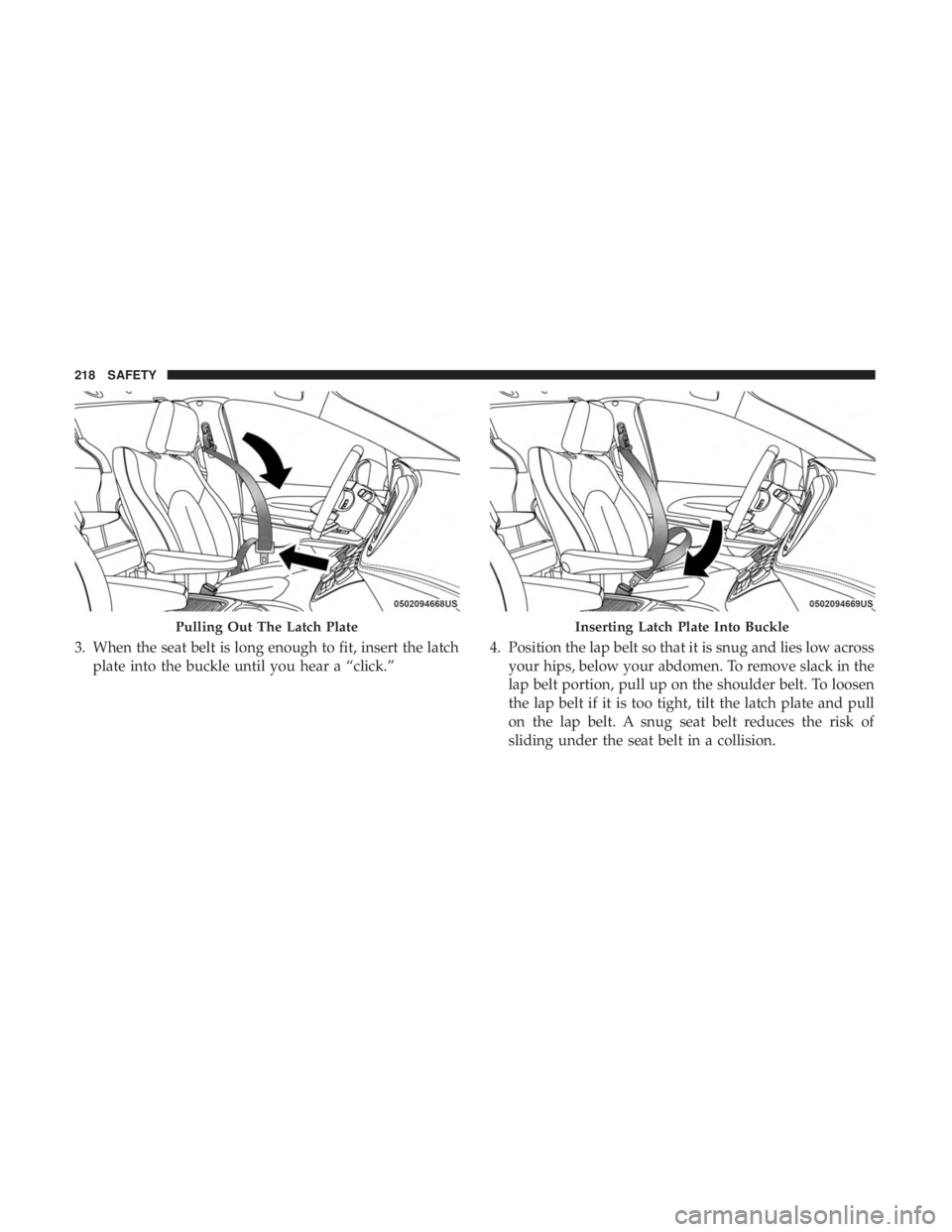
3. When the seat belt is long enough to fit, insert the latchplate into the buckle until you hear a “click.” 4. Position the lap belt so that it is snug and lies low across
your hips, below your abdomen. To remove slack in the
lap belt portion, pull up on the shoulder belt. To loosen
the lap belt if it is too tight, tilt the latch plate and pull
on the lap belt. A snug seat belt reduces the risk of
sliding under the seat belt in a collision.
Pulling Out The Latch PlateInserting Latch Plate Into Buckle
218 SAFETY
Page 221 of 614
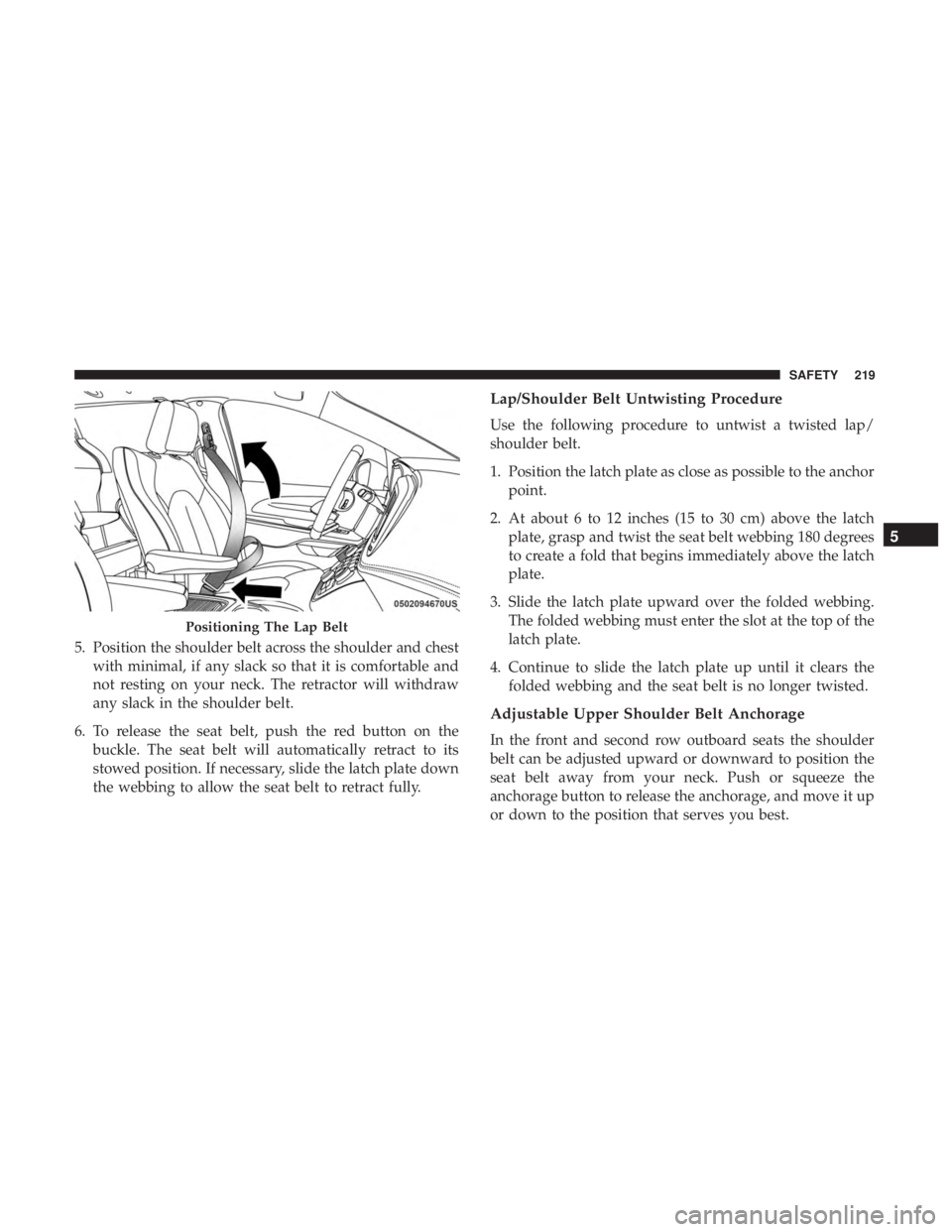
5. Position the shoulder belt across the shoulder and chestwith minimal, if any slack so that it is comfortable and
not resting on your neck. The retractor will withdraw
any slack in the shoulder belt.
6. To release the seat belt, push the red button on the buckle. The seat belt will automatically retract to its
stowed position. If necessary, slide the latch plate down
the webbing to allow the seat belt to retract fully.
Lap/Shoulder Belt Untwisting Procedure
Use the following procedure to untwist a twisted lap/
shoulder belt.
1. Position the latch plate as close as possible to the anchorpoint.
2. At about 6 to 12 inches (15 to 30 cm) above the latch plate, grasp and twist the seat belt webbing 180 degrees
to create a fold that begins immediately above the latch
plate.
3. Slide the latch plate upward over the folded webbing. The folded webbing must enter the slot at the top of the
latch plate.
4. Continue to slide the latch plate up until it clears the folded webbing and the seat belt is no longer twisted.
Adjustable Upper Shoulder Belt Anchorage
In the front and second row outboard seats the shoulder
belt can be adjusted upward or downward to position the
seat belt away from your neck. Push or squeeze the
anchorage button to release the anchorage, and move it up
or down to the position that serves you best.
Positioning The Lap Belt
5
SAFETY 219
Page 222 of 614
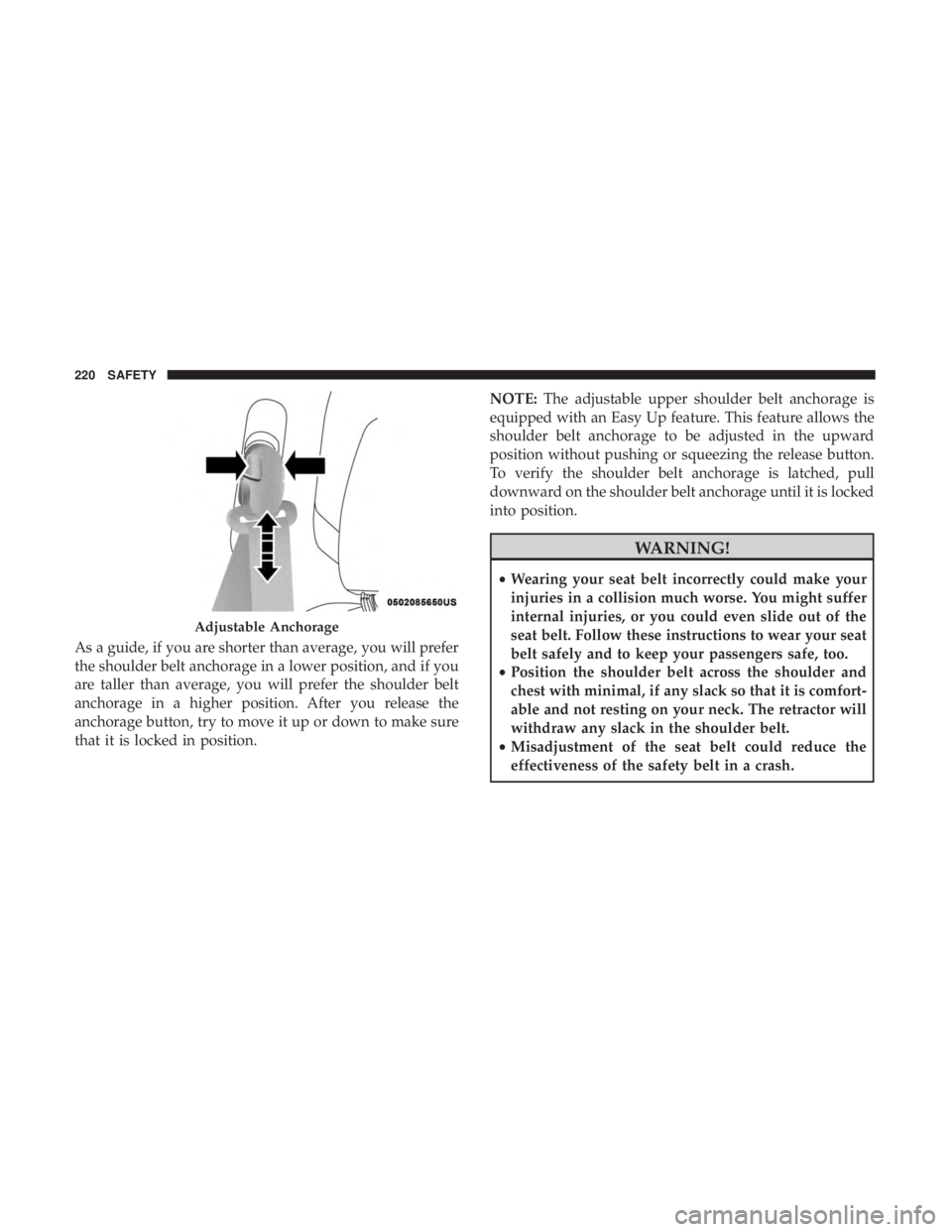
As a guide, if you are shorter than average, you will prefer
the shoulder belt anchorage in a lower position, and if you
are taller than average, you will prefer the shoulder belt
anchorage in a higher position. After you release the
anchorage button, try to move it up or down to make sure
that it is locked in position.NOTE:
The adjustable upper shoulder belt anchorage is
equipped with an Easy Up feature. This feature allows the
shoulder belt anchorage to be adjusted in the upward
position without pushing or squeezing the release button.
To verify the shoulder belt anchorage is latched, pull
downward on the shoulder belt anchorage until it is locked
into position.
WARNING!
• Wearing your seat belt incorrectly could make your
injuries in a collision much worse. You might suffer
internal injuries, or you could even slide out of the
seat belt. Follow these instructions to wear your seat
belt safely and to keep your passengers safe, too.
• Position the shoulder belt across the shoulder and
chest with minimal, if any slack so that it is comfort-
able and not resting on your neck. The retractor will
withdraw any slack in the shoulder belt.
• Misadjustment of the seat belt could reduce the
effectiveness of the safety belt in a crash.
Adjustable Anchorage
220 SAFETY
Page 223 of 614
Second Row Center (If Equipped) And Third Row
Center Seat Belt Operating Instructions
The second row center (if equipped) and third row center
seat belts feature a seat belt with a mini-latch plate and
buckle, which allows the seat belt to detach from the lower
anchor when the seat is folded. The mini-latch plate and
regular latch plate can then be stored out of the way in the
headliner for added convenience to open up utilization of
the storage areas behind the front seats when the seat is not
occupied.
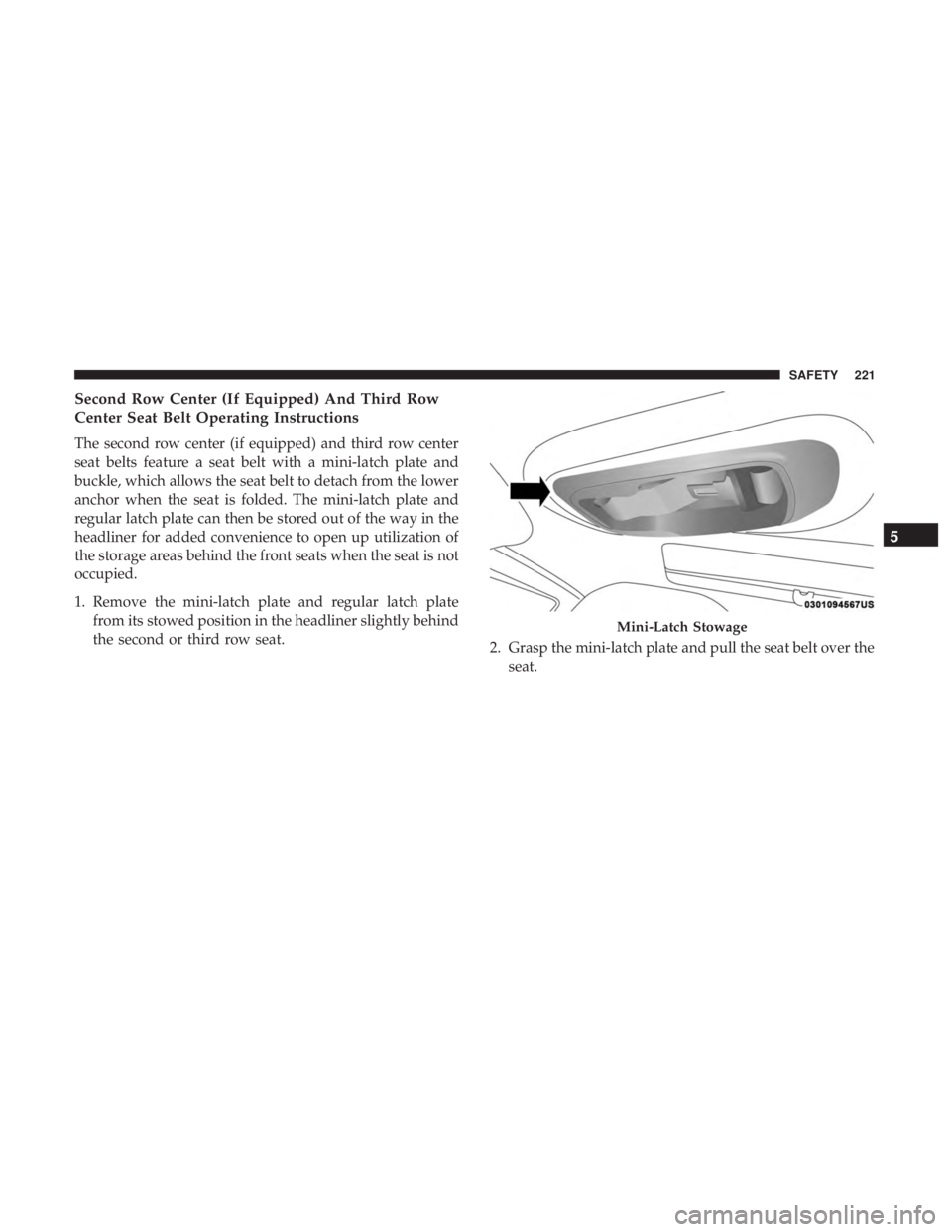
1. Remove the mini-latch plate and regular latch platefrom its stowed position in the headliner slightly behind
the second or third row seat. 2. Grasp the mini-latch plate and pull the seat belt over the
seat.
Mini-Latch Stowage
5
SAFETY 221
Page 224 of 614
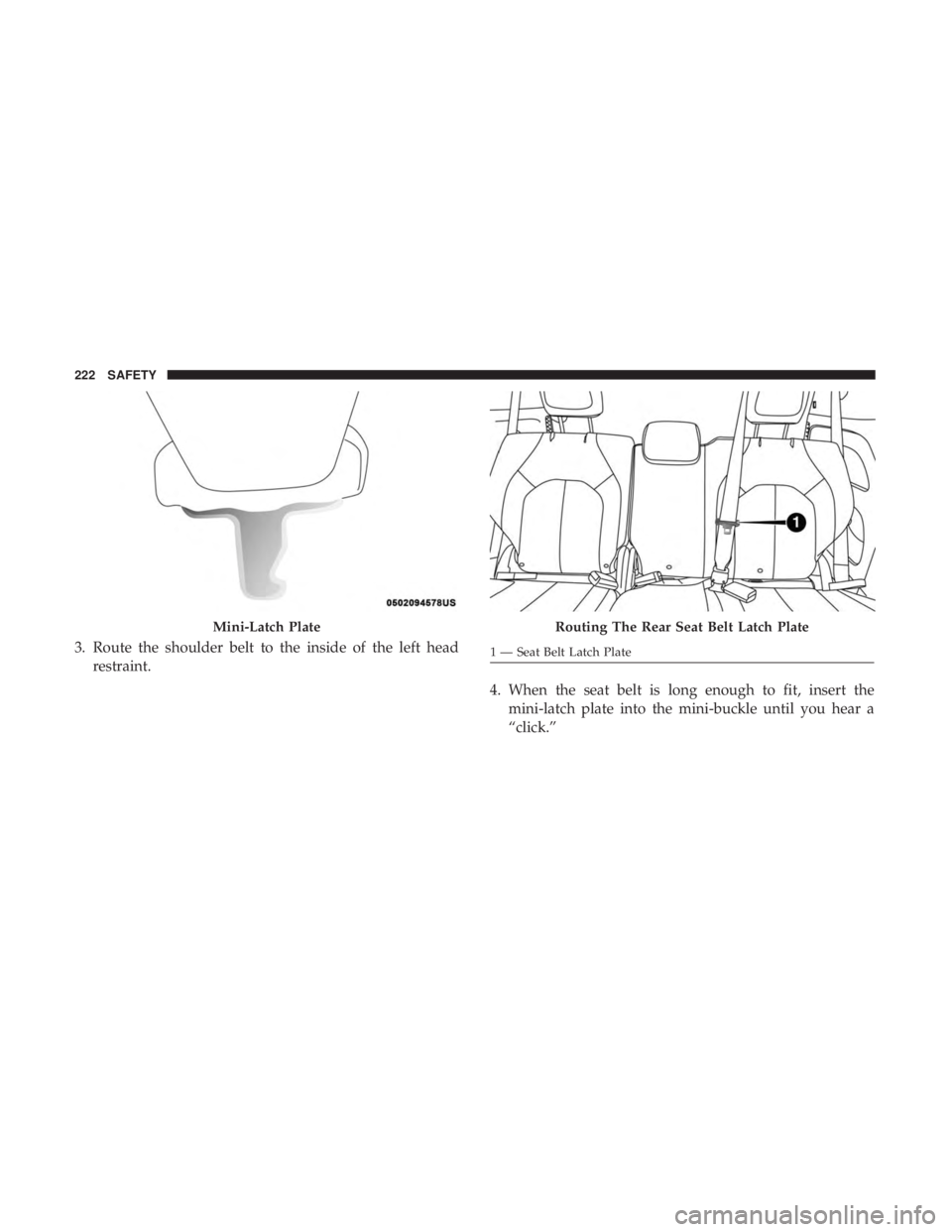
3. Route the shoulder belt to the inside of the left headrestraint.
4. When the seat belt is long enough to fit, insert themini-latch plate into the mini-buckle until you hear a
“click.”
Mini-Latch PlateRouting The Rear Seat Belt Latch Plate
1 — Seat Belt Latch Plate
222 SAFETY
Page 225 of 614
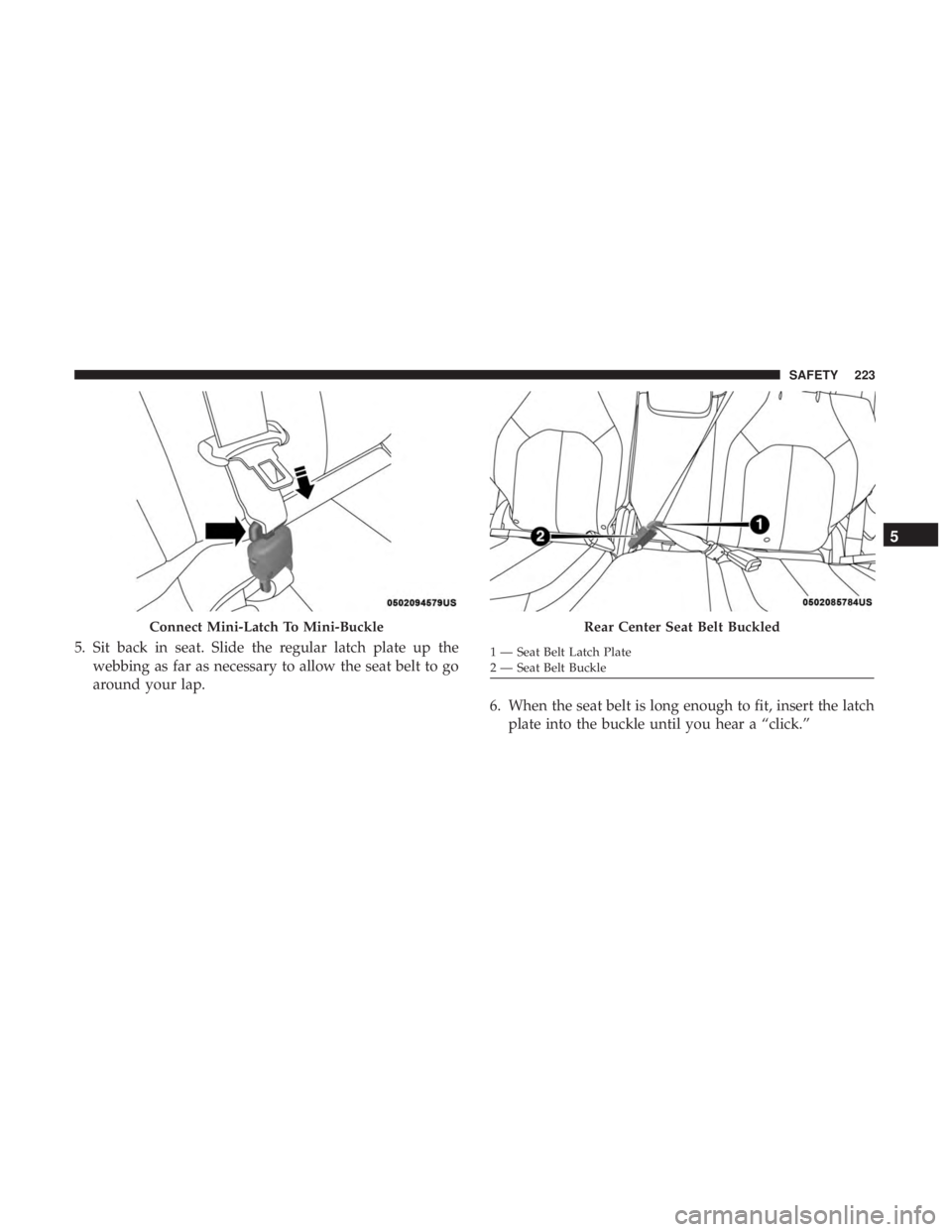
5. Sit back in seat. Slide the regular latch plate up thewebbing as far as necessary to allow the seat belt to go
around your lap.
6. When the seat belt is long enough to fit, insert the latchplate into the buckle until you hear a “click.”
Connect Mini-Latch To Mini-BuckleRear Center Seat Belt Buckled
1 — Seat Belt Latch Plate
2 — Seat Belt Buckle
5
SAFETY 223
Page 226 of 614
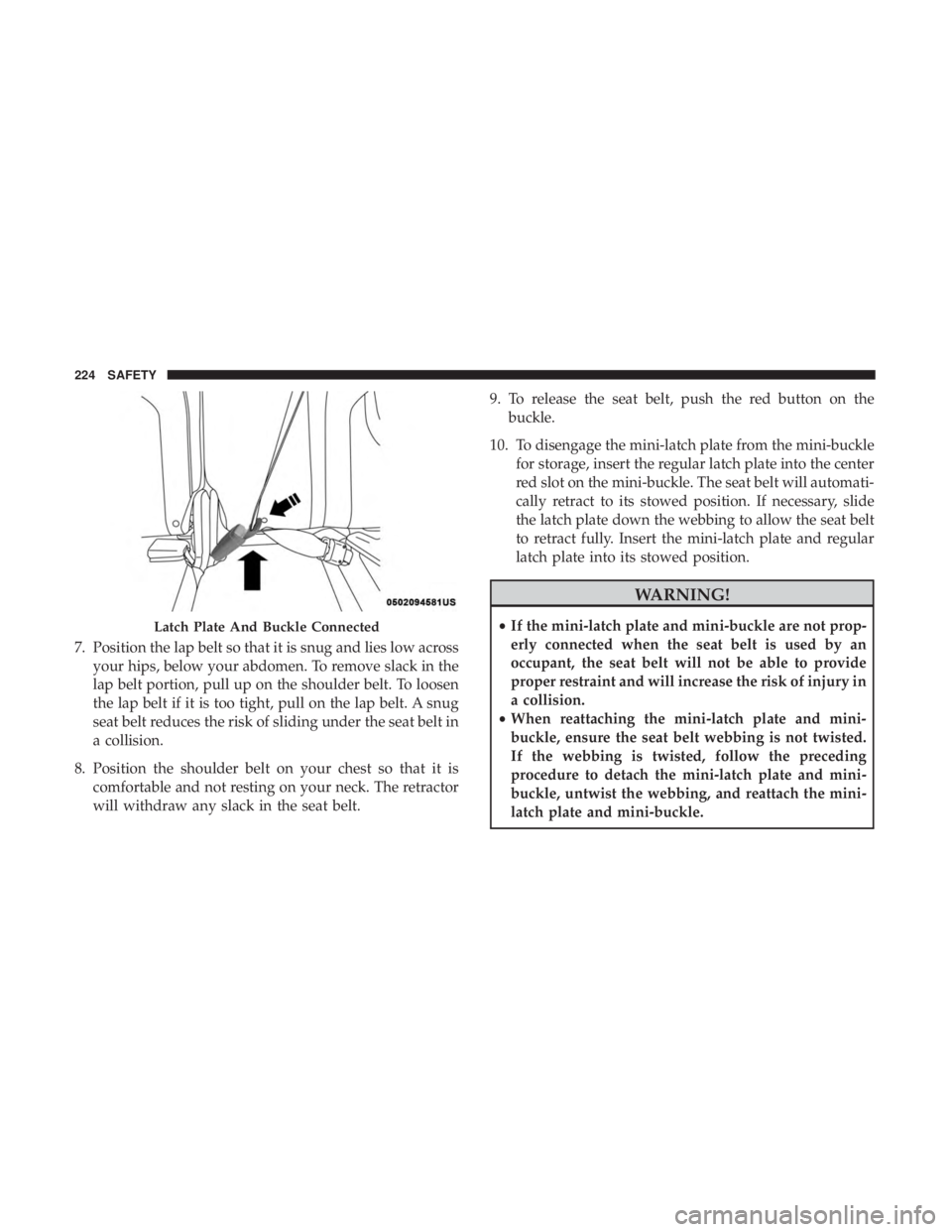
7. Position the lap belt so that it is snug and lies low acrossyour hips, below your abdomen. To remove slack in the
lap belt portion, pull up on the shoulder belt. To loosen
the lap belt if it is too tight, pull on the lap belt. A snug
seat belt reduces the risk of sliding under the seat belt in
a collision.
8. Position the shoulder belt on your chest so that it is comfortable and not resting on your neck. The retractor
will withdraw any slack in the seat belt. 9. To release the seat belt, push the red button on the
buckle.
10. To disengage the mini-latch plate from the mini-buckle for storage, insert the regular latch plate into the center
red slot on the mini-buckle. The seat belt will automati-
cally retract to its stowed position. If necessary, slide
the latch plate down the webbing to allow the seat belt
to retract fully. Insert the mini-latch plate and regular
latch plate into its stowed position.
WARNING!
•If the mini-latch plate and mini-buckle are not prop-
erly connected when the seat belt is used by an
occupant, the seat belt will not be able to provide
proper restraint and will increase the risk of injury in
a collision.
• When reattaching the mini-latch plate and mini-
buckle, ensure the seat belt webbing is not twisted.
If the webbing is twisted, follow the preceding
procedure to detach the mini-latch plate and mini-
buckle, untwist the webbing, and reattach the mini-
latch plate and mini-buckle.Latch Plate And Buckle Connected
224 SAFETY
Page 227 of 614
Seat Belt Extender
If a seat belt is not long enough to fit properly, even when
the webbing is fully extended and the adjustable upper
shoulder belt anchorage (if equipped) is in its lowest
position, your authorized dealer can provide you with a
Seat Belt Extender. The Seat Belt Extender should be used
only if the existing seat belt is not long enough. When the
Seat Belt Extender is not required for a different occupant,
it must be removed.
WARNING!
•ONLY use a Seat Belt Extender if it is physically
required in order to properly fit the original seat belt
system. DO NOT USE the Seat Belt Extender if,
when worn, the distance between the front edge of
the Seat Belt Extender buckle and the center of the
occupant’s body is LESS than 6 inches.
• Using a Seat Belt Extender when not needed can
increase the risk of serious injury or death in a
collision. Only use the Seat Belt Extender when the
lap belt is not long enough and only use in the
recommended seating positions. Remove and store
the Seat Belt Extender when not needed.
Seat Belts And Pregnant Women
Seat belts must be worn by all occupants including preg-
nant women: the risk of injury in the event of an accident
is reduced for the mother and the unborn child if they are
wearing a seat belt.
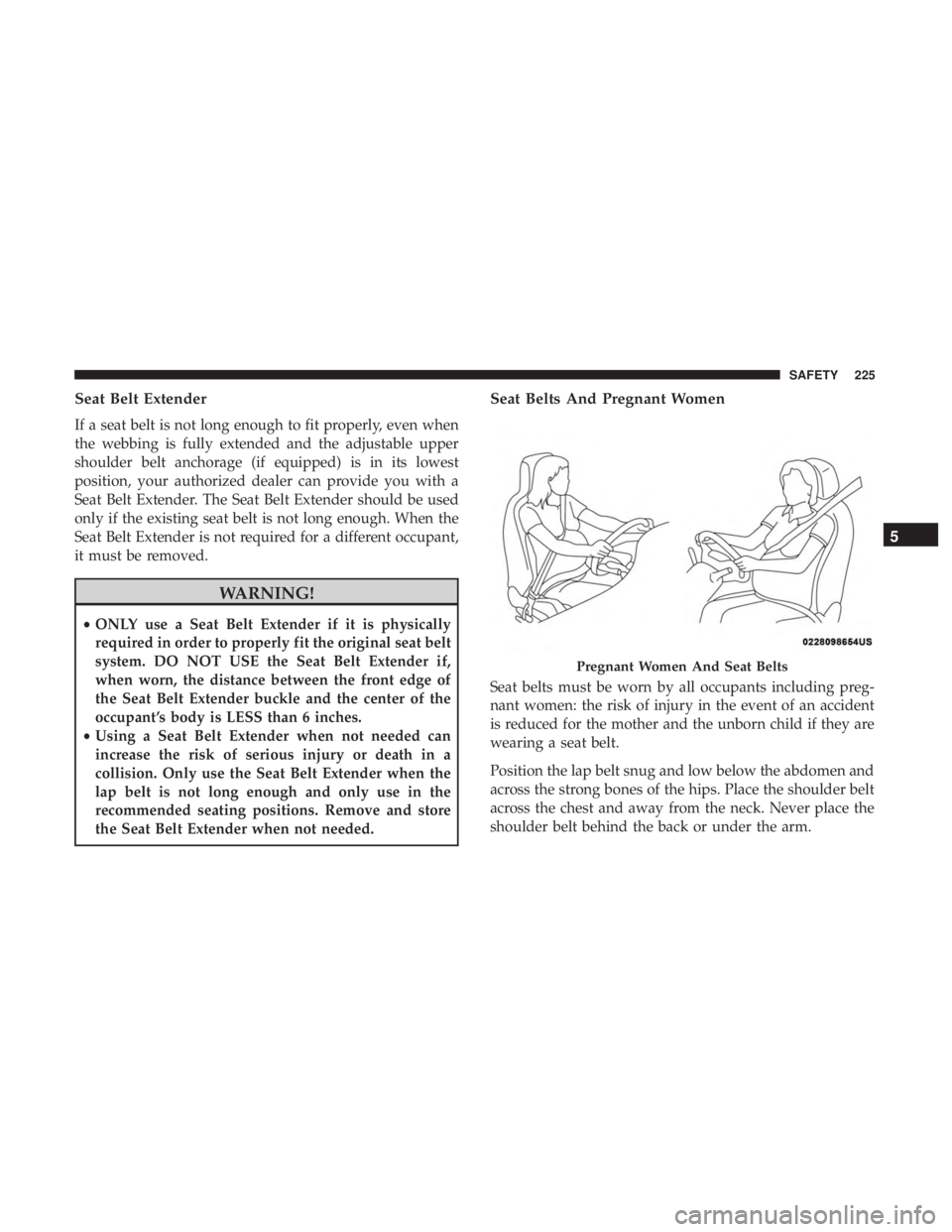
Position the lap belt snug and low below the abdomen and
across the strong bones of the hips. Place the shoulder belt
across the chest and away from the neck. Never place the
shoulder belt behind the back or under the arm.
Pregnant Women And Seat Belts
5
SAFETY 225