2018 CHRYSLER PACIFICA HYBRID coolant
[x] Cancel search: coolantPage 435 of 614

Mileage or time passed (whichever comes first)
20,000
30,000
40,000
50,000
60,000
70,000
80,000
90,000
100,000
110,000
120,000
130,000
140,000
150,000
Or Years: 2 3 4 5 6 7 8 9 10 11 12 13 14 15
Or Kilometers:
32,000
48,000
64,000
80,000
96,000
112,000
128,000
144,000
160,000
176,000
192,000
208,000
224,000
240,000
Additional Inspections
Inspect the CV joints. X X X X X X X
Inspect front suspension, boot seals, tie rod ends,
and replace if necessary. XXX X X X X
Inspect the brake linings, parking brake function. X X X X X X X
Inspect front accessory drive belt, tensioner, idler pul-
ley, and replace if necessary. X
Additional Maintenance
Replace engine air cleaner filter. XX X XX
Replace air conditioning/cabin air filter. X X X X X X X
Replace spark plugs.(**) X
Flush and replace the engine, power electronics, and
battery coolant at 10 years or 150,000 miles
(240,000 km), whichever comes first.(***) XX
Inspect and replace PCV valve if necessary. X
8
SERVICING AND MAINTENANCE 433
Page 436 of 614

(**) The spark plug change interval is mileage based only,
yearly intervals do not apply.
(***) Some vehicles require special tools to add coolant
properly. Failure to fill these systems properly could lead to
severe internal damage. If any coolant is needed to be
added to the system please contact your local authorized
dealer.
WARNING!
•You can be badly injured working on or around a
motor vehicle. Do only service work for which you
have the knowledge and the right equipment. If you
have any doubt about your ability to perform a
service job, take your vehicle to a competent me-
chanic.
• Failure to properly inspect and maintain your vehicle
could result in a component malfunction and effect
vehicle handling and performance. This could cause
an accident.
Heavy Duty Use Of The Vehicle
Change Engine Oil at 4,000 miles (6,500 km) or 350 hours of
engine run time if the vehicle is operated in a dusty and off
road environment. This type of vehicle use is considered
Severe Duty.
434 SERVICING AND MAINTENANCE
Page 437 of 614

ENGINE COMPARTMENT — HYBRID
1 — Battery Coolant Reservoir*6 — Power Distribution Center (Fuses)
2 — Engine Coolant Reservoir 7 — Engine Air Cleaner
3 — Engine Oil Fill 8 — Engine Oil Dipstick
4 — Brake Fluid Reservoir 9 — Power Electronics Coolant Reservoir*
5 — Remote Jump Start Positive Terminal 10 — Washer Fluid Reservoir
* See your authorized dealer for service.
8
SERVICING AND MAINTENANCE 435
Page 455 of 614
Cooling System
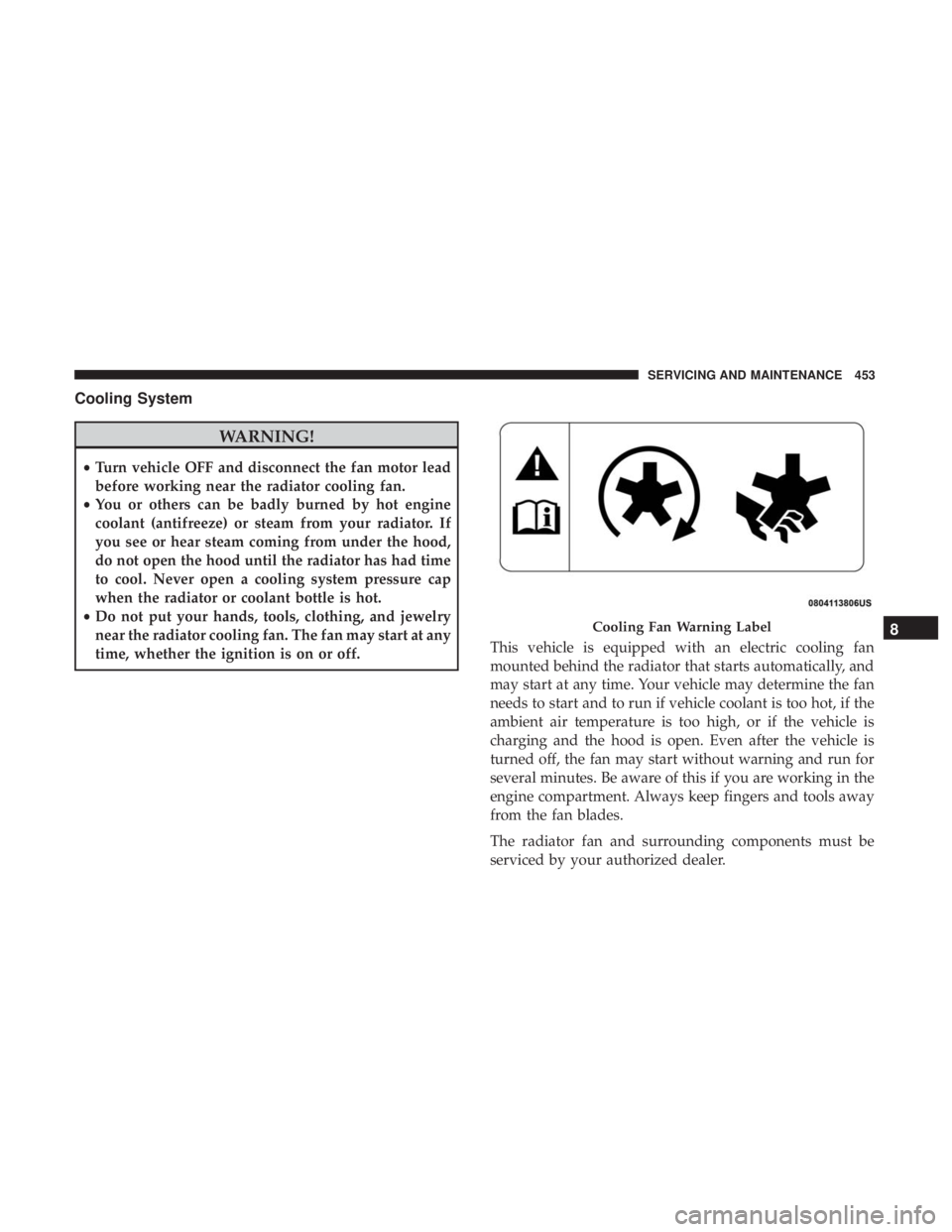
WARNING!
•Turn vehicle OFF and disconnect the fan motor lead
before working near the radiator cooling fan.
• You or others can be badly burned by hot engine
coolant (antifreeze) or steam from your radiator. If
you see or hear steam coming from under the hood,
do not open the hood until the radiator has had time
to cool. Never open a cooling system pressure cap
when the radiator or coolant bottle is hot.
• Do not put your hands, tools, clothing, and jewelry
near the radiator cooling fan. The fan may start at any
time, whether the ignition is on or off. This vehicle is equipped with an electric cooling fan
mounted behind the radiator that starts automatically, and
may start at any time. Your vehicle may determine the fan
needs to start and to run if vehicle coolant is too hot, if the
ambient air temperature is too high, or if the vehicle is
charging and the hood is open. Even after the vehicle is
turned off, the fan may start without warning and run for
several minutes. Be aware of this if you are working in the
engine compartment. Always keep fingers and tools away
from the fan blades.
The radiator fan and surrounding components must be
serviced by your authorized dealer.
Cooling Fan Warning Label8
SERVICING AND MAINTENANCE 453
Page 456 of 614
Engine Coolant Checks
Check the engine coolant (antifreeze) protection every 12
months (before the onset of freezing weather, where appli-
cable). If the engine coolant (antifreeze) is dirty, the system
should be drained, flushed, and refilled with fresh OAT
coolant (conforming to MS.90032) by an authorized dealer.
Check the front of the A/C condenser for any accumula-
tion of bugs, leaves, etc. If dirty, clean by gently spraying
water from a garden hose vertically down the face of the
condenser.
Check the engine cooling system hoses for brittle rubber,
cracking, tears, cuts, and tightness of the connection at the
coolant recovery bottle and radiator. Inspect the entire
system for leaks. DO NOT REMOVE THE COOLANT
PRESSURE CAP WHEN THE COOLING SYSTEM IS HOT.
Cooling System — Drain, Flush And Refill
NOTE:Some vehicles require special tools to add coolant
properly. Failure to fill these systems properly could lead to
severe internal engine damage. If any coolant is needed to
be added to the system please contact an local authorized
dealer. If the engine coolant (antifreeze) is dirty or contains visible
sediment, have an authorized dealer clean and flush with
OAT coolant (antifreeze) (conforming to MS.90032).
Refer to the “Maintenance Plan” in this section for the
proper maintenance intervals.
Electric/Battery Coolant System
These coolant systems must be serviced by an authorized
dealer. If the coolant level is below what is specified on the
reservoir, contact an authorized dealer for service.
These systems require the use of high purity water, such as
deionized, or distilled water, when mixing the water and
coolant (antifreeze) solution. The use of lower quality
water will reduce the amount of corrosion protection in the
cooling systems. If the coolant level of the battery coolant
system is low, the wrench warning light will be illuminated
on the instrument cluster.
Selection Of Coolant
Refer to “Fluids And Lubricants” in “Technical Specifica-
tions” for further information.
454 SERVICING AND MAINTENANCE
Page 457 of 614
NOTE:
•Mixing of engine coolant (antifreeze) other than speci-
fied Organic Additive Technology (OAT) engine coolant
(antifreeze), may result in engine damage and may
decrease corrosion protection. Organic Additive Tech-
nology (OAT) engine coolant is different and should not
be mixed with Hybrid Organic Additive Technology
(HOAT) engine coolant (antifreeze) or any “globally
compatible” coolant (antifreeze). If a non-OAT engine
coolant (antifreeze) is introduced into the cooling system
in an emergency, the cooling system will need to be
drained, flushed, and refilled with fresh OAT coolant
(conforming to MS.90032), by an authorized dealer as
soon as possible.
• Do not use water alone or alcohol-based engine coolant
(antifreeze) products. Do not use additional rust inhibi-
tors or antirust products, as they may not be compatible
with the radiator engine coolant and may plug the
radiator.
• This vehicle has not been designed for use with propyl-
ene glycol-based engine coolant (antifreeze). Use of
propylene glycolbased engine coolant (antifreeze) is not
recommended. •
Some vehicles require special tools to add coolant prop-
erly. Failure to fill these systems properly could lead to
severe internal engine damage. If any coolant is needed
to be added to the system please contact your local
authorized dealer.
Adding Coolant
Your vehicle has been built with an improved coolant (OAT
coolant conforming to MS.90032) that allows extended
maintenance intervals. This coolant (antifreeze) can be
used up to ten years or 150,000 miles (240,000 km) before
replacement. To prevent reducing this extended mainte-
nance period, it is important that you use the same coolant
(OAT coolant conforming to MS.90032) throughout the life
of your vehicle.
Please review these recommendations for using Organic
Additive Technology (OAT) coolant (antifreeze) that meets
the requirements of FCA Material Standard MS.90032.
When adding coolant (antifreeze):
• We recommend using Mopar Antifreeze/Coolant
10 Year/150,000 Mile (240,000 km) Formula OAT (Or-
ganic Additive Technology) that meets the requirements
of FCA Material Standard MS.90032.
8
SERVICING AND MAINTENANCE 455
Page 458 of 614
•Mix a minimum solution of 50% OAT coolant that meets
the requirements of FCA Material Standard MS.90032
and deionized, or distilled water. Use higher concentra-
tions (not to exceed 70%) if temperatures below 34°F
(37°C) are anticipated.
CAUTION!
Use only high purity water such as deionized, or
distilled water when mixing the water/ coolant (anti-
freeze) solution for the engine, battery or high voltage
electronics cooling systems. The use of lower quality
water will reduce the amount of corrosion protection in
the engine cooling system.
Please note that it is the owner’s responsibility to maintain
the proper level of protection against freezing according to
the temperatures occurring in the area where the vehicle is
operated. NOTE:
•
Mixing coolant (antifreeze) types is not recommended
and can result in cooling system damage. If HOAT and
OAT coolant are mixed in an emergency, have a autho-
rized dealer drain, flush, and refill with OAT coolant
(conforming to MS.90032) as soon as possible.
• Low pressure expansion bottles for power electronics
and battery cooling require a special tool for removing
the cap from the expansion bottle. For the battery
coolant bottle, it is important to not add coolant if level
is low. The vehicle should be taken to dealer for proper
servicing of the battery coolant loop if this should occur.
Cooling System Pressure Cap
The cap must be fully tightened to prevent loss of engine
coolant (antifreeze), and to ensure that engine coolant
(antifreeze) will return to the radiator from the coolant
expansion bottle/recovery tank if so equipped.
The cap should be inspected and cleaned if there is any
accumulation of foreign material on the sealing surfaces.
456 SERVICING AND MAINTENANCE
Page 459 of 614
WARNING!
•Do not open hot engine cooling system. Never add
engine coolant (antifreeze) when the engine is over-
heated. Do not loosen or remove the cap to cool an
overheated engine. Heat causes pressure to build up
in the cooling system. To prevent scalding or injury,
do not remove the pressure cap while the system is
hot or under pressure.
• Do not use a pressure cap other than the one speci-
fied for your vehicle. Personal injury or engine
damage may result.
Disposal Of Used Coolant
Used ethylene glycol-based coolant (antifreeze) is a regu-
lated substance requiring proper disposal. Check with your
local authorities to determine the disposal rules for your
community. To prevent ingestion by animals or children,
do not store ethylene glycol-based coolant in open contain-
ers or allow it to remain in puddles on the ground. If
ingested by a child or pet, seek emergency assistance
immediately. Clean up any ground spills immediately.
Coolant Level
The coolant expansion bottle provides a quick visual
method for determining that the coolant level is adequate.
With the engine off and cold, the level of the coolant
(antifreeze) in the bottle should be between the “MAX” and
“MIN” lines marked on the bottle.
As long as the engine operating temperature is satisfactory,
the coolant bottle need only be checked once a month.
When additional coolant (antifreeze) is needed to maintain
the proper level, it should be added to the coolant bottle.
Do not overfill.
See an authorized dealer for service.
Points To Remember
NOTE: When the vehicle is stopped after a few miles/
kilometers of operation, you may observe vapor coming
from the front of the engine compartment. This is normally
a result of moisture from rain, snow, or high humidity
accumulating on the radiator and being vaporized when
the thermostat opens, allowing hot engine coolant (anti-
freeze) to enter the radiator.
8
SERVICING AND MAINTENANCE 457