2018 AUDI TT ROADSTER fuel
[x] Cancel search: fuelPage 235 of 310

Cl co .... N ,....
N .... 0 ,....
Vl co
Emissions control
systems
Catal ytic conve rt er
The vehicle may on ly be driven with unleaded
gasoline, otherwise the catalyt ic converter will be
destroyed.
Never drive until the tank is completely empty.
The irregular supply of f uel that results from that
can cause engine m isfires. Uncombusted fuel will
enter the exhaust system, wh ich can cause over
heat ing and damage to the catalyt ic converter .
A WARNING
The temperature of the exhaust system is
high, both when d riving and after stopping
the engine.
-
- Never touch the exhaust tail pipes once they
have become ho t. This could result in bu rns.
- Do not park your vehicle ove r flammable
materials such as g rass or leaves because
the high temperat ure of the em iss ions con
trol system co uld s tart a fire.
- Do not apply underbody p rotectant in the
exha ust system area, because this inc reases
the risk of fi re.
On Board Diagnostic
System (OBD)
The On -Board Diagnostic System monitors the
engine and transmission components that influ
ence emissions.
F ig . 177 Footwell on left side of the vehicle : connect ion
port for the On-Board Diagnostic System (OBD)
Chec king and Filling
On -Board Diagnostic System
Engine da ta can be read out at the On-Board Di
agnost ic System connection port using a spec ia l
testing
dev ice~ fig. 177 .
Indicator light
If thP ¢'4 ind icator light blinks or turns on, there
is a ma lf u nction that is caus ing poo r emissions
quality and that cou ld damage the catalytic con
verter .
Drive slowly to an a uthorized Aud i dea ler or au
t h orized Audi Serv ice Facili ty to have t he mal
f unct ion corrected.
A WARNING ..
Incorrect use of the connection port for the
On-Board D iagnostic System can cause ma l
f u nctions, which can then result in accidents
and serious injuries.
- Only allow an authorized Audi dea ler or au
thor ized Audi Service Fac ility to read out the
engine data.
Engine compartment
Working in the engine compartment
Special care is required if you are working in the
engine compartment
-
F o r work in the engine compa rtment such as
checking and fill ing fl uids , there i s a risk of in
jury , scalding, accident s, and b urn s. For thi s
re ason , follow all the warnings and general
safety pre cautions prov ided in the following
in
formati on. The engine compartm ent i s a dan
gerou s area .
~ .&..
A WARNING
-----Turn the engine off.
- Sw itch the igni tio n off.
- Set the parking brake.
- P lace the se lector lever in the P position.
-Let the eng ine cool down.
-Never open the hood when there is steam or
coolant escaping from the engine compart
ment, because there is a risk that you could
233
Page 236 of 310

Check ing and F illing
be burned. Wait until no steam or coolant is
escaping.
- Keep children away from the engine com
partment.
- Never spill fluids on a hot engine . These flu
ids (such as the freeze protection contained
in the coolant) can catch fire.
- Avoid short circuits in the e lectrica l system,
especially to the battery.
- When working in the engine compartment,
remember that the radiator fan can switch
on even if the ign ition is switched off, which
increases the risk of personal in jury.
- Never open the cap on the coolant expan
sion tank when the eng ine is warm. The
cooling system is under pressure.
- To protect your face, hands, and arms from hot steam or coolant, cover the cap with a
large cloth when opening.
- Do not remove the engine cover under any circumstances. This increases the risk of
burns .
- If tests need to be performed w ith the en
gine ru nning, there is additional danger due
to moving components (such as the ribbed
belt, a lter nator and radiator fa n) and from
the high-voltage ign it io n system.
- Do not press the accelerator pedal inadver
tent ly if a gear is selected when the veh icle
is sta tionary and the eng ine is ru nning. Oth
erwise, the veh icle w ill start to move imme
diately and t his co uld r esult in an a ccid en t.
- Pay attention to the fo llow ing warnings list
ed whe n wo rk on the fuel system or on the
electri cal eq uipment is requ ired.
- Do not smoke.
- Never work near open flames.
- Always have a working fire extinguisher
nearby.
- All work on the battery or e lectrica l system
in yo ur vehicle can res ult in injuries, chemi
ca l burns, accidents or burns. Because of
t h is, all wor k must be performed
only by an
autho rized Aud i dealer or authorized Aud i
Service Facility .
- To reduce the risk of electric shock and in
jury , never touch the following components
234
when t he engine is runni ng or is being start
ed:
- Ig nition cable
- Other compone nts in the electron ic high-
vo ltage ig nition system
- If you must check or perform work on the
eng ine wh ile it is ru nning:
- Set the pa rking brake and p lace the selec
tor lever in the P (par k) position fi rst .
- Alw ays proceed w ith ext reme cau tion so
t h at clothing, jewelry or long hair do not
become ca ught in the radiator fan, fan
belt or other moving components or do
not come into contact with hot compo
nents. Tie back long hair before begin ning
work and do not wear clothing that can
hang dow n into the eng ine .
- Lim it your exposure to exhaust and chemi
cals to as short a time as possible
<=> &. .
A WARNING
Ca lifo rnia Proposition 65 Warning:
- Engine exhaust, some of its const ituents,
a nd certa in veh icle components conta in or
em it chem icals know n to the State of Cal i
fornia to ca use cancer and b irth defects and
reproductive harm. In add ition, certain flu
ids cont ained in vehicles a nd certai n prod
uc ts of component we ar con tain or em it
chemica ls known to the State o f Califo rnia
to cause cancer and birth defects or othe r
reproductive harm.
- Battery posts, terminals and related acces
sories contain lead and lead compounds,
chemicals known to the State of California
to cause cancer and reproductive harms.
Was h ha nds after handling.
@ Note
When filling fluids, be sure not to mix the flu
i ds up. Otherwise severe mal functions and en
g ine damage will occu r.
@ For the sake of the environment
You sho uld regularly check the gro und under
your vehicle in order to detect leaks quick ly. If
there are visible spots from oi l or othe r fluids,
ll-
Page 239 of 310
Cl co .... N ,....
N .... 0 ,....
Vl co
Audi recommend s
~castrol /Jg/g/!i;lg ?nw.::<-.1-:J.oNAl.
Aud i recomm ends using the Lo ng Life h igh
pe rfo rm ance e ng ine oil from Audi G enu ine
Parts.
Checking the engine oil level
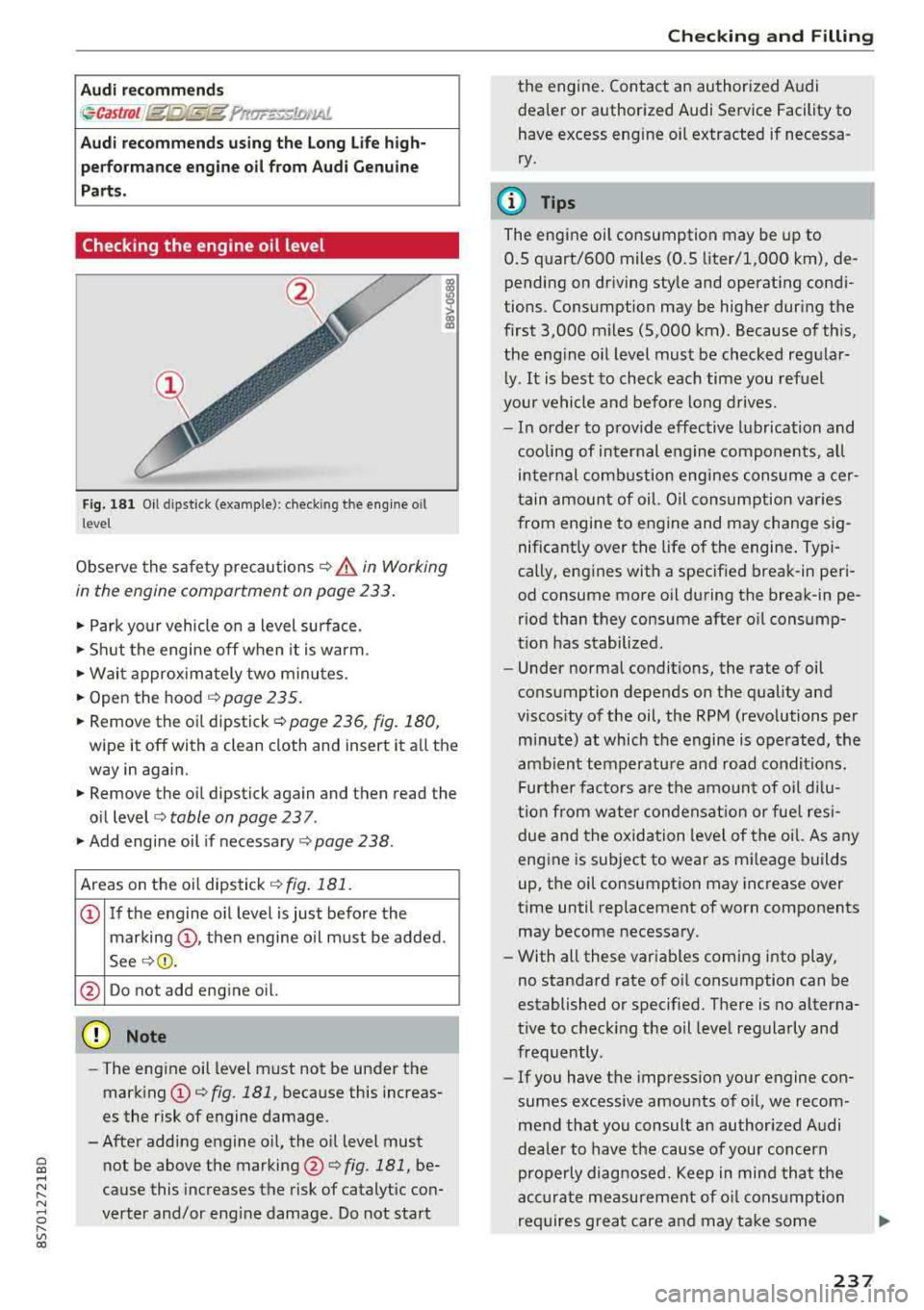
F ig. 181 O il dipstick (example): check ing the engine o il
leve l
Observe the safety precautions¢ &_ in Working
in the engine compartment on page 233 .
.. Park your vehicle on a level surface.
.. Shu t the engine off when it is warm .
.. Wait approx imately two minutes.
.. Open the hood ¢ page 235.
.. Remove the oi l dipstick ¢page 236, fig. 180,
wipe it off with a clean cloth and insert it all the
way in again.
.. Remove the o il dipstick again and then read the
o il level <=>
table on page 2 3 7.
.. Add engine oil if necessary ¢ page 238.
Areas on the oil dipstick¢ fig. 181.
© If t he engine o il level is just before the
marking ©, then engine oil must be added.
See
¢ (1) .
@ Do not add eng ine oil.
@ Note
- The eng ine oil level must not be under the
mark ing © <=>
fig. 181, because this increas
es the risk of engine damage.
-After adding engine oil, the o il level must
not be above the marking @¢
fig. 181, be
cause this increases the risk of catalytic con
verter and/or eng ine damage . Do not start
Chec king and Filling
the engine . Con tact an authorized A udi
dealer or authorized Audi Service Facility to
have excess eng ine oil extracted if necessa
ry.
@ Tips
The engine oil consumption may be up to
0.5 quart/600 miles (0.5 liter/1,000 km), de
pending on driving style and operat ing condi
tions. Consumption may be hig her during the
first 3,000 m iles (5,000 km) . Because of th is,
the engine o il level must be checked reg ular
l y .
It is best to check each time you refuel
your vehicle and befo re long drives.
- In order to prov ide effec tive lubrication and
cooling of internal engine components, a ll
internal combustion engines consume acer
tain amount of oil. Oil consumption var ies
from engine to engine and may change sig nificantly over the life of the engine . Typi
cally, eng ines with a specified break-in peri
od consume more oil during the break-in pe
r iod than they consume after oil consump
tion has stabilized .
- Under normal condit ions, the rate of oil
consumption depends on the quality and
viscos ity of the oil, the RPM (revolutions per
m in ute) at which the engine is operated, the
ambient temperatu re and road conditions .
Further factors a re t he amo unt of oi l di lu
t ion from water condensat ion or fue l resi
due and the oxidation level of the oil. As any
eng ine is subject to wear as m ileage builds
up, the oil consumption may increase over
time until replacement of worn components may become necessary.
- With all these var iables coming into play,
no standard rate of o il consumption can be
established or specified. There is no alterna
t ive to check ing the oil leve l regularly and
frequently.
- If you have the impression your engine con
sumes excessive amounts of oil, we recom
mend that you consult a n author ized Audi
dea le r to have the cause of your conc ern
properly diagnosed. Keep in mind tha t the
acc ura te measurement of o il cons umption
requires great care and may take some
237
Page 246 of 310

Wheels
Wheels
Wheels and T ires
General information
~check your tires regularly for
damage (punctures, cuts, cracks
and bulges). Remove foreign ob
jects from the tire tread.
~ If driving over curbs or similar
obstacles, drive slowly and ap proach the curb at an angle.
~Have faulty tires or rims re
placed immediately.
~ Protect your tires from oil,
grease and fuel.
~ Mark tires before removing
them so that the same running
direction can be maintained if
they are reinstalled.
~Lay tires flat when storing and
store them in a cool, dry location
with as little exposure to light as
possible.
_&. WARNING -
-Never drive faster than the maximum permitted speed
for your tires. This could cause
the tires to heat up too much.
This increases the risk of an
accident because it can cause
the tire to burst .
-Always adapt your driving to the road and traffic condi-
244
tions . Drive carefully and re
duce your speed on icy or slip
pery roads . Even winter tires
can lose traction on black ice.
(@ Note
-Please note that summer and
winter tires are designed for
the conditions that are typical
i n those seasons . Aud i recom
mends using winter tires dur
ing the winter months . Low
temperatures significantly de
crease the elasticity of summ
er tires, which affects traction
and braking ability. If summer
tires are used in very cold
temperatures, cracks can form
on the tread bars, resulting in
permanent tire damage that
can cause loud driving noise
and unbalanced tires.
-Burnished, polished or chromed rims must not be used in winter driving condi
t ions. The surface of the r ims
does not have sufficient corro
sion protection for this and
could be permanently dam
aged by road salt or similar
substances.
Page 257 of 310

0 co .... N
" N .... 0
" "' co
Checking/correcting ti re
pressure
.,,. Chec k the tire pressure at least
once per month and also check it before every long drive.
.,,. Always check the tire pressure
when the tires are
cold . Do not
reduce the pressure if it inc reas
es when the tires are warm.
.,,. Check the label c:> fig . 190 for
the correct tire pressure based on vehicle load .
.,,.Correct the tire pressure if nec
essary .
.,,.Vehicles with Tire Pressure Mon
itoring System*: store the modi
fied tire pressure in the Infotain ment system
c:> page 262.
.,,. Chec k the pressure in the emer
gency tire*/spare tire* . Always
maintain the maximum temper
ature that is specified for the
ti re .
&_ WA RNIN G
Always adapt the tire pressure
to your driving style and vehicle load.
Tire pressure table
P lease note that the information
contained in the following table
was correct at the time of print-
Wh eel s
-Overloading can lead to loss of
vehicle control and increase the risk of an accident. Read
and follow the important safe
ty precautions
inc:> page 256,
Tires and vehicle load limits .
-The tire must flex more if the
tire pressure is too low or if
the vehicle speed or load are
too high. This heats the tire up
too much. This increases the
risk of an accident because it
can cause the tire to burst and result in loss of vehicle con
trol.
- Incorrect t ire pressure in
creases tire wear and has a
negative effect on driving and
braking behavior, which in
creases the risk of an acc iden t.
@) Note
Replace lost valve caps to re
duce the ris k of damage to the
tire va lves .
@) For th e sa ke o f th e e nvi ro nm ent
Tire pressure that is too low in
creases fuel consumption .
ing, and the information is sub
ject to change. If there are differ- ences between this information
..
255
Page 258 of 310

Wheels
and the tire pressures specified
on the label on the driver's side
B
pillar, always follow the specifica
tion on the B-pillar label
¢ page 254, fig. 189.
Make sure that the tire designa
tion on your tire matches the des-
Model/ Tire designation
ignation on the tire pressure label
and the tire pressure table.
The following table lists recom mended tire pressures in cold
tires according to the load and
the size of the tires installed.
Tire pressure
Engine Normal load Maximum load
(up to 2 people)
front
PSI
TT : 245/45 R17 95Y 32
2.0 l
245/40 R18 93H 32
4-cylinder
245/40 R18 93Y 32
245/35 R19 93Y 35
255/30 R20 92Y 35
A WARNING
Please note the important safe
ty precautions regarding tire
pressure ¢ page 254 and load
limits¢ page 256.
Tires and vehicle load limits
There are limits to the amount of
load or weight that any vehicle
and any tire can carry. A vehicle
that is overloaded will not handle
well and is more difficult to stop.
Overloading can not only lead to loss of vehicle control, but can al
so damage important parts of the
vehicle and can lead to sudden
tire failure, including a blowout
256
kPA
220
220
220
240
240
rear front rear
PSI kPA PSI kPA PSI
29 200 33 230 30
29 200 33 230 30
29 200 33 230 30
32 220 35 240 32
32 220 38 260 32
and sudden deflation that can
cause the vehicle to crash.
kPA
210
210
210
220
220
Your safety and that of your pas
sengers also depends on making
sure that load limits are not ex
ceeded. Vehicle load includes ev
erybody and everything in and on
the vehicle. These load limits are
technically referred to as the vehi
cle's
Gross Vehicle Weight Rat
ing
("GVWR").
The "GVWR" includes the weight
of the basic vehicle, all factory in
stalled accessories, a full tank of
fuel, oil, coolant and other fluids
plus maximum load. The maxi
mum load includes the number
of .,.
Page 261 of 310

Cl 00 .-< N r--N .-< 0 r--Vl 00
rims yourself, because this increases the risk
of an accident.
Winter tires
Winter tires significantly improve the vehicle 's
handling when driving in winter conditions. Be
cause of their construction (width, compound,
tread pattern), summer tires provide less trac
tion on ice and snow.
.. Use winter tires on all four wheels.
.. Only use winter tires that are approved for your
vehicle .
.. Please note that the maximum permitted
speed may be lower with winter tires
9 .&, in
General information on page 244.
An author
ized Audi dea ler or authorized Audi Service Fa
cility can inform you about the maximum per
mitt ed sp eed for your tires .
.. Check the tire pressure after installing wheels
9page 254.
The effectiveness of winter tires is reduced great
ly when the tread is worn down to a depth of
0 .1S7 in (4 mm) . The chara cteristics of winter
tires also decrease greatly as the tire ages, re
gardless of the remaining tread .
@.l For the sake of the environment
Reinstall summer tires at the appropriate
time, because they provide better handling
when roads are free of snow and ice. Summer
tires cause less road noise, tire wear and fuel
consumption.
(D Tips
You can also use all season tires instead of
w inter tires . Please note that in some coun
tries where w inter tire s are required, only
w int er tires with
the£ symbol may be per
mitted.
Snow chains
Snow chains not only improve the driving in win
ter road conditions, but also the braking.
Wheels
.. Only install snow chains on the front wheels.
This applies a lso to vehicles with all wheel
drive* .
.. Check and correct the seating of the snow
chains after driving a few feet, if necessary. Fol
low the instructions from the manufacturer .
.. Note the maximum speed of 30 mph (SO km/
h) . Note the local regulations .
Use of snow chains is only permitted with certa in
rim/tire comb inat ions due to technical reasons .
Check with an author ized Audi dealer or author
ized Audi Service Facility to see if you may use
snow chains .
You must remove the snow chains on roads with
out snow . Otherwise, you could impair driving
ability and damage the tires .
.8, WARNING
Using incorrect snow chains or install ing snow
chains inc orrectly can resu lt in loss of veh icle
control, which increases the risk of an acci
dent.
(W) Note
- Snow chains can damage the rims/wheel
covers* if the chains come into direct con
tact with them. Remove the wheel covers*
first. Use coated snow chains.
- Using snow chains that add more than O.S3
in (13,S mm) of height can severe ly damage
the whee l housings and other vehicle com
ponents .
(D Tips
When using snow chains, it may be usefu l to
switch on sport mode
~ page 87.
Low-profile tires
App lies to: vehicles wi th low- pro fil e tir es
Compared to other tire/rim combinations, low
profile tires offer a wider tread surface and a
larger rim diameter with shorter tire sidewalls .
This results in an ag ile driving style . However, it
may reduce the level of comfort and increase
r oad noise when driving on roads in poor condi-
tion.
..,_
259
Page 263 of 310

Cl 00 .-< N r-N .-< 0 r-Vl 00
Tire pressure monitoring system
(J_) General notes
Each tire, incl uding the spare (if provided),
should be checked month ly when co ld and inflat
ed to the inf lation pressure recommended by the
ve hicle manufacturer on the vehicle placard or
tire inflat ion pressure label. (If your vehicle has
tires of a d ifferent s ize tha n the s ize indicated on
the veh icle placa rd or t ire inflation pressure la
be l, you s hou ld determine the prope r tir e infla
tion pressure fo r th ose tires).
As an added safety feature, your ve hicle has been
equ ipped w ith a t ire pressu re monito ring system
(TPMS) that ill uminates a low tire p ress ure tell
tale whe n one or more of yo ur t ires is sign ificant
l y unde r-infla ted. Accord ingly, whe n the low tire
p ressure tellta le illuminates, yo u should stop and
check your tires as soon as possible, and inflate
them to the proper press ure. D riving on a signifi
cantly under-inflated tire causes the tire to ove r
h eat and can lead to t ire failure. Under-inflation
a lso reduces fuel efficiency and ti re tread life,
and may affect the veh icle's handling and stop
p ing ability .
P lease note that the TPMS is not a substitute for
proper tire maintenance, and it is the driver's re
sponsib il ity to ma inta in correct tire pressure,
even if u nder-inflation has not reached t he leve l
to tr igger illum inat io n of t he TPM S low tire p res
sure telltale.
Your veh icle has also been equ ipped w ith a TPMS
malfunct ion ind icator to indicate when the sys
tem is not operat ing properly. The TPMS ma l
f u nction ind icator is combined w ith the low tire
p ressure tellta le. Whe n the system det ects a
mal function, the te lltale wi ll flash fo r approxi
mate ly one mi nute and then remain continuous ly
illum inated. This sequence will continue upon
subseq uent ve hicle start-ups as long as the ma l
function ex ists .
W hen t he malfunctio n indicator is ill uminated,
the system may not be ab le to detect or signa l
low t ire press ure as intended. TPMS ma lfunctions
may occur for a var iety of reasons, including the
Wheels
insta llation o f replacement or alternate tires or
whee ls on the vehicle that prevent the TPMS
from functioning p roperly . Always check the
TPMS ma lfunction te lltale after replac ing one or
more tires or wheels on you r vehicle to ensure
t h at the rep lacement or a lternate tires a nd
wheels allow t he TPMS to continue to function
prope rly.
If the Tire Pressure Monitoring System
indicator appears
Applies to: vehicles with Tire Pressure Monitoring System in
dicator
The tire pressure indicator in the instrument
cluster informs you if the tire pressure is too low
or if there is a system malfunction.
U sing the ABS se nsors, the t ire pressure monitor
ing system compares the tire tread c ircumfer
ence and v ibration characterist ics of the ind ividu
al tires. If the pressu re changes in one o r more
t ir es, th is is indica ted in the Info tainment sys tem
display wi th an indica to r li ght
ti] and a message.
If only one ti re is affected, the location of tha t
tire will be indicated.
T he tire press ures mus t be store d in the Infota in
me nt system agai n ea ch t ime t he p ressures
change (switching between partia l and full load
pressure) or after c hanging or replacing a tire on
yo ur vehicle
¢ page 262 . The tire pressure moni
toring system on ly monitors the tire pressure you
have stored. Refer to the t ire pressure label for
the recommended t ire pressure for your vehicle
¢ page 254, fig . 190 .
Tire tread c ircumference and vibration character
istics can change and cause a tire pressu re warn
i ng if:
- the ti re pressure in one or more tires is too low
- the tire has str uctural damage
- t he t ire w as replaced or the t ire pressu re w as
changed and it was no t stored ¢
page 262
- the spare tire* is i nstalled
Indicator lights
ti] -loss of pressure in at least one tire ¢,& .
Check the t ires and replace or repair if necessary.
Check/correct the pressures of all fou r tires and
.,.
261