2018 AUDI TT ROADSTER roof
[x] Cancel search: roofPage 224 of 310

Child safety
-Never install a rearward facing child safety
seat on the front passenger seat unless the
PASSENGER AIR BAG OFF,;; light comes
on and stays on . If the
PASSENGER AIR
BAG OFF
~; light does not come on and stay
on the inflating airbag will hit the child safe
ty seat or infant carrier with great force and
will smash the child safety seat and child
against the backrest, center armrest, door
or roof. Have the airbag system inspected
immediately by your Audi dealer.
-Never place or use any electrical device
(such as a laptop, CD player, electronic
games device, power inverter or seat heater
for child seats) on the front passenger seat
if the device is connected to the 12-volt
socket or the cigarette lighter socket .
-If a seat heater has been retrofitted or oth·
erwise added to the front passenger seat,
never install any child restraint system on
this seat .
-Make sure that there are no wet objects
(such as a wet towel) and no water or other
liquids on the front passenger seat cushion .
-Never place objects on the seat (such as a
laptop, CD player, electronic games device,
power inverter or seat heater for child
seats). These may influence the electrical
capacitance measured by the capacitive pas
senger detection system and can also fly
around in an accident and cause serious per
sonal injury .
-Always read and heed all WARNINGS when
ever using a child restrained in a vehicle is
being used
r=> page 187, Safety belts,
¢ page 194, Airbag system and
¢ page 216, Important information.
222
Convertible child safety seats
Properly used convertible child safety seats con
help protect toddlers and children over age one
who weigh between 20 and 40 lbs (9 and 18 kg)
in a crash .
.... a,
Fig. 170 Schem atic ov erview: ins tallation of t he se at us ing
the vehi cle's safety belt system
""When using the vehicle safety belt to install a
child safety seat, you must first activate the
convertible locking retractor on the safety belt
to prevent the child safety seat from moving
r=>page225.
"" Push the child safety seat down with your full
weight to get the safety belt really tight so that
the seat cannot move forward or sideways
more than 1 in (2.S
cm) ¢ page 225.
A toddler or child is usually too large for an in·
fant restraint if it is more than one year old and
weighs more than 20 lbs (9 kg).
Toddlers and children who are older than one
year up to about 4 years old and weigh more than
20 lbs (9 kg) up to 40 lbs (18 kg) must always be
properly restrained in a child safety seat certified
for their size and weight and
r=> fig. 170 .
A WARNING
Not using a child safety seat, using the wrong
child safety seat or improperly installing a
child restraint increases the risk of serious
personal injury and death in a collision or oth
er emergency situation.
- Children on the front seat of any car, even
with Advanced Airbags, can be seriously in
jured or even killed when an airbag inflates.
A child in a rearward-facing child safety seat
installed on the front passenger seat will be
~
Page 225 of 310
Cl co .... N ,....
N ...... 0 ,....
Vl co
seriously injured and can be killed if the
front airbag inflates
-even with an Ad
vanced Airbag System.
- The inflating airbag will hit the child safety
seat or infant carrier with great force and
will smash the child safety seat and child against the backrest, center arm rest, door
or roof.
- Never install a rearward facing child safety
seat on the front passenger seat unless the
PASSENGER AIR BAG OFF~; light comes
on and stays on. If the
PASSENGER AIR
BAG OFF
~ ; light does not come on and stay
on have the airbag system inspected imme
diately by your Audi dealer.
- The rear side of the child safety seat should
be positioned as close as possible to the
backrest on the vehicle seat.
- Always read and heed all WARNINGS when
ever using a child restrained in a vehicle is
being used ¢
page 187, Safety belts,
¢ page 194, Airbag system and
c> page 216, Important information.
A WARNING
If exceptional circumstances require the use
of a forward-facing child restraint on the
front passenger's seat, the child's safety and
well-being require that the following special precautions be taken:
- Make sure the forward -facing seat has been
designed and certified by its manufacturer
for use on a front seat with a passenger
front and side airbag .
- Always follow the manufacturer's instruc
tions provided with the child safety seat or
infant carrier.
- Always move the front passenger seat into
the rearmost position of the passenger
seat's fore and aft adjustment range, and as
far away from the airbag as possible before
installing the child restraint.
- Always make sure that nothing prevents the
front passenger's seat from being moved to
the rearmost position in its fore and aft ad
justment range.
Child safety
- Always make sure the backrest is in an up
right position .
- Never place or use any electrical device
(such as a laptop, CD player, electronic
games device , power inverter or seat heater
for child seats) on the front passenger seat if the device is connected to the 12-volt
socket or the cigarette lighter socket.
- If a seat heater has been retrofitted or oth
erwise added to the front passenger seat,
never install any child restraint system on
this seat.
- Make sure that there are no wet objects
(such as a wet towel) and no water or other
liquids on the front passenger seat cushion.
- Never place objects on the seat (such as a
laptop, CD player, electronic games device ,
power inverter or seat heater for child
seats). These may influence the electrical
capacitance measured by the capacitive pas
senger detection system and can also fly
around in an accident and cause serious per
sonal injury.
- Make sure that the
PASSENGER AIR BAG
OFF
'1; light comes on and stays on all the
time whenever the ignition is switched on.
- If the
PASSENGER AIR BAG OFF '1; light
does not come on and stay on have the air
bag system inspected by your authorized
Audi dealer .
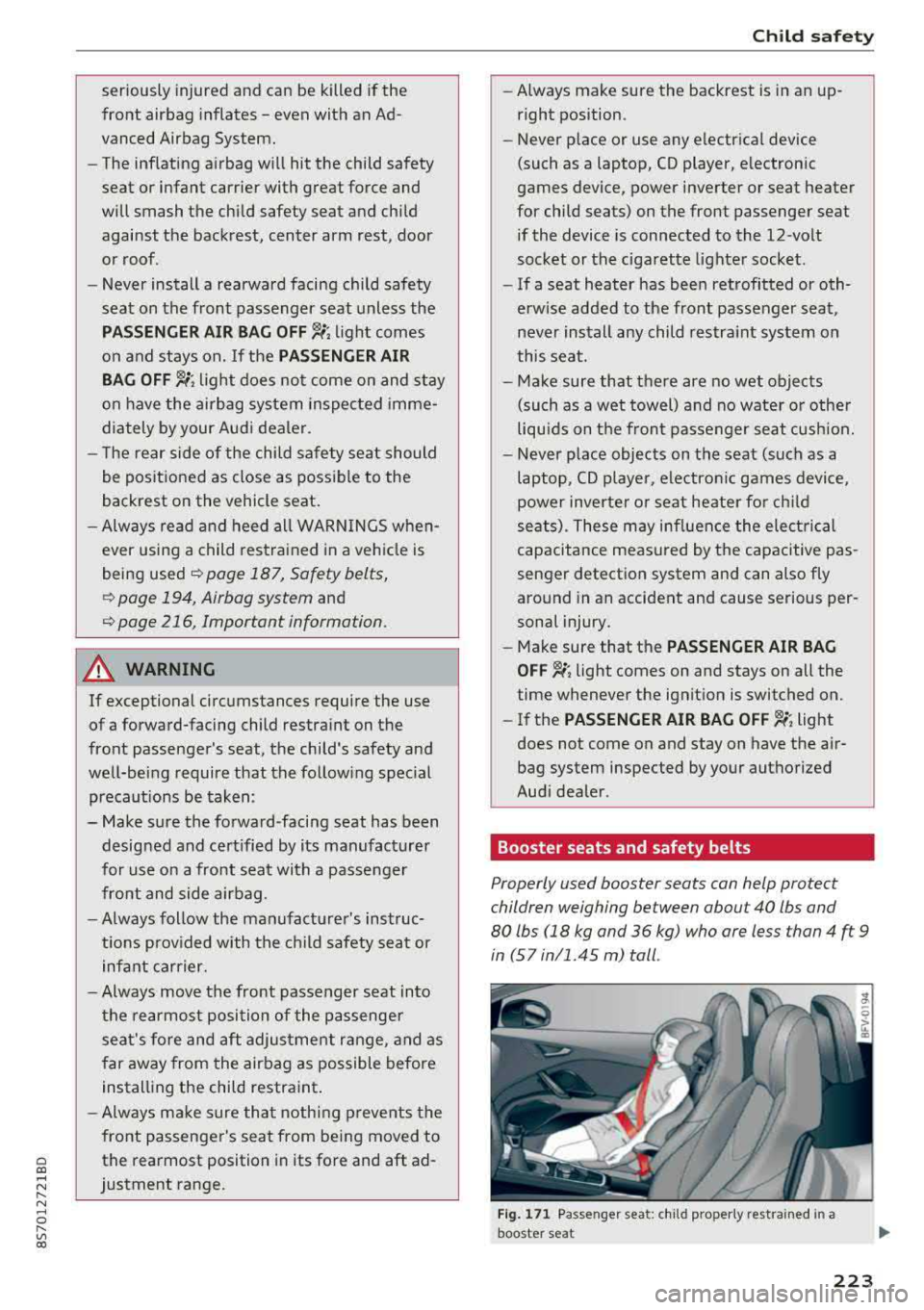
Booster seats and safety belts
Properly used booster seats con help protect
children weighing between abou t 40 lbs and
80 lbs (18 kg and 36 kg) who are less than 4 ft
9
in (5 7 in/1.45 m) tall .
Fig. 171 Passenger sea t: child properly restrained in a
booste r se at
223
Page 227 of 310

Cl 00 .-< N r--N .-< 0 r--Vl 00
-Children on the front seat of any car, even
with Advance d Airbags, can be seriously in
jured or even killed when an airbag inflates.
- Never let a child stand or knee l on the seat .
- Never let a child ride in the cargo area of
your vehicle.
-Always remember that a child leaning for
ward, sitting sideways or out of position in any way during an accident can be struck by
a deploying airbag . This will result in ser ious
personal injury or death.
- If you must install a booster seat on the front passenger seat because of exceptional c ircumstances the
PA SSENGER AIR BAG
OFF ~; light must come on and stay on,
whenever the ignition is switched on .
- If the PASSENGER AIR BAG OFF~; light
does not come on and stay on, perform the
checks descr ibed
¢ page 205, Monitoring
the Advan ced Airbag System.
- If the PASSENGER AIR BAG OFF ~; light
does not come on and stay on wheneve r the
ignition is switched on the infla ting airbag
will hit the child safety sea t or i nfant ca rr ier
with great force and will smash the child
safety seat and child against the bac krest,
center armrest, doo r or roof . Have the ai r
bag system inspected immediately by your
Audi dealer.
- Always read and heed all WARNINGS when
ever using a child restrained in a veh icle is
being
used¢ page 187, Safety belts,
¢ page 194, Airbag system and
¢page 216, Important information .
Securing child safety
seats
Securing a child safety seat using a safety
belt
Safe ty belts for the front passenger can be
locked with the convertible locking retractor to
properly secure child safety seats .
The safety belt emergency locking ret ractor fo r
the fro nt passenger's seat safety belt have a con
ve rt ible lock ing retractor for child restra ints . The
safety belt must be locked so t hat belt webb ing
Ch ild saf ety
cannot unreel. The retractor can be activated to
l ock the safety belt and p revent the safety be lt
webb ing from loosening up dur ing no rma l driv
ing . A chi ld safety seat can only be properly in
stalled when the safety belt is locked so that the
c hi ld and ch ild safety seat will stay in p lace .
Always remembe r: Even thoug h your ve hicle is
equipped with an Advanced Airbag system, a
c hi ld shou ld always r ide in the seat proper ly re
strained for its age and s ize .
A WARNING
-
Imp roperly installed child safety seats in
crease the ris k of serious personal injury and
d eat h in a co llision.
- Always make sure that the safety be lt re
tractor is locked w hen installing a child
safety sea t. An unlo cked safe ty be lt retra c
tor cannot hold t he ch ild sa fety sea t in place
du ring normal driving or in a crash.
- Always buckle the child safety seat fi rmly in
place even if a ch ild is not si tt ing in it . A
loose child safety seat can fly a round dur ing
a sudden s to p or in a co llision .
- If the backrest is not se curely latched, the
child and the ch ild restraint will be thrown
forward togethe r with the backrest and w ill
strike parts o f the veh icle inter ior. The child
can be seriously injured or killed.
- The inflating airbag will h it the ch ild safety
seat o r infant ca rrier with great force and
will smash the child safety seat and child
aga inst the backrest, center a rmrest, door
or roof.
- Forward-facing child safety seats o r infant
car riers installed on the front passenger's
seat may in terfere w ith the deployment o f
the airbag and ca use serio us in ju ry to t he
child.
- Always read and hee d all WARNINGS when
eve r using a child restrained in a vehicle is
be ing used
¢ page 216. Spe cial precautions
apply w hen ins tall ing a child safety seat on
the front passenge r seat
r=;, page 195, Child
restraints on the front seat
-some impor-
tant things to know .
~
225
Page 228 of 310

Child sa fety
A WARNING
Always take specia l precautions if you must
install a forward or rearward-facing chi ld re
straint on the front passenger's seat in excep
tional situations:
- Whenever a forward or rearward-facing
child restraint is installed on the front pas
senger seat, the
P ASS ENGER AIR B AG OFF
'-i; light must come on and stay on whenev
er the ignition is sw itched on .
- If the
PASS ENGER AIR B AG O FF ~; light
does not come on and stay on, perform the
checks descr ibed
<=> page 205, Monitoring
the Advanced Airbag System.
- If the PA SSENGER AIR BAG OFF ~; light
does not come on and stay on whenever the
ignition is switched on the inflating airbag
will hit the child safety seat o r infant ca rr ier
with great force and will smash the child safety seat and child against the backrest,
center armrest, door or roof . Have the air
bag system inspected immediately by your
Audi dealer.
- Improper installation of chi ld restraints can
red uce their effect iveness or even prevent
them from providing any protection.
- An improperly installed chi ld restraint can
interfere with the airbag as it deploys and
seriously injure or even kill the child.
- Always carefully follow the manufacturer's
instructions provided w ith the ch ild safety
seat or carrier.
- After checking to make sure that the child
restra int is properly installed, make certain
that the child restraint is correctly recog
nized by the capac it ive passenger detection
system in the front passenger seat and that
the
PASSENGER AIR BAG OFF '-i; light sig
nals the co rrect front passenge r frontal air
bag status.
A WARNING
Forward-fac ing ch ild rest raints:
- Always make sure the forward-facing seat
has been designed and cert ified by its man
ufact urer for use on a front seat with a pas
senger front and side airbag .
226
--
Never put the forward-facing child restraint
up, against or very near the instrument pan
el.
- Always move the passenger seat into its
rearmost posit ion in the seat's fore and aft
adjustment range, as far away from the a ir
bag as poss ible before installing the for
ward-facing chi ld restraint. The backrest
must be adjusted to an upr ight position.
- Make sure that the
PASSENGER AIR BAG
OFF
'-i; light comes on and stays on all the
time wheneve r the ign it ion is switched on.
A WARNING
Rearward-facing chi ld restraints:
- A child in a rearward-fac ing ch ild safety seat
installed on the front passenger seat will be
serious ly injured and can be killed if the
front airbag inflates
-even with an Ad
vanced Airbag System.
- The inflating airbag will h it the ch ild safety
seat o r infant c arr ier with great force and
w ill smash the child safety seat and child
against the backrest, center armrest, door
or roof.
- Always be especially carefu l if you must in
stall a rearward facing child safety seat on
the front passenger seat in exceptiona l cir
cumstances.
- Make sure that the
PASSENGER AIR BAG
OFF
'-i; light comes on and stays on all the
time whenever the ign it ion is switched on.
- If the
PASSENGER AIR BAG OFF '-i; light
does not come on and stay on, have the air bag system inspected by your Audi dealer.
Activating the convertible locking retractor
Use the convertible locking retractor to secure a
child restraint.
A lways heed the c hil d safety seat manufacturer's
instructions when insta lling a child restraint in
your vehicle. To activate the convertib le locking
retractor:
.,. Place the chi ld restraint on a seat .
.,. Slowly pull the belt all the way out .
Page 250 of 310

Wheel s
Load rating (code )
means the maximum load that a
tire is ra ted to carry for a given in
flation pressure. You may not find
this info rmatio n on all tires be
cause it is not required by law .
Maximum load rating
means the load rating for a tire at
the maximum permissible infla
tion pressure for that tire .
Maximum loaded vehicle
weight
means the sum of:
(a) Curb weight
(b) Accessory weight
(c) Vehicle capacity weight, and
(d) Production options weight
Ma ximum (permissible )
inflation pressure
means the maximum cold infla
tion pressure to which a tire may be inflated . A lso called "maxi
mum inflation pressure."
Normal occupant weight
means 150 lbs (68 kg) times the
number of occupants seated in
the vehicle up to the total seating
capacity of your vehicle.
248
Occupant distribution
means distribution of occupants
in a vehicle.
Outer diameter
means the overall diameter of an
inflated new tire.
Overall width
means the linear distance be
tween the exteriors of the side
walls of an inflated tire, inc lud ing
elevations due to labeling, deco rations, or protective bands or
ribs.
Ply
means a layer of rubber-coated
parallel cords.
Production options weight
means the combined weight of
those installed regular production options weighing over 5 lbs
(2 .3 kg) in excess of those stand
ard items which they replace, not
previously considered in curb
weight or accessory weight, in cluding heavy duty brakes, ride
levelers, roof rack, heavy duty
battery, and special trim.
Radial ply ti re
means a pneumatic tire in which
the ply cords that extend to the
...
Page 293 of 310

Cl 00 .-< N r-N .-< 0 r-Vl 00
scope of maintenance and repairs which can be
carried out by vehicle owners.
Al so, sa fety a nd
en vir onment al
concerns place very strict limits
on the nature of repairs and adjustments to en
g ine and transm ission parts wh ich an owner can
perform .
Maintenance, adjustments and repairs usually re
qu ire special tools, test ing devices and other
equ ipment available to specially trained work
shop personnel in order to assure proper per
formance, rel iability and safety of the veh icle and
its many systems .
Improper maintenance, adjustments and repairs
can impair the operation and reliability of your
veh icle and even void your vehicle warranty .
Therefore, proof of servicing in accordance with
the ma intenance sc hedule may be a condition for
upho ld ing a possib le wa rranty claim made within
the warranty period.
Above all, operational safety can be adversely af
fected, creating unnecessa ry risks fo r you and
your passenger.
If i n doubt about any servicing, have it done by
your author ized Audi dealer or any other properly
equ ipped and qua lified workshop. We strongly
urge yo u to g ive your author ized Audi dealer the
opportunity to perform a ll scheduled ma inte
nance and necessary repairs. Your dealer has the
facilities, origina l parts and trained specialists to
keep your vehicle running properly .
Performing limited m aint ena nc e y our self
The follow ing pages describe a lim ited number of
p rocedures w hich can be per formed on your ve hi
cle with ordinary tools, should the need arise and
trained personnel be unavai lable . Before per
forming any of these procedures, always thor
ough ly read a ll of the app licab le text and carefu l
ly follow the instructions g iven . Always rigorously
observe the
W ARNING S provided .
Before you ch eck anything in the engine com
partment , always read a nd heed all WARNIN GS
c> & and c> & in Working in the engine compart
ment on page 233 . Con
sum er In form ation
A WARNING
--
- Ser ious personal injury may occur as a result
of improperly performed maintenance, ad
justments or repairs .
- Always be extremely careful when work ing
on the vehicle . Always follow commonly ac
cepted safety practices and general com mon sense. Never risk pe rsonal inj ury.
- Do not attempt any of the maintenance,
checks or repairs described on the following pages if you are not fu lly famil iar with these
or other proced ures with respect to the ve
h icle, or are uncerta in how to pro ceed.
- Do not do any work without the proper tools
and eq uipment. Have the necessary wo rk
done by your authorized Audi dealer or an
other proper ly equipped and qualified work
shop.
- The engine compartment of any motor vehi
cle is a potentially hazardous area . Never
reach into the area around or touch the radi
ator fan.
It is temperature controlled and
can switch on suddenly
-even when the en
g ine is off . The radiator fan switches on au
tomatically when the coolant reaches a cer
tain tempe rature and will cont inue to run
until the coolant temperature d rops.
- Always sw itch off the ignition before anyone
gets under the vehicle.
- Always support your veh icle with safety
stands if it is necessary to work underneath
the vehicle. The jack suppl ied with the veh i
cle is no t adequate for this pu rpose and
could collapse caus ing serious personal in
jury.
- I f you must wor k unde rneath the vehicle
with the wheels on the ground, always make
sure the vehicle is on level ground, that the
wheels are always securely blocked and that
the engine cannot be started.
- Always make sure the transmission se lector
lever (automatic transmiss ion) is in P (Park
position) and the park brake is applied.
II>
291