2018 AUDI S3 SEDAN led
[x] Cancel search: ledPage 253 of 404
u. 00 .-< N l' N .-< 0 N > 00
-Pointing the steering wheel toward your
face decreases the ability of the supplemen
tal driver's airbag to protect you in a colli sion.
- Always sit in an upright position and never
lean against or place any part of your body
too close to the area where the airbags are
located.
- Before driving, always adjust the front seats
properly and make sure that all passengers
are properly restrained.
- For adjustable head restraints : before driv
ing, always also adjust the head restraints
properly.
- Never adjust the seats while the vehicle is moving . Your seat may move unexpectedly
and you could lose control of the vehicle.
- Never drive with the backrest reclined or
tilted far back! The farther the backrests are
tilted back, the greater the risk of injury due
to incorrect positioning of the safety belt
and improper seating position.
- Children must always ride in child seats
~ page 294. Special precautions apply
when installing a child seat on the front
passenger seat
i::> page 269 .
Proper seating position for the front
passenger
The proper front passenger seating position is
important for safe, relaxed driving.
For your own safety and to reduce the risk of in
jury in the event of an accident, we recommend that you adjust the seat for the front passenger
to the following position:
.. Adjust the angle of the seatback so that it is in
an upright position and your back comes in full
contact with it whenever the vehicle is moving.
.. For adjustable head restraints: adjust the head
restraint so the upper edge is as even as possi
ble with the top of your head. If that is not pos
sible, try to adjust the head restraint so that it
is as close to this position as possible
~ page 61. Move the head restraint so that it is
as close to the back of the head as possible.
Driving safety
.. Keep both feet flat on the floor in front of the
front passenger seat.
.. Fasten and wear safety belts correctly
<=:>page 264.
For detailed information on how to adjust the
front passenger's seat, see
<=:>page 59.
A WARNING
= -
Front seat passengers who are unbelted, out
of position or too close to the airbag can be
seriously injured or killed by the airbag as it
unfolds . To help reduce the risk of serious
personal injury:
- Passengers must always sit in an upright po
sition and never lean against or place any part of their body too close to the area
where the airbags are located.
- Passengers who are unbelted, out of posi
tion or too close to the airbag can be seri
ously injured by an airbag as it unfolds with
g reat force in the blink of an eye.
- Always make sure that there are at least
10 inches (25 cm) between the front pas
senger's breastbone and the instrument panel.
- Always make sure that there are at least
4 inches (10 cm) between the front passen
ger's knees and the lower part of the instru
ment panel.
- Each passenger must always sit on a seat of
their own and properly fasten and wear the
safety belt belonging to that seat.
- Before driving, always adjust the front pas
senger seat properly.
- For adjustable head restraints: before driv
ing, always also adjust the head restraints
properly .
- Always keep your feet on the floor in front
of the seat. Never rest them on the seat, in
strument panel, out of the window, etc. The
airbag system and safety belt will not be
able to protect you properly and can even in
crease the risk of injury in a crash .
- Never drive with the backrest reclined or
tilted far back! The farther the backrests are
tilted back, the greater the risk of injury due
~
251
Page 256 of 404
Drivin g saf ety
proper deployment of the airbag. Small ob
jects can be thrown through the vehicle if the a irbag deploys and injure you or your
passengers .
Pedal area
Pedals
The pedals must always be free to move and
must never be interfered with by a floor mat or
any other object.
Make sure that all pedals move freely without in
terference and that not hing prevents them from
retu rni ng to the ir origi na l positions.
Only use floor mats that leave the pedal area free
and can be secured with floor mat fasteners .
If a brake c ircuit fa ils, increased brake peda l trav
el is required to br ing the veh icle to a full stop .
A WARNING
Pedals that cannot move freely can cause loss
of vehicle control and inc rease the risk of ser i
ous
in Jur y.
-Never place any objects in t he driver's foot
we ll. An object cou ld get into the peda l area
and interfere w it h pedal fu nction. In case of
s u dden brak ing o r an accident, yo u wo uld
not be ab le to brake or accelerate!
- Always make sure that noth ing ca n fa ll o r
move in to the dr iver's foo twell .
Floor mats on the driver side
Always use floor mats that can be securely at
tached to the floor mat fasteners and do not in
terfere with the free movement of the pedals .
.,. Make sure that the floor mats are properly se
cu red and cannot move and inte rfe re with the
peda ls ~ & -
Use o nly floo r mats that leave the pedal a rea un
obstructed and that are firmly secured so that
they cannot slip out of pos it ion. Yo u ca n ob tain
sui table floo r ma ts from yo ur autho riz ed Aud i
Dea le r.
254
Floor mat fasteners are installed in your Audi .
Floor mats used in you r vehicle must be attached
to these fasteners . Properly secur ing the floor
mats will p revent them from slid ing into pos i
tions that could interfere with the pedals or im
pair safe operation of your vehicle in other ways.
A WARNING
Pedals that cannot move freely can res ult in a
l oss of vehicle contro l and increase the r isk of
serious personal injury.
- Always make sure that floor mats are prop erly secured.
- Never p lace or install floor mats o r other
floor coverings in the vehicle that cannot be properly secured in place to prevent them
from s lipping and interfer ing with the ped
als or the ab ility to control the vehicle .
- Never p lace or install floor mats or other
floor coverings on top of already installed
floor mats . Additional floor mats and other
cover ings will reduce the si ze of t he pedal
a rea and interfe re w ith the pedals.
- Always properly re insta ll and sec ure floo r
mats that have been ta ke n out for clea ning.
- Always make sure that objects cannot fall
into t he d river footwe ll whi le the vehicle is
mov ing. Objects can become t rapped under
t he br ake pedal and accelerator pedal c aus
ing a loss o f vehicle con trol.
Page 259 of 404

LL co .... N
" N .... 0 N > co
Active rollover protection system
Function
Applies to: vehicles wit h power top
The rollover protection system protects vehicle
occupants in the event of a rollov er.
........ ..._____ ----
F ig. 220 Re ar seats: rol lb ar deploy men t ran ge
----
Fig. 221 Rear seats: deployed rollbar
,.-., I ~--, 1' I
' ' I ' I I
The ac tive rollover prote ction sys tem consists of :
- two ro llbars
- the safety belts with belt tensioners
- the windshie ld frame
- the rollover sensors
The active rollover prote ction system provides
additional sa fety in the event of a rollover . With
in m illiseconds, sensors deploy two rollbars lo
cated behind the head restraints in the rear seats
¢ fig. 221 .
The rollbars, re inforced windshield frame and
belt tensioners help protect front and rear pas
sengers in the event of a rollover .
The rollover protec tion system functions when
t he power top is both open and closed .
Dri ving safety
A WARNING
Do not use the area behind the rear seat head
restraints
¢ fig . 220 as a seat or storage area .
This is the area where the rollbars deploy . If
the rollover protection system is t riggered,
objects placed there can be p ropelled th rough
the veh icle and ma ke it more diffic ult for the
r ollbars to deploy. This increases the risk for
serious or life -threatening injuries.
When is rollover protection deployed?
Applies to: veh icles w ith power top
Rollover protection deploys in a collision or roll
over.
Depend ing on the co llision, senso rs thro ughout
the vehicle and the co ntro l modu le trigger the
rollove r system to deploy.
For safety reasons, rollover protection also de
ploys during front, s ide and rear collisions above
a certain level of severity.
Retracting rollover protection
Applies to: veh icles w ith power top
Fig . 222 De ployed ro llbar wi th release loo p.
-
~
8
> CD a,
Fig. 223 De ployed ro llbar w ith powe r to p frame facing up·
-~-~
257
Page 263 of 404

LL co .... N
" N .... 0 N > co
injury and death in automobile accidents.
For your protect ion and that of your passen
gers, always correctly wear safety belts
when the vehicle is moving .
- Failure to pay attention to the warn ing light
that come on, could lead to personal injury.
Why use safety belts?
Frontal collisions and the law of physics
Frontal crashes create very strong forces for peo
ple riding in vehicles .
Fig . 225 Unbe lted occupants in a veh icle head ing fo r a wall
Fig . 2 26 The ve hicle c rashes into the wall
The physical principles are simple . Both the vehi
cle and the passengers possess energy which var
ies w ith veh icle speed and body we ight. Engi
neers call this energy "k inetic energy ."
The higher the speed of the vehicle and the
greater the vehicle's we ight, the more energy
that has to be "absorbed" in the crash.
Vehicle speed is the most signif icant facto r. If
the speed doubles from 15 to 30 mph (25 to
SO km/h), the energy increases 4 times!
Because the passengers of t his veh icle are not us
ing safety
belts ~ fig. 225, they will keep mov ing
Safet y bel ts
at the same speed the vehicle was moving just
before the crash, until something stops them -
here, the
wall ~ fig. 226 .
The same p rinciples apply to people s itting in a
vehicle that is invo lved in a fronta l co llision. Even
at city speeds of 20 to 30 mph (30 to SO km/h),
the forces acting on the body can reach one ton (2,000 lbs, o r 1,000 kg) or more. At greater
speeds, these forces are even higher.
People who do not use safety belts are a lso not
attached to the ir vehicle . In a frontal col lis ion
they will also keep mov ing forward at the speed
their vehicle was travelling just before the crash. Of course, the laws of physics don't just apply to
frontal collisions , they determine wha t happens
in a ll kinds of accidents and co llisions .
What happens to occupants not wearing
safety belts?
In crashes unbelted oc cupants cannot stop
them selves from flying forward and being in
jured or killed. Always wear your safety belts!
Fi g. 227 A driver not wear ing a safe ty belt is violen tly
throw n forward
Fig. 228 A rea r passe nge r not we aring a safety be lt w ill fly
forwa rd a nd strike t he drive r
Ill-
261
Page 264 of 404

Safety belts
Unbelted occupants are not able to resist the tre
mendous forces of impact by holding tight or
bracing themselves. Without the benefit of safe
ty restraint systems, the unrestrained occupant
will slam violently into the steering wheel, in
strument panel, windshield, or whatever else is
in the
way ¢ fig. 227. This impact with the vehi
cle interior has all the energy they had just be
fore the crash.
Never rely on airbags alone for protection . Even
when they deploy, airbags provide only add itional
protection . Airbags are not supposed to deploy in
all kinds of accidents. Although your Audi is
equipped with airbags, all vehicle occupants, in
cluding the driver, must wear safety belts cor
rectly in order to minimize the risk of severe in
jury or death in a crash.
Remember too, that airbags will deploy only
once and that your safety belts are always there
to offer protection in those accidents in which
airbags are not supposed to deploy or when they
have already deployed. Unbelted occupants can
also be thrown out of the vehicle where even
more severe or fatal injuries can occur.
It is also important for the rear passengers to
wear safety belts correctly. Unbelted passengers
in the rear seats endanger not only themselves
but also the driver and other passengers
c> fig . 228 . In a frontal collision they will be
thrown forward violently, where they can hit a nd
injure the driver and/or front seat passenger.
262
Safety belts protect
People think it's possible to use the hands to
brace the body in a minor collision . It's simply
not true!
Fig. 229 Driver is correctly res trained in a sudde n braking
maneuver
Safety belts used properly can make a big differ
ence . Safety belts help to keep passengers in
their seats, gradually reduce energy levels ap
plied to the body in an accident, and help prevent
the uncontrolled movement that can cause seri
ous injuries. In addition, safety belts reduce the
danger of being thrown out of the vehicle.
Safety belts attach passengers to the car and give
them the benefit of being slowed down more gently or "softly" through the
"give" in the safety
belts, crush zones and other safety features engi
neered into today's vehicles. By "absorbing" the
kinetic energy over a longer period of time, the
safety belts make the forces on the body more
"tolerable" and less likely to cause injury .
Although these examples are based on a frontal
collision, safety belts can also substantially re
duce the risk of injury in other kinds of crashes.
So, whether you're on a long trip or just going to
the corner store, always buckle up and make sure
others do, too . Accident statistics show that vehi
cle occupants properly wearing safety belts have
a lower risk of being injured and a much better
chance of surviving an accident. Properly using
safety belts also greatly increases the ability of
the supplemental airbags to do their job in a col lision. For this reason, wearing a safety belt is le
gally required in most countries including much
of the United States and Canada.
.,.
Page 265 of 404

u. 00 .-< N l' N .-< 0 N > 00
Although your Audi is equipped with ai rbags, yo u
still have to wear the safety belts provided. Front
airbags, for examp le, are activated on ly in some
frontal coll is ions. The front a irbags are not acti
vated in all frontal coll is ions, in side and rear col
lisions, in roll overs or in cases where there is not
enough deceleration through impact to the front
of the vehicle. The same goes for the other airbag
sys tems in yo ur Audi . So, always wea r you r safety
be lt and ma ke sure eve rybody in yo ur vehicle is
properly restrained!
Important safety instructions about safety
belts
Safety belts must always be correctly positioned across the strongest bones of your body.
~ Always wea r sa fety be lts as i llust ra ted and de
scribed in this chapter.
~ Make sure that your safety belts are a lways
ready for use and are not damaged .
A WARNING
Not wearing safety belts or wearing them im
properly increases the risk of serious personal
injury and death . Safety be lts can work only
when used correctly.
- Always fasten your safety belts correctly be
fore dr iving off and make sure all passen
gers are correct ly restrained.
- For maximum protection, safety belts must
always be pos it io ned p roperly on the body .
- Never strap more tha n one person, includ
ing small ch ildren, into any belt .
- Never place a safety be lt over a chi ld sitt ing
on your lap.
- Always keep feet in the footwell in front of
the seat w hile the vehicle is be ing driven.
- Never let any pe rson ride w ith their feet on
the instrument pane l or st icking out the
window or on the seat .
- Never remove a safety belt while the vehicle
is mov ing. Do ing so w ill inc rease your r isk of
being in ju red or k illed.
- Never wear belts twisted.
- Never wear belts over rigid o r breakab le ob-
jects in or on your clot hing, such as eye
Safet y be lts
g lasses, pens, keys, etc ., as t hese may ca use
in jur y.
- Never a llow safety belts to become dam
aged by be ing ca ught in door or seat hard
ware.
- Do not wear t he shoulder part of the belt
under yo ur arm or otherwise o ut of pos ition.
- Several layers of heavy clothing may inter
fe re with co rrect pos ition ing of be lts and re
duce the ove rall effectiveness of the system.
- Always keep be lt buck les free of anything
that may prevent the buck le from latch ing
securely.
- Never use comfort cl ips or dev ices that cre
ate s lack in t he shoulder belt. However, spe
cial clips may be required for the proper use
of some child restraint systems.
- Torn or frayed safety be lts can tear, and
damaged be lt hardware ca n break in an acci
dent. Inspect be lts regularly . If webb ing,
b indings, buckles, or retractors are dam
aged, have belts rep laced by an author ized
Aud i deale r or q ualified wo rkshop.
- Safety belts that have been worn and loaded
i n an ac cident must be repla ced with the
cor rect replaceme nt sa fe ty belt by an a u
thor ized A udi dealer. Rep lacement may be
necessary even if damage cannot be clea rly
seen . Anchorages t hat we re loaded must a l
so be inspected.
- Neve r remove, modify, disassemble, o r try
to repair the safety belts yourse lf .
-A lways keep the belts clean. Dirty belts may
not wor k prope rly and ca n impair the func
tion of the inert ia reel
c> table Interior
cleaning on page 356.
263
Page 266 of 404
Safe ty belts
Safety belts
Fastening safety belts
Safety first -everybody buckle up!
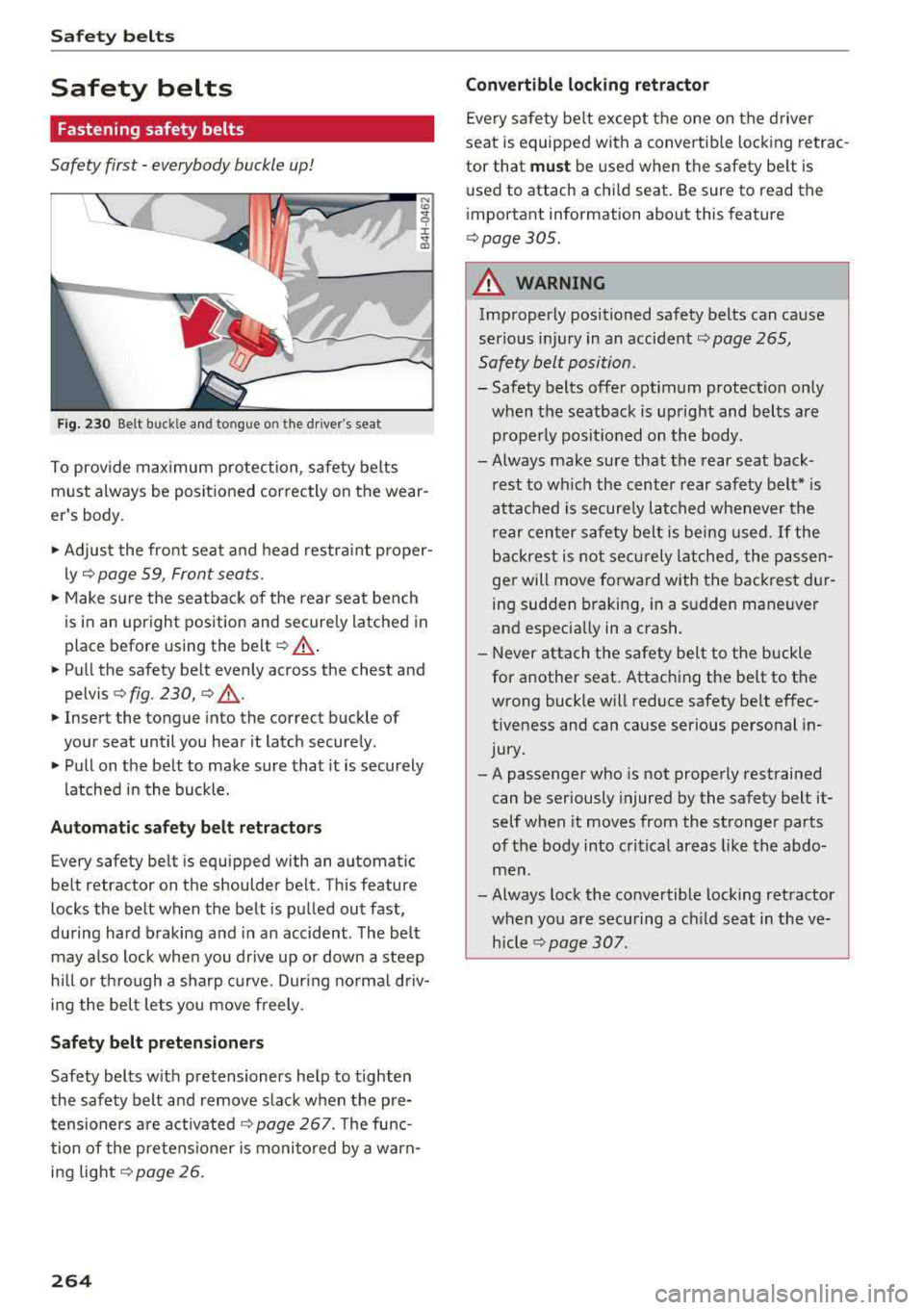
F ig. 230 Belt buckle and tong ue o n the dr iver's seat
N
To prov ide max imum protection, safety belts
must always be positioned correctly on the wear
er's body .
"'Adjust the fro nt sea t and head restra int proper
ly
¢ page 59 , Front seats .
"'Make su re the seatback of the rear sea t bench
is in an upright position and secure ly latched in
place before using the
belt ¢.&_ .
"'Pull the safety belt evenly across the chest and
pelvis ¢ fig. 230, ¢ .&_.
"'Insert the tongue into the correct buckle of
you r seat until you hear it latch securely .
"' Pull on the belt to make sure that it is securely
l atched in the buck le.
Autom atic safety belt retractors
Every safety belt is equipped with an automatic
belt retractor on the shoulder belt . This feature
locks the belt when the belt is pulled out fast,
du ring hard braking and in an accident . The be lt
may a lso lock when you drive up or down a steep
h ill or th rough a sharp curve. Dur ing no rma l dr iv
i n g the bel t lets you move freely.
Safety belt pretensioners
Safety belts w ith pretensioners help to tighten
the safety belt and remove slack when the pre tensioners a re
activated ¢ page 267. The func
tion of the pretens ioner is moni to red by a w arn
ing
light¢ page 26.
264
Convertible lock ing retractor
Eve ry safe ty belt except the one on t he d river
seat is equipped with a convertib le lock ing retrac
tor that
mu st be used when the safety be lt is
used to attach a ch ild seat. Be sure to read the
i mportant information about this feature
¢ page 305 .
A WARNING
Improperly positioned safety belts can cause
serious inj ury in an
accident ¢ page 265,
Safety belt position .
- Safety belts offer optimum protection only
when the seatback is up right and belts are
properly posit ioned on the body .
- Always make sure that the rear seat back
rest to which the center rear safety belt* is
at tached is securely latched whenever the
rear cen ter safety belt is being used.
If the
b ackrest is not sec urely latche d, the passen
ger will move forward with the bac krest du r
ing sudden b raking, in a sudden maneuver
and especia lly in a crash.
-Never attach the safety belt to the buckle
for another seat. Attaching the belt to the
wrong buckle will reduce safety be lt e ffec
tiveness and can cause serio us personal in
jury.
-A passenge r who is not properly restrained
can be seriously injured by the safety belt it
self when it moves from the stronger parts
of the body into cri tical areas like the abdo
men .
- Always lock the convertible locking retractor when yo u are securing a c hild seat in the ve
h icle
~ page 307.
Page 268 of 404
Safety belts
Unfastening safety belts
Unbuckle the safety belt with the red release
button only after the vehicle has stopped .
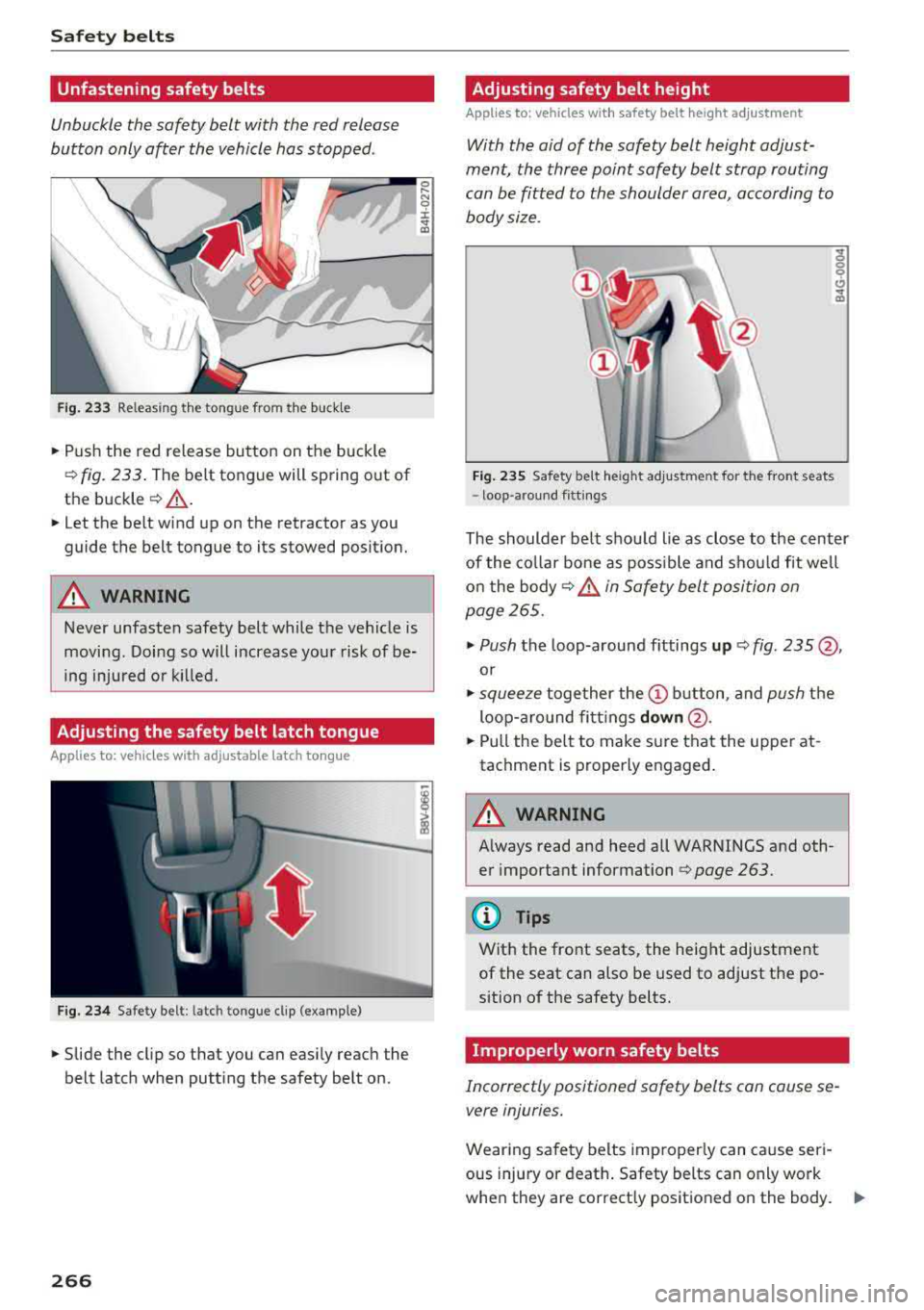
Fig. 233 Releasing the tongue from the buckle
.,. Push the red release button on the buckle
¢
fig. 233. The belt tongue will spring out of
the buckle ¢
,&.
.. Let the belt wind up on the retractor as you
guide the belt tongue to its stowed position.
A WARNING
Never unfasten safety belt while the vehicle is
moving. Doing so will increase your risk of be
ing injured or killed.
Adjusting the safety belt latch tongue
Applies to: vehicles with adjustable latch tongue
Fig. 234 Safety belt: latch tongue cl ip (example)
.. Slide the clip so that you can easily reach the
belt latch when putting the safety belt on .
266
0 i:::; 0 ± .. a,
Adjusting safety belt height
Applies to: vehicles with safety belt height adjustment
With the aid of the safety belt height adjust
ment, the three point safety belt strap routing
can be fitted to the shoulder area, according to
body size .
Fig. 235 Safety belt heigh t adjustment for the front seats
-loop-around fittings
The shoulder belt shou ld lie as close to the center
of the collar bone as possible and shou ld fit well
on the body¢
A in Safety belt position on
page 265 .
.,. Push the loop-around fittings up q fig . 235 @,
or
.,. squeeze together the (D button, and push the
loop-a round fittings
down @.
.. Pull the belt to make sure that the upper at
tachment is properly engaged.
A WARNING
Always read and heed all WARNINGS and oth
er important information¢
page 263.
(l} Tips
With the front seats, the height adjustment
of the seat can also be used to adjust the po
sition of the safety belts.
Improperly worn safety belts
Incorrectly positioned safety belts can cause se vere injuries.
Wearing safety belts imp roper ly can cause seri-
ous injury or death. Safety belts can only work
when they are correct ly positioned on the body.
IIJ,,