2018 AUDI Q7 brake
[x] Cancel search: brakePage 258 of 398

Drivin g saf ety
- Never attempt to adjust head restraint
wh ile driving. If you have dr iven off and
must adjust the driver headrest for any rea
son, first stop the vehicle safely before at
tempting to ad just the head restra int.
- Children must always be properly restrained
in a child restraint that is appropriate for
their age and size
c> page 291 .
Examples of improper seating positions
The occupant restraint system can only reduce
the risk of injury if vehicle occupants are properly
seated .
Improper seating positions can cause serious in
jury or deat h. Safety belts can only work when
they are properly positioned on the body . Im
proper seating positions reduce the effect iveness
of safety belts and w ill even increase the r isk of
i n ju ry and death by moving the safety be lt to crit
ical a reas of t he body. Improper seat ing posit ions
a lso increase the risk of serious injury and dea th
when an airbag deploys and strikes an occupant
who is not in the proper seating position. A driver is responsib le for the safety of all vehicle occu
pants and especially for children. Therefore :
~ Never allow anyone to assume an incorrect
seating position when the vehicle is being used
c> & .
The fo llowing bulletins list only some sample po
sitions that wi ll increase the risk of serio us inj ury
and death. Our hope is that these examples will
make you more aware of seating posit ions that
are dangerous.
The refore, when ever th e vehicle i s mo ving :
-never stand up in the vehicle
- never s tand on the seats
- never knee l on the seats
- never r ide with the seatback reclined
- never lie down on the seats
- never lean up against the instrument pane l
- never sit on the edge of the seat
- never sit sideways
- never lea n ou t t he w indow
- never put yo ur feet out the window
256
-never put your feet on the instrument panel
- neve r rest your feet on the seat c ushion or bac k
o f the seat
- neve r ride in the footwell
- never ride in the cargo area
.8, WARNING
Imp roper seating positions in cr ease the risk
of ser ious personal inju ry and dea th whenever
a veh icle is being used.
- Always make sure that all veh icle o ccupants
s tay in a proper sea ting posit ion and a re
proper ly restrained whenever the vehicle is
being used .
Pedal area
Pedals
The pedals must always be free to move and
must never be interfered with by a floor mat or
any other object.
Make sure that all pedals move free ly without in
terference and that nothing prevents them from retur ning to their or ig inal pos itions .
Only use floor mats that leave the pedal area free
and can be secured with floor mat fasteners.
If a bra ke circuit fails, increased brake pedal trav
e l is req uired to bring the vehicle to a fu ll stop.
.8, WARNING
Pedals that cannot move freely can cause loss
of vehicle contro l and increase the r isk of seri
ous injury.
- Never p lace any objects in the driver's foot
wel l. An object could get into the pedal area
and interfere with pedal funct ion. In case of
sudden braking or an acc ident, you would
no t be able to brake o r acce le rate!
- Always make sure that nothing can fall or
move into the driver's footwell.
Page 259 of 398

a co ...... N r--. N ...... 0
0
:E '
Always use floor mats that can be securely at
tached to the floor mat fasteners and do not in
terfere with the free movement of the pedals.
.,. Make sure that the floor mats are properly se
cured and cannot
move and interfere with the
pedals ¢&_ .
Use only floor mats that leave the pedal area un
obstructed and that are firmly secured so that
they cannot slip out of pos it ion . You can obtain
suitab le floor mats from your authorized Audi
deale r.
F loor mat fasteners are installed in your Audi.
Floor mats used in your vehicle must be attached
to these fasteners. Proper ly securing the floor
mats will prevent them from sliding into posi
tions that could interfere with the pedals or im
pa ir safe operation of your vehicle in other ways.
A WARNING
Peda ls that cannot move free ly can result in a
loss of vehicle control and increase the risk of
ser ious personal in jury.
- Always make sure tha t floor mats are p rop
erly sec ured.
- Never place o r install floor mats or other
floo r coverings in the ve hicle that cannot be
prope rly secured in place to prevent them
from slipp ing and interfering with the ped
als or the ability to control t he vehicle .
- Never place o r inst all floo r m ats or o ther
floor coverings on top of already insta lled
floo r mats. Additional floor mats and other
cove rings wi ll reduce the size of the peda l
area and interfere with the pedals.
- Always properly reinstall and secure floor
mats that have been taken o ut for cleaning.
- Always make sure that objects cannot fa ll
into the dr iver footwell while the veh icle is
moving. Objects can become trapped under
the brake peda l and accelerator peda l caus
ing a loss of veh icle control.
Dri ving sa fety
Storing cargo correctly
Loading the luggage compartment
All luggage and other objects must be properly
stowed and secured in the luggage compart
ment .
Fig . 221 Safe load pos ition ing: place heavy objects as low
a n d as far forward as possible.
Loose items in the luggage compartment can
sh ift suddenly, changing vehicle hand lin g charac
te ristics. Loo se i tems can a lso increase the risk of
se rious persona l injury in a sudden veh icle ma
neuver or in a collision .
.,. Distr ibute the load evenly in the luggage com
pa rtment .
.,. Always p lace and properly secu re heavy items in
t he l uggage compartment as low and as far for
wa rd as possib le
¢ fig . 221.
.,. Secure luggage usi ng the tie -downs provided
¢ page 64.
.,. Make sure that the rear seatback is secure ly
latched in place.
A WARNING
-
Improperly stored luggage or other items can
f ly through the vehicle ca us ing se rious per
sona l injury i n the event of ha rd bra king or an
accident. To help reduce the risk of serio us
personal injury:
- Always put obje cts, for examp le, l uggage or
o ther heavy item s in the luggage compa rt
men t.
- Always secure objects in the luggage com
p art ment us ing the tie-down eyelets and
suitable straps .
257
Page 321 of 398

Cl a:, ...... N
" N ...... 0
0
::r -
Working in the engine compartment
Special care is required if you are working in the engine compartment
F or wo rk in th e en gine co mpartm en t, suc h as
ch eck ing and filli ng flu id s, th ere is a r isk o f in
jur y, sca lding, ac cident s, a nd b urn s. Fo r this
re aso n, follow all the warning s and gener al
s af ety pr ecau tions pr ovided in the f ollowin g in
f o rm ation . The engine comp artm en t is a d an
g ero us ar ea .
¢ ,&. .
A WARNING
- T urn the engine off.
- Swit ch the ign ition off.
- Set the parking brake .
- Select the "P" selector lever posit ion .
- Let the engine cool down.
- Never open the hood when there is steam or coolant escaping from the eng ine compart
ment, because there is a risk that you could
be burned . Wait until no steam or coolant is
escaping.
- Keep children away from the engine com
partment .
- Never spill flu ids on a hot engine. These flu
ids (such as the anti -freezing agent con
tained in the coolant) can ignite .
- Avoid short circu its in the electrical system .
- When working in the engine compartment,
remember that the radiator fan can sw itch
on even if the ign ition is switched off, which
increases the risk of injury .
- Never open the cap on the coolant expan
sion tank when the eng ine is warm. The
cooling system is under pressure .
- To protect your face, hands, and arms from hot steam or coolant, cover the cap with a
large cloth when opening.
- Do not remove the engine cover under any circumstances . This increases the risk of
burns.
- If tests need to be performed w ith the en
gine running, there is additional danger due
to moving components (such as the ribbed
Ch eck ing and F illing
be lt, alternator and radiator fan) and from
the high-voltage ignition system.
- Do not under any circumstances activate the
throttle inadvertently (for example, by hand
from the engine compartment) if the veh i
cle is stat ionary but the eng ine is running
and a gear is engaged . Otherwise, the veh i
cle will start to move immed iately and this
could result in an acc ident.
- Pay attent ion to the following warnings
when work on the fue l system is required :
- Do not smoke .
- Never wor k nea r open flames .
- Always have a working fi re extingu isher
nearby.
- All work on the battery or electrical system
in your veh icle can result in inju ries, chemi
cal burns, acc iden ts or bu rns . Because of
this, all work m ust be performed
onl y by an
authorized Audi dealer or authorized Audi
Service Facility.
- To reduce the risk o f electric shock and in
jury, never touch the following components
when the engine is running or is being start
ed:
- Ign it ion cable
- Other components in the electronic high -
voltage ign ition system
- If you must check or perform work on the
engine wh ile it is running:
- Set the parking brake first and then se lect
the "P" selector lever position .
- Always proceed w ith extreme caution so
that clothing, jewelry or long hair do not
become caught in the radiator fan, fan
belt or other moving components or do
not come into contact with hot compo
nents. Tie back long hair before beginning
work and do not wear clothing that can hang down into the engine .
- lim it your exposure to exhaust and chemi
cals to as short a time as possible
¢ ,&. .
A WARNING
California Proposition 65 Warning:
319
Page 323 of 398

a co ...... N r--. N ...... 0
0
:E '
could fly up while you are driv ing and ob
struct your vision.
Engine compartment overview
The most important check points.
Chec king and Filling
Fig . 2 63 Typ ical location of the reservoir a nd t he eng ine o il filler ope ning
@ Jump start point(+) under a cover,(-) with
hex head screw
c::> page 32 7 c::> page 369
@ Coolant expans ion tank ( - L) c::> page 325
@ Engine oi l label * with VW standard
<=:> page 321
© Engine oil filler opening ('t=:r.) c::> page 322
® Brake f luid reservoir ((0)) c::> page 326
® Washer fluid reservoir (~) c::> page 328
The coolant expansion tank @and the engine oil
fi ller opening ©
c::> fig. 263 may be located in dif
ferent places depending on the engine version.
A WARNING
Read and follow all WARNINGS before check
ing anything in the eng ine compartment
c::> page 319.
Engine oil
If the engine oil level is too low
If you need to add engine oil, us e an oil that i s
li sted on the st icker.
The sticker is located at the
front of the engine compartment
c::> page 321 ,
fig. 263.
If the recommen ded engine o il is not avai lab le,
in an emergency you may add a maximum of 1
quart
( l liter) of ACEA C3 or API SN eng ine oi l
one time until the next oil change.
F or more i nformation on the correct eng ine oil
for yo ur vehicle, contact an author ized A udi deal
er or authorized Aud i Service Facility . Have the o il
c h anged by an authorized Audi dealer or author-
i z ed Service Facility.
ll>
321
Page 328 of 398
Checking and Filling
Brake fluid
N
N
~ N ,l: CX) al
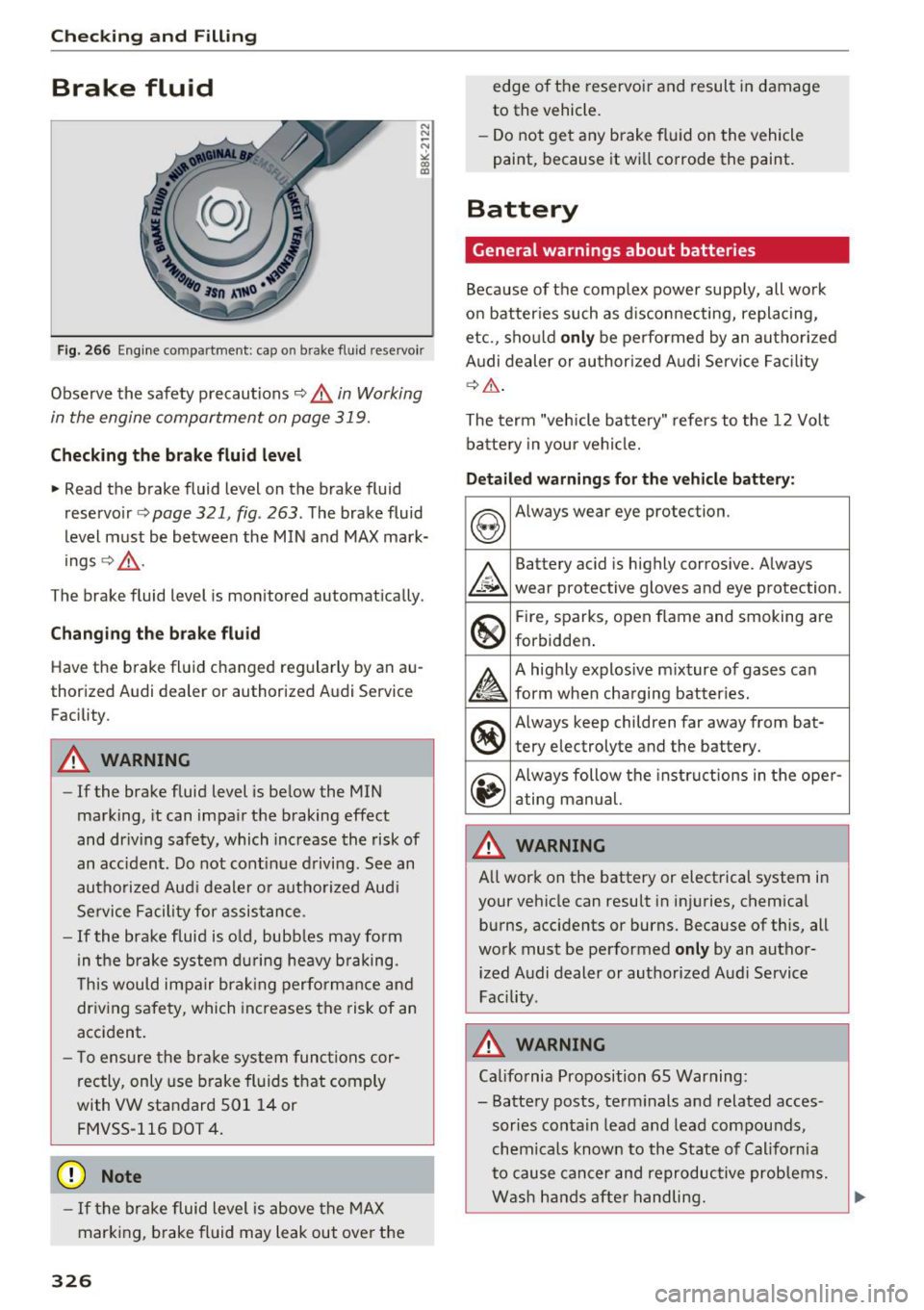
Fig. 266 Engine compartment: cap on brake flu id reservo ir
Observe the safety precautions c> .&. in Working
in the engine compartment on page 319.
Checking the br ake fluid l evel
~ Read the brake fluid level on the brake fluid
reservo ir
c> page 321, fig . 263 . The brake fluid
level must be between the MIN and MAX mark
ings
Q ,&. .
The brake fluid level is mon itored automat ically .
Chan ging the b ra ke fluid
Have the brake fluid changed regularly by an au
thorized Audi dealer or authorized Audi Servic e
Facility .
A WARNING
-If the brake fluid level is be low the MIN
marking, it can impair the braking effect
and dr iving safety, which increase the risk of
an accident. Do not cont inue d riving . See an
authorized Aud i dealer or autho rized Audi
Service Facility for assistance .
-If the brake fluid is o ld, bubbles may form
in the b rake system du ring heavy b raking.
T his would impair brak ing performance and
driving safety, which increases the risk of an
accident.
- T o ensure the brake system functions cor
rectly, only use brake fluids t hat comply
with VW standard 501 14 or
FMVSS-116 DOT 4 .
(D Note
-If the brake fluid level is above the MAX
mark ing, brake fluid may leak out over the
326
edge of the reservoi r and result in damage
to the vehicle.
- Do not get any brake fluid on the vehicle
paint, because it will corrode the paint.
Battery
General warnings about batteries
Because of the comp lex power supp ly, all wo rk
on batter ies such as d isconnecting, replacing,
etc., sho uld
onl y be performed by an autho rized
Audi dealer or au thorized A udi Servi ce Fac ility
Q _& .
The term "vehicle battery" refers to the 12 Volt
ba ttery in your vehicle.
Detail ed warnings for th e vehicle battery :
&
Battery acid is highly corros ive. Always
wear protective gloves and eye protection .
So
®
Fire, sparks, open flame and smoking are
forbidden .
£
A highly explosive m ixture of gases can
form when charging batter ies.
®
Always keep children far away from bat-
tery electrolyte and the battery.
~
Always follow the instructions in the oper -
ating manual.
A WARNING
All work on the battery or electrical system in
your vehicle can result in injuries, chemical burns, accidents or burns. Because of this, all
work must be performed
on ly by an author
ized Audi dealer or authorized Audi Service
Fac ility .
A WARNING
California Proposition 65 Warning:
- Battery posts, term inals and related acces
sories conta in lead and lead compounds,
chemicals known to the State of California
to cause cancer and reproductive problems.
Wash hands after handling.
~
Page 335 of 398

0 a, .... N
" N .... 0
0
l: ..
Glossary of tire and loading
terminology
Accessory weight
means the combined weight (in
excess of those standard items
which may be replaced) of auto matic transmission, power steer
ing, power brakes, power win
dows, power seats, radio, and
heater, to the extent that these
items a re available as factory- in
stalled equipment (whether i n
stalled or not) .
Aspect ratio
means the ratio of the height to
the width of the tire in percent .
Numbers of 55 or lower indicate a
low s idewall for improved steer
ing response and better overall
handling on dry pavement.
Bead
means the part of the tire that is
made of steel wires, wrapped or
reinforced by ply cords and that is
shaped to fit the rim .
Bead separation
means a breakdown of the bond
between components in the bead .
Wheel s
Cord
means the strands forming the
plies in the tire .
Cold tire inflation pressure
means the tire pressure recom
mended by the vehicle manufac
turer for a tire of a designated
size that has not been driven for more than a couple of miles (kilo
meters) at low speeds in the
three hour period before the tire pressure is measured or adjusted .
Curb weight
means the weight of a motor ve
hicle with standard equipment in
cluding the maximum capacity of
fuel, oil , and coolant, air condi
tioning and additional weight of
optional eq uipment .
Extra load tire
means a tire designed to operate
at higher loads and at highe r in
flation pressures than the corre
sponding standard tire . Extra load
tires may be identified as "X L",
"xl", "EXTRA LOAD", or "RF" on
the sidewall. .,.
333
Page 337 of 398

0 a, .... N
" N .... 0
0
l: ..
Production options weight
means the combined weight of
those installed regular production
options weighing over 5 lbs .
(2.3 kg) in excess of those stand
ard items which they replace, not
previously considered in curb
weight or accessory we ight, in
c luding heavy duty brakes, ride
levelers, roof rack, heavy duty
battery, and special trim .
Radial ply tire
means a pneumatic tire in which
the ply cords that extend to the beads are laid at substantially
90 degrees to the centerline of
the tread .
Recommended inflation
pressure
see ¢ page 333, Cold tire infla
tion pressure .
Reinforced tire
means a tire designed to operate
at higher loads and at h igher in
flat ion pressures than the corre
sponding standard tire. Rein
forced t ires may be identified as
"XL " "xl" "EXT RA LOA D" or "RF" , , ,
on the sidewall.
Wheels
Rim
means a metal support for a tire
or a tire and tube assembly upon
which the tire beads are seated .
Rim diameter
means nominal diameter of the
bead seat. If you change your
whee l size, you will have to pur
chase new tires to match the new
rim diameter .
Rim size designation
means rim diameter and width .
Rim width
means nominal distance between
rim flanges.
Sidewall
means that portion of a ti re be
tween the tread and bead.
Speed rating (letter code)
means the speed at which a tire is
designed to be driven for extend
ed periods of time . The rat ings
range from
93 mph (150 km/h)
to
186 mph (298 km/h) ¢ table
on page 331.
You may no t find
this info rmat ion on all tires be
cause it is not required by law.
T he speed rating letter code,
where applicable, is molded on
the tire sidewall and indicates t he
11>
335
Page 341 of 398

0
a:,
.... N
equipped with them at the
factory
r=> page 349.
-If you install wheel covers on
the vehicle, make sure they al low enough air circulation to
cool the brake system. If they
do not, this could increase the risk of an accident.
Tire wear/damage
Fig. 270 Tire profile : treadwear indica
tor
Tire wear
Check the tires regularly for wear.
-Inflation pressure that is too low or high can increase tire wear
considerably.
-Driving quickly through curves, rapid acceleration and heavy
braking increase tire wear.
-Have an authorized Audi dealer or authorized Audi Service Facili-
"
8 l) Obey any applicable regulations in your
0 ~ country.
Wheels
ty check the wheel alignment if
there is unusual wear.
-Have the wheels rebalanced if an imbalance is causing noticeable
vibration in the steering wheel. If you do not, the tires and other
vehicle components could wear more quickly.
Treadwear indicator
Original equipment tires contain
treadwear indicators in the tread
pattern, which are bars that are 1/16 in (1.6 mm) high and are
spaced evenly around the tire per pendicular to the running direc
tion ¢
fig. 2 70. The letters "TWI"
or triangles on the tire sidewall indicate the location of the tread
wear indicators.
The tires have reached the mini mum tread depth
l) when they
have worn down to the treadwear
indicators. Replace the tires with
new ones¢ &.-
Tire rotation
Rotating the tires regularly is rec
ommended to ensure the tires
wear evenly. To rotate the tires, install the tires from the rear axle ..,.
339