2018 AUDI Q5 light
[x] Cancel search: lightPage 356 of 392

Emergency assistance
Raising the vehicle
Fig. 276 Sill p ane ls : mar kin gs
Fig. 277 Sill: pos itio nin g th e ve hicle jack
"' Place the vehicle jack* (vehicle tool kit) on a
firm surface . Use a flat , stable support if neces
sary . On a slippery surface such as tile, you
shou ld use a non-slip pad (such as a rubber
mat) ¢,&. .
"'Find the mark ing on the sill that is closest to
the tire that will be changed
¢ fig. 2 76 . Behind
the marking, there is a lifting point on the side
sill for the vehicle jack*.
"'Turn the handwheel to raise the vehicle jack*
under the lifting point on the side sill until the
bracket on the jack @completely covers the
notch on your vehicle .
"' Align the vehicle jack* so the bracket @covers
the notch and the base @ is flat on the ground .
T he base @ mus t be direct ly unde r the lifting
po int @ .
"'Mount the crank on the vehicle jack*: insert the
crank into the opening on the handwheel. Turn
the crank to the left or right to secure it.
"'Continue raising the vehicle jack* with the
crank until the wheel lifts off the ground slight
ly .
354
A WARNING
,-
- Make sure the vehicle jack* is stable . There
is a risk of injury when the ground is slick or
soft, because the vehicle jack* could slide or
sink .
- Only raise your vehicle with the vehicle jack*
provided by the factory. If you use a veh icle
jack designed for another vehicle, your vehi
cle can slide and cause injury.
- Position the vehicle jack* only at the desig
nated mounting points on the side sill and
align the jack. Otherwise, the vehicle jack*
could slip and cause an injury if it does not
have sufficient hold on the vehicle.
- Vehicles with air suspension*: changes in
temperature or load can affect the height of
the stopped vehicle .
- To reduce the risk of an accident,
neve r start
the engine when the vehicle is raised.
- To reduce the risk of injury, support the
ve
hicle securely with suitable stands if work is
to be performed underneath the vehicle .
- To help prevent injury to yourself and your
passengers:
- Do not raise the veh icle until you are sure
the jack* is securely engaged.
- Passengers must not remain in the vehicle
when it is jacked up .
- Make sure that passengers wait in a safe
place away from the vehicle and well away
from the road and traffic .
- Make sure jack position is correct, adjust
as necessary and then continue to ra ise
the jack*.
- If work has to be done under the vehicle,
ensure that it is safely supported on suita
ble stands -risk of injury!
- Never start the engine when the vehicle is
on the jack* - risk of accident!
(D Note
Do not lift the vehicle by the sill. Position the
vehicle jack* only at the designated mounting
po ints on the side sill. Otherw ise, your vehicle
will be damaged .
..,.
Page 361 of 392

u co .-, N r-N .-,
~ 0 co
Fuse color identification
Color Current rating
in amps
Black 1
Purple 3
Light brown 5
Brown 7.5
Red 10
Blue 15
Yellow 20
White or transparent 25
Green 30
Orange 40
A WARNING
Do not repair fuses and never replace a blown
fuse with one that has a higher amp rating.
This can cause damage to the electrical sys
tem and increases the risk of fire.
(D Note
If a new fuse burns out again shortly after you
have installed it, have the electrical system
checked as soon as possible by an authorized
Audi dealer or authorized Audi Service Facili ty.
(D Tips
- The following table does not list fuse loca
tions that are not used.
- Some of the equipment listed in the follow
ing tables applies only to certain model ver
sions or certain optional equipment.
Fuses and bulbs
Fuse assignment - driver's/front
passenger's footwell
Fig. 282 Drive r's footwell (left -hand dr ive vehicle): fuse
panel with plastic clip
Fig. 283 Front passenger's footwell (right -hand drive vehi -
cle): fuse panel wit h plastic clip
II>-
359
Page 362 of 392

Fuses and bulb s
Fuse panel@ (brown ) Fuse panel© (blac k)
N o. E quip ment No. Equipmen t
2
Mass airflow sensor, camshaft adjust-
ment, charge air cooler pump 1 Fr ont seat heating
2 Windshie ld wipers
3 Exhaust doors, fuel injectors, radiator inlet 3 Left head light elect ronics
4 Vacuum pump , hot water p ump, particu-
late sensor, biodiesel sensor 4 Panorama glass roof
s L eft front doo r contro l modu le
5 Brake light sensor 6 Sockets
6 Engine valves, camshaft adjustment 7 Right rear door cont rol mod ule
7
Heated oxygen sensor, mass airflow sen-8 All wheel drive
sor
8
Water pump, high pressure pump, high
pressure regulator va lve
9 Hot water pump
9 R ight headlight electronics
10
Windshield washer system/headlight
washer system
1 1 Left rear door contro l module
10
Oil pressure sensor, oil temperature sen-
sor
Fu se p anel @ (blac k)
11 Clutch pedal position sensor No. Equipment
12 Engine valves
Seat ventilation, rearv iew mirror, cl imate
13 Radiator fan 1 control system, rear cl imate control sys-
14 Fuel injectors tern controls
, windsh ie ld defogger
15 Ignition coils 2 Gateway, climate control system
16 Fuel pump 3 Sound act uator/exhaust sound tuning
Fuse panel @ (red )
4 Clutch pedal posit ion sensor
5 Engine start
N o. Equipment 7 Rear USB charging port
1 Anti-theft a larm system 8 Homelink
2 Engine control module 9 Adaptive cruise control
3 Lumbar support 11 Video camera
4 Automatic transm ission selector mecha-
nism 12 Matrix LED headlight/right LED headlight
5 Horn
13 Matrix LED headlight/ left LED headlight
6 Electromechan ica l park ing brake
14 Rear window wiper
7 Gateway control module Fu se panel © (red )
8 Interior headliner lights No . Equipmen t
10 Airbag control module 1 Ignition coils
11 Electronic Stabilization Control (ESC) 5 E ng ine mount
12 Diagnostic connector, light/rain sensor 6 Automatic transmiss ion
13 Climate control system 7 I nstrument panel
1 4 Right front door control module 8 C limate control system (blower)
lS A/C compressor
10 Dynamic stee ring
11 Eng ine start
36 0
Page 363 of 392

u co ..... N r-N .....
~ 0 co
Fuse assignment - Driver's side of the
cockpit
Fig. 284 Driver s ide cockpit: fuse panel wit h plastic bracket
Fuse panel
No . Equipment
2 Telephone
4 Head-up display
5 Audi music interface, USB charging port
6 Front climate control system controls
7 Steering column lock
8 Infotainment system display
9 Instrument cluster
10 Infotainment unit
11 Light switch
12 Steering column electronics
14 Infotainment system
15 Power steering column adjustment
16 Steering wheel heating
Fuses and bulbs
Fuse assignment - Left side of the luggage
compartment
Fig. 285 Left side of the l uggage compartment: fuse panel
wi th plastic cl ip
Fuse panel @ (black)
No. Equipment
2 Windshield defroster
3 Windshield defroster
5 Air su spension/s uspension control
6 Automatic transmission
7 Rear window defogge r
8 Rear seat h eating
9 Tail lights
10 Left safety belt tensioner
11 Central locking system
12 Electr ic luggage compartment lid
Fuse panel@ (red)
No. Equipment
Not assigned
Fuse panel © (brown)
No. Equipment
2 Telephone
3 Lumbar support
361
Page 364 of 392
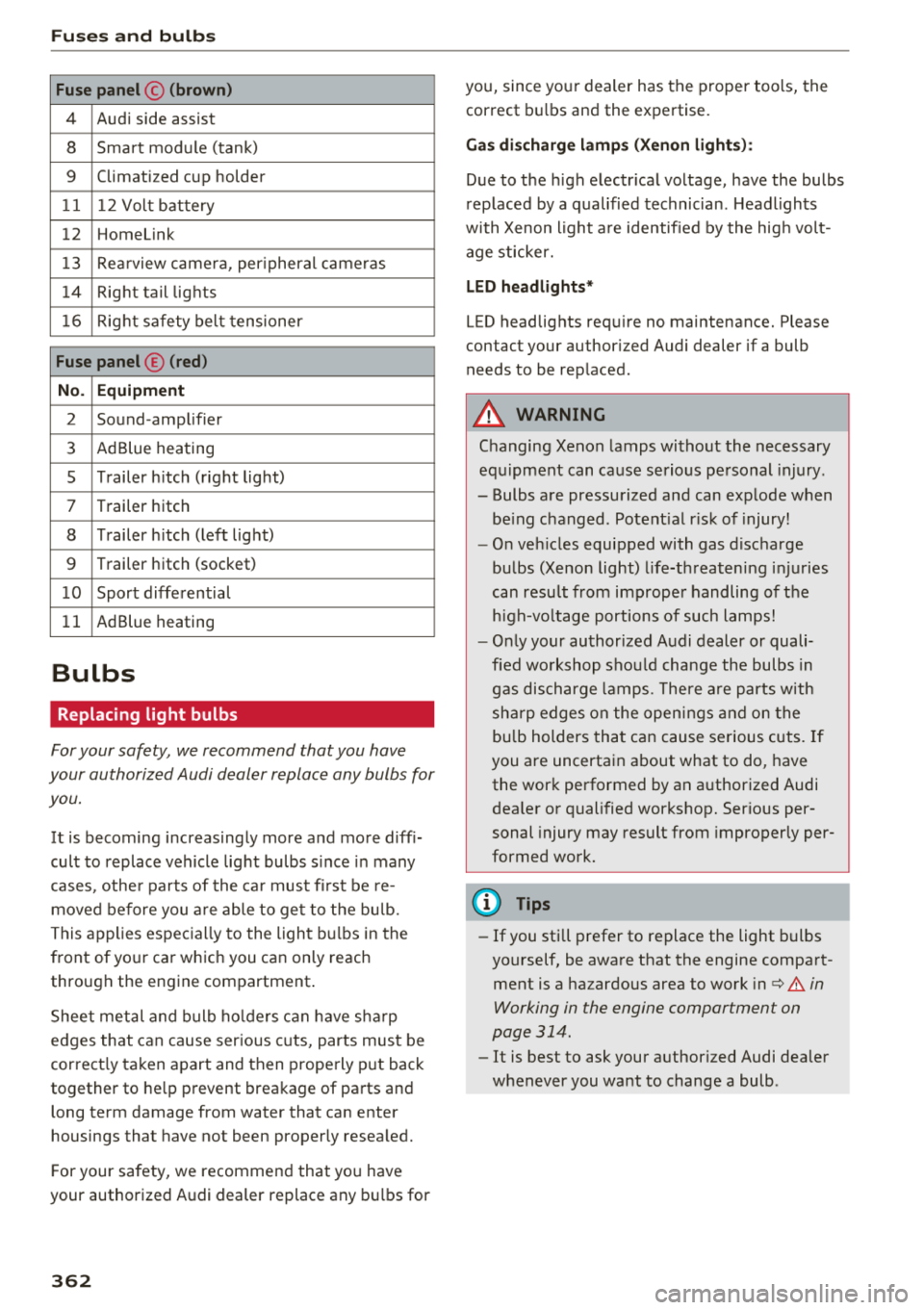
Fuses and bulb s
Fuse panel © (brown )
4 Audi side assist
8 Smart module (tank)
9 Climatized cup holder
11 12 Volt battery
12 Homelink
13 Rea rview camera, per ipheral cameras
14 Right tail lights
16 Right safety belt tensioner
Fu se panel ® (red )
No . Equipm ent
2 Sound-amplifier
3 AdBlue heating
s Trailer h itch (right light)
7 Trailer hitch
8 Trailer h itch (left lig ht)
9 Trailer hitch (socket)
1 0 Sport differential
11 AdBlue heating
Bulbs
Replacing light bulbs
For your safety, we recommend that you have
your authorized Audi dealer replace any bulbs for
you.
It is becoming increasingly more and more diff i
cult to replace vehicle light bulbs s ince in many
cases, other parts of the ca r must fi rst be re
moved before you a re able to get to the bu lb.
This applies espec ially to the light bu lbs in the
front of your car which you can only reach
through the engine compartment .
Sheet metal and bulb ho lde rs can have sha rp
edges that can cause ser ious cuts, parts must be
correct ly taken apart and then properly put back
together to he lp prevent breakage of parts and
long term damage from water that can enter
housings that have not been properly resea led.
F or your safety, we recommend that you have
your authorized Audi dealer replace any bu lbs for
3 6 2
you, since your dealer has the proper tools, the
correct bu lbs and the expertise.
Ga s di sc harg e lamp s (Xeno n ligh ts):
Due to the high electr ical voltage, have the bulbs
rep laced by a qualified technician . Headlights
with Xenon light a re identified by the hig h volt
age sticker.
L ED he adligh ts*
LED headlights requ ire no maintenance. Please
contact your author ized Audi dealer if a bulb
needs to be replaced .
A WARNING
Changing Xenon lamps without the necessary
equ ipment can cause serious personal injury.
-Bulbs are pressurized and can explode when
be ing changed. Potent ial r isk of injury!
-O n veh icles equipped with gas discharge
bulbs (Xenon light) l ife-threaten ing injuries
can resu lt from improper handling of the
h igh-vo ltage portions of such lamps!
-O nly your author ized Audi dealer or quali
fied wo rkshop shou ld change the bulbs in
gas discharge lamps. The re a re parts w ith
sha rp edges on the open ings and on the
bu lb holders that can cause serious cuts. If
you are uncertain about what to do, have the work performed by an authorized Audi
dea ler or qualified workshop. Serious per
sonal injury may result from improperly per
formed work.
(D Tips
-If you still prefer to replace the light bulbs
yourself, be aware that the engine compart ment is a hazardous area to work
i n c:> .&. in
Working in the engine compartment on
page 314.
-It is best to ask your authorized Audi dealer
whenever you want to change a bulb .
Page 365 of 392

u co .... N r--N .... 0 <( 0 00
Emergency situations
General
This chapter is intended for trained emergency
crews and working personnel who have the nec
essary tools and equipment to perform these
operations.
Starting by pushing or
towing
~ Note
Vehicles with an automatic transmission
cannot be started by pushing or towing.
Starting with jumper
cables
If necessary, the engine can be started by con
necting it to the battery of another vehicle.
If the engine should fail to start because of a dis
charged or weak battery, the battery can be con
nected to the battery of
another vehicle, using a
pair of jumper cables to start the engine.
Jumper cables
Use only jumper cables of sufficiently large cross
section
to carry the starter current safely. Refer
to the manufacturer's specifications.
Use only jumper cables with
insulated terminal
clamps which are distinctly marked:
plus(+) cable in most cases colored red
minus(-) cable
in most cases colored black.
A WARNING -
Batteries contain electricity, acid, and gas.
Any of these can cause very serious or fatal in
jury. Follow the instructions below for safe
handling of your vehicle's battery.
-Always shield your eyes and avoid leaning
over the battery whenever possible.
- A dead battery can freeze at temperatures
around 32 °F (0 °C). If the vehicle battery is
frozen, you must thaw it before connecting
the jump start cables. If you do not, this in-
Emergency situations
creases the risk of an explosion and chemi
cal burns. After jump starting the vehicle,
drive to an authorized Audi dealer or author
ized Audi Service Facility immediately to
have the vehicle battery checked.
- Do not allow battery acid to contact eyes or
skin. Flush any contacted area with water
immediately.
- Improper use of a booster battery to start a
vehicle may cause an explosion .
- Vehicle batteries generate explosive gases.
Keep sparks, flame and lighted cigarettes
away from batteries.
- Do not try to jump start any vehicle with a
low acid level in the battery .
- The voltage of the booster battery must also
have a 12-Volt rating. The capacity (Ah) of
the booster battery should not be lower
than that of the discharged battery. Use of
batteries of different voltage or substantial
ly different "Ah" rating may cause an explo
sion and personal injury.
- Never charge a frozen battery. Gas trapped
in the ice may cause an explosion.
- Never charge or use a battery that has been
frozen. The battery case may have be weak
ened.
- Use of batteries of different voltage or sub
stantially different capacity (Ah) rating may
cause an explosion and injury. The capacity
(Ah) of the booster battery should not be
lower than that of the discharged battery.
- Before you check anything in the engine
compartment, always read and heed all
WARNINGS
c>page 314.
@ Note
-Applying a higher voltage booster battery
will cause expensive damage to sensitive
electronic components, such as control
units, relays, radio, etc.
- There must be no electrical contact between
the vehicles as otherwise current could al
ready start to flow as soon as the positive
(+) terminals are connected.
363
Page 366 of 392

Emergency situations
@ Tips
The discharged battery must be properly con
nected to the vehicle's electrical system .
When jump starting or charging the battery,
never connect the negative ground cable to
the battery negative post because the battery
manager system must be able to detect the
battery's state of charge. Always connect the
negat ive g round cable to the negative ground
post of the battery manager control unit.
Using the jump start
cable
Both jump start cables must be connected in the
correct order!
Fig. 286 E ngin e compartme nt: co nn ectors for jump start
cables and a charger
Fig. 287 Jump starting with a battery in another vehicle:
@-pro vidi ng current, @-dra ined
The procedure described below for connecting
jumper cables is intended to provide a jump start
for your vehicle.
Vehicle with discharged battery
... Turn off lights and accessories, move automatic
transm ission lever to "N" (Neutral) or "P" (Pa rk)
and set parking bra ke.
364
Connecting the positive cable (red) to the
positive terminal
... Open the red cover on the positive terminal
c:::>fig. 286.
1. Secure one end of the pos itive cable (red) to
the jump start pin
c:::> fig. 287 (J) (pin under
the red cover = "pos itive") on the veh icle that
needs to be started @.
2. Secure the other end of the positive cable
(red) to the posit ive terminal @on the bat
tery provid ing the cur rent @.
Connecting the negative cable (black) to the
negative terminal
3. Secure one end of the negative cable (black)
to the negative terminal @ on the battery
that is providing the current @.
4. Secure the other end of the negative cable
(black) to the jump start
pin @ (hex head pin
= "negative") on the vehicle that needs to be
started @.
Starting the engine
... Sta rt the eng ine on the vehicle providing the
jump start @and let it run at idle .
... Now start the engine on the vehicle with the
drained battery @.
... If the engine does not start, stop the starting
procedure after 10 seconds and then repeat it
after approx imately 30 seconds.
"' Once the engine w it h the drained vehicle bat
tery has been started, remove the cables in the
reverse order from the way they were install ed.
"' Close the red cover on the positive terminal.
The battery is vented to the outside to prevent
gases from enter ing the vehicle inter ior. Make
sure th at the j umper clamps are well connected
with their
metal ports in full contact with the
battery terminals .
A WARNING
-To avoid serious personal injury and damage
to the vehicle, heed all warnings and instruc
tions of the jumper cable manufacturer. If in
doubt, call for road service .
-Jumper cables must be long enough so that
the vehicles do not touch.
..,.
Page 371 of 392

u co ..... N r-N .....
~ 0 co
Technical data
Vehicle specifications
XXXXX XX -X -XXXX XXX XX
®-+ : ::::::. XXXXXXXX XX X XX XXX XXX
IYP /lffl XXX XXX
XX XXXXXXX XX X X XX
XXX KW XXX
®i ~=-:~~ XXXX XXX XXX
©+ ~ rur:i~ xxxx I xxxx XXX I xx
II. · AIJSlit I OPTIONS
EOA 7D 5 4U B 6XM SSG SR W
2 EH JO Z 1LB 1AS 1BA
3FC SM U 7Xl
F O A 9G3 OG7 O YH OJF
TL 6 3 KA 8EH UlA X 9B OZ7
l XW
803
908 8Z4 020
7 T6 CV7
71<0 4X3 21< 2
3L4 4 KC 3YO 413 5 02
1S A 7GB
01A 4GQ
XX . X XX X XX X XXXX
Fig. 293 Vehicl e ident ifica tion labe l
Vehicle Identification Number (VIN )
The VIN n umber is located in the following pla
ces :
0
0
~ :x:
t rol button
> Servi ce & check s > Vehicle infor·
mati on.
-On t he vehicle identificat io n labe l
Dimensions
Technical data
-At the front behind the windshield *
-in the engine comp artme nt on the r igh t side
Vehicle identification label
The vehicle identification label¢ fig. 293 is locat
ed in the luggage compartment under the cargo
floor cover.
The vehicle identification label informat ion can
also be found in the Warranty a nd Maintenance
booklet .
The sticker contains the fo llow ing vehicle data:
© Vehicle Identif ication Number (VIN)
@ Vehicle type, engine output, transm ission
@ Engine and transmiss ion codes
© Paint and interior codes
® Optional equipment numbers
Notes about technical
data
T he values may vary base d on special eq uipment
as well as m arket -specific equipment and meas
u ring methods .
Please note that the specifications listed in the
vehicle documen tat ion a lways take prece dence.
(D Tips
Missing technical data was not ava ilable at
the time of pr int ing.
Length (in (mm )) Width (in (mm ))
Width across the Height at curb
mirrors (in (mm )) weight (in (mm))
Q5 183.6 (4,663) 74 .5 (1 ,893) 84.3 (2,140) 65.3 (1 ,659)
SQ5 183.9 (4,671) 74.5 (1,893) 84 .3 (2,140) 65.3 (1,659)
Capacities
Approximate capaci·
ties
Fuel tank 1
8.5 gal (70 L)
Windsh ield and headlight washer system* 5.3qt(5L)
369