2018 AUDI Q3 ESP
[x] Cancel search: ESPPage 167 of 230

0 co ......
"' ,....
"' ...... 0 0 :::,
00
@ Tips
- Only charge the vehicle battery through the
connections in the engine compartment.
- Read all of the manufacturer's instructions
for the charger before charging the vehicle
battery.
Windshield washer system
Fig. 143 Engine compartment: windshield washer fluid
reservoir
Observe the safety precautions q page 155,
Working in the engine compartment.
M N ~ N
"' a) ID
The windshield washer fluid reservoir W contains
the cleaning solution for the windshield and the rear w indow
q page 158, fig . 137,. The reservoir
capacity can be found in
qpage 210.
To reduce the risk of lime scale deposits on the
spray nozzles, use clean water with low amounts
of calc ium . Always add window cleaner to the wa
ter. When the outside temperatures a re cold, an
anti-freezing agent should be added to the water
so that it does not freeze.
- The concent ration of anti-freezing agent
must be adjusted to the vehicle operating
conditions in the respective climate. A con
cent ration that is too high can lead to vehi
cle damage.
- Never add radiator anti-freeze or other addi
tives to the washer fluid.
- Do not use a glass cleaner that contains
paint solvents, because this could damage
the paint .
Checking and Filling
Service interval display
The service interval display detects when your ve
hicle is due for service .
The service interval display works in two stages:
-Inspection or oil change reminder : after a cer-
tain distance is driven, a message appears in
t he instrument cluster display every time the
ignition is switched on. The remaining distance
or time is displayed br iefly.
- Inspection or oil change due: if your vehicle
has reached an inspection or oil change interval
or both intervals at the same time, the mes
sage
Inspection due! or Oil change due! or Oil
change and inspection due!
appears briefly af
ter sw itching the ignition on.
Checking service intervals
You can check the remaining distance or time un
ti l the next oi l change or next inspection .
- Select: the
I CARI function button > (Car) Sys
tems*
control button > Servicing & checks >
Service intervals .
Resetting the indicator
An autho rized Aud i dea ler or a uthorized Audi
Service Facility will reset the service in terva l dis
play after performing service .
If you have changed the o il yourself, you must re
set the oil change interval.
Perform the follow ing to reset the d isplay:
- Select: the
I CAR I function button > (Car) Sys
tems *
control button > Servicing & checks >
Service intervals . Turn the control knob down
ward to
Reset oil change interval and press the
control knob .
~ Note
-Only reset the oil change ind icator if the oil
was changed.
- Following the service intervals is crit ica l to
ma intaining the service life and value of
your vehicle, especially the engine . Even if
the mileage on the vehicle is low, do not ex
ceed the time for the next service.
165
Page 171 of 230

0 C0
-N
" N
-0 g a)
Glossary of tire and loading
terminology
Accessory weight
means the combined we ight (in
excess of those standard items
which may be replaced) of auto matic transmission, power steer
ing, power brakes, power win
dows, power seats, radio, and
heater, to the extent that these
items a re available as factory- in
stalled equipment (whether in
stalled or not) .
Aspect ratio
means the ratio of the height to
the width o f the tire in percent .
Numbers of 55 or lower indicate a
low s idewal l for improved steer
ing response and better overall
handling on dry pavement.
Bead
means the part of the t ire that is
made of steel wires, wrapped or
reinforced by ply cords and that is
shaped to fit the rim .
Bead separation
means a breakdown of the bond
between components in the bead .
Wheels
Cord
means the strands forming the
plies in the tire.
Cold tire inflation pressure
means the tir e pressure recom
mended by the vehicle manufac
tu rer for a tire of a designated
size that has not been driven for
more than a couple of m iles (k ilo
meters) at low speeds in the
three hour period before the t ire
pressure is measured or adjusted .
Curb weight
means the weight of a motor ve
hicle with standard equipment in
cluding the maximum capacity of
f u el, o il, and coolant, a ir cond i
tioning and additional weight of
optio nal eq uipment .
Extra load tire
means a tire designed to operate
at higher loads and at higher in
flat ion pressu res than the corre
sponding standard tire . Extra load
tires may be ident ified as "X L",
"xl", "EXTRA LOAD", or "RF" on
the sidewall. .,.
169
Page 175 of 230

0 C0
-N
" N
-0
0
::, a)
by the tire manufacturer. This in
formation is used to contact con
sumers if a tire defect requires a
recall.
Ve hicle capacity weight
means the rated cargo and lug
gage load plus 150 lbs. (68 k ilo
grams) times the vehicle's desig
nated seating capacity.
Vehicle ma ximum load on the
tire
means that load on an individual
tire that is determined by distrib
uting to each axle its share of the
maximum loaded vehicle weight
and dividing by two.
Vehicle normal load on the tire
means that load on an individual
tire that is determined by distrib
uting to each axle its share of the
curb weight, accessory weight,
and normal occupant weight (dis
tributed in accordance with¢
ta
ble on page
178) and dividing by
two.
Occupant loading and distr i
bution for vehicle normal load
for various design ated seating
capacities
Refer to the tire inflation pres
sure label¢
page 176, fig. 147
Wheels
for the number of seating posi
tions . Refer to the table ¢
table
on page
178 for the number of
people that correspond to the ve
hicle normal load.
New tires or wheels
Audi recommends having all work
on tires or wheels performed by an authorized Audi dealer or au
thorized Audi Service Facility.
These facilities have the proper
knowledge and are equipped with
the required tools and replace ment parts.
.,,. New tires do not yet have the
optimum gripp ing properties .
Drive carefully and at moderate
speeds for the first 350 miles (500 km) with new tires.
.,,. Only use tires with the same de
sign, size (rolling circumference)
and as close to the same tread
pattern as possible on all four
wheels.
.,,. Do not replace tires individually .
At least replace both tires on the
same axle at the same time.
.,,. Audi recommends that you use
Audi Original Tires . If you would
like to use different tires, please note that the tires may perform ...
173
Page 184 of 230

Wheels
with them. Remove the wheel covers" first.
Use coated snow chains.
Low-profile tires
App lies to: veh icles with low-profile tires
Your vehicle is equipped with low-profile tires* at
t he factory . Compared to other tire/rim combina
ti ons, low-profile tires offer a wider tread sur face
and a larger rim diameter with shorter tire side
walls . This results in an agile driving style . How
ever, it may reduce the level of comfort and in
crease road noise when dr iv ing on roads in poor
condition .
Low-profile tires can become damaged more
qu ickly than standard t ires when driving over
large b umps, potholes, manhole covers, speed
bumps and curbs. Therefore, it is part icu lar ly im
portant to maintain the cor rect tire pressure
¢page 176.
To reduce the r isk of damage to the tires and
rims, drive very carefully on poor roads.
Check your wheels regularly every 2,000 mi (3 ,000 km) for damage. For example , check for
bu lges/cracks on the tir es or deformations/
cracks on the r ims.
After a heavy impact or damage, have the tires
and rims inspected or replaced immediate ly by
an author ized Audi dealer or author ized A udi
Serv ice Facility .
Low-profile tires can wear out faster than stand
ard tires.
Summer tires are not suitable for cold weather,
snow or black ice . If you are driving in these con
d itions, use winter or all season t ires
¢ page 181.
Uniform tire quality grading
-Tread wear
- T raction AA A B C
- Temperature ABC
Qua lity grades can be found where applicab le on
the tire side wall between tre ad shoulder and
maximum section width
¢ page 16 7, fig . 144 .
182
For example: Tread wear 200 , Traction AA, Tem
perature
A .
All passenger car tir es must conform to Federal
Safety Requirements in addit ion to these grades .
Tread wear
The tread wear grade is a comparative rating
based on the wear rate of the tire when tested
under controlled conditions on a specified gov
ernment test course.
For example, a tire graded 150 would wear one
and one half (1 1/2) times as well on the govern
ment course as a tir e graded 100 .
T he relative performance of tires depends upon
the actual cond itions of their use, however, and
may depart sign ificantly from the norm due to
variations in driv ing habits, service practices and
differences in road characteristics and climate.
Traction
The traction grades , from highest to lowest, are
AA , A, Band
C. Those grades represent the tire's
ability to stop on wet pavement as measured un
der controlled conditions on specified govern
ment test surfaces of asphalt and concrete. A tire
marked C may have poor traction performance
¢_& .
Temperature
The temperature grades are A (the highest), B,
and C , representing the tire's resistance to the
generat ion of heat and its ability to dissipate
heat when tested under controlled conditions on
a spec ified indoor laboratory test wheel.
Sustained high temperature can cause the mate
rial of the tire to degenerate and reduce tire life ,
and excessive temperature can lead to sudden
tire failure ¢.& .
The grade C corresponds to a level of perform
ance which all passenger car tires must meet un
der the Federal Motor Vehicle Safety Standard
No. 109. Grades Band A represent higher levels
of performance on the laboratory test wheel than
the minimum required by law .
ll>
Page 186 of 230

Wheels
The tire pressures must be stored in the Infotain
ment system again each time the pressures
change (switch ing between partial and full load
pressure) or after changing or replacing a tire on
your vehicle
c:::> page 184. The tire pressure moni
toring system only monitors the tire pressure you have stored . Refer to the tire pressure label for
the recommended tire pressure for your vehicle
c:::> page 176, fig. 147.
Tire tread circumference and vibration character istics can change and cause a t ire pressure warn
ing if:
- the tire pressure in one or more tires is too low
- the tire has structural damage
- the tire was replaced or the tire pressure was
changed and it was not stored
c:::> page 184
- the spare tire* is installed
Indicator lights
ti] -Loss of pressure in at least one tire c:::> & .
Check the tires and replace or repair if necessary.
Check/correct the p ressures of all four tires and
store the pressure again in the menu display
c:::> page 184.
@m (Ti re Pressure Monitoring System) Tire
pressure : System malfunction!. If@m
appears
after switching the ignit ion on or whi le driving
and the
ti] indicator light in the instrument clus
ter blinks for approximately one minute and then
stays on, there is system malfunction. Try to
store the correct tire pressures
c:::> page 184. If
the indicator light does turn off or turns on again
after a short period of time, dr ive to an author
ized Audi dealer or authorized Aud i Service Facili
ty immediately to have th e malfunct ion correct
ed.
_& WARNING
- If the tire pressure indicator appea rs in the
display, reduce your speed immediate ly and
avoid any hard steering or braking maneu
vers. Stop as soon as possib le and check the
t ir es and their pressure.
- The driver is responsible for maintaining the
correct tire pressure. You must check the
tire pressure regularly.
184
'
-Under certain conditions (such as a sporty
driving style, w inter conditions or unpaved
roads), the tire pressure monitoring system
ind icator may be delayed .
- Do not use run-flat tires on your vehicle. Us
ing them when not permitted can lead to
veh icle damage or accidents.
(D Tips
- The tire pressure monitor ing system can al
so stop working when there is an ESC mal
function.
- Using snow chains may result in a system
malfunction.
- The tire pressure monitor ing system in your
Audi was calibrated with "Audi Or iginal
Tires"
c:::> page 173. Using these tires is rec
ommended.
Storing tire pressures
App lies to: vehicles wit h Tire Pressure Monito rin g Syste m in
dic ator
.. Make sure before storing that the tire pressures
of all four tires meet the specified values and
are adapted to the load <=:>page
175 .
.. Switch the ignition on.
.. Select: the
I CARI funct ion button > (Car) Sys
tems *
control button > Servicing & checks >
Tire pressure monitoring > Store tire pressures
> Yes, store now.
(D Tips
Do not store the tire pressures if snow chains
are installed.
Page 187 of 230

0 co ......
"' ,....
"' ...... 0 0 :::,
00
Care and cleaning
General information
Regular, proper care helps to maintain your vehi
cle's value. It can a lso be a requirement when
submitting warranty claims for corrosion damage
and paint defects on the body.
The necessary care products can be obtained
from an authorized Audi dealer or authorized
Audi Service Facility . Read and follow the instruc
tions for use on the packaging.
A WARNING
- Us ing clean ing and care products incorrectly
can be dangerous to your health.
- Always store clean ing and care products out
of reach of children to reduce the r isk of po i
son ing .
@ For the sake of the environment
- Preferably purchase env ironmenta lly-friend
l y cleaning products.
- Do not d ispose of leftover cleaning and care
products with household trash.
Car washes
T he longer that deposits remain on the vehicle,
the more the surface may be damaged. High
temperatures such as those caused by sunlight increase the damag ing effect.
Befor e washing, rinse
off heavy depos its with
p lenty of water.
S tubborn depos its such as bird droppings or tree
sap are best removed with plenty of water and a
microfiber cloth.
A lso, wash t he un derside of yo ur vehicle once
road sa lt stops being used for the season .
Pressure washers
When washing your ve hicle w ith a pressure wash
e r, a lways fo llow the operating instructions pro
vided wi th the p ressure washer. This is especially
i mportant in rega rd to the pressure and sp raying
d istance . Do not aim the spray directly at seals on
side windows, doors, the hood, the luggage com-
Ca re and cleaning
partment lid or the panorama glass roof* or at
tires, rubber hoses, insulating material, sensors *
o r camera lenses* . Keep a distance of at least 16
in
(40 cm).
Do not remove snow and ice with a pressure
washer.
Never use cone nozz les o r high press ure nozzles .
T he water temperatu re must not be above
140 °F
(60 °().
Automatic car washes
Spray off the vehicle before washing.
Make s ure that the windows and roo f* are closed
and the windshie ld wipers are
off . Follow instruc
tions from the car wash ope rator, especially if
there are accessories attached to your vehicle.
If possible, use car washes that do not have
brushes .
Washing by hand
Clean the ve hicl e starting from the top and wor k
i ng down using a soft sponge o r cleaning br ush.
U se solven t-free cleaning produ cts.
Washing vehicles with matte finish paint by
hand
T o avo id damag ing the pa int w hen washi ng, fi rst
remove dust and large pa rticl es from you r vehi
cle . Insects, grease spots and fingerprints are
best removed w ith a special cleaner for matte
finish paint.
Apply t he product using a microf iber cloth . To
avoid damaging the paint surface, do not use too
much pressure.
Rinse the ve hicl e thoroug hly w ith wate r. Then
cl ean usi ng a neutral shampoo and a soft micro
fiber cloth .
Rinse the ve hicl e thorough ly aga in and let it air
dry. Remove any wate r residue using a chamois.
WARNING
-On ly wash the vehicle when the ign ition is
off and follow the instr uctions from the car
185
Page 189 of 230
0 co .-I
"' ,....
"' ...... 0 0 :::,
00
Care and cleaning
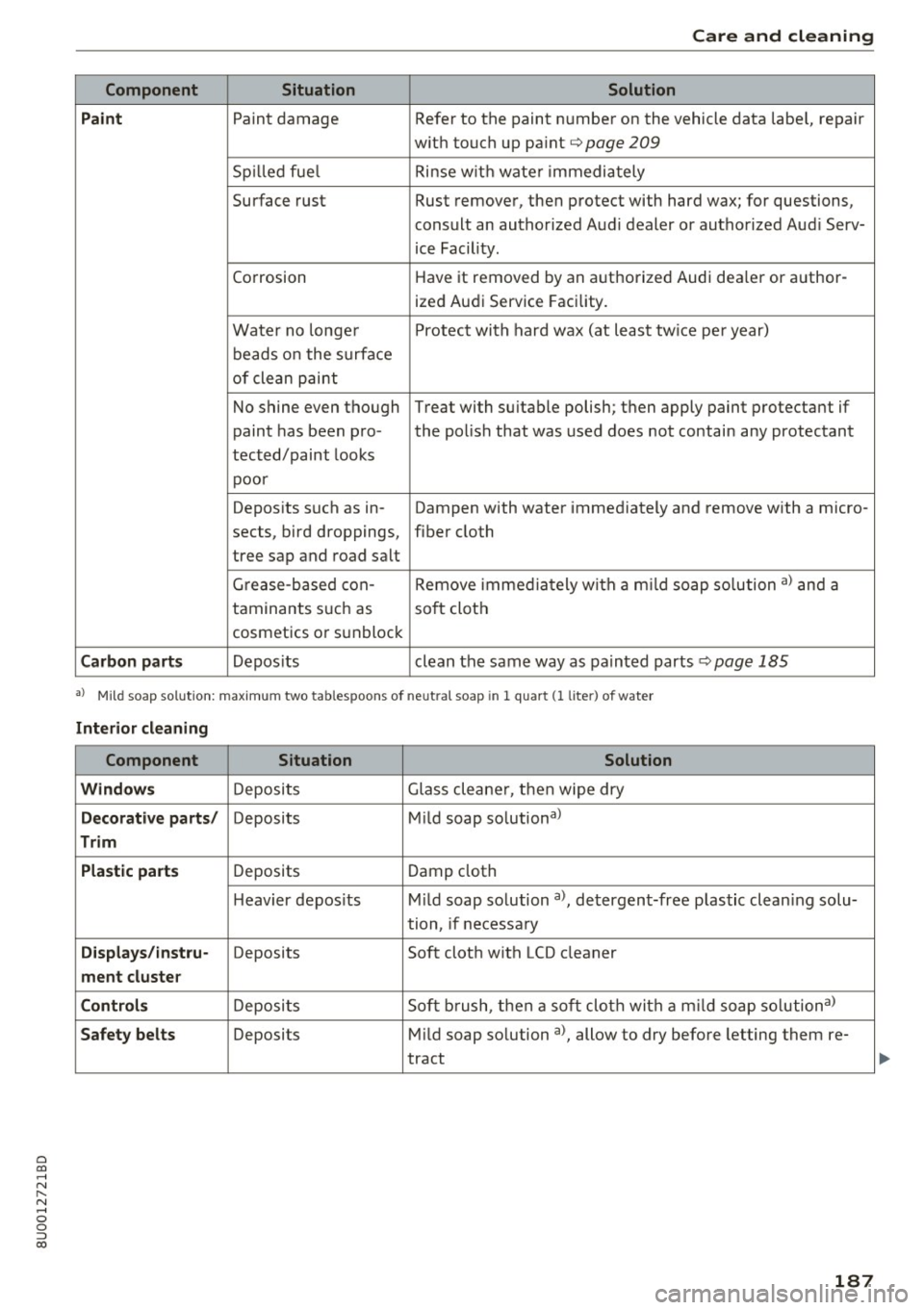
Component Situation Solution
Paint
Paint damage Refer to the paint number on the vehicle data label, repair
w ith touch up pa int
c;,poge 209
Spilled fuel Rinse with wate r immediately
Surface rust Rust remover, then protect with hard wax; for questions,
consult an authorized Audi dealer or authorized Aud i Serv-
ice Facility.
Corrosion Have
it removed by an authorized Audi dea ler or author-
ized Audi Service Facility.
Water no longer Protect with hard wax (at least twice per year)
beads on the surface
of clean paint
No shine even though Treat with su itable polish; then apply paint protectant if
paint has been pro- the polish that was used does not contain any protectant
tected/paint looks poor
Deposits such as in -Dampen with water immediately and remove w ith a micro-
sects, bird droppings, fiber clloth
tree sap and road salt
Grease-based con- Remove
immediat ely with a mild soap so lution
al and a
taminants such as soft cloth
cosmetics or sunblock
Carbon parts Depos its clean the same way as painted parts ¢page 185
a) Mi ld soap solution: maximum two tab lespoons of neu tral soap in 1 quart (1 lite r) of water
Interior cleaning
Component Situation Solution
Windows
Deposits Glass cleaner, then wipe dry
Decorative parts/ Deposits Mild soap solutiona>
Trim
Plastic parts
Deposits Damp cloth
He avier deposits Mild soap solution a), detergent-free plastic clean ing solu-
tion, if necessa ry
Oisplays/instru -Deposits Soft
cloth with LCD cleaner
ment cluster
Controls
Deposits Soft brush, then a soft
cloth with a mild soap solutiona>
Safety belts Deposits Mild
soap solution al, allow to dry before letting them re-
tract
187
Page 190 of 230
Care and cleaning
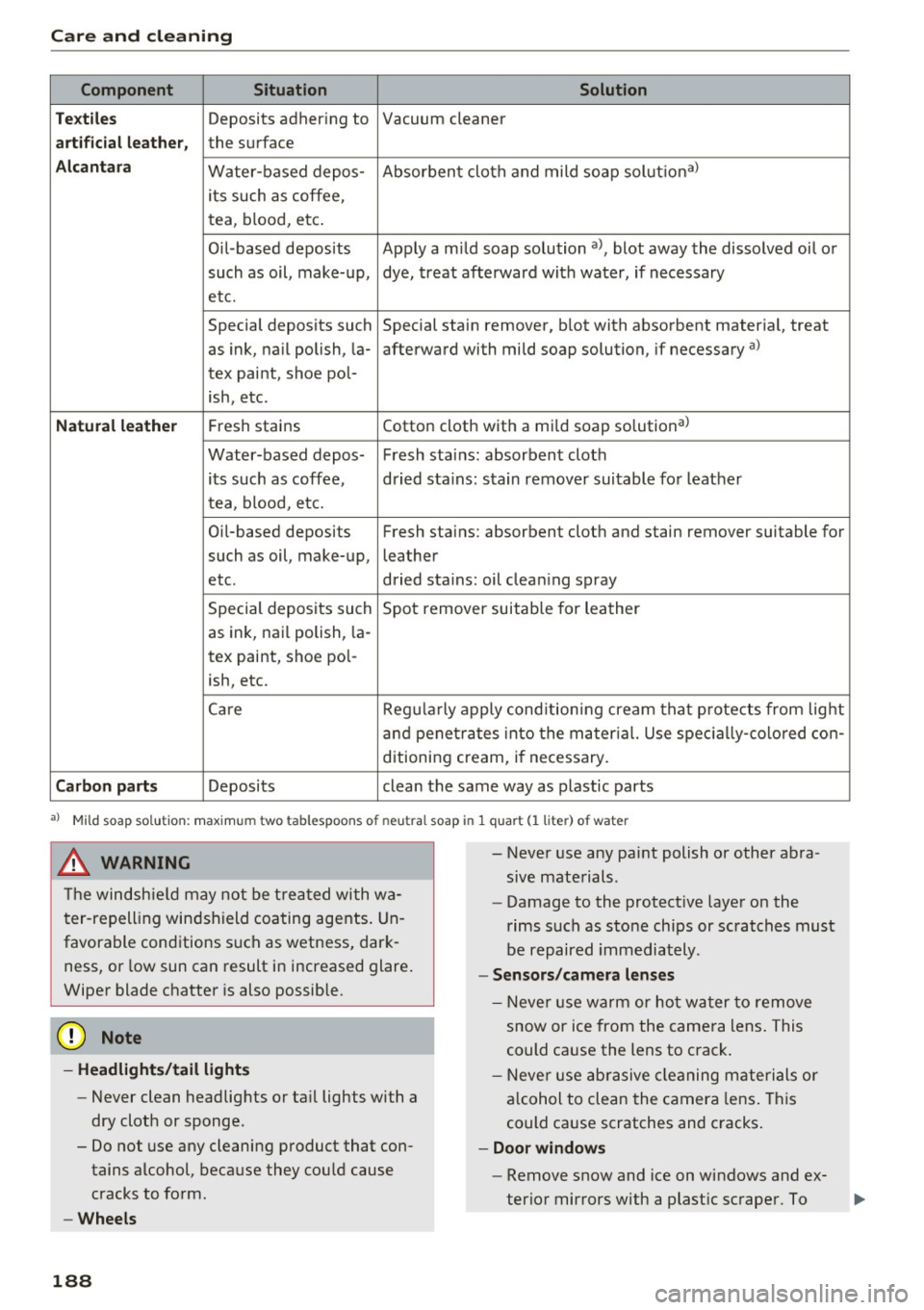
Component Situation Solution
Te xtil es
Deposits adhering to Vacuum cleaner
artifi cial le ather , the surface
Alcan tara Water-based depos- Absorbent cloth and mild soap
solutional
its such as coffee,
tea, blood, etc.
O il-based deposits Apply a mild soap solution a), blot away the dissolved oil o r
such as oil, make-up, dye, treat afterward with water, if necessary
etc.
Special deposits such Special sta ,in remover, blot with absorbent material, treat
as ink, na il polish, la- afterward with mild soap solution, if necessary al
tex paint, shoe pol-
ish, etc.
Natural leather Fresh stains Cotton cloth w
ith a mi ld soap solutional
Water-based depos- Fresh stains: absorbent cloth its such as coffee, dried sta ins: stain remover suitable fo r leather
tea, blood, etc.
Oil-based deposits Fresh stains: absorbent cloth and stain remover suitable for
such as oil, make-up, leather
etc. dried sta
ins: oil clea ning sp ray
Special deposits such Spot remover suitable for leather
as ink, nai l polish, la -
tex paint, shoe pol-
ish, etc.
Ca re Regularly apply cond itioning cream tha t protects from light
a nd penetr ates into the ma ter ial. Use spec ia lly-co lored con -
ditioning cream, i f necessary.
Carbon parts Deposits clean the same way as plastic parts
a) Mild soap sol ution: maxim um two tablesp oons of neutral soap in 1 quart (l liter) of water
_& WARNING
The windshie ld may not be trea ted with w a
ter-repelling windshield coating agents. Un
favorable conditions s uch as wetness, dark
ness, or low sun can result in increased glare .
Wipe r blade chatter is also possib le.
(D Note
- Headlights/tail light s
-Never clean headlights or ta il lights with a
dry cloth or sponge.
- Do not use any cleaning p roduct that con
tains alcohol, because they cou ld cause
cracks to form.
- Wheels
188 -
- Never use any paint polish or other abra
sive materials.
- Damage to the protect ive layer on the
rims such as stone chips or scratches must
be repaired immediately.
- Sensors /camera lenses
- N ever use wa rm or ho t wa ter to remove
snow or ice from the camera lens . This
could ca use the lens to crack .
- N eve r use abrasive cleaning m aterials or
a lcohol to clea n the camera lens . This
could cause scratches and c racks .
-Door windows
- Remove snow and ice on windows and ex-
terior mirrors with a plast ic scraper. To