Page 137 of 396
1374-2. Driving procedures
4
Driving
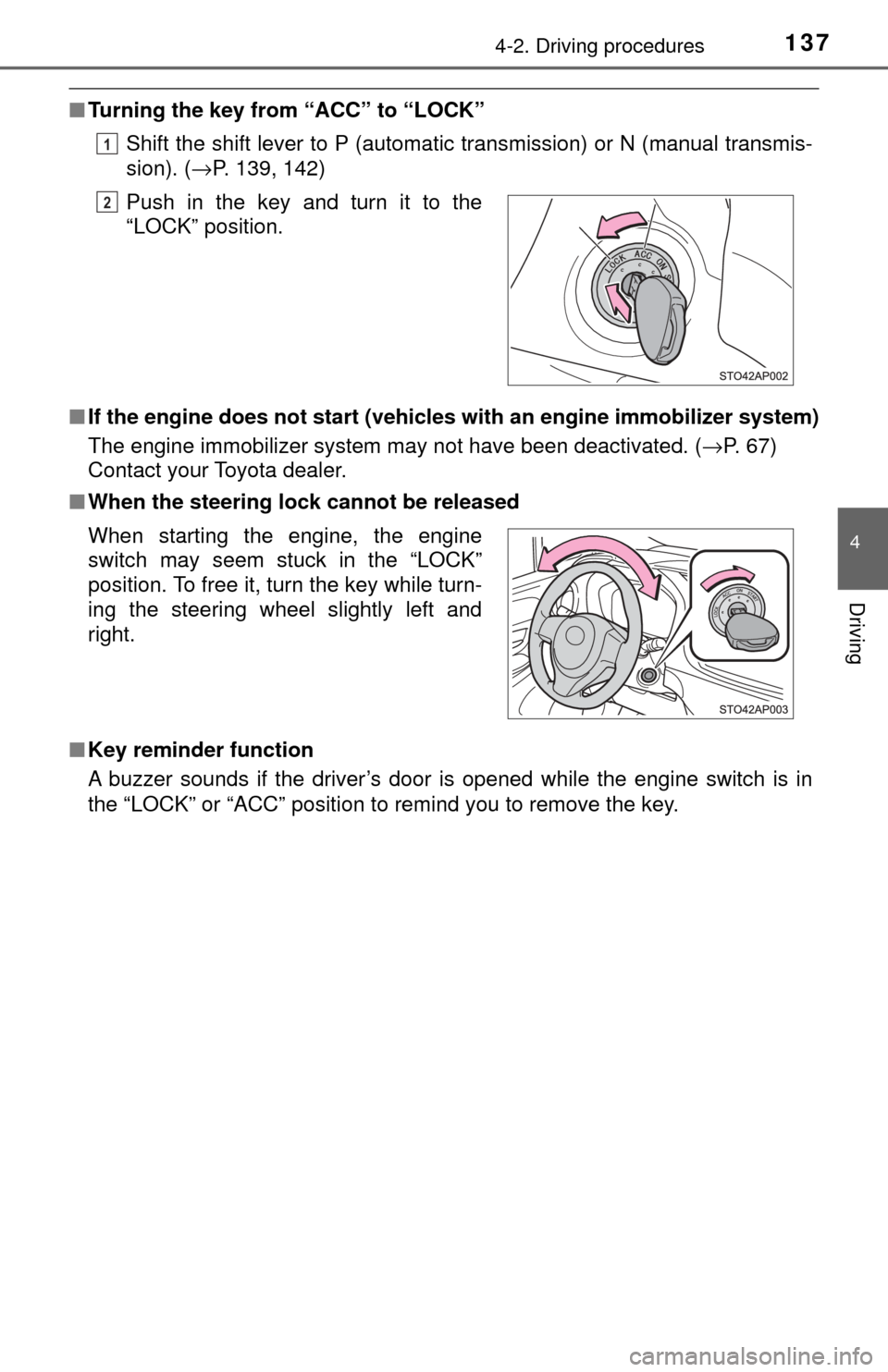
■Turning the key from “ACC” to “LOCK”
Shift the shift lever to P (automatic transmission) or N (manual transmis-
sion). ( →P. 139, 142)
■ If the engine does not start (vehicl es with an engine immobilizer system)
The engine immobilizer system may not have been deactivated. ( →P. 67)
Contact your Toyota dealer.
■ When the steering lock cannot be released
■ Key reminder function
A buzzer sounds if the driver’s door is opened while the engine switch is in
the “LOCK” or “ACC” position to remind you to remove the key. Push in the key and turn it to the
“LOCK” position.
When starting the engine, the engine
switch may seem stuck in the “LOCK”
position. To free it, turn the key while turn-
ing the steering wheel slightly left and
right.
1
2
Page 139 of 396
1394-2. Driving procedures
4
Driving
Automatic transmission∗
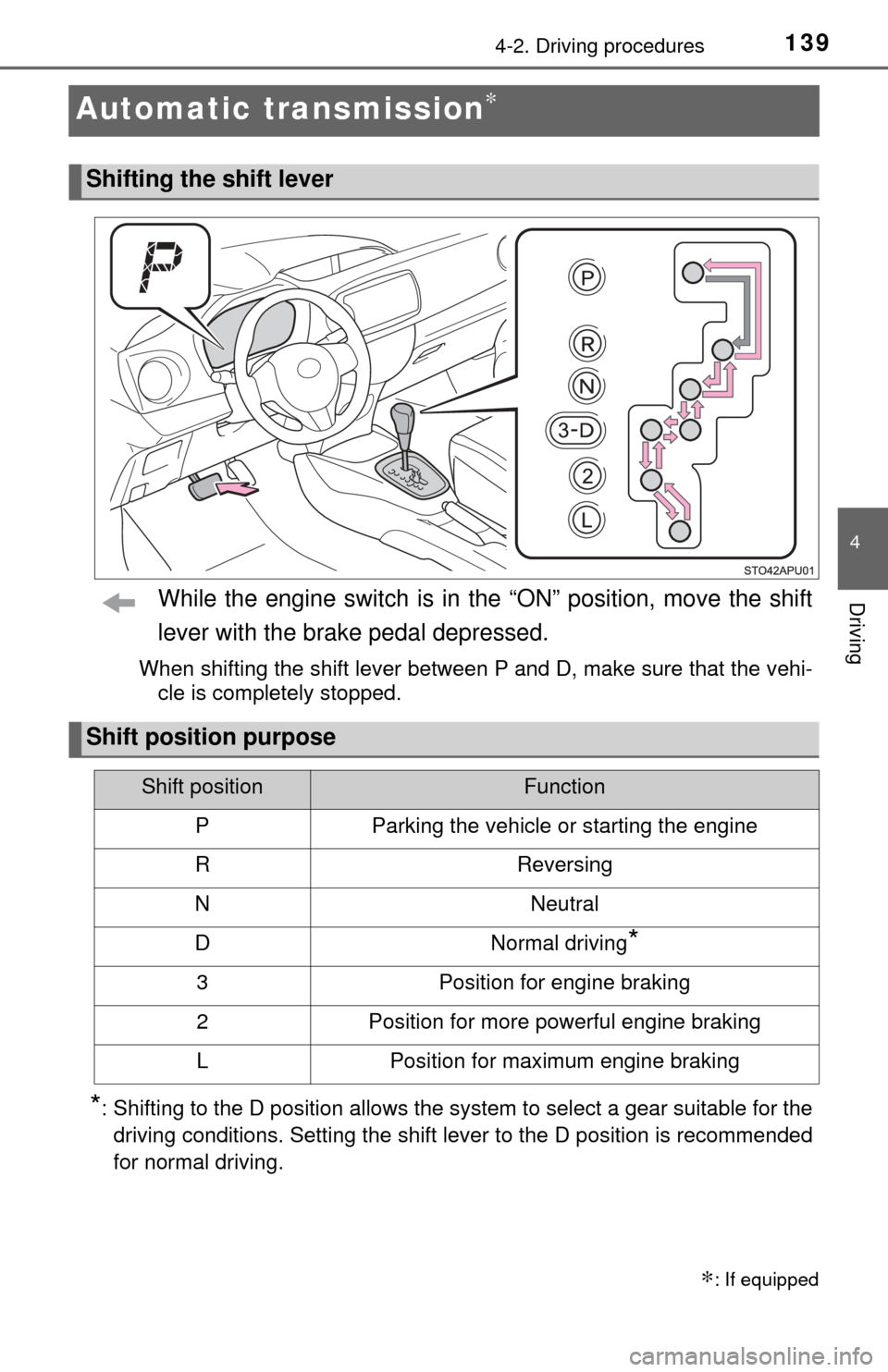
While the engine switch is in the “ON” position, move the shift
lever with the brake pedal depressed.
When shifting the shift lever between P and D, make sure that the vehi-cle is completely stopped.
*: Shifting to the D position allows the system to select a gear suitable for the
driving conditions. Setting the shift lever to the D position is recommended
for normal driving.
∗: If equipped
Shifting the shift lever
Shift position purpose
Shift positionFunction
PParking the vehicle or starting the engine
RReversing
NNeutral
DNormal driving*
3Position for engine braking
2Position for more powerful engine braking
LPosition for maximum engine braking
Page 297 of 396
2977-2. Steps to take in an emergency
7
When trouble arises
If a tow truck is not available in an emergency, your vehicle may be
temporarily towed using cables or chains secured to the emergency
towing eyelets. This should only be attempted on hard surfaced roads
for at most 50 miles (80 km) at under 18 mph (30 km/h).
A driver must be in the vehicle to steer and operate the brakes. The
vehicle’s wheels, drive train, axles, steering and brakes must be in
good condition.
For vehicles with an automatic transmission, only the front towing
eyelets may be used.
Take out the towing eyelet. ( →P. 313)
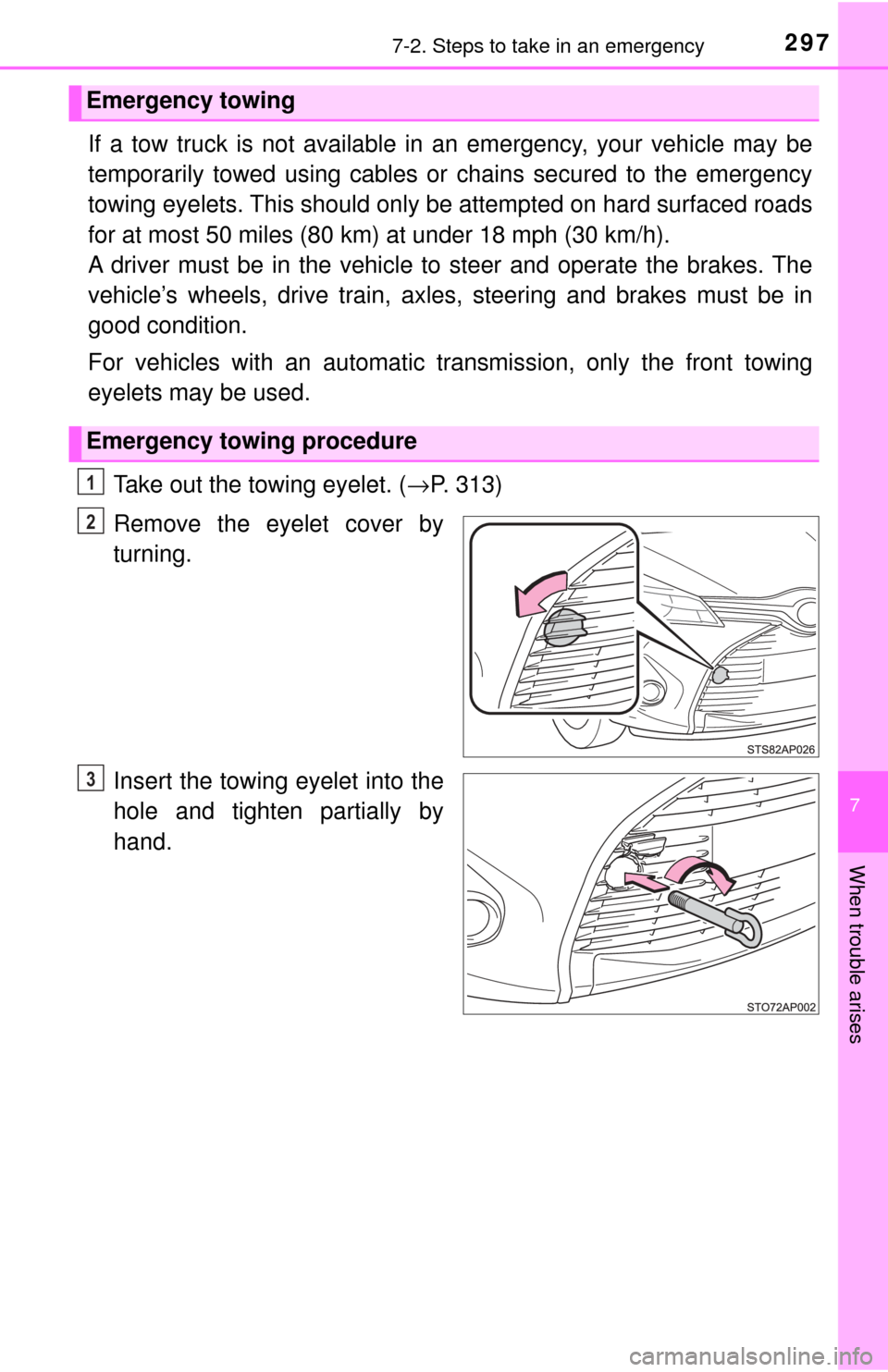
Remove the eyelet cover by
turning.
Insert the towing eyelet into the
hole and tighten partially by
hand.
Emergency towing
Emergency towing procedure
1
2
3
Page 298 of 396
2987-2. Steps to take in an emergency
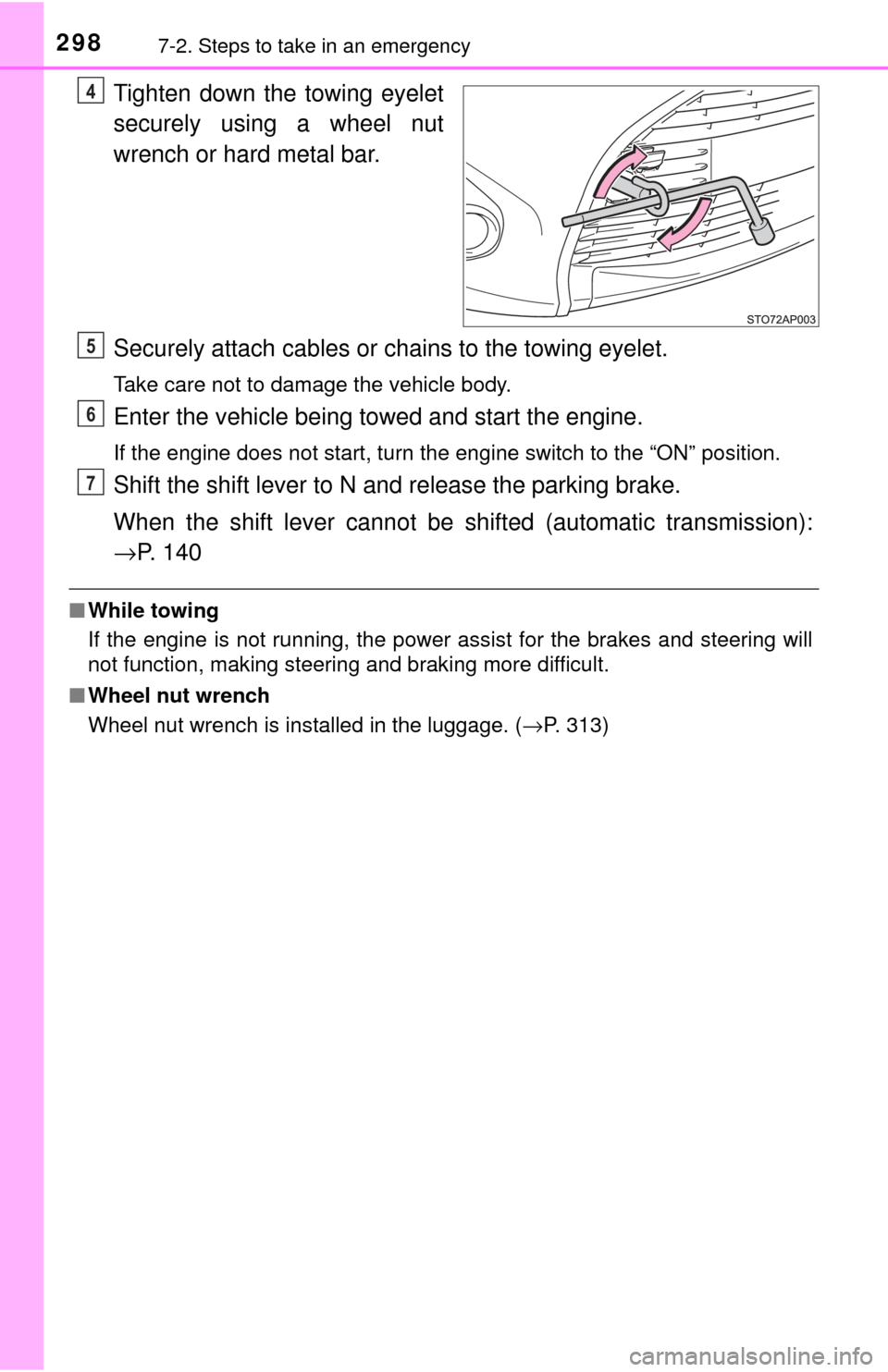
Tighten down the towing eyelet
securely using a wheel nut
wrench or hard metal bar.
Securely attach cables or chains to the towing eyelet.
Take care not to damage the vehicle body.
Enter the vehicle being towed and start the engine.
If the engine does not start, turn the engine switch to the “ON” p\
osition.
Shift the shift lever to N and release the parking brake.
When the shift lever cannot be sh ifted (automatic transmission):
→ P. 1 4 0
■While towing
If the engine is not running, the power assist for the brakes and steering will
not function, making steering and braking more difficult.
■ Wheel nut wrench
Wheel nut wrench is installed in the luggage. ( →P. 313)
4
5
6
7
Page 302 of 396
3027-2. Steps to take in an emergency
If a warning light turns on or a warning
buzzer sounds
Calmly perform the following actions if any of the warning lights
comes on or flashes. If a light comes on or flashes, but then
goes off, this does not necessarily indicate a malfunction in the
system. However, if this continues to occur, have the vehicle
inspected by your Toyota dealer.
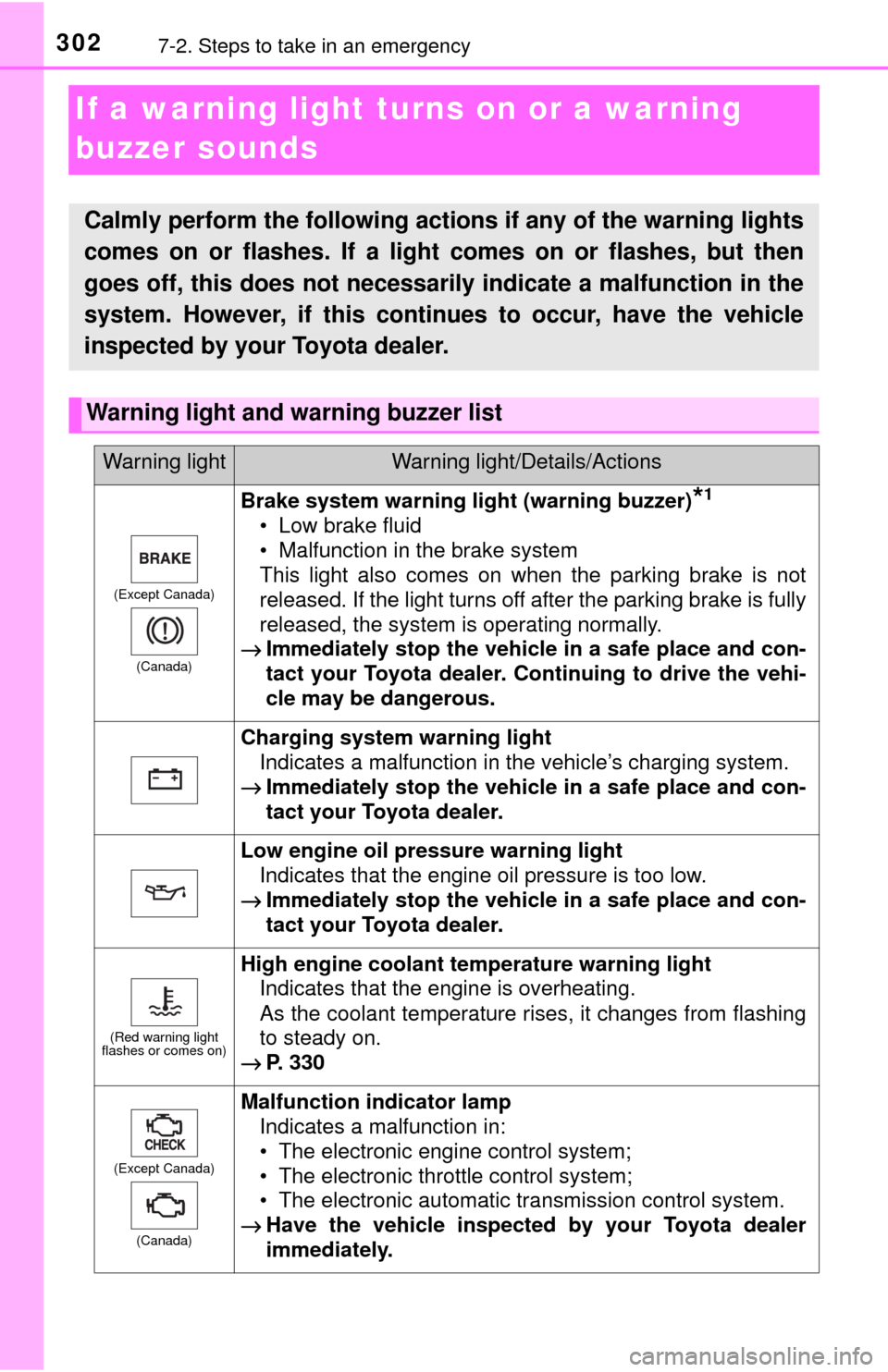
Warning light and warning buzzer list
Warning lightWarning light/Details/Actions
(Except Canada)
(Canada)
Brake system warning light (warning buzzer)*1
• Low brake fluid
• Malfunction in the brake system
This light also comes on when the parking brake is not
released. If the light turns off after the parking brake is fully
released, the system is operating normally.
→ Immediately stop the vehicle in a safe place and con-
tact your Toyota dealer. Continuing to drive the vehi-
cle may be dangerous.
Charging system warning light
Indicates a malfunction in the vehicle’s charging system.
→ Immediately stop the vehicle in a safe place and con-
tact your Toyota dealer.
Low engine oil pressure warning light
Indicates that the engine oil pressure is too low.
→ Immediately stop the vehicle in a safe place and con-
tact your Toyota dealer.
(Red warning light
flashes or comes on)
High engine coolant temperature warning light
Indicates that the engine is overheating.
As the coolant temperature rises, it changes from flashing
to steady on.
→ P. 330
(Except Canada)
(Canada)
Malfunction indicator lampIndicates a malfunction in:
• The electronic engine control system;
• The electronic throttle control system;
• The electronic automatic transmission control system.
→ Have the vehicle inspected by your Toyota dealer
immediately.
Page 312 of 396
3127-2. Steps to take in an emergency
If you have a flat tire
●Stop the vehicle in a safe pl ace on a hard, flat surface.
● Set the parking brake.
● Shift the shift lever to P (automatic transmission) or R (manual
transmission).
● Stop the engine.
● Turn on the emergency flashers. ( →P. 292)
Your vehicle is equipped with a spare tire. The flat tire can be
replaced with the spare tire.
For details about tires: →P. 2 5 3
WARNING
■If you have a flat tire
Do not continue driving with a flat tire.
Driving even a short dist ance with a flat tire can damage the tire and the
wheel beyond repair, which could result in an accident.
Before jacking up the vehicle
Page 328 of 396

3287-2. Steps to take in an emergency
Start the engine of the second vehicle. Increase the engine speed
slightly and maintain at that level for approximately 5 minutes to
recharge the batter y of your vehicle.
Maintain the engine speed of t he second vehicle and start the
engine of your vehicle.
Once the vehicle’s engine has star ted, remove the jumper cables in
the exact reverse order from which they were connected.
Once the engine starts, have the v ehicle inspected at your Toyota
dealer as soon as possible.
■ Starting the engine when the batt ery is discharged (vehicles with an
automatic transmission)
The engine cannot be started by push-starting.
■ To prevent battery discharge
●Turn off the headlights and the audio system while the engine is not running.
● Turn off any unnecessary electrical components when the vehicle is running
at a low speed for an extended period, such as in heavy traffic.
■ Charging the battery
The electricity stored in the battery will discharge gradually even when the
vehicle is not in use, due to natural discharge and the draining effects of cer-
tain electrical appliances. If the vehicle is left for a long time, the battery may
discharge, and the engine may be unable to start. (The battery recharges
automatically during driving.)
3
4
5
Page 333 of 396
333
7
When trouble arises
7-2. Steps to take in an emergency
If the vehicle becomes stuck
Stop the engine. Set the parking brake and shift the shift lever to P
(automatic transmission) or N (manual transmission).
Remove the mud, snow or sand from around the front wheels.
Place wood, stones or some othe r material under the front wheels
to help provide traction.
Restart the engine.
Shift the shift lever to D or R (a utomatic transmission) or 1 or R
(manual transmission) and releas e the parking brake. Then, while
exercising caution, depre ss the accelerator pedal.
■When it is difficult to free the vehicle
■ Emergency hooks
Carry out the following procedures if the tires spin or the vehicle
becomes stuck in mud, dirt or snow:
Press the button to turn off TRC.
When your vehicle becomes stuck and
cannot move, the emergency hooks are
used for another vehicle to pull your vehi-
cle out in an emergency.
Your vehicle is not designed to tow
another vehicle.
1
2
3
4
5