Page 320 of 396
3207-2. Steps to take in an emergency
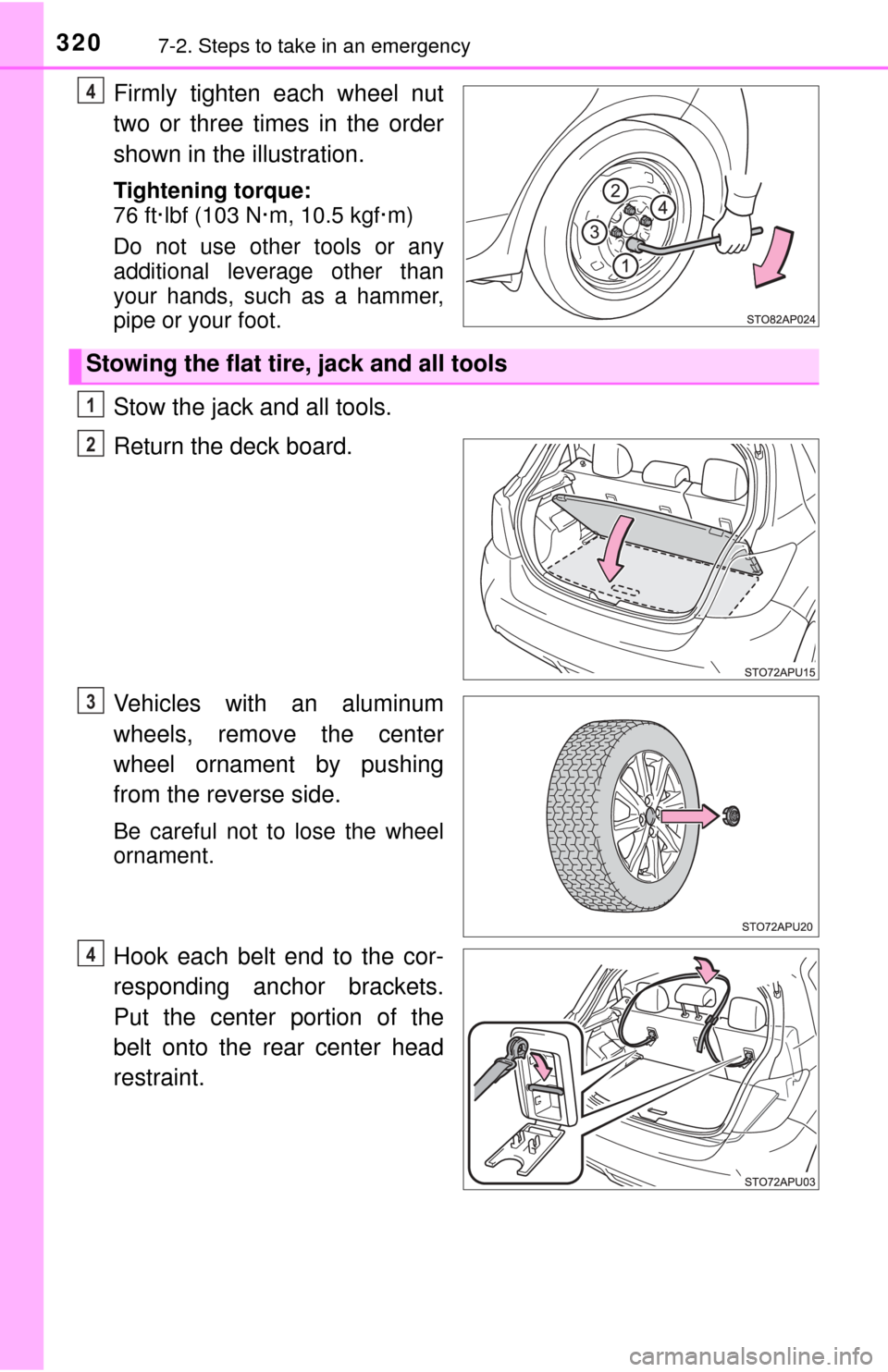
Firmly tighten each wheel nut
two or three times in the order
shown in the illustration.
Tightening torque:
76 ft·lbf (103 N·m, 10.5 kgf·m)
Do not use other tools or any
additional leverage other than
your hands, such as a hammer,
pipe or your foot.
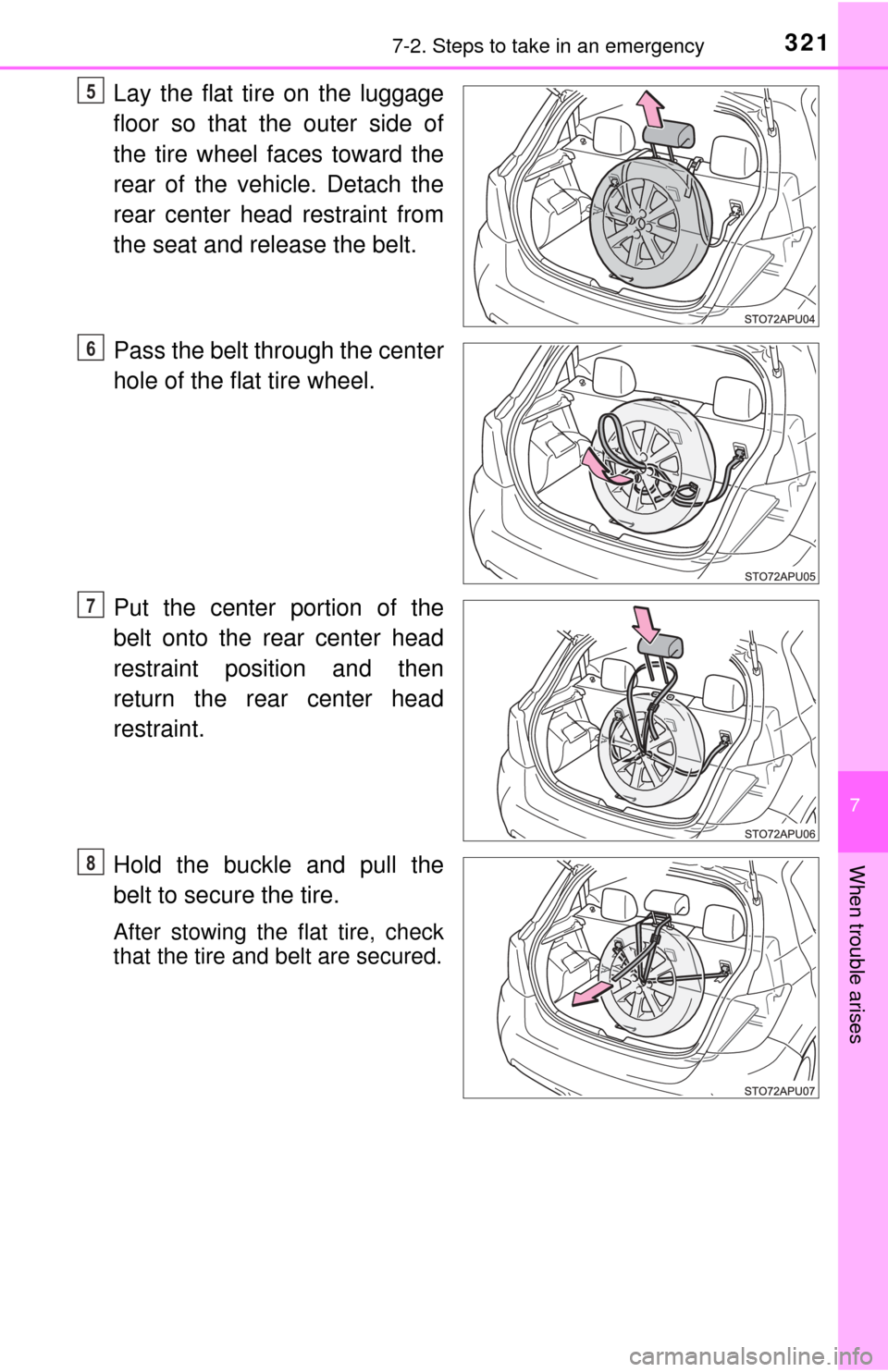
Stow the jack and all tools.
Return the deck board.
Vehicles with an aluminum
wheels, remove the center
wheel ornament by pushing
from the reverse side.
Be careful not to lose the wheel
ornament.
Hook each belt end to the cor-
responding anchor brackets.
Put the center portion of the
belt onto the rear center head
restraint.
4
Stowing the flat tire, jack and all tools
1
2
3
4
Page 321 of 396
3217-2. Steps to take in an emergency
7
When trouble arises
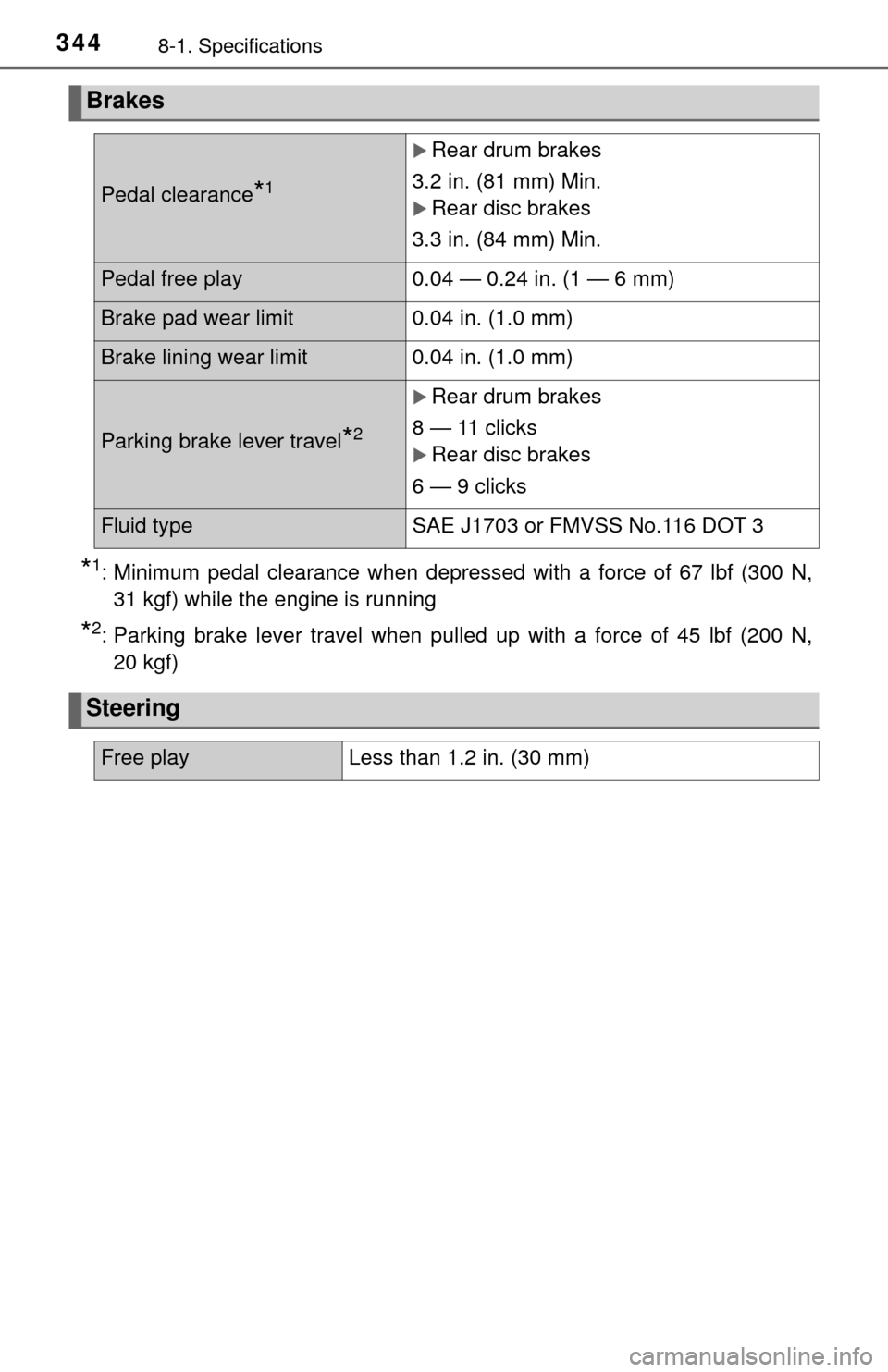
Lay the flat tire on the luggage
floor so that the outer side of
the tire wheel faces toward the
rear of the vehicle. Detach the
rear center head restraint from
the seat and release the belt.
Pass the belt through the center
hole of the flat tire wheel.
Put the center portion of the
belt onto the rear center head
restraint position and then
return the rear center head
restraint.
Hold the buckle and pull the
belt to secure the tire.
After stowing the flat tire, check
that the tire and belt are secured.
5
6
7
8
Page 322 of 396

3227-2. Steps to take in an emergency
■The compact spare tire
●The compact spare tire is identified by the label “TEMPORARY USE
ONLY” on the tire sidewall.
Use the compact spare tire temporarily, and only in an emergency.
●Make sure to check the tire inflation pressure of the compact spare tire.
(→ P. 345)
■After completing the tire change (vehicles with a tire pressure warn-
ing system)
The tire pressure warning system must be reset. ( →P. 254)
■When using the compact spare tire (vehicles with a tire pressure
warning system)
As the compact spare tire is not equipped with a tire pressure warning
valve and transmitter, low inflation pressure of the spare tire will not be
indicated by the tire pressure warning system. Also, if you replace the
compact spare tire after the tire pressure warning light comes on, the light
remains on.
■If you have a flat front tire on a road covered with snow or ice
Install the compact spare tire on one of the rear wheels of the vehicle.
Perform the following steps and fit tire chains to the front tires:
Replace a rear tire with the compact spare tire.
Replace the flat front tire with the tire removed from the rear of the
vehicle.
Fit tire chains to the front tires.
1
2
3
Page 323 of 396

3237-2. Steps to take in an emergency
7
When trouble arises
WARNING
■When using the compact spare tire
●Remember that the compact spare tire provided is specifically
designed for use with your vehicle. Do not use your compact spare tire
on another vehicle.
●Do not use more than one compact spare tire simultaneously.
●Replace the compact spare tire with a standard tire as soon as possi-
ble.
●Avoid sudden acceleration, abrupt steering, sudden braking and shift-
ing operations that cause sudden engine braking.
■When storing the compact spare tire
Be careful not to catch fingers or other body parts between the compact
spare tire and the body of the vehicle.
■After using the tools and jack
Before driving, make sure all the tools and jack are securely in place in
their storage location to reduce the po ssibility of personal injury during a
collision or sudden braking.
■When the compact spare tire is attached
The vehicle speed may not be correctly detected, and the following sys-
tems may not operate correctly:
●ABS
●Brake assist
●VSC
●TRAC
●PCS (Pre-Collision System) (if equipped)
●LDA (Lane Departure Alert) (if equipped)
●Automatic High Beam (if equipped)
●Cruise control (if equipped)
●EPS (Electric Power Steering)
■Speed limit when using the compact spare tire
Do not drive at speeds in excess of 50 mph (80 km/h) when a compact
spare tire is installed on the vehicle.
The compact spare tire is not designed for driving at high speeds. Fail-
ure to observe this precaution may lead to an accident causing death or
serious injury.
■When stowing the flat tire
●Make sure the rear seats are in their original position.
●Secure it using a tire tie-down belt. Otherwise, the flat tire may fly out
in case of the sudden braking or an accident, resulting in death or seri-
ous injury.
Page 336 of 396
3368-1. Specifications
Maintenance data (fuel, oil level, etc.)
*1: Unladen vehicles
*2: P175/65R15 tires
*3: P195/50R16 tires
Dimensions and weights
Overall length 155.5 in. (3950 mm)
Overall width 66.7 in. (1695 mm)
Overall height*159.4 in. (1510 mm)
Wheelbase98.8 in. (2510 mm)
Tread
Front58.5 in. (1485 mm)*2
57.5 in. (1460 mm)*3
Rear57.9 in. (1470 mm)*2
56.9 in. (1445 mm)*3
Vehicle capacity weight
(Occupants + luggage) 845 lb. (380 kg)
Page 344 of 396
3448-1. Specifications
*1: Minimum pedal clearance when depressed with a force of 67 lbf (300 N,31 kgf) while the engine is running
*2: Parking brake lever travel when pulled up with a force of 45 lbf (200 N,20 kgf)
Brakes
Pedal clearance*1
Rear drum brakes
3.2 in. (81 mm) Min.
Rear disc brakes
3.3 in. (84 mm) Min.
Pedal free play0.04 — 0.24 in. (1 — 6 mm)
Brake pad wear limit0.04 in. (1.0 mm)
Brake lining wear limit0.04 in. (1.0 mm)
Parking brake lever travel*2
Rear drum brakes
8 — 11 clicks
Rear disc brakes
6 — 9 clicks
Fluid typeSAE J1703 or FMVSS No.116 DOT 3
Steering
Free playLess than 1.2 in. (30 mm)
Page 345 of 396
3458-1. Specifications
8
Vehicle specifications
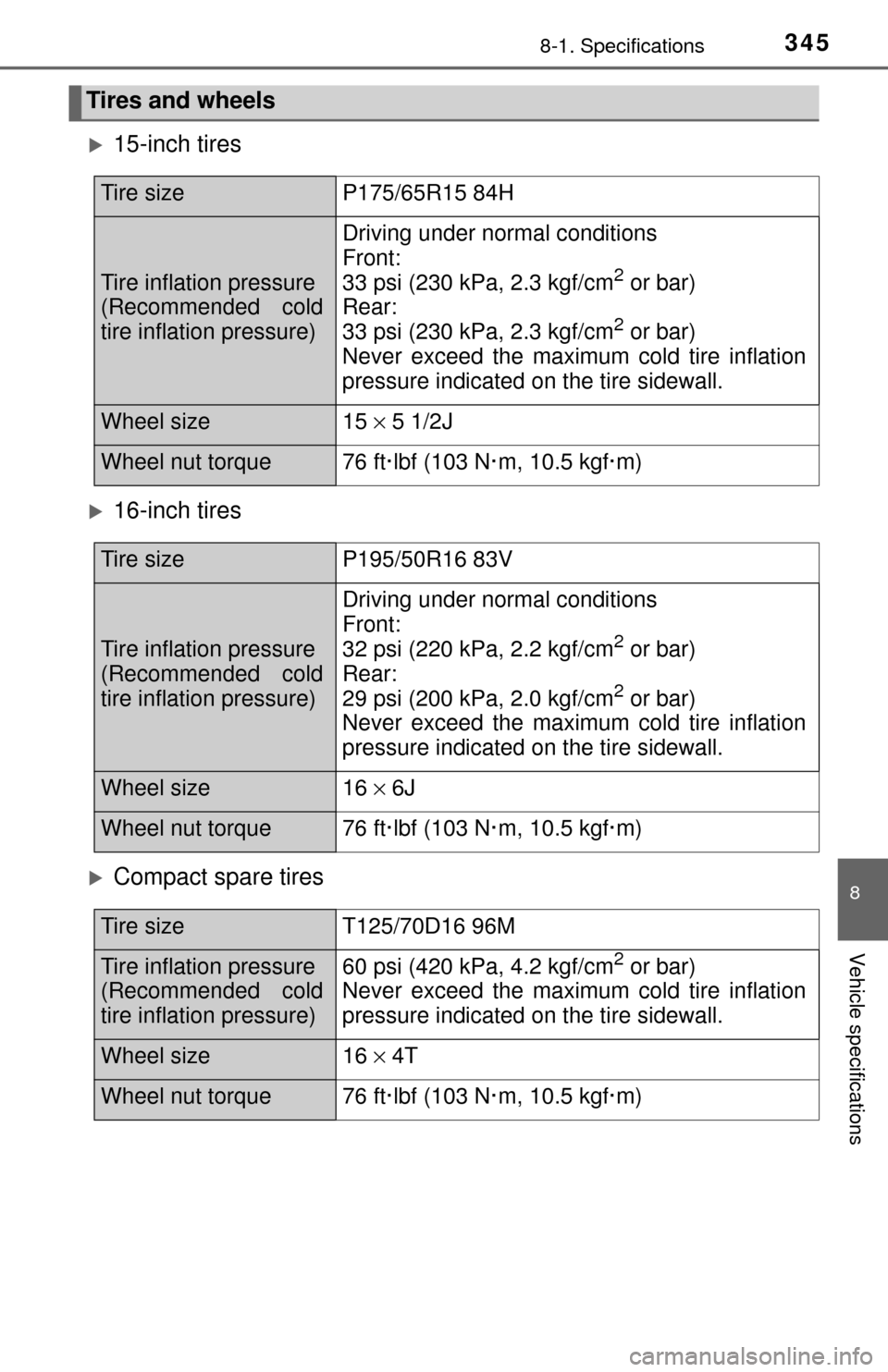
15-inch tires
16-inch tires
Compact spare tires
Tires and wheels
Tire sizeP175/65R15 84H
Tire inflation pressure
(Recommended cold
tire inflation pressure)
Driving under normal conditions
Front:
33 psi (230 kPa, 2.3 kgf/cm
2 or bar)
Rear:
33 psi (230 kPa, 2.3 kgf/cm
2 or bar)
Never exceed the maximum cold tire inflation
pressure indicated on the tire sidewall.
Wheel size15 × 5 1/2J
Wheel nut torque76 ft·lbf (103 N·m, 10.5 kgf·m)
Tire sizeP195/50R16 83V
Tire inflation pressure
(Recommended cold
tire inflation pressure)
Driving under normal conditions
Front:
32 psi (220 kPa, 2.2 kgf/cm
2 or bar)
Rear:
29 psi (200 kPa, 2.0 kgf/cm
2 or bar)
Never exceed the maximum cold tire inflation
pressure indicated on the tire sidewall.
Wheel size16 × 6J
Wheel nut torque76 ft·lbf (103 N·m, 10.5 kgf·m)
Tire sizeT125/70D16 96M
Tire inflation pressure
(Recommended cold
tire inflation pressure)60 psi (420 kPa, 4.2 kgf/cm2 or bar)
Never exceed the maximum cold tire inflation
pressure indicated on the tire sidewall.
Wheel size16 × 4T
Wheel nut torque76 ft·lbf (103 N·m, 10.5 kgf·m)
Page 346 of 396
3468-1. Specifications
A: HB2 halogen bulbs B: HIR2 halogen bulbs
C: H16 halogen bulbs D: Wedge base bulbs (clear)
E: Wedge base bulbs (amber) F: Single end bulbs (clear)
G: Double end bulbs
Light bulbs
Light BulbsBulb NoWTy p e
Exterior Headlights and daytime running
lights (if equipped)
Type A
Type B
9003
— 60/55
55 A
B
Front fog lights (if equipped) — 19 C
Front side marker lights — 5 D
Front turn signal lights/
parking lights 7444NA 28/8 E
Rear turn signal lights — 21 F
Stop/tail and rear side marker
lights 7443 21/5 D
Back-up lights 921 16 D
License plate light — 5 D
Interior
Personal lights/interior light —5D
Luggage compartment light —5G