Page 254 of 396
2546-3. Do-it-yourself maintenance
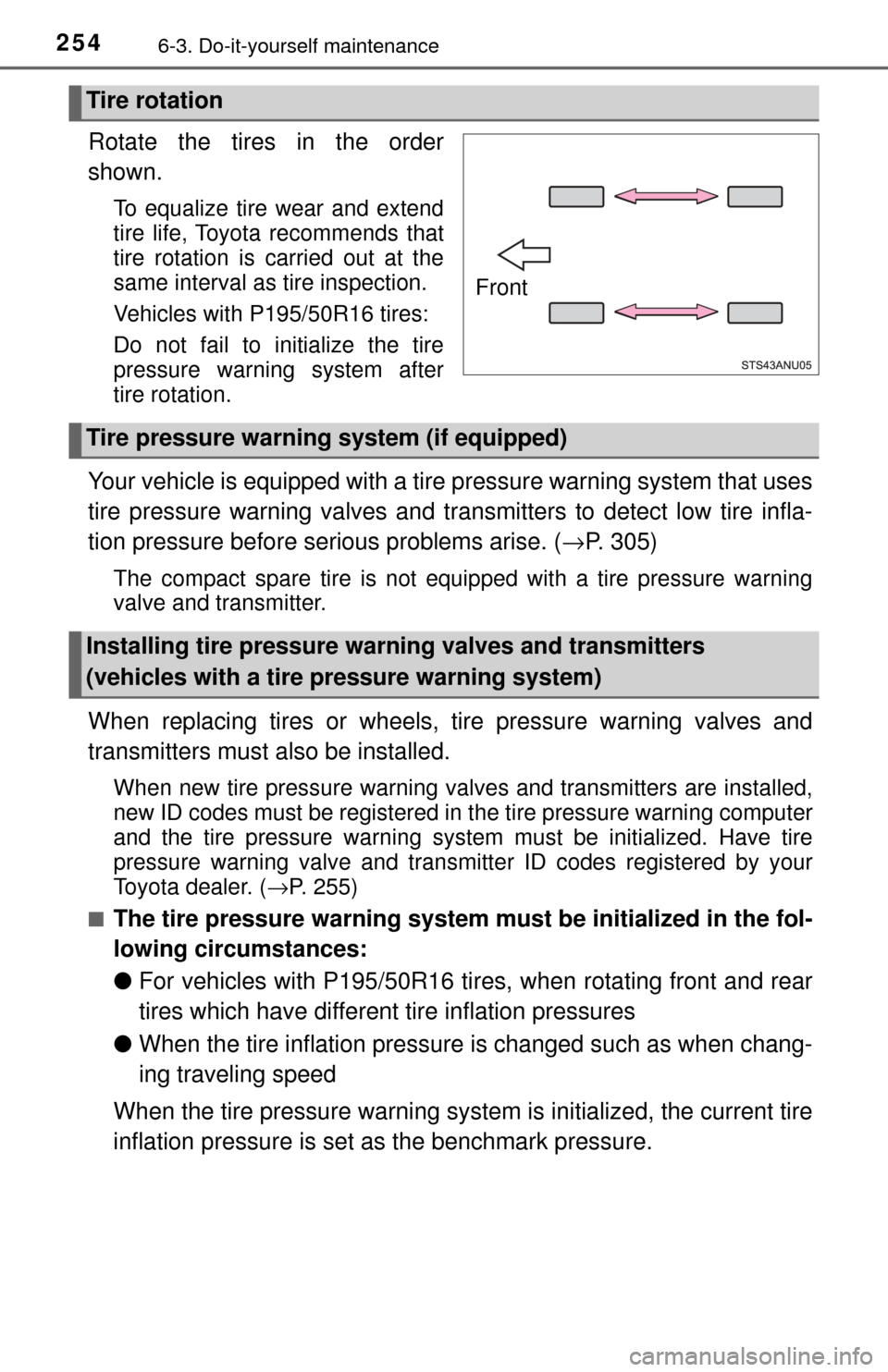
Rotate the tires in the order
shown.
To equalize tire wear and extend
tire life, Toyota recommends that
tire rotation is carried out at the
same interval as tire inspection.
Vehicles with P195/50R16 tires:
Do not fail to initialize the tire
pressure warning system after
tire rotation.
Your vehicle is equipped with a tire pressure warning system that uses
tire pressure warning valves and tr ansmitters to detect low tire infla-
tion pressure before serious problems arise. ( →P. 305)
The compact spare tire is not equipped with a tire pressure warning
valve and transmitter.
When replacing tires or wheels, tire pressure warning valves and
transmitters must also be installed.
When new tire pressure warning valves and transmitters are installed,
new ID codes must be registered in the tire pressure warning computer
and the tire pressure warning syst em must be initialized. Have tire
pressure warning valve and transmitter ID codes registered by your
Toyota dealer. ( →P. 255)
■The tire pressure warning system must be initialized in the fol-
lowing circumstances:
● For vehicles with P195/50R16 ti res, when rotating front and rear
tires which have different tire inflation pressures
● When the tire inflation pressure is changed such as when chang-
ing traveling speed
When the tire pressure warning system is initialized, the current tire
inflation pressure is set as the benchmark pressure.
Tire rotation
Front
Tire pressure warning system (if equipped)
Installing tire pressure warning valves and transmitters
(vehicles with a tire pressure warning system)
Page 257 of 396

2576-3. Do-it-yourself maintenance
6
Maintenance and care
■Maximum load of tire
Check that the maximum load of the replacement tire is greater than 1/2
of the Gross Axle Weight Ratings (GAWR) of either the front axle or the
rear axle, whichever is greater.
■Tire types
●Summer tires
Summer tires are high-speed performance tires best suited to highway
driving under dry conditions. Since summer tires do not have the same
traction performance as snow tires, summer tires are inadequate for
driving on snow-covered or icy ro ads. For driving on snow-covered
roads or icy roads, the use of snow tires is recommended. When install-
ing snow tires, be sure to replace all four tires.
●All season tires
All season tires are designed to provide better traction in snow and to
be adequate for driving in most winter conditions as well as for use
year-round. All season tires, however, do not have adequate traction
performance compared with snow tires in heavy or loose snow. Also, all
season tires fall short in acceleration and handling performance com-
pared with summer tires in highway driving.
●Snow tires
For driving on snow-covered roads or icy roads, we recommend using
snow tires. If you need snow tires, select tires of the same size, con-
struction and load capacity as the or iginally installed tires. Since your
vehicle has radial tires as original equipment, make sure your snow
tires also have radial construction. Do not install studded tires without
first checking local regulations fo r possible restrictions. Snow tires
should be installed on all wheels. ( →P. 199)
For the GAWR, see the Certification
Label. For the maximum load of the tire,
see the load limit at maximum cold tire
inflation pressure mentioned on the
sidewall of the tire. (
→P. 350)
Page 279 of 396
2796-3. Do-it-yourself maintenance
6
Maintenance and care
■Rear
■Headlights and daytime running lights (if equipped)
Reflector typeUnplug the connector.
Remove the rubber cover.
Back-up lights
License plate lights Rear turn signal lights
Stop/tail and rear side marker
lights
Replacing light bulbs
1
2
3
4
1
2
Page 285 of 396
2856-3. Do-it-yourself maintenance
6
Maintenance and care
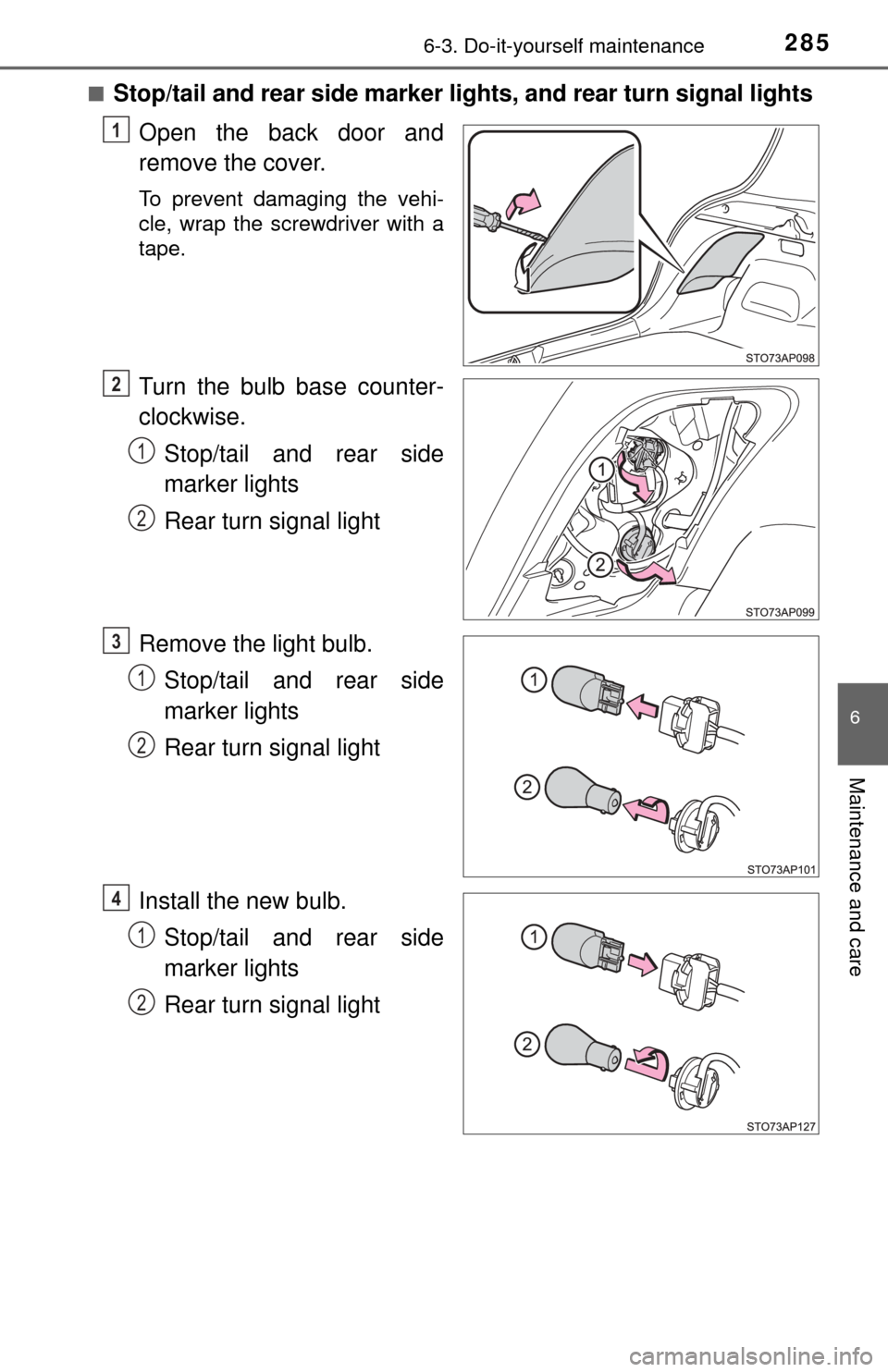
■Stop/tail and rear side marker lights, and rear turn signal lights
Open the back door and
remove the cover.
To prevent damaging the vehi-
cle, wrap the screwdriver with a
tape.
Turn the bulb base counter-
clockwise. Stop/tail and rear side
marker lights
Rear turn signal light
Remove the light bulb. Stop/tail and rear side
marker lights
Rear turn signal light
Install the new bulb. Stop/tail and rear side
marker lights
Rear turn signal light
1
2
1
2
3
1
2
4
1
2
Page 286 of 396
2866-3. Do-it-yourself maintenance
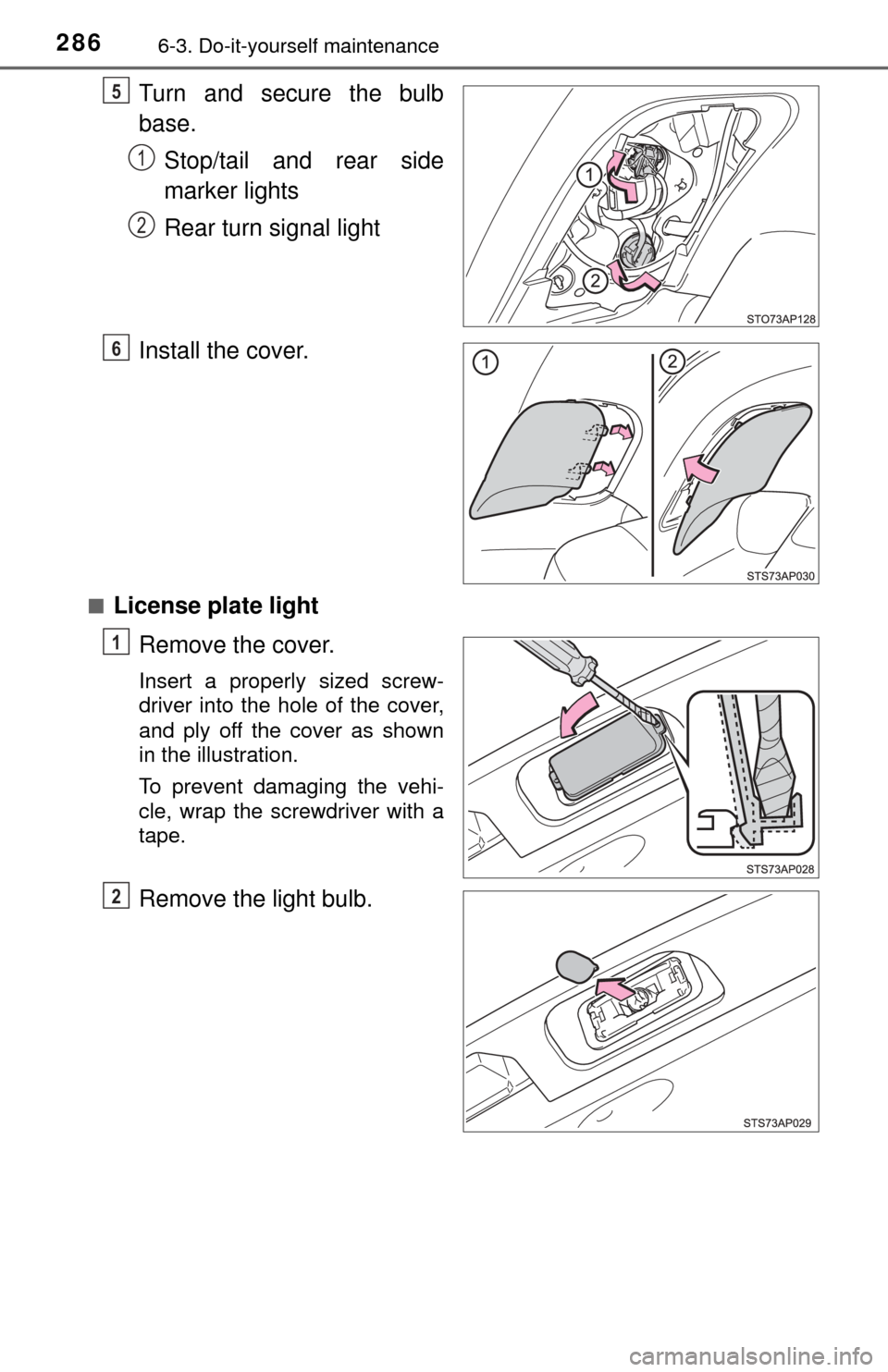
Turn and secure the bulb
base.Stop/tail and rear side
marker lights
Rear turn signal light
Install the cover.
■License plate light Remove the cover.
Insert a properly sized screw-
driver into the hole of the cover,
and ply off the cover as shown
in the illustration.
To prevent damaging the vehi-
cle, wrap the screwdriver with a
tape.
Remove the light bulb.
5
1
2
6
1
2
Page 296 of 396
2967-2. Steps to take in an emergency
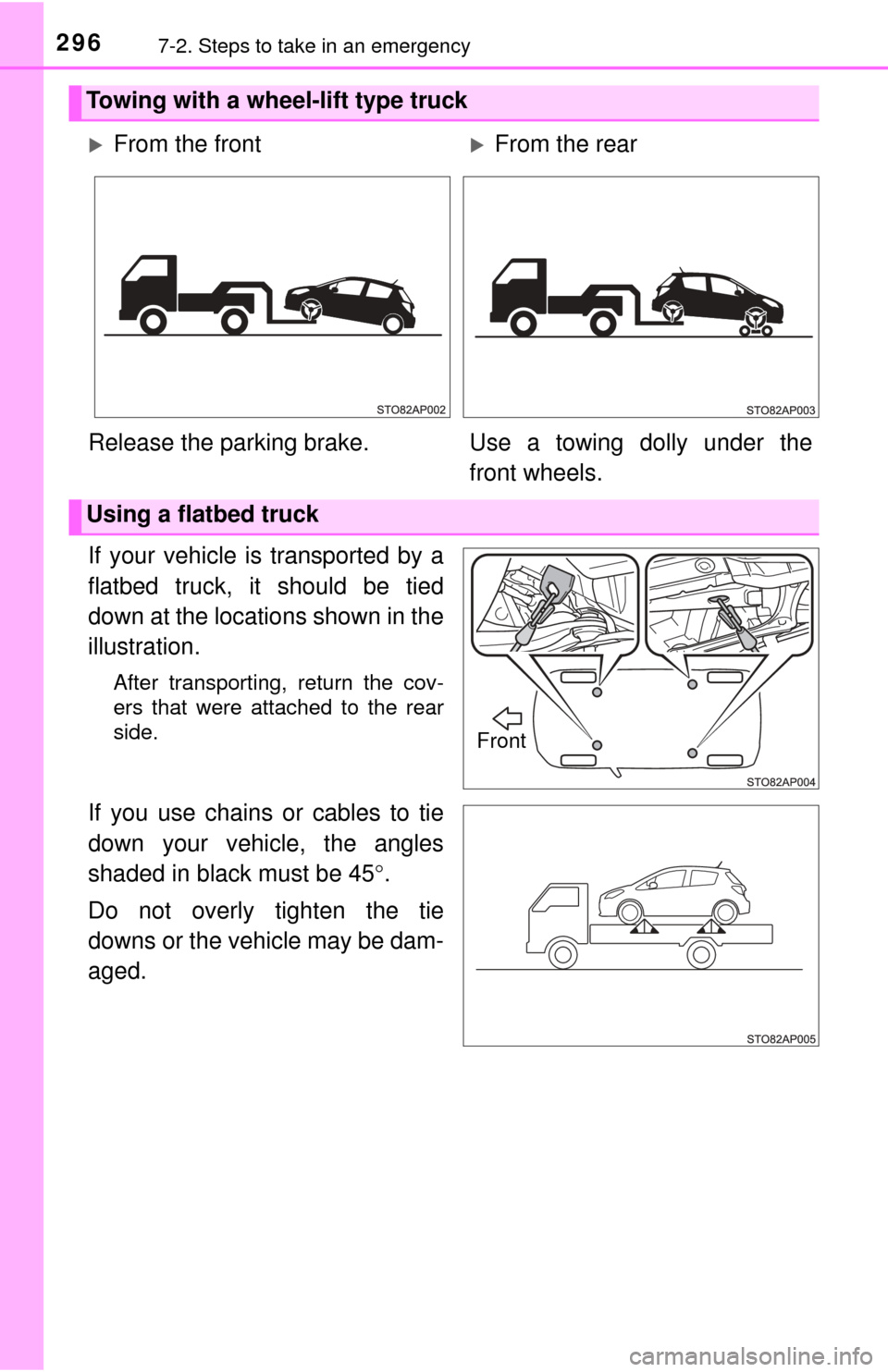
If your vehicle is transported by a
flatbed truck, it should be tied
down at the locations shown in the
illustration.
After transporting, return the cov-
ers that were attached to the rear
side.
If you use chains or cables to tie
down your vehicle, the angles
shaded in black must be 45°.
Do not overly tighten the tie
downs or the vehicle may be dam-
aged.
Towing with a wheel-lift type truck
From the frontFrom the rear
Release the parking brake. Use a towing dolly under the front wheels.
Using a flatbed truck
Front
Page 299 of 396
2997-2. Steps to take in an emergency
7
When trouble arises
WARNING
Observe the following precautions.
Failure to do so may result in death or serious injury.
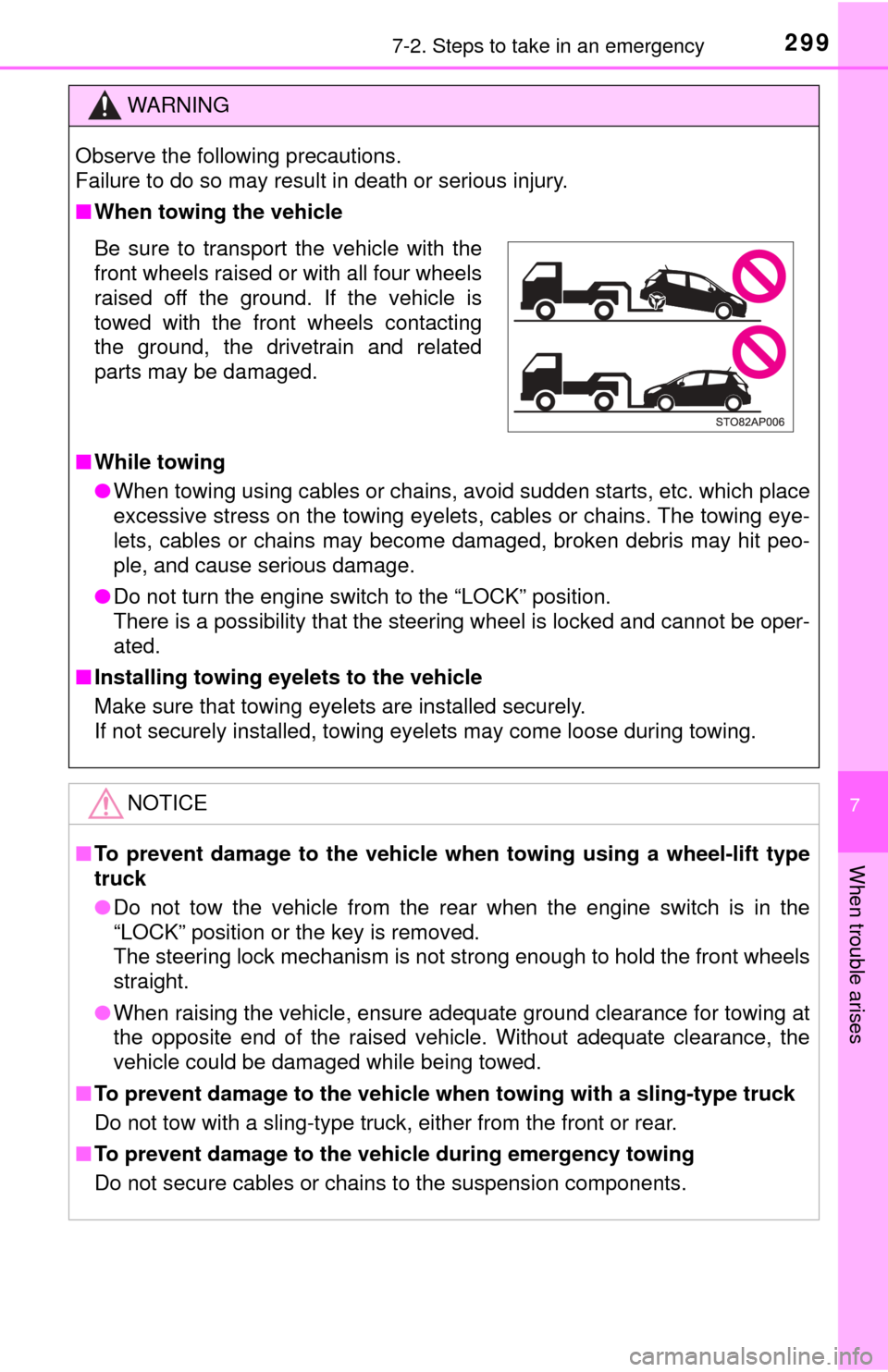
■When towing the vehicle
■ While towing
● When towing using cables or chains, avoid sudden starts, etc. which place
excessive stress on the towing eyelets, cables or chains. The towing eye-
lets, cables or chains may become damaged, broken debris may hit peo-
ple, and cause serious damage.
● Do not turn the engine switch to the “LOCK” position.
There is a possibility that the steering wheel is locked and cannot be oper-
ated.
■ Installing towing eyelets to the vehicle
Make sure that towing eyelets are installed securely.
If not securely installed, towing eyelets may come loose during towing.
NOTICE
■To prevent damage to the vehicle when towing using a wheel-lift type
truck
● Do not tow the vehicle from the rear when the engine switch is in the
“LOCK” position or the key is removed.
The steering lock mechanism is not strong enough to hold the front wheels
straight.
● When raising the vehicle, ensure adequate ground clearance for towing at
the opposite end of the raised vehicle. Without adequate clearance, the
vehicle could be damaged while being towed.
■ To prevent damage to the vehicle when towing with a sling-type truck
Do not tow with a sling-type truck, either from the front or rear.
■ To prevent damage to the vehic le during emergency towing
Do not secure cables or chains to the suspension components.
Be sure to transport the vehicle with the
front wheels raised or with all four wheels
raised off the ground. If the vehicle is
towed with the front wheels contacting
the ground, the drivetrain and related
parts may be damaged.
Page 316 of 396
3167-2. Steps to take in an emergency
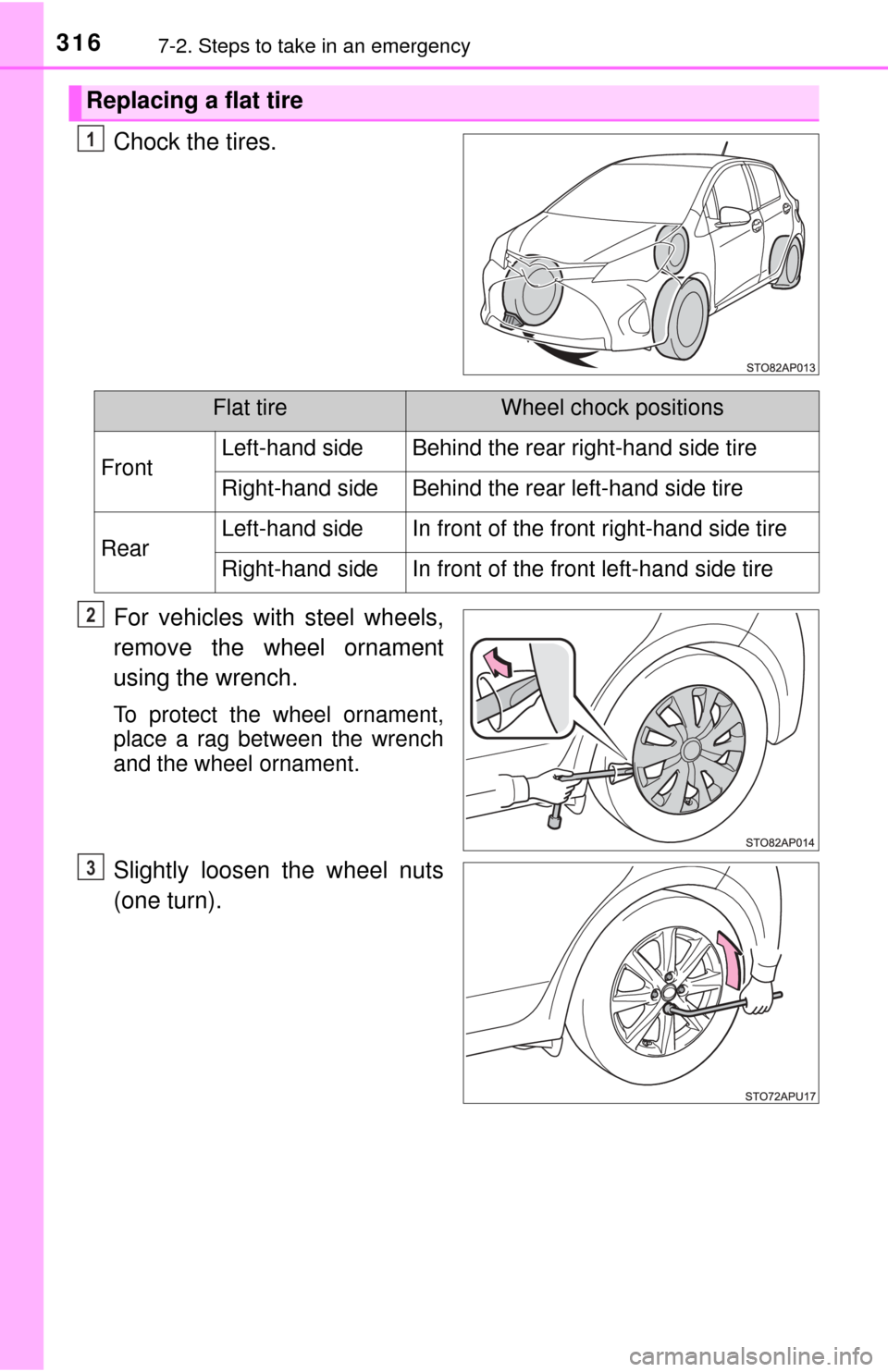
Chock the tires.
For vehicles with steel wheels,
remove the wheel ornament
using the wrench.
To protect the wheel ornament,
place a rag between the wrench
and the wheel ornament.
Slightly loosen the wheel nuts
(one turn).
Replacing a flat tire
1
Flat tireWheel chock positions
FrontLeft-hand sideBehind the rear right-hand side tire
Right-hand sideBehind the rear left-hand side tire
RearLeft-hand sideIn front of the front right-hand side tire
Right-hand sideIn front of the front left-hand side tire
2
3