2017 TOYOTA TUNDRA inflation pressure
[x] Cancel search: inflation pressurePage 5 of 588

5
1
9 8
7 5 4
3
2
10
6
6-4. Using the other interior featuresOther interior features ....... 384• Sun visors ..................... 384
• Vanity mirrors................ 384
• Clock ............................. 385
• Outside temperature
display........................... 386
• Power outlets ................ 387
• Armrest ......................... 389
• Assist grips ................... 390
Garage door opener .......... 391
Compass ........................... 397
7-1. Maintenance and care Cleaning and protecting the vehicle exterior .......... 402
Cleaning and protecting the vehicle interior ........... 404
7-2. Maintenance Maintenance requirements ................... 407
General maintenance ........ 409
Emission inspection and maintenance (I/M)
programs ......................... 412
7-3. Do-it-yourself maintenance Do-it-yourself service precautions ..................... 413
Hood.................................. 415
Engine compartment ......... 416
Tires .................................. 426
Tire inflation pressure........ 434
Wheels .............................. 437
Air conditioning filter .......... 440
Wireless remote control battery ............................. 443
Checking and replacing fuses ............................... 445
Light bulbs ......................... 448 8-1. Essential information
Emergency flashers ........... 466
If your vehicle has to be stopped in
an emergency.................. 467
8-2. Steps to take in an emergency
If your vehicle needs to be towed .......................... 468
If you think something is wrong............................... 473
Fuel pump shut off system ............................. 474
If a warning light turns on or a warning buzzer
sounds ............................. 475
If a warning message is displayed ......................... 482
If you have a flat tire .......... 486
If the engine will not start ................................. 501
If the vehicle battery is discharged ....................... 502
If your vehicle overheats.... 505
If the vehicle becomes stuck ................................ 507
7Maintenance and care
8When trouble arises
Page 15 of 588

15Pictorial index
Fuel filler door . . . . . . . . . . . . . . . . . . . . . . . . . . . . . . . . . . . . P. 200
Refueling method . . . . . . . . . . . . . . . . . . . . . . . . . . . . . . . . . . . P. 200
Fuel type/fuel tank capacity . . . . . . . . . . . . . . . . . . . . . . . . . . . P. 520
Tires . . . . . . . . . . . . . . . . . . . . . . . . . . . . . . . . . . . . . . . . . . . . P. 426
Tire size/inflation pressure . . . . . . . . . . . . . . . . . . . . . . . . . . . . P. 526
Winter tires/tire chain . . . . . . . . . . . . . . . . . . . . . . . . . . . . . . . . P. 245
Checking/rotation/tire pressure warning system . . . . . . . . . . . P. 426
Coping with flat tires . . . . . . . . . . . . . . . . . . . . . . . . . . . . . . . . P. 486
Hood . . . . . . . . . . . . . . . . . . . . . . . . . . . . . . . . . . . . . . . . . . . . P. 415
Opening . . . . . . . . . . . . . . . . . . . . . . . . . . . . . . . . . . . . . . . . . . P. 415
Engine oil . . . . . . . . . . . . . . . . . . . . . . . . . . . . . . . . . . . . . . . . . P. 521
Coping with overheat . . . . . . . . . . . . . . . . . . . . . . . . . . . . . . . . P. 505
Camera . . . . . . . . . . . . . . . . . . . . . . . . . . . . . . . . . . . . . . . . . . P. 213
Headlights . . . . . . . . . . . . . . . . . . . . . . . . . . . . . . . . . . . . . . . P. 193
Fog lights
*2 . . . . . . . . . . . . . . . . . . . . . . . . . . . . . . . . . . . . . . P. 196
Front turn signal lights . . . . . . . . . . . . . . . . . . . . . . . . . . . . . P. 191
Parking lights (bulb type)
*2/
daytime running lights (bulb type) . . . . . . . . . . . . . . . . . . . . P. 193
Parking lights (LED type)
*2/
daytime running lights (LED type) . . . . . . . . . . . . . . . . . . . . P. 193
Rear turn signal lights . . . . . . . . . . . . . . . . . . . . . . . . . . . . . . P. 191
Tail lights . . . . . . . . . . . . . . . . . . . . . . . . . . . . . . . . . . . . . . . . P. 193
License plate lights . . . . . . . . . . . . . . . . . . . . . . . . . . . . . . . . P. 193
Back-up lights
Shifting the shift lever to R . . . . . . . . . . . . . . . . . . . . . . . . . . . . P. 184
Side marker lights . . . . . . . . . . . . . . . . . . . . . . . . . . . . . . . . . P. 193
6
7
8
9
Light bulbs of the exterior lights for driving
(Replacing method: P. 448, Watts: P. 528)
*1: If equipped on CrewMax models
*2: If equipped
10
11
12
13
14
15
16
17
18
Page 241 of 588

2414-5. Using the driving support systems
4
Driving
CAUTION
■When the VSC and Trailer Sway Control are activated
The slip indicator light flashes. Always drive carefully. Reckless driving may
cause an accident. Exercise particular care when the indicator light flashes.
■ When the TRAC/VSC/A-TRAC/Trailer Sway Control systems are turned
off
Be especially careful and drive at a speed appropriate to the road condi-
tions. As these are the systems to help ensure vehicle stability and driving
force, do not turn the TRAC/VSC/A-TRAC/Trailer Sway Control systems off
unless necessary.
■ Replacing tires
Make sure that all tires are of the specified size, brand, tread pattern and
total load capacity. In addition, make sure that the tires are inflated to the
recommended tire inflation pressure level.
The ABS, TRAC, A-TRAC, VSC and Trailer Sway Control systems will not
function correctly if different tires are installed on the vehicle.
Contact your Toyota dealer for further information when replacing tires or
wheels.
■ Handling of tires and the suspension
Using tires with any kind of problem or modifying the suspension will affect
the driving assist systems, and may cause a system to malfunction.
■ Trailer Sway Control precaution
The Trailer Sway Control system is not able to reduce trailer sway in all situ-
ations. Depending on many factors such as the conditions of the vehicle,
trailer, road surface, and driving environment, the Trailer Sway Control sys-
tem may not be effective. Refer to your trailer owner’s manual for informa-
tion on how to tow your trailer properly.
■ If trailer sway occurs
Observe the following precautions.
Failure to do so may cause death or serious injury.
● Firmly grip the steering wheel. Steer straight ahead.
Do not try to control trailer swaying by turning the steering wheel.
● Begin releasing the accelerator pedal immediately but very gradually to
reduce speed.
Do not increase speed. Do not apply vehicle brakes.
If you make no extreme correction with the steering or brakes, your vehicle
and trailer should stabilize. ( →P. 178)
Page 401 of 588

401
7Maintenance and care
7-1. Maintenance and careCleaning and protecting the vehicle exterior .......... 402
Cleaning and protecting the vehicle interior ........... 404
7-2. Maintenance Maintenance requirements ................... 407
General maintenance ........ 409
Emission inspection and maintenance (I/M)
programs ......................... 412 7-3. Do-it-yourself maintenance
Do-it-yourself service precautions ..................... 413
Hood ................................. 415
Engine compartment ......... 416
Tires .................................. 426
Tire inflation pressure ....... 434
Wheels .............................. 437
Air conditioning filter.......... 440
Wireless remote control battery ............................. 443
Checking and replacing fuses ............................... 445
Light bulbs......................... 448
Page 411 of 588
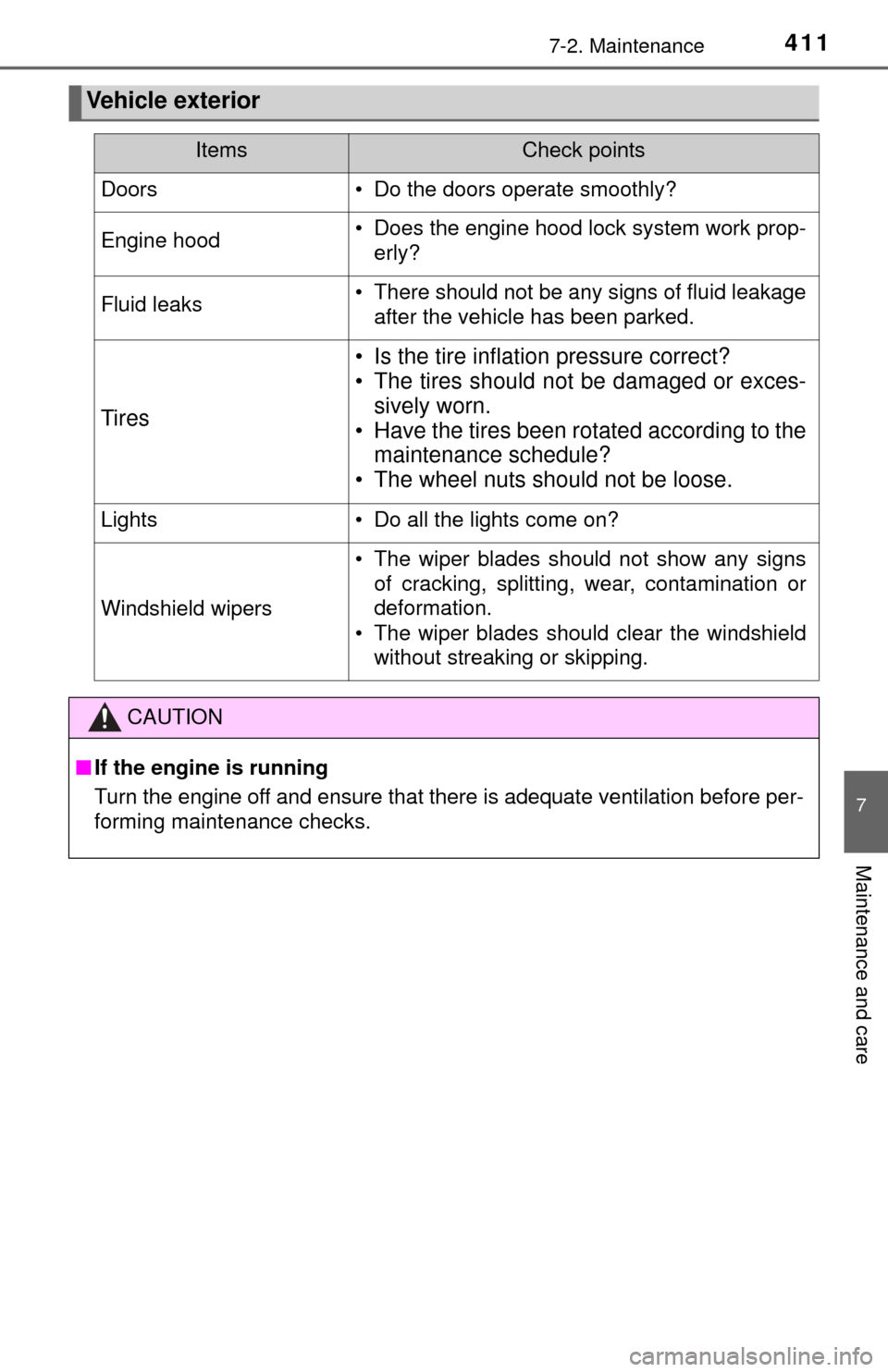
4117-2. Maintenance
7
Maintenance and care
Vehicle exterior
ItemsCheck points
Doors• Do the doors operate smoothly?
Engine hood• Does the engine hood lock system work prop-erly?
Fluid leaks• There should not be any signs of fluid leakageafter the vehicle has been parked.
Tires
• Is the tire inflation pressure correct?
• The tires should not be damaged or exces-sively worn.
• Have the tires been rotated according to the maintenance schedule?
• The wheel nuts should not be loose.
Lights• Do all the lights come on?
Windshield wipers
• The wiper blades should not show any signs
of cracking, splitting, wear, contamination or
deformation.
• The wiper blades should clear the windshield without streaking or skipping.
CAUTION
■If the engine is running
Turn the engine off and ensure that there is adequate ventilation before per-
forming maintenance checks.
Page 413 of 588

4137-3. Do-it-yourself maintenance
7
Maintenance and care
Do-it-yourself service precautions
If you perform maintenance by yourself, be sure to follow the
correct procedure as given in these sections.
ItemsParts and tools
Battery condition
(→ P. 423)• Warm water• Baking soda• Grease
• Conventional wrench (for terminal clamp bolts)
Brake fluid level
(→ P. 421)• FMVSS No.116 DOT 3 or SAE J1703 brake fluid
• Rag or paper towel
• Funnel (used only for adding brake fluid)
Engine coolant
level ( →P. 419)
• “Toyota Super Long Life Coolant” or a similar high
quality ethylene glycol-based non-silicate, non-
amine, non-nitrite and non-borate coolant with long-
life hybrid organic acid technology
For the U.S.A.:
“Toyota Super Long Life Coolant” is pre-mixed with
50% coolant and 50% deionized water.
For Canada:
“Toyota Super Long Life Coolant” is pre-mixed with
55% coolant and 45% deionized water.
• Funnel (used only for adding coolant)
Engine oil level
( → P. 417)• “Toyota Genuine Motor Oil” or equivalent
• Rag or paper towel
• Funnel (used only for adding engine oil)
Fuses
(→ P. 445)• Fuse with same amperage rating as original
Light bulbs
(→ P. 448)
• Bulb with same number and wattage rating as origi-
nal
• Phillips-head screwdriver
• Flathead screwdriver• Wrench
Power steering
fluid level
(
→P. 422)
• Automatic transmission fluid DEXRON® II or III
• Rag or paper towel
• Funnel (used only for adding power steering fluid)
Radiator and
condenser
(
→P. 421)
⎯
Tire inflation
pressure
( → P. 434)• Tire pressure gauge
• Compressed air source
Washer fluid
(→ P. 425)• Water or washer fluid containing antifreeze (for win-
ter use)
• Funnel (used only for adding water or washer fluid)
Page 427 of 588

4277-3. Do-it-yourself maintenance
7
Maintenance and care
Your vehicle is equipped with a tire pressure warning system that uses
tire pressure warning valves and tr ansmitters to detect low tire infla-
tion pressure before serious problems arise. ( →P. 477)
◆Installing tire pressure warning valves and transmitters
When replacing tires or wheels, tire pressure warning valves and
transmitters must also be installed.
When new tire pressure warning valves and transmitters are
installed, new ID codes must be registered in the tire pressure
warning computer and the tire pr essure warning system must be
initialized. Have tire pressure warning valve and transmitter ID
codes registered by your Toyota dealer. ( →P. 428)
◆Initializing the tire pressure warning system
■The tire pressure warning system must be initialized in the fol-
lowing circumstances:
● When rotating the tires.
● When changing the tire size.
When the tire pressure warning system is initialized, the current tire
inflation pressure is set as the benchmark pressure.
Tire pressure warning system
Page 428 of 588

4287-3. Do-it-yourself maintenance
■How to initialize the tire pressure warning systemPark the vehicle in a safe place and turn the engine switch off.
Initialization cannot be performed while the vehicle is moving.
Adjust the tire inflation pressure to the specified cold tire inflation
pressure level. ( →P. 526)
Make sure to adjust the tire pressu re to the specified cold tire infla-
tion pressure level. The tire pressure warning system will operate
based on this pressure level.
Turn the engine switch to the “ON” position.
Press and hold the tire pres-
sure warning reset switch
until the tire pressure warn-
ing light blinks slowly 3 times.
Wait for a few minutes with the eng ine switch in the “ON” position
and then turn the engine switch to the “LOCK” position.
◆Registering ID codes
The tire pressure warning valve and transmitter is equipped with a
unique ID code. When replacing a tire pressure warning valve and
transmitter, it is necessary to register the ID code. Have the ID code
registered by your Toyota dealer.
1
2
3
4
5