Page 393 of 588

3936-4. Using the other interior features
6
Interior features
Test the HomeLink® opera-
tion by pressing the newly
programmed button.
If a HomeLink® button has been
programmed for a garage door,
check to see if the garage door
opens and closes. If the garage
door does not operate, see if
your garage transmitter is of the
rolling code type. Press and
hold the programmed Home-
Link
® button. The remote control
transmitter is of the rolling code
type if the HomeLink
® indicator
light flashes rapidly for
2 seconds and then remains lit.
If your transmitter is the rolling
code type, proceed to the head-
ing “Programming a rolling code
system”.
Repeat the steps above to program another device for any of the
remaining HomeLink® buttons.
■Programming a rolling code sys tem (for U.S.A. owners)
If your device is rolling code eq uipped, follow the steps under the
heading “Programming HomeLink
®” before proceeding with the
steps listed below.
Locate the training button on the ceiling mounted garage door
opener motor. The exact location and color of the button may
vary by brand of garage door opener motor.
Refer to the operation manual supplied with the garage door opener for
the location of the training button.
Press the training button.
Following this step, you have 30 seconds in which to initiate step
below.
3
4
1
2
3
Page 426 of 588
4267-3. Do-it-yourself maintenance
Tires
Check if the treadwear indicators are showing on the tires. Also check
the tires for uneven wear, such as excessive wear on one side of the
tread.
Check the spare tire condition and pressure if not rotated.
New tread
Worn tread
Treadwear indicator
The location of treadwear indicators is shown by a “TWI” or “ \b”
mark, etc., molded into the sidewall of each tire.
Replace the tires if the treadwear indicators are showing on a tire.
Rotate the tires in the order
shown.
To equalize tire wear and extend
tire life, Toyota recommends that
tire rotation is carried out at the
same interval as tire inspection.
Do not fail to initialize the tire
pressure warning system after
tire rotation.
Replace or rotate tires in accordance with maintenance sched-
ules and treadwear.
Checking tires
1
2
3
Tire rotation
Front
Page 429 of 588
4297-3. Do-it-yourself maintenance
7
Maintenance and care
■When to replace your vehicle’s tires
Tires should be replaced if:
●The treadwear indicators are showing on a tire.
●You have tire damage such as cuts, splits, cracks deep enough to
expose the fabric, and bulges indicating internal damage
●A tire goes flat repeatedly or cannot be properly repaired due to the size
or location of a cut or other damage
If you are not sure, consult with your Toyota dealer.
■Replacing tires and wheels
If the ID code of the tire pressure warning valve and transmitter is not reg-
istered, the tire pressure warning system will not work properly. After driv-
ing for about 20 minutes, the tire pressure warning light blinks for 1
minute and stays on to indicate a system malfunction.
■Tire life
Any tire over 6 years old must be checked by a qualified technician even
if it has seldom or never been used or damage is not obvious.
■Routine tire inflation pressure checks
The tire pressure warning system does not replace routine tire inflation
pressure checks. Make su re to check tire inflation pressure as part of
your routine of daily vehicle checks.
■Maximum load of tire
Check that the number given by dividing the maximum load by 1.10 of the
replacement tire is greater than 1/ 2 of the Gross Axle Weight Ratings
(GAWR) of either the front axle or the rear axle, whichever is greater.
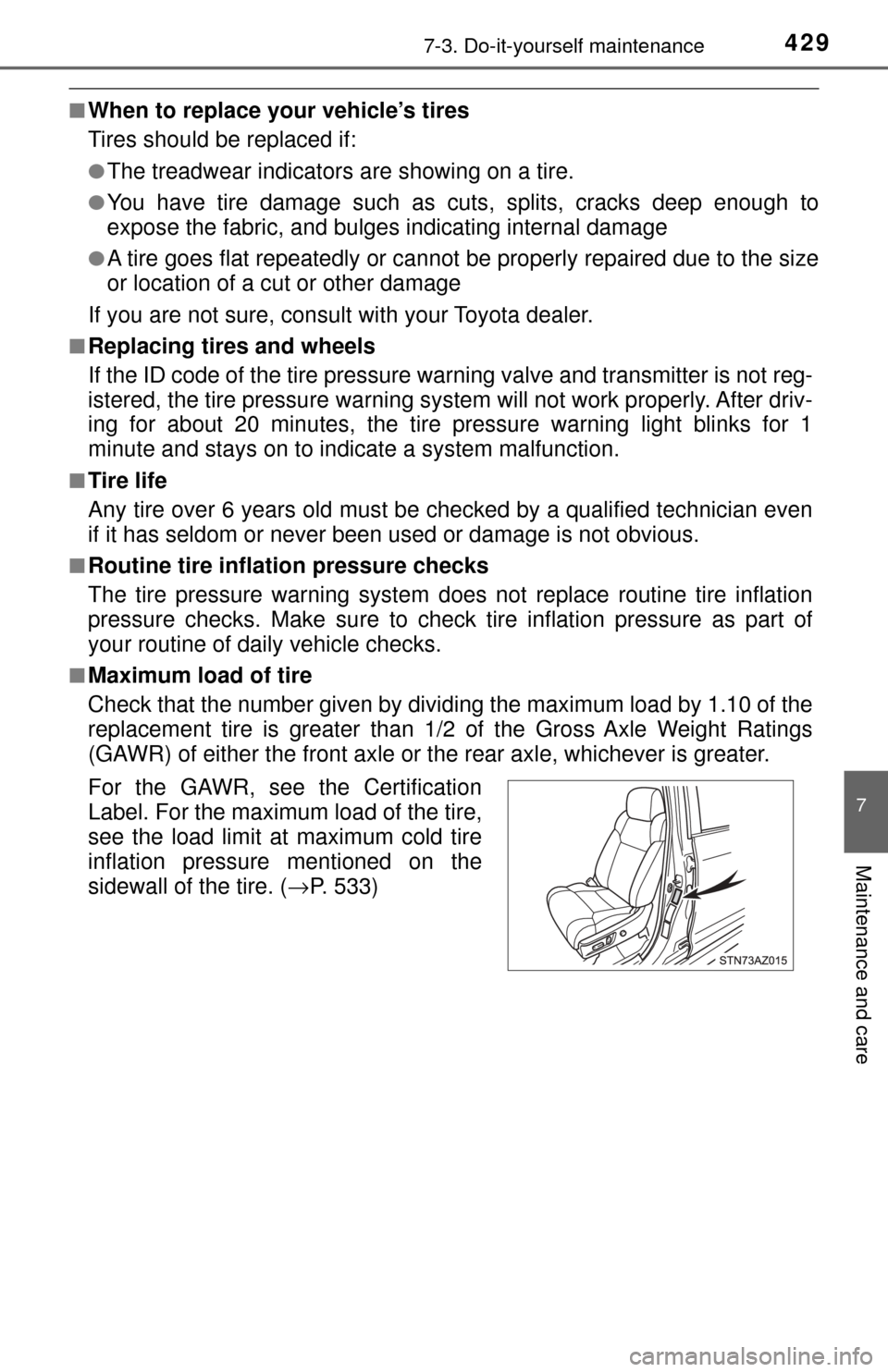
For the GAWR, see the Certification
Label. For the maximum load of the tire,
see the load limit at maximum cold tire
inflation pressure mentioned on the
sidewall of the tire. ( →P. 533)
Page 448 of 588
4487-3. Do-it-yourself maintenance
Light bulbs
Check the wattage of the light bulb to be replaced. (→P. 528)
■Front
You may replace the following bulbs by yourself. The difficulty
level of replacement varies de pending on the bulb. If necessary
bulb replacement seems difficult to perform, contact your Toy-
ota dealer.
For more information about replacing other light bulbs, contact
your Toyota dealer.
Preparing for light bulb replacement
Bulb locations
Headlights
Front turn signal lights/parking li ghts (bulb type)/daytime running
lights (bulb type)
Front side marker lights
Fog lights (if equipped)1
2
3
4
Page 469 of 588
4698-2. Steps to take in an emergency
8
When trouble arises
From the front
Use a towing dolly under the rear
wheels.
From the rear
Use a towing dolly under the front
wheels.
If your vehicle is transported by a
flatbed truck, it should be tied
down at the locations shown in the
illustration.
If you use chains or cables to tie
down your vehicle, the angles
shaded in black must be 45 °.
Do not overly tighten the tie
downs or the vehicle may be dam-
aged.
Towing with a wheel-lift type truck
Using a flatbed truck
Front
Page 487 of 588
4878-2. Steps to take in an emergency
8
When trouble arises
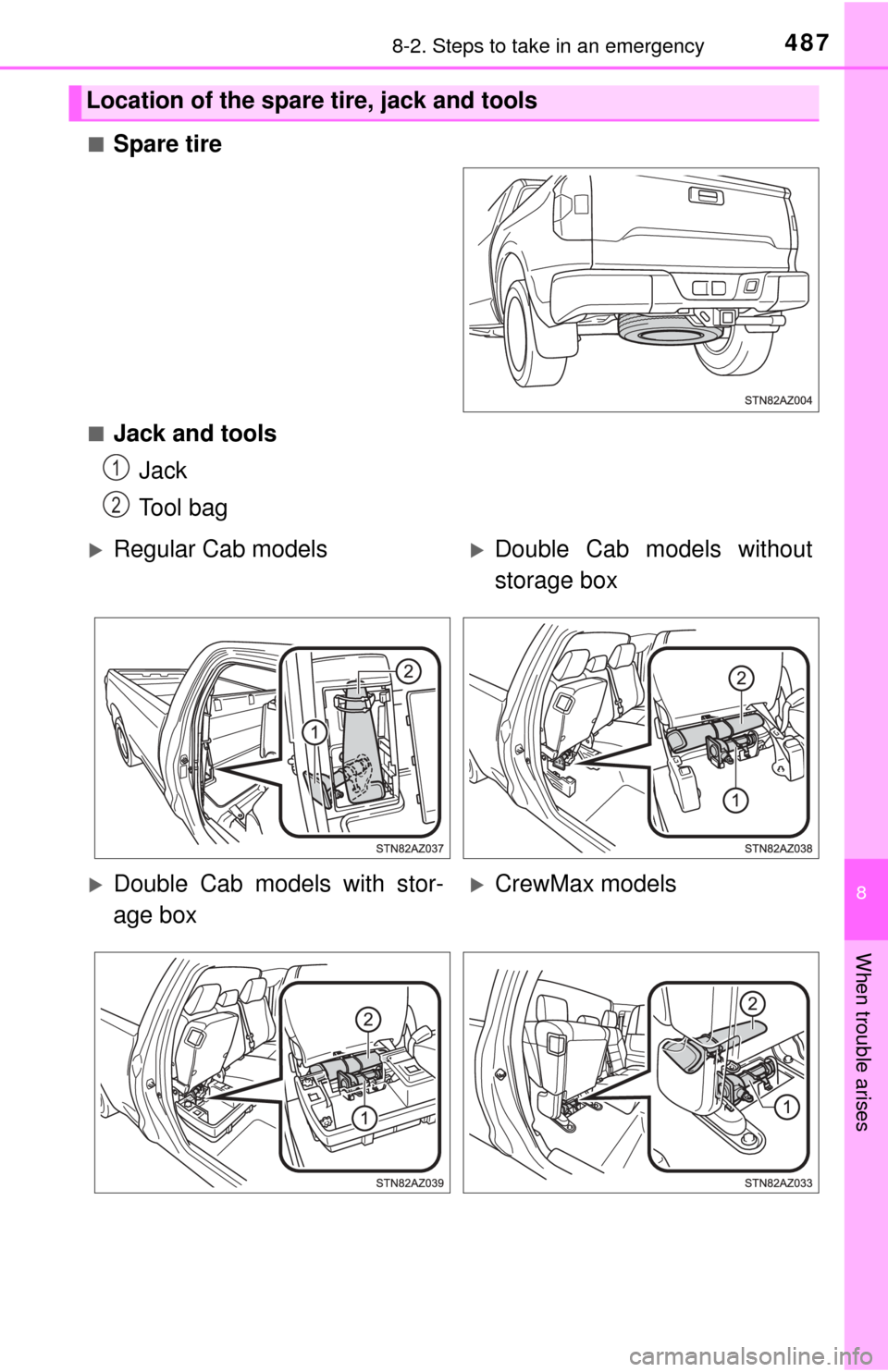
■Spare tire
■Jack and toolsJack
Tool bag
Location of the spare tire, jack and tools
1
2
Regular Cab modelsDouble Cab models without
storage box
Double Cab models with stor-
age boxCrewMax models
Page 533 of 588
5339-1. Specifications
9
Vehicle specifications
Tire information
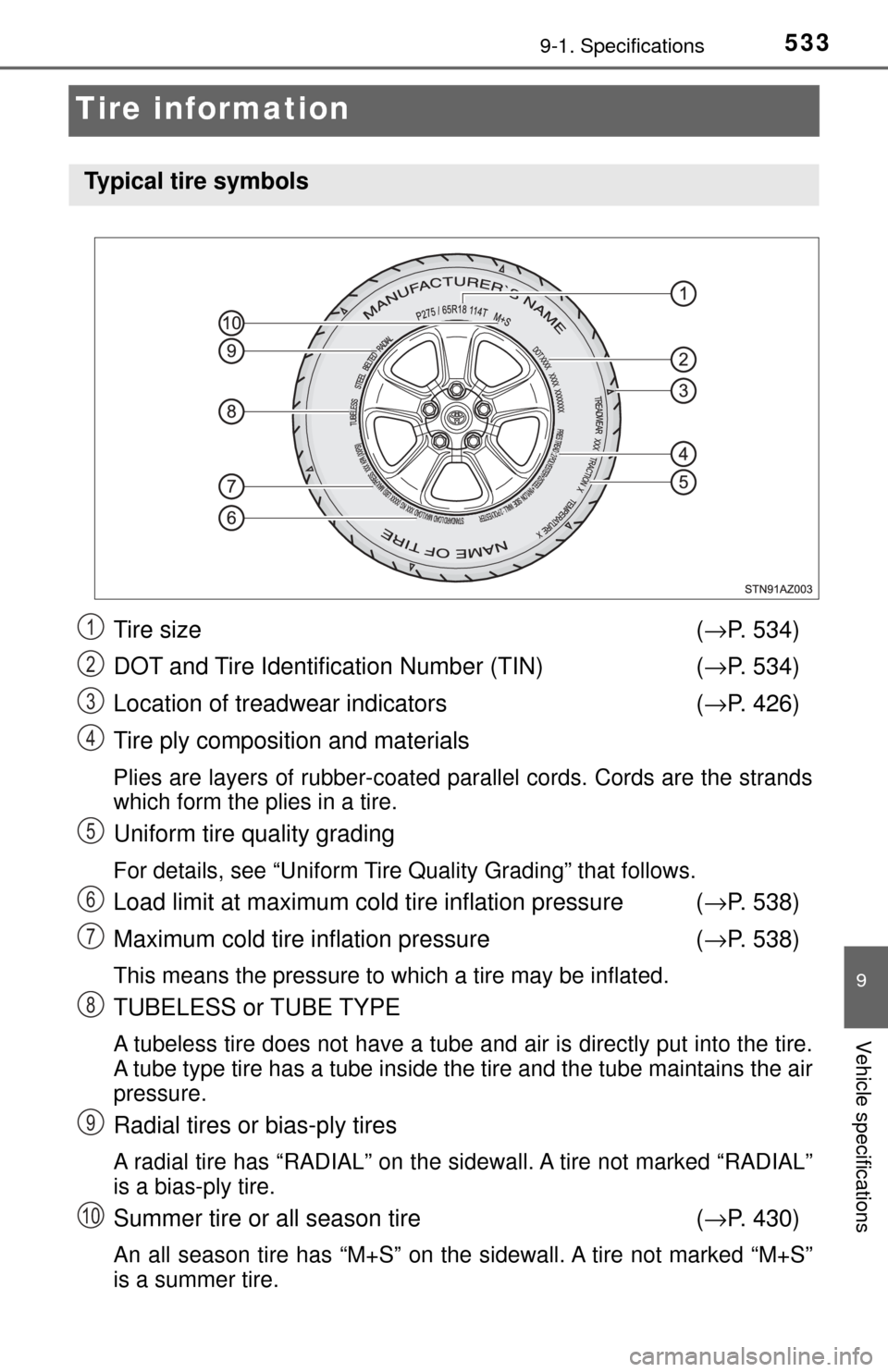
Tire size (→ P. 534)
DOT and Tire Identification Number (TIN) (→ P. 534)
Location of treadwear indicators (→ P. 426)
Tire ply composition and materials
Plies are layers of rubber-coated parallel cords. Cords are the strands
which form the plies in a tire.
Uniform tire quality grading
For details, see “Uniform Tire Quality Grading” that follows.
Load limit at maximum cold tire inflation pressure ( →P. 538)
Maximum cold tire inflation pressure (→ P. 538)
This means the pressure to which a tire may be inflated.
TUBELESS or TUBE TYPE
A tubeless tire does not have a tube and air is directly put into the tire.
A tube type tire has a tube inside the tire and the tube maintains the air
pressure.
Radial tires or bias-ply tires
A radial tire has “RADIAL” on the sidewall. A tire not marked “RADIAL”
is a bias-ply tire.
Summer tire or all season tire (→ P. 430)
An all season tire has “M+S” on the sidewall. A tire not marked “M+S”
is a summer tire.
Typical tire symbols
1
2
3
4
5
6
7
8
9
10
Page 562 of 588
562
Camper information
The figures given in the illustration indicate the recommended center
of gravity zone.
Recommended location for cargo center of gravity for cargo weight
rating
Rear end of truck bed
This information has been prepared in accordance with regulation
issued by the National Highway Tr affic Safety Administration of the
U.S. Department of Transportation. It provides the purchasers and/
or prospective purchasers of Toyota vehicles with information on
truck-camper loading. Your Toyota dealer will help answer any
questions you may have as you read this information.
Center of gravity location
1
2
Regular Cab modelsDouble Cab models with stan-
dard bed
Double Cab models with long
bedCrewMax models