2017 TOYOTA PRIUS PRIME ECO mode
[x] Cancel search: ECO modePage 96 of 784

96
PRIUS PRIME_OM_OM47A88U_(U)
2-1. Plug-in hybrid system
NOTICE
■Hybrid battery (traction battery) air vents
● Make sure not to block the air intake vent with anything, such as a seat
cover, plastic cover, or luggage. The hybrid battery (traction battery) may
overheat and be damaged.
● When dust etc. has accumulated in the air intake vent, clean it with a vac-
uum cleaner to prevent the vent from clogging.
● Do not wet or allow foreign substances to enter the air vents as this may
cause a short circuit and damage the hybrid battery (traction battery).
● Do not carry large amounts of water such as water cooler bottles in the
vehicle. If water spills onto the hybrid battery (traction battery), the battery
may be damaged. Have the vehicle inspected by your Toyota dealer.
● A filter is installed to the air intake vent. When the filter remains noticeably
dirty even after cleaning the air intake vent, filter cleaning or replacement
is recommended. When cleaning the filter, refer to P. 562.
■ Notice about fuel
● For plug-in hybrid vehicles, fuel may remain in the tank for a long time and
undergo changes in quality depending on the how the vehicle is used.
Refuel at least 5.3 gal.(20 L, 4.4 Imp.gal.) of fuel every 12 months (refuel a
total of at least 5.3 gal. [20 L, 4.4 Imp.gal.] over a 12-month period), as this
may affect components of the fuel system or the gasoline engine.
● If the vehicle has not been refueled for a certain amount of time and it is
possible that the quality of the fuel remaining in the tank has changed, “No
new fuel has been added recently. Please refuel” is displayed on the multi-
information display when the power switch is turned to ON mode. If the
message is displayed, refuel the vehicle immediately.
Page 97 of 784

97
PRIUS PRIME_OM_OM47A88U_(U)
2-1. Plug-in hybrid system
2
Plug-in hybrid system
Plug-in hybrid vehicle driving tips
◆Using EV mode and HV mode effectively
Primarily using EV mode when driving in cities and using HV mode
when driving on highways (or freeways) can help conserve fuel and
electricity. ( →P. 8 2 )
◆Using Eco drive mode
When using Eco drive mode, the torque corresponding to the accel-
erator pedal depression amount can be generated more smoothly
than it is in normal conditions. In addition, the operation of the air
conditioning system (h eating/cooling) will be minimized, improving
fuel and electricity economy. ( →P. 406)
◆Use of Hybrid System Indicator
Eco-friendly driving is possible by keeping the Hybrid System Indi-
cator within Eco area. ( →P. 210)
◆Shift position operation
Shift the shift position to D when st opped at a traffic light, or driving
in heavy traffic etc. Shift the sh ift position to P when parking. When
using the N, there is no positive effect on fuel consumption. In the
N, the gasoline engine operates but electricity cannot be gener-
ated. Also, when using the air cond itioning system, etc., the hybrid
battery (traction batter y) power is consumed.
For economical and ecological driv ing, pay attention to the fol-
lowing points:
Page 98 of 784

98
PRIUS PRIME_OM_OM47A88U_(U)
2-1. Plug-in hybrid system
◆Accelerator pedal/brake pedal operation
●Drive your vehicle smoothly. Avoid abrupt acceleration and
deceleration. Gradual accelerati on and deceleration will make
more effective use of the electric motor (traction motor) without
having to use gasoline engine power.
● Avoid repeated acceleration. Repeated acceleration consumes
hybrid battery (traction battery) power, resulting in poor fuel con-
sumption. Battery power can be restored by driving with the
accelerator pedal slightly released.
◆When braking
Make sure to operate the brakes gently and a timely manner. A
greater amount of electrical energy can be regenerated when slow-
ing down.
◆Delays
Repeated acceleration and deceleration, as well as long waits at
traffic lights, will lead to high fuel and electricity consumption.
Check traffic reports before leav ing and avoid delays as much as
possible. When driving in a traffi c jam, gently release the brake
pedal to allow the vehicle to move forward slightly while avoiding
overuse of the accelerator pedal. Doing so can help control exces-
sive electricity and fuel consumption.
◆Highway driving
● Control and maintain the vehicl e at a constant speed. Before
stopping at a toll booth or similar, allow plenty of time to release
the accelerator and gently apply the brakes. A greater amount of
electrical energy can be regenerated when slowing down.
● Electricity consumption will increa se significantly when driving at
high speeds in EV mode. If there will be a long distance to the
next external charging point after leaving a freeway, it is recom-
mended to drive in HV mode while on the freeway and change to
EV mode after leaving the freeway.
Page 99 of 784

PRIUS PRIME_OM_OM47A88U_(U)
992-1. Plug-in hybrid system
2
Plug-in hybrid system
◆Air conditioning
●Turn the “A/C” switch (
*1 • *2) off when it is
not needed. Doing so can help r educe excessive electricity and
fuel consumption.
In summer: When the ambient temperature is high, use the recir-
culated air mode. Doing so will he lp to reduce the burden on the
air conditioning system and reduc e electricity and fuel consump-
tion as well.
In winter: Avoid excessive and unn ecessary use of the heater.
Usage of the heated steering wheel (if equipped) and seat heat-
ers is effective. ( →P. 513)
● Using the Remote Air Conditioning System (→P. 509) while the
charging cable is connected to th e vehicle can reduce electricity
consumption immediately after starting off by operating air condi-
tioning mainly using electricity from an external power source.
● When setting the timer, selecting the start time setting mode and
setting “Climate Prep” to “On” can reduce electricity consumption
immediately after starting off by operating air conditioning before
charging is completed. ( →P. 147)
*1: Vehicles with 7-inch display
*2: Vehicles with 11.6-inch display
◆Checking tire inflation pressure
Make sure to check the tire infl ation pressure frequently. If there is
improper tire inflation pressure in the tires, the EV driving range will
become shorter, and fuel c onsumption when in HV mode will
increase.
Also, as snow tires can cause larg e amounts of friction, their use on
dry roads can lead to increased fuel and electricity consumption.
◆Luggage
Carrying heavy luggage will lead to poor fuel economy. Avoid carry-
ing unnecessary luggage. Installing a large roof rack will also cause
poor fuel economy.
◆Warming up before driving
Since the gasoline engine starts up and cuts out automatically,
warming up is not necessary.
Page 100 of 784

100
PRIUS PRIME_OM_OM47A88U_(U)
2-1. Plug-in hybrid system
EV driving range
The value displayed on the multi-information display etc. (→P. 199,
215, 222, 239) is estimated from the following information.
● The amount of hybrid battery (traction battery) charge currently
remaining
● The electricity consumption (the estimated distance that can be
driven in EV mode per unit of electrical energy) based on the
recorded value
● Past air conditioning system electricity consumption amount
The electricity consum ption varies depending on how the vehicle is
driven. The vehicle automatically re cords the electricity consumption
when being charged and uses the el ectricity consumption for estimat-
ing the EV driving range. Therefor e, the EV driving range displayed
when the hybrid battery (traction ba ttery) is fully charged may differ
from the previous EV driving range depending on how the vehicle was
driven.
The EV driving range may change si gnificantly with each charging
until the electricity consumption based on the recorded value is stable
(for approximately the fi rst month or two). However, this does not indi-
cate a malfunction.
When the air conditioning system is turned on, the EV driving range
(with using the air conditioning syst em) is estimated based on the past
air conditioning electricity consumption amount considering that the
electricity consumpt ion may become higher.
The EV driving range displayed on the multi-information display
etc. shows the reference distance that EV driving (driving using
only the electric motor) is possible, and the actual distance that
can be driven may differ from that displayed.
Even if the EV driving range is displayed, EV driving may be can-
celed and both gasoline engine and electric motor are used depend-
ing on the situation. ( →P. 8 7 )
Displayed value
Page 101 of 784

PRIUS PRIME_OM_OM47A88U_(U)
1012-1. Plug-in hybrid system
2
Plug-in hybrid system
The distance that can be driven in EV mode varies significantly
depending on how the vehicle is driven, road conditions, the weather,
the outside temperature, usage cond itions of electrical components
and the number of occupants.
The distance that can be driven in EV mode can be extended if the fol-
lowing is performed:
● Maintain a safe distance from the vehicle in front and avoid unnec-
essary acceleration and deceleration
● Accelerate and decelerate the v ehicle as smoothly as possible
● Drive at moderate speeds as much as possible and maintain a con-
stant speed
● Set the air conditioning to a moderate temperature and turn the “A/C”
switch (
*1 • *2) off when it is not needed
● Use tires of the specified size and maintain the specified tire pres-
sure
● Use the EV/HV mode selection switch to drive in HV mode when
driving on a highway
Electricity consumption will increa se substantially when driving on a
highway in EV mode.
● Do not add unnecessary weight to the vehicle
*1: Vehicles with 7-inch display
*2: Vehicles with 11.6-inch display
The following indicate that charging has been carried out properly.
●The charging indicator turns off
● The Hybrid battery (traction battery ) status indicators illuminate for
approximately 15 seconds. ( →P. 104)
● “Charging Complete” is displayed on the multi-information display
when starting off ( →P. 130)
Regardless of the type of power source or whether the charging timer
function is used, charging is completed if the above can be confirmed.
Charging-related messages: →P. 175
Tips for extending the EV driving range
Display when charging is completed
Page 128 of 784

128
PRIUS PRIME_OM_OM47A88U_(U)
2-2. Charging
■“Traction Battery Cooler”
●When the hybrid battery (traction battery) is above a certain temperature
and the power switch is turned off, a check screen is displayed on the multi-
information display that indicates whether “Traction Battery Cooler” is imple-
mented. Approximately 5 minutes after selecting “Yes” on this screen, sys-
tem operation becomes possible.
● When charging starts, “Traction Battery Cooler” only operates if the hybrid
battery (traction battery) temperature is hot.
● The charging indicator is illuminated while “Traction Battery Cooler” is on
standby or operating.
● “Traction Battery Cooler” is implem ented for a maximum of approximately
30 minutes. However, when the “Departure” time is set ( →P. 147) and there
is not sufficient time between the current time and the time that charging will
complete, “Traction Battery Cooler” operation time may become shorter.
● When there is a small amount of remaining charge in the hybrid battery
(traction battery), even if the hybrid battery (traction battery) is hot, “Traction
Battery Cooler” may not be implemented.
● When the following operations are performed while “Traction Battery Cooler”
is operating, the hybrid battery (traction battery) cooling operation stops.
• A door is opened
• The hood is opened
• The power switch is turned to any mode other than off
• The shift position is changed to any position other than P
• The Remote Air Conditioning System is operated ( →P. 509)
• “Charge Now” is implemented ( →P. 156, 165)
• The amount of remaining charge in the hybrid battery (traction battery) is
below a certain amount
● When the power switch is turned off, a check screen is displayed on the
multi-information display that indicates whether “Traction Battery Cooler” is
implemented. This check screen can be turned on and off in the “Meter Cus-
tomize” settings on the multi-information display ( →P. 234). However, when
the check screen is set to “Off”, “Traction Battery Cooler” is no longer oper-
ates.
● “Traction Battery Cooler” uses the power of the hybrid battery (traction bat-
tery) and external power source.
• While “Traction Battery Cooler” is operating, the amount of the remaining
charge of the hybrid battery (traction battery) increases and decreases in
a certain range, and does not increase as in normal charging.
• The operation of “Traction Battery Cooler” is recognized as charging by a
charging equipment. The charging equipment that calculates the fee
according to charging time causes a charging fee.
Page 129 of 784
129
PRIUS PRIME_OM_OM47A88U_(U)
2-2. Charging
2
Plug-in hybrid system
Charging tips
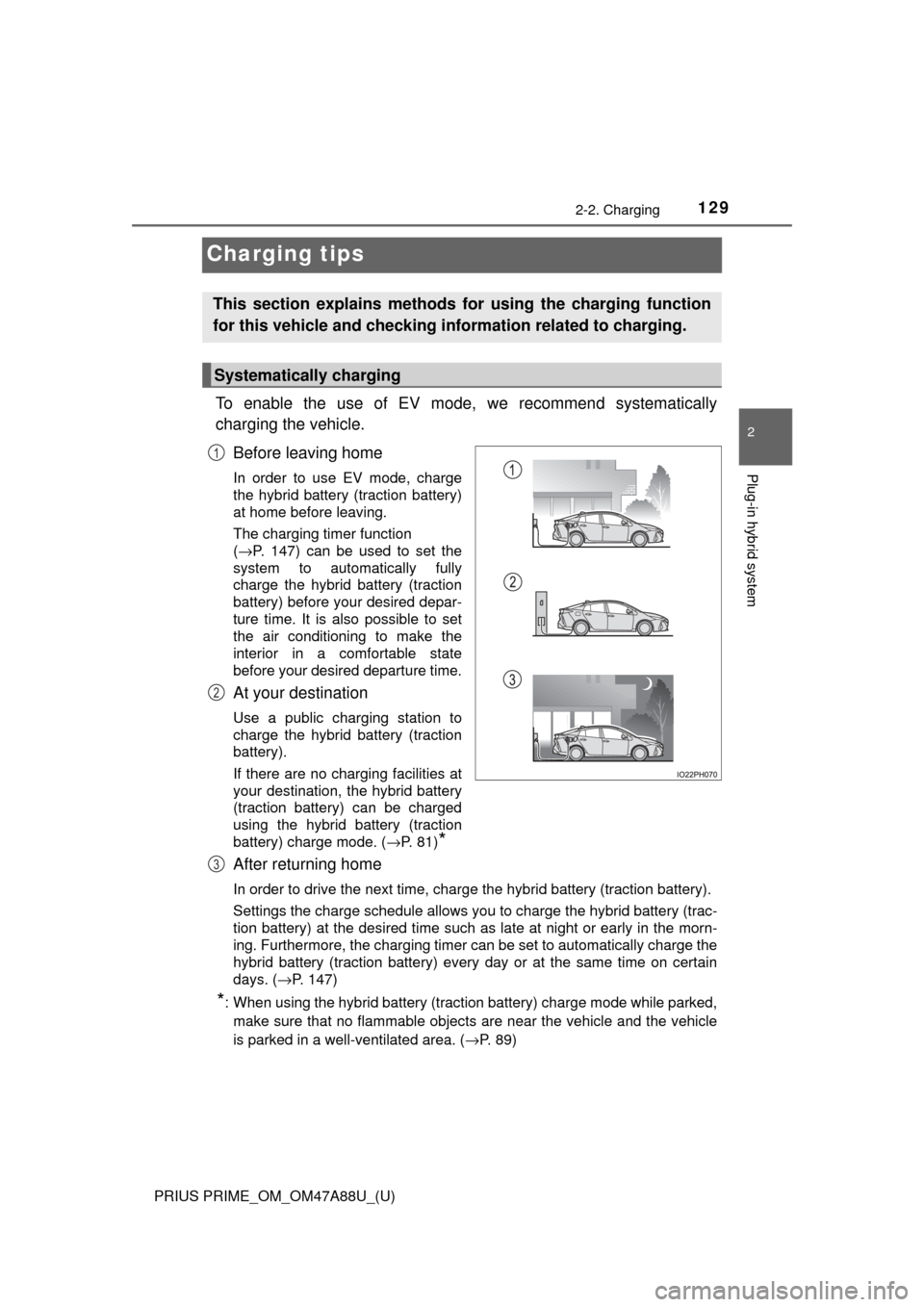
To enable the use of EV mode, we recommend systematically
charging the vehicle.Before leaving home
In order to use EV mode, charge
the hybrid battery (traction battery)
at home before leaving.
The charging timer function
(→P. 147) can be used to set the
system to automatically fully
charge the hybrid battery (traction
battery) before your desired depar-
ture time. It is also possible to set
the air conditioning to make the
interior in a comfortable state
before your desired departure time.
At your destination
Use a public charging station to
charge the hybrid battery (traction
battery).
If there are no charging facilities at
your destination, the hybrid battery
(traction battery) can be charged
using the hybrid battery (traction
battery) charge mode. (→P. 81)
*
After returning home
In order to drive the next time, charge the hybrid battery (traction battery).
Settings the charge schedule allows you to charge the hybrid battery (t\
rac-
tion battery) at the desired time such as late at night or early in the morn-
ing. Furthermore, the charging timer can be set to automatically charge the
hybrid battery (traction battery) every day or at the same time on certain
days. ( →P. 147)
*: When using the hybrid battery (traction battery) charge mode while parked,
make sure that no flammable objects are near the vehicle and the vehicle
is parked in a well-ventilated area. ( →P. 89)
This section explains methods for using the charging function
for this vehicle and checking in formation related to charging.
Systematically charging
1
2
3