Page 70 of 464
701-1. For safe use
MIRAI_OM_USA_OM62023U■
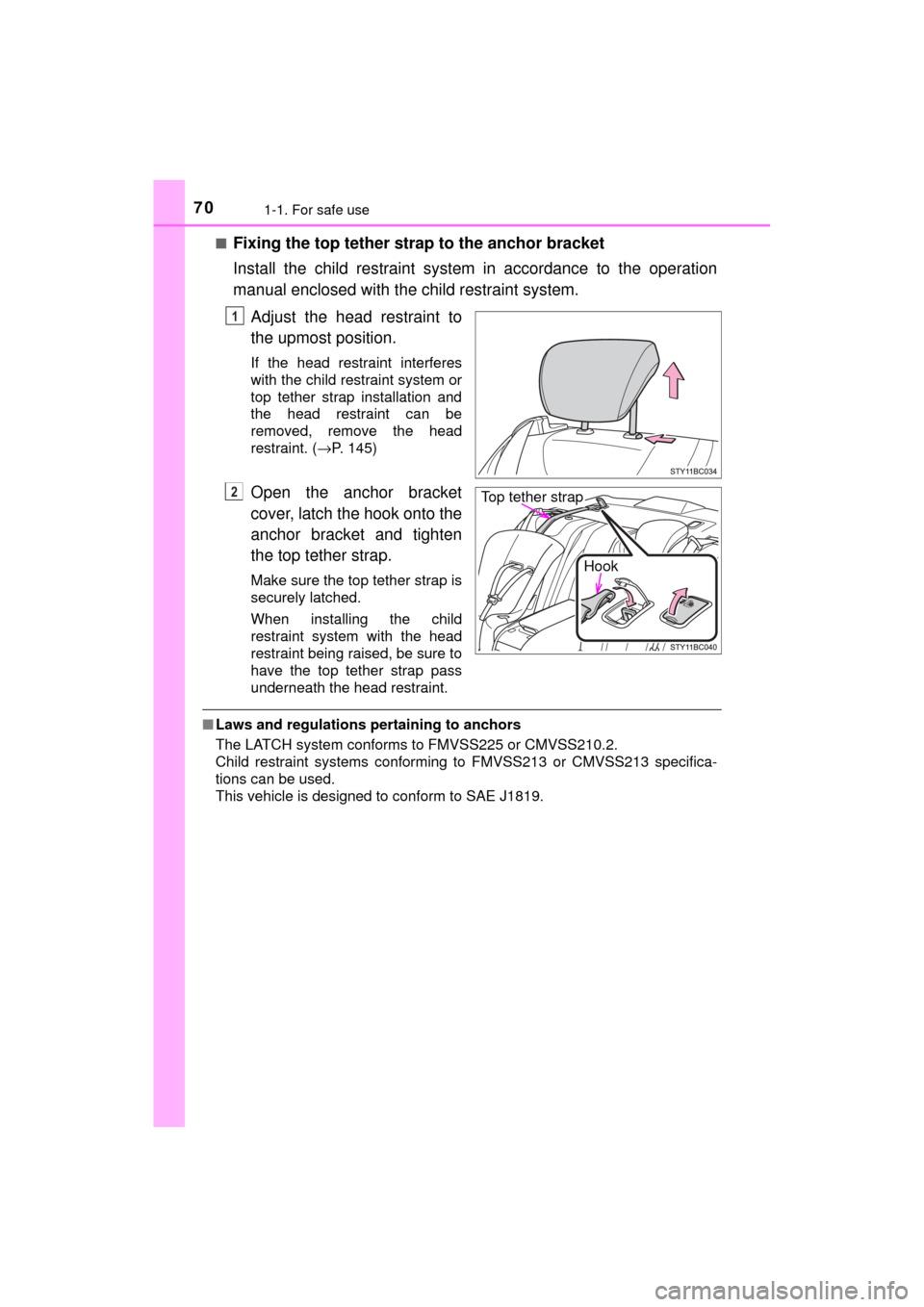
Fixing the top tether strap to the anchor bracket
Install the child restraint system in accordance to the operation
manual enclosed with the child restraint system.
Adjust the head restraint to
the upmost position.
If the head restraint interferes
with the child restraint system or
top tether strap installation and
the head restraint can be
removed, remove the head
restraint. (→P. 145)
Open the anchor bracket
cover, latch the hook onto the
anchor bracket and tighten
the top tether strap.
Make sure the top tether strap is
securely latched.
When installing the child
restraint system with the head
restraint being raised, be sure to
have the top tether strap pass
underneath the head restraint.
■Laws and regulations pertaining to anchors
The LATCH system conforms to FMVSS225 or CMVSS210.2.
Child restraint systems conforming to FMVSS213 or CMVSS213 specifica-
tions can be used.
This vehicle is designed to conform to SAE J1819.
1
Hook
Top tether strap
2
Page 71 of 464
711-1. For safe use
1
For safety and security
MIRAI_OM_USA_OM62023U
WARNING
■When installing a child restraint system
Observe the following precautions.
Failure to do so may result in death or serious injury.
● Firmly attach the top tether strap and make sure that the belt is not twisted.
● Do not attach the top tether strap to anything other than the anchor
bracket.
● Shake the child restraint system left and right, and forward and backward
to ensure that it has been securely installed.
● Follow all installation instructions provided by the child restraint system
manufacturer.
● When installing the child restraint system with the head restraint being
raised, after the head restraint has been raised and then the anchor
bracket has been fixed, do not lower the head restraint.
NOTICE
■ Anchor brackets (for top tether strap)
When not in use, make certain to close the lid. If it remains open, the lid
may be damaged.
Page 73 of 464
731-2. Theft deterrent system
1
For safety and security
MIRAI_OM_USA_OM62023U
■System maintenance
The vehicle has a maintenance-free type immobilizer system.
■ Conditions that may cause the system to malfunction
●If the grip portion of the key is in contact with a metallic object
● If the key is in close proximity to or touching a key registered to the security
system (key with a built-in transponder chip) of another vehicle
■ Certification for the immobilizer system
FCC ID: NI4TMIMB-3
This device complies with part 15 of the FCC Rules. Operation is subject to
the following two conditions: (1) This device may not cause harmful interfer-
ence, and (2) this device must accept any interference received, including
interference that may cause undesired operation.
Changes or modifications not expressly approved by the party responsible for
compliance could void the user’s authority to operate the equipment.
WARNING
■ Certifications for the immobilizer system
Changes or modifications not expressly approved by the party responsible
for compliance could void the user’s authority to operate the equipment.
NOTICE
■To ensure the system operates correctly
Do not modify or remove the system. If modified or removed, the proper
operation of the system cannot be guaranteed.
Page 74 of 464
741-2. Theft deterrent system
MIRAI_OM_USA_OM62023U
Alarm
The alarm uses light and sound to give an alert when an intrusion is
detected.
The alarm is triggered in the following situations when the alarm is
set:
●A locked door or trunk is unlocked or opened in any way other than
using the entry function, wireless remote control or mechanical key.
(The doors will lock again automatically.)
● The hood is opened.
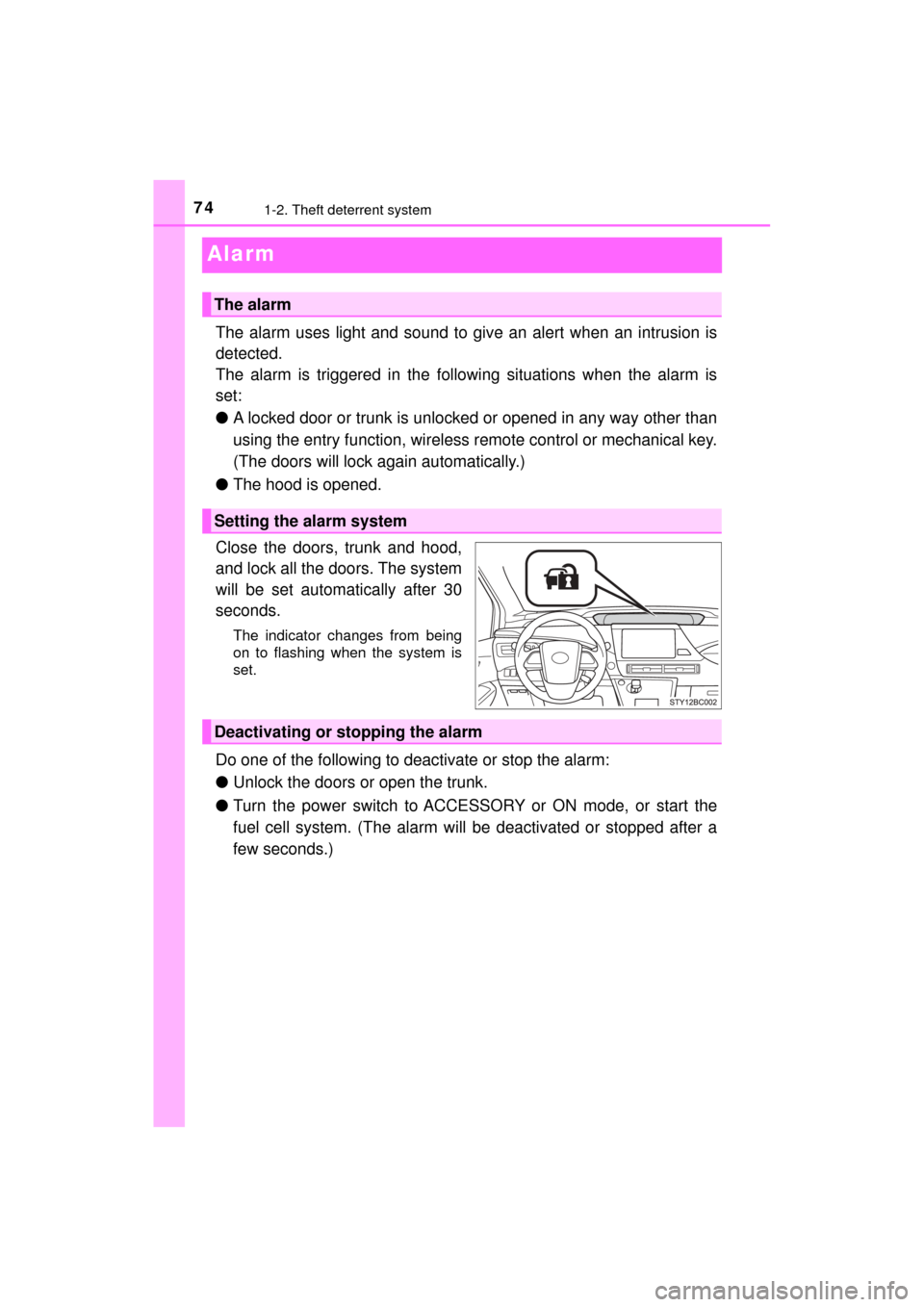
Close the doors, trunk and hood,
and lock all the doors. The system
will be set automatically after 30
seconds.
The indicator changes from being
on to flashing when the system is
set.
Do one of the following to deactivate or stop the alarm:
● Unlock the doors or open the trunk.
● Turn the power switch to ACCESSORY or ON mode, or start the
fuel cell system. (The alarm will be deactivated or stopped after a
few seconds.)
The alarm
Setting the alarm system
Deactivating or stopping the alarm
Page 75 of 464
751-2. Theft deterrent system
1
For safety and security
MIRAI_OM_USA_OM62023U
■System maintenance
The vehicle has a maintenance-free type alarm system.
■ Items to check before locking the vehicle
To prevent unexpected triggering of the alarm and vehicle theft, make sure of
the following:
●Nobody is in the vehicle.
● The windows are closed before the alarm is set.
● No valuables or other personal items are left in the vehicle.
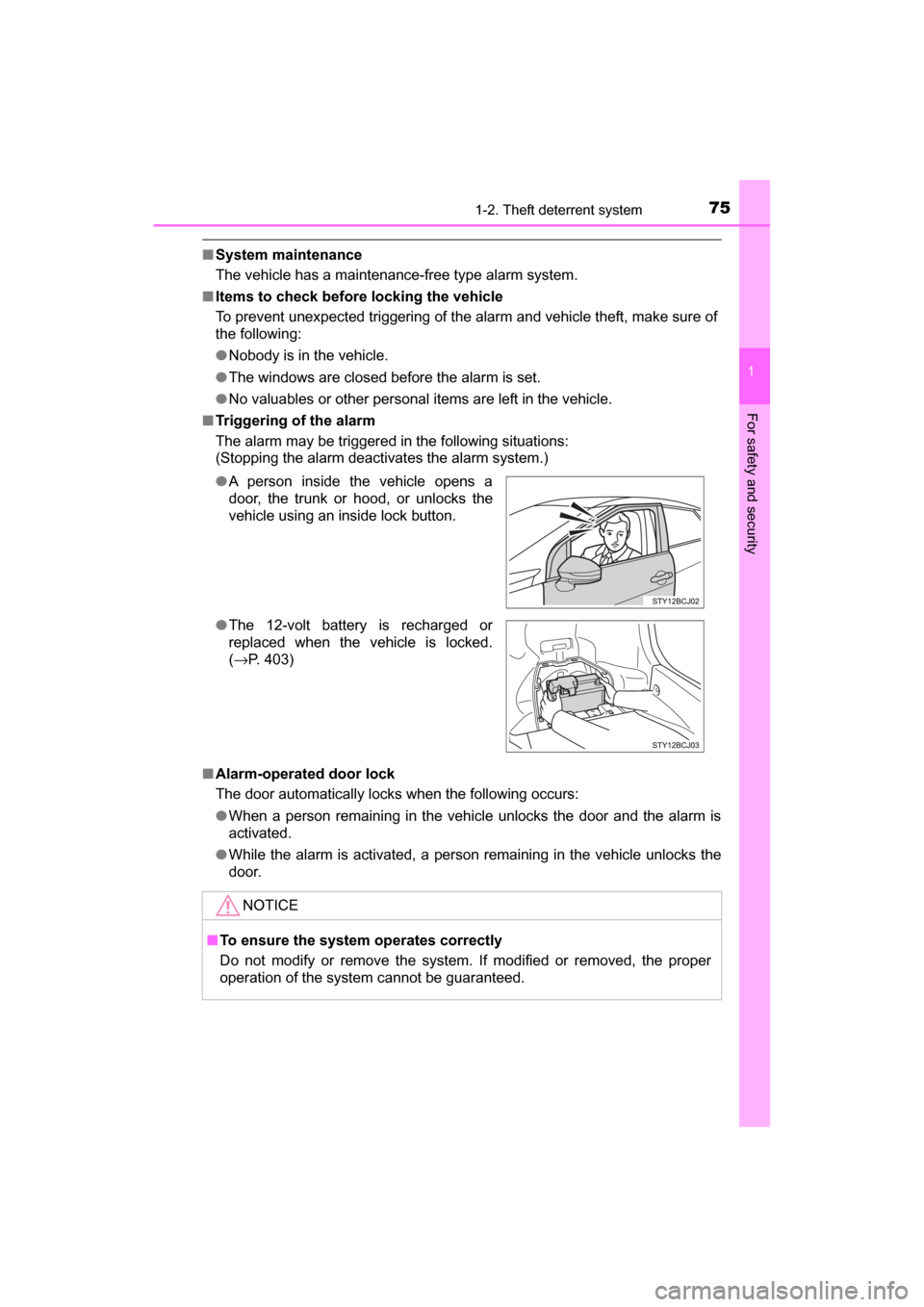
■ Triggering of the alarm
The alarm may be triggered in the following situations:
(Stopping the alarm deactivates the alarm system.)
■ Alarm-operated door lock
The door automatically locks when the following occurs:
●When a person remaining in the vehicle unlocks the door and the alarm is
activated.
● While the alarm is activated, a person remaining in the vehicle unlocks the
door.
●
A person inside the vehicle opens a
door, the trunk or hood, or unlocks the
vehicle using an inside lock button.
● The 12-volt battery is recharged or
replaced when the vehicle is locked.
(→P. 403)
NOTICE
■ To ensure the system operates correctly
Do not modify or remove the system. If modified or removed, the proper
operation of the system cannot be guaranteed.
Page 76 of 464
761-2. Theft deterrent system
MIRAI_OM_USA_OM62023U
Theft prevention labels
These labels are attached to the
vehicle to reduce vehicle theft by
facilitating the tracing and recov-
ery of parts from stolen vehicles.
Do not remove under penalty of
law.
Page 77 of 464
77
Fuel cell system2
MIRAI_OM_USA_OM62023U2. Fuel cell vehicle
Fuel cell vehicle characteristics ................... 78
Fuel cell vehicle precautions ....................... 82
Advice for driving fuel cell vehicles ............................. 94
Page 78 of 464
782. Fuel cell vehicle
MIRAI_OM_USA_OM62023U
Fuel cell vehicle characteristics
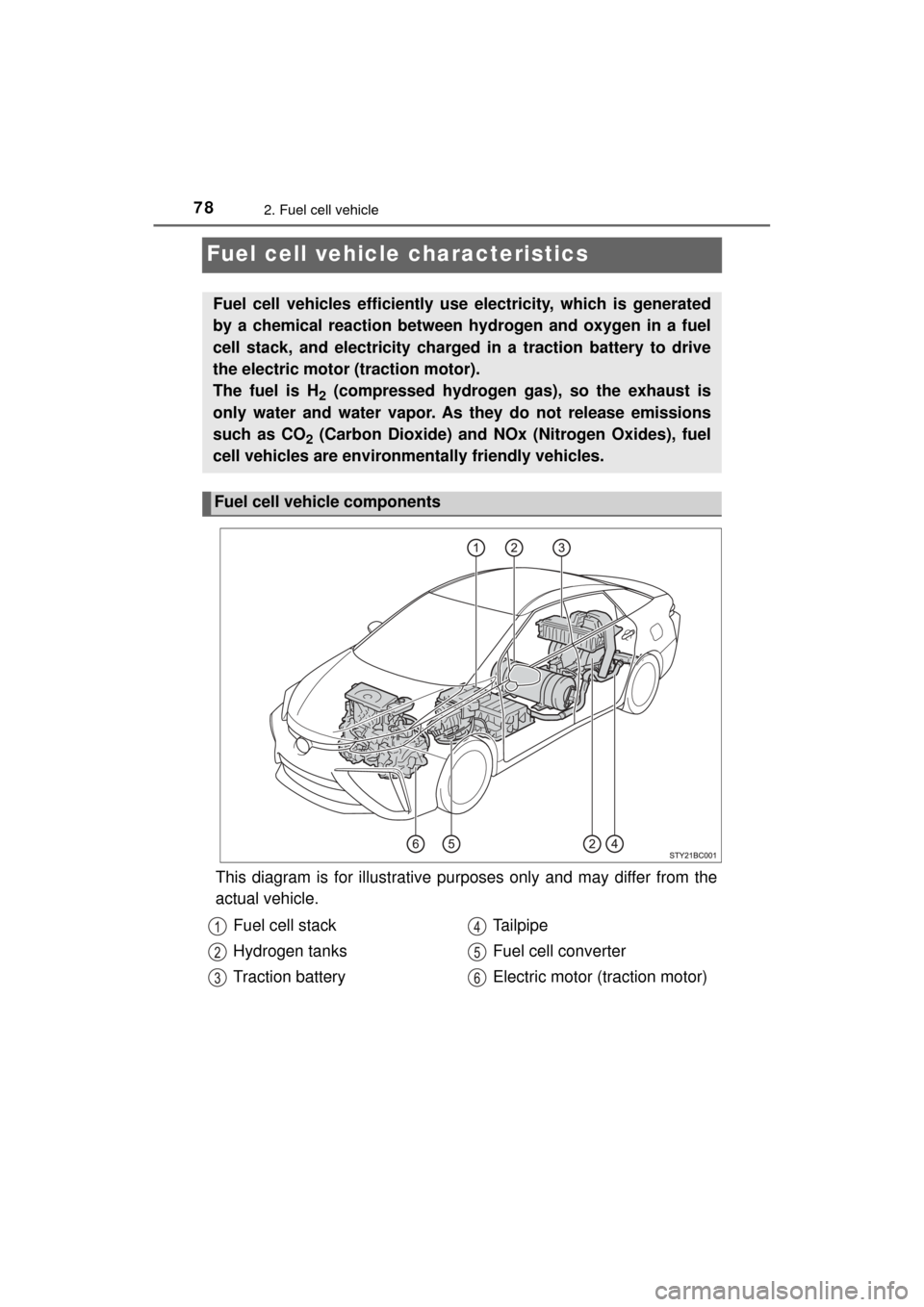
This diagram is for illustrative purposes only and may differ from the
actual vehicle.
Fuel cell vehicles efficiently use electricity, which is generated
by a chemical reaction between hydrogen and oxygen in a fuel
cell stack, and electricity charged in a traction battery to drive
the electric motor (traction motor).
The fuel is H
2 (compressed hydrogen gas), so the exhaust is
only water and water vapor. As they do not release emissions
such as CO
2 (Carbon Dioxide) and NOx (Nitrogen Oxides), fuel
cell vehicles are environm entally friendly vehicles.
Fuel cell vehicle components
Fuel cell stack
Hydrogen tanks
Traction battery Tailpipe
Fuel cell converter
Electric motor (traction motor)