Page 79 of 464
792. Fuel cell vehicle
2
Fuel cell system
MIRAI_OM_USA_OM62023U
The electric motor (traction motor) allows smooth, powerful takeoff
and acceleration. This vehicle drives similarly to a gasoline vehicle
without any special actions by the driver. ( →P. 158) As there are no
engine sounds and the vehicle is qu iet, operation noises unique to
fuel cell vehicle components may be heard. ( →P. 8 0 )
The system may behave differently on cold days. It is performing a
special cold-start process to im prove start-up performance. (→P. 175)
Operation noises (→ P. 80), purge process ( →P. 175), etc., differ from
usual. However, this is not a malfunction.
Compressed hydrogen gas fuel can be filled at hydrogen stations.
Opening the fuel door ( →P. 198)
Driving the vehicle
Fuel cell system
Fuel filling
Page 80 of 464

802. Fuel cell vehicle
MIRAI_OM_USA_OM62023U
■Sounds unique to the fuel cell vehicle
Due to the design of your fuel cell vehicle, there are various relays, valves
and pumps which under normal driving conditions will produce sounds. This
is a normal characteristic of the vehicle and does not indicate a malfunction.
Furthermore, way of hearing may differ based on usage environment or con-
dition.
Noticeable soundsSource of the sounds
Clunking, clicking and clack-
ingOperation of relays and hydrogen tank
valves
Sounds may come from under the floor or
behind the rear seats.
(Sounds may be heard when starting the
fuel cell system.)
KnockingThe parking lock is engaged
Sounds may come from the motor
compartment.
(Sounds may be heard when press the P
position switch or stopping the fuel cell
system.)
Whooshing, squealingGas is flowing through the nozzle and
valvesSounds may come from behind the rear
seats, or from the dispenser hose/nozzle.
(Sounds may be heard when filling the
fuel.)
• High pitch sound
• Gurgle sound
• Pulsing soundOperation of the pumpsSounds may come from the motor com-
partment or under the front seats.
(In particular, sounds may be heard when
starting the fuel cell system, accelerating
from a stop, or press the H
2O switch. The
sound may be louder when in Br mode or
when the vehicle decelerates during
dynamic radar cruise control.)
Humming soundOperation of the pumps are speeding up
Sounds may come from the motor com-
partment or under the front seats.
(In particular, sounds may be heard when
accelerating or decelerating.)
Whooshing sound Operation of the hydrogen injectorSounds may come from under the front
seats or behind the rear seats.
(In particular, sounds may be heard when
starting the fuel cell system, driving at low
speeds, or charging the traction battery.)
Page 81 of 464
812. Fuel cell vehicle
2
Fuel cell system
MIRAI_OM_USA_OM62023U■
Regenerative braking
In the following situations, the vehicle generates electricity from the decelera-
tion of the vehicle while driving.
●The accelerator pedal is released while driving with the shift position in D.
● The brake pedal is depressed while driving with the shift position in D.
■ Charging the traction battery
Because electricity generated by the fuel cell stack and regenerative braking
charges the traction battery, the battery does not need to be charged from an
outside source. However, if the vehicle is left parked for a long time, the trac-
tion battery will slowly discharge. For this reason, be sure to drive the vehicle
at least once every few months for at least 30 minutes or 10 miles (16 km).
If the traction battery becomes fully discharged and you are unable to start
the fuel cell system, contact your Toyota dealer.
■ Charging the 12-volt battery
→P. 403
■ Parking
Because there is no engine sound or vibration, it is easy to mistake the fuel
cell vehicle for being off when it is actually still running, as indicated by the
“READY” indicator being illuminated. For safety, make sure to always shift the
shift position to P and apply the parking brake when parked.
■ Maintenance, repair, recycling, and disposal
Contact your Toyota dealer regarding maintenance, repair, recycling, and dis-
posal. Do not dispose of the vehicle or any of its components yourself.
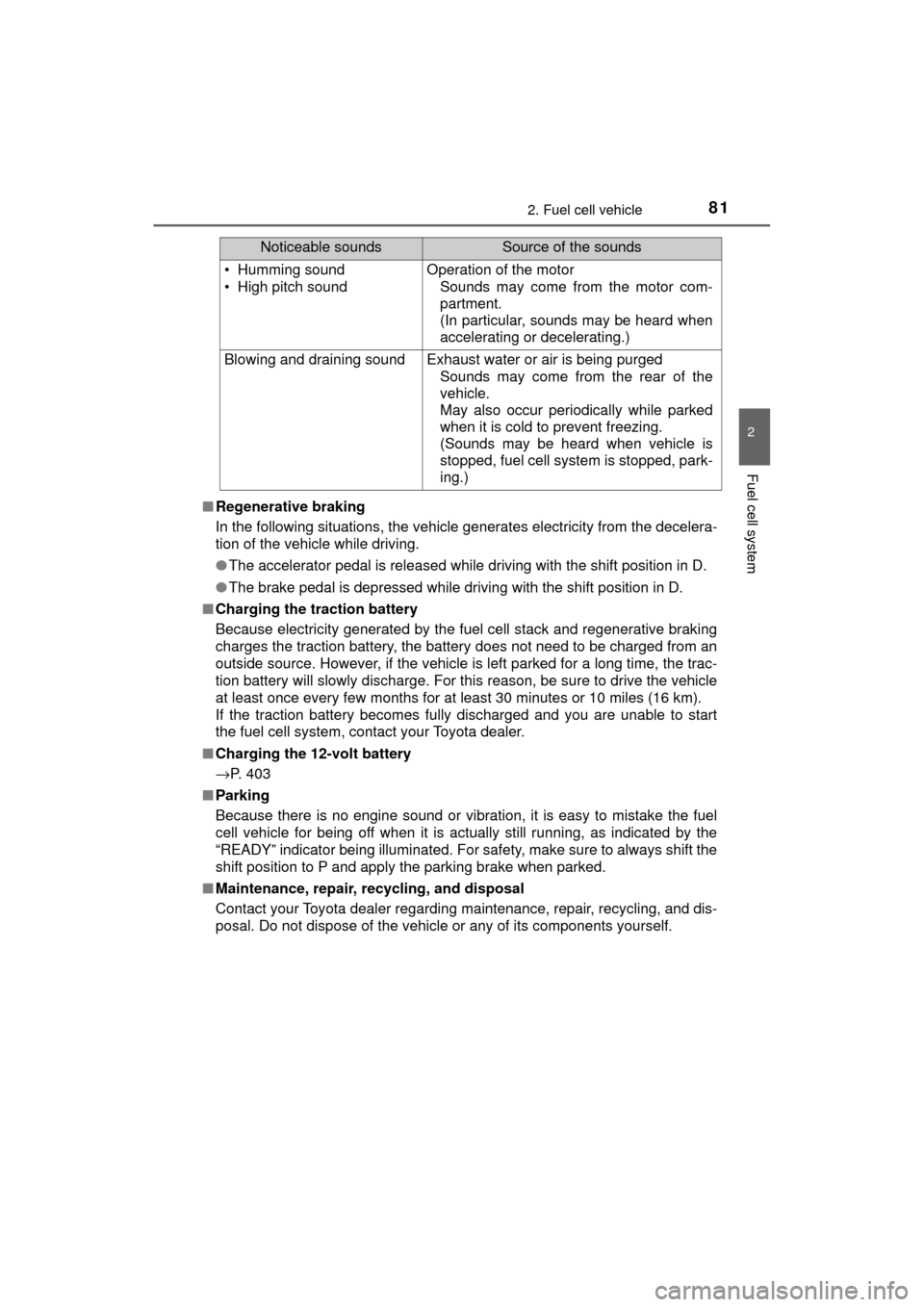
• Humming sound
• High pitch soundOperation of the motor
Sounds may come from the motor com-
partment.
(In particular, sounds may be heard when
accelerating or decelerating.)
Blowing and draining soundExhaust water or air is being purgedSounds may come from the rear of the
vehicle.
May also occur periodically while parked
when it is cold to prevent freezing.
(Sounds may be heard when vehicle is
stopped, fuel cell system is stopped, park-
ing.)
Noticeable soundsSource of the sounds
Page 82 of 464
822. Fuel cell vehicle
MIRAI_OM_USA_OM62023U
Fuel cell vehicle precautions
The fuel cell vehicle has hydrogen tanks (10150 psi [70 MPa,
714 kgf/cm2, 700 bar]), fuel cell stack, and hydrogen pipelines as
hydrogen-related components. Pay attention to all warning labels
attached to the vehicle.
This diagram is for illust rative purposes only and may differ from the
actual vehicle.
Hydrogen-related components
Warning label
Hydrogen detectors
Fuel cell stack Hydrogen tanks
Hydrogen tank valves
Hydrogen pipelines
Page 83 of 464
832. Fuel cell vehicle
2
Fuel cell system
MIRAI_OM_USA_OM62023U
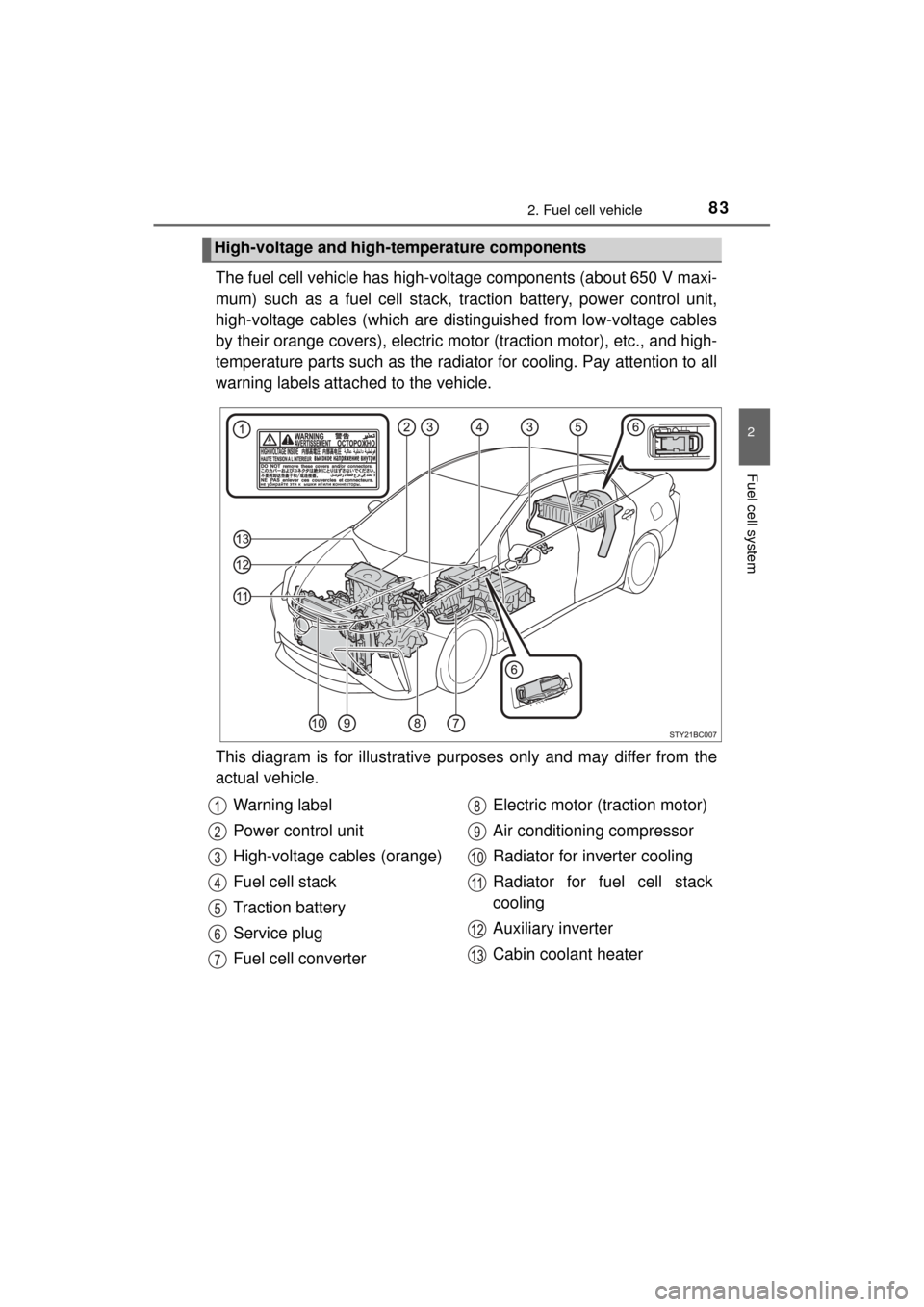
The fuel cell vehicle has high-voltage components (about 650 V maxi-
mum) such as a fuel cell stack, traction battery, power control unit,
high-voltage cables (which are distinguished from low-voltage cables
by their orange covers), electric motor (traction motor), etc., and high-
temperature parts such as the radiator for cooling. Pay attention to all
warning labels attached to the vehicle.
This diagram is for illust rative purposes only and may differ from the
actual vehicle.
High-voltage and high-temperature components
Warning label
Power control unit
High-voltage cables (orange)
Fuel cell stack
Traction battery
Service plug
Fuel cell converter Electric motor (traction motor)
Air conditioning compressor
Radiator for inverter cooling
Radiator for fuel cell stack
cooling
Auxiliary inverter
Cabin coolant heater
Page 84 of 464

842. Fuel cell vehicle
MIRAI_OM_USA_OM62023U
When a certain level of impact from an accident is detected, the fuel
cell system is shut down and the system shuts out the high voltage.
Also, the fuel supply is stopped from the hydrogen tank valves. If the
emergency shut off system activates, your vehicle will not restart. To
restart the fuel cell system, contact your Toyota dealer.
A message is automatically displa yed when a malfunction occurs in
the fuel cell system or an im proper operation is attempted.
If a warning message is shown on
the multi-information display, read
the message and follow the
instructions. ( →P. 376)
Fuel cell vehicles do not have engi ne sounds like gasoline vehicles.
Therefore, it makes an artificial no ise at low speeds to notify pedestri-
ans and nearby vehicles that it is approaching. The sound varies with
speed and will stop when the v ehicle exceeds approximately 15 mph
(25 km/h).
Emergency shut off system
Fuel cell warning message
Vehicle proximity notification system
Page 85 of 464

852. Fuel cell vehicle
2
Fuel cell system
MIRAI_OM_USA_OM62023U
There is an air intake vent beside
the rear left seat for the purpose
of cooling the traction battery. If
the air intake vent is blocked, it
could lead to a reduction in trac-
tion battery output.
■ If a warning light comes on, a warn ing message is displayed, or the 12-
volt battery connection is disconnected
The fuel cell system may not be able to restart.
If the “READY” indicator does not come on, even when the start pro\
cedure is
repeated, contact your Toyota dealer.
■ If “Hydrogen Leakage Detected Visit Your Dealer” is displayed on the
multi-information display
A small amount of hydrogen gas may be leaking. Have the vehicle inspected
immediately at the nearest Toyota dealer.
■ If “FC System Shutdown due to Hydrogen Leakage Stop Your Vehicle in
a Safe Place and Contact Your Dealer ” is displayed on the multi-informa-
tion display
● Hydrogen gas may be leaking.
When hydrogen gas is leaking or some other malfunction is detected:
→P. 9 0
● The air conditioning system will shut off automatically.
■ Running out of fuel
When the vehicle has run out of fuel and the fuel cell system cannot be
started, refuel the vehicle until the low fuel level warning light ( →P. 371) turns
off before trying to restart. It may not be able to restart if the refueled amount
is too low (less than about 2.7 lb. [1.2 kg]).
Traction battery air intake vent
Page 86 of 464

862. Fuel cell vehicle
MIRAI_OM_USA_OM62023U■
Fuel cell stack
●Depending on the usage environment, the fuel cell power output may
decline over the life of the vehicle. However, this will have almost no effect
on driving performance.
● In the following situations, the fuel cell power output may decline faster than
normal driving:
• Extended use in areas with high amounts of dust
• Extended use in areas with high levels of sulfur (such as volcanoes or hot
springs).
• Extended use in areas with high concentrations of the following substances:
-Organic solvents, such as paint and thinner
-Amine-related materials such as ammonia
-Chlorinated substances such as salt air and snow-melting agent
However, upon returning to normal environment, the fuel cell power output
will recover over time.
• Salt water gets into the air cleaner filter It is recommended to replace the air cleaner filter and clean the surround-
ing components. Have the vehicle inspected at your Toyota dealer
• The number of times the fuel cell system is started and stopped is exces- sively high
• Extended use in freezing temperatures
■ Hydrogen tanks
●The hydrogen tanks are the high-pressure storage containers that are filled
with compressed hydrogen gas. The vehicle can be refueled at hydrogen
stations.
● The hydrogen tanks have an expiration date. Vehicles with expired hydro-
gen tanks must not be driven or refueled until the hydrogen tanks are
replaced. The expiration date is written on the inside of the fuel door. Con-
sult your Toyota dealer.
● When disposing of the hydrogen tanks or the hydrogen tank valves, consult
your Toyota dealer for details.
![TOYOTA MIRAI 2017 1.G Owners Manual 822. Fuel cell vehicle
MIRAI_OM_USA_OM62023U
Fuel cell vehicle precautions
The fuel cell vehicle has hydrogen tanks (10150 psi [70 MPa,
714 kgf/cm2, 700 bar]), fuel cell stack, and hydrogen pipelines](/manual-img/14/6553/w960_6553-81.png "TOYOTA MIRAI 2017 1.G Owners Manual 822. Fuel cell vehicle
MIRAI_OM_USA_OM62023U
Fuel cell vehicle precautions
The fuel cell vehicle has hydrogen tanks (10150 psi [70 MPa,
714 kgf/cm2, 700 bar]), fuel cell stack, and hydrogen pipelines")