Page 133 of 732
1333-2. Opening, closing and locking the doors
3
Operation of each component
HIGHLANDER_U (OM0E017U)
WARNING
■Jam protection function (vehicles with a power back door)
Observe the following precautions.
Failure to do so may cause death or serious injury.
● Never use any part of your body to intentionally activate the jam protection
function.
● The jam protection function may not work if something gets caught just
before the back door fully closes. Be careful not to catch fingers or any-
thing else.
● The jam protection function may not work depending on the shape of the
object that is caught. Be careful not to catch fingers or anything else.\
Page 138 of 732
1383-2. Opening, closing and locking the doors
HIGHLANDER_U (OM0E017U)
WARNING
Observe the following precautions.
Failure to do so may result in death or serious injury.
■Before driving
● Make sure that the glass hatch is fully closed. If the glass hatch is not fully
closed, it may open unexpectedly while driving and hit near-by objects or
luggage in the luggage compartment may be thrown out, causing an acci-
dent.
● Do not allow a child to open or close the glass hatch.
Doing so may cause the glass hatch to move unexpectedly, or cause the
child’s hands, head, or neck to be caught by the closing glass hatch.
■ Operating the glass hatch
Observe the following precautions.
Failure to do so may cause parts of the body to be caught, resulting in death
or serious injury.
● Remove any heavy loads, such as snow and ice, from the glass hatch
before opening it. Failure to do so may cause the glass hatch to suddenly
shut again after it is opened.
● When opening or closing the glass hatch, thoroughly check to make sure
the surrounding area is safe.
● If anyone is in the vicinity, make sure they are safe and let them know that
the glass hatch is about to open or close.
● Use caution when opening or closing the glass hatch in windy weather as
it may move abruptly in strong wind.
Page 139 of 732
1393-2. Opening, closing and locking the doors
3
Operation of each component
HIGHLANDER_U (OM0E017U)
WARNING
●Do not pull on the glass hatch damper stay to close the glass hatch, and
do not hang on the glass hatch damper stay.
Doing so may cause hands to be caught or the glass hatch damper stay to
break, causing an accident.
● Do not attach any accessories other than genuine Toyota parts to the
glass hatch. Such additional weight on the glass hatch may cause the
glass hatch to suddenly shut again after it is opened, resulting in death or
serious injury.
● Do not open the glass hatch while the rear wiper is switched on. (If the rear
wiper is switched on while the glass hatch is open, the wiper motor drive
disc will be rotating on the door panel.)
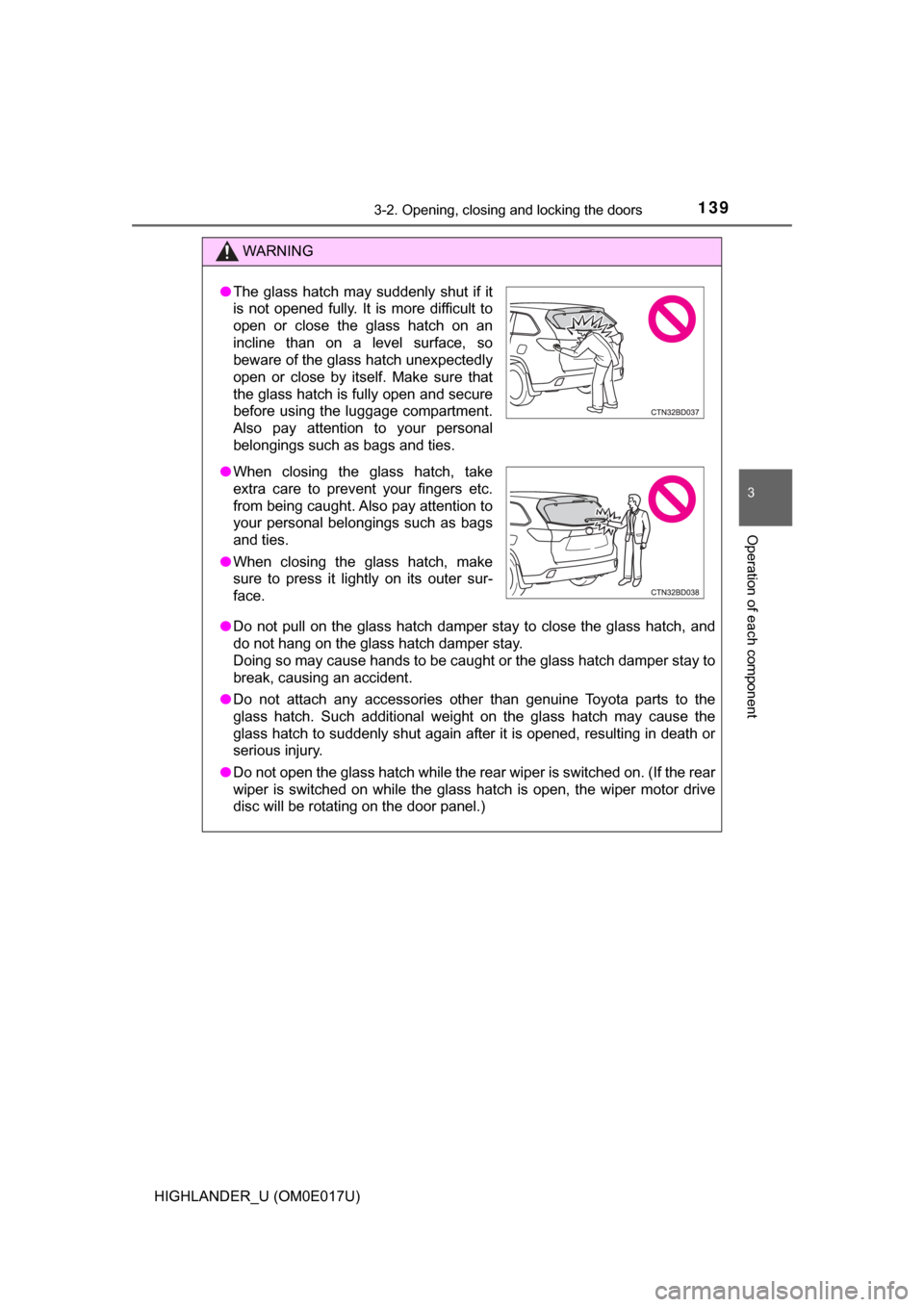
●The glass hatch may suddenly shut if it
is not opened fully. It is more difficult to
open or close the glass hatch on an
incline than on a level surface, so
beware of the glass hatch unexpectedly
open or close by itself. Make sure that
the glass hatch is fully open and secure
before using the luggage compartment.
Also pay attention to your personal
belongings such as bags and ties.
● When closing the glass hatch, take
extra care to prevent your fingers etc.
from being caught. Also pay attention to
your personal belongings such as bags
and ties.
● When closing the glass hatch, make
sure to press it lightly on its outer sur-
face.
Page 140 of 732
1403-2. Opening, closing and locking the doors
HIGHLANDER_U (OM0E017U)
WARNING
●Do not close the glass hatch while the rear wiper is switched on. The rear
wiper arm may be restarted suddenly after closing the glass hatch.
NOTICE
■Glass hatch damper stays
The glass hatch is equipped with damper stays that hold the glass hatch in
place. Observe the following precautions.
Failure to do so may cause damage to the glass hatch damper stay, result-
ing in malfunction.
● Do not place your hand or foot on the damper stay or apply lateral forces
to it.
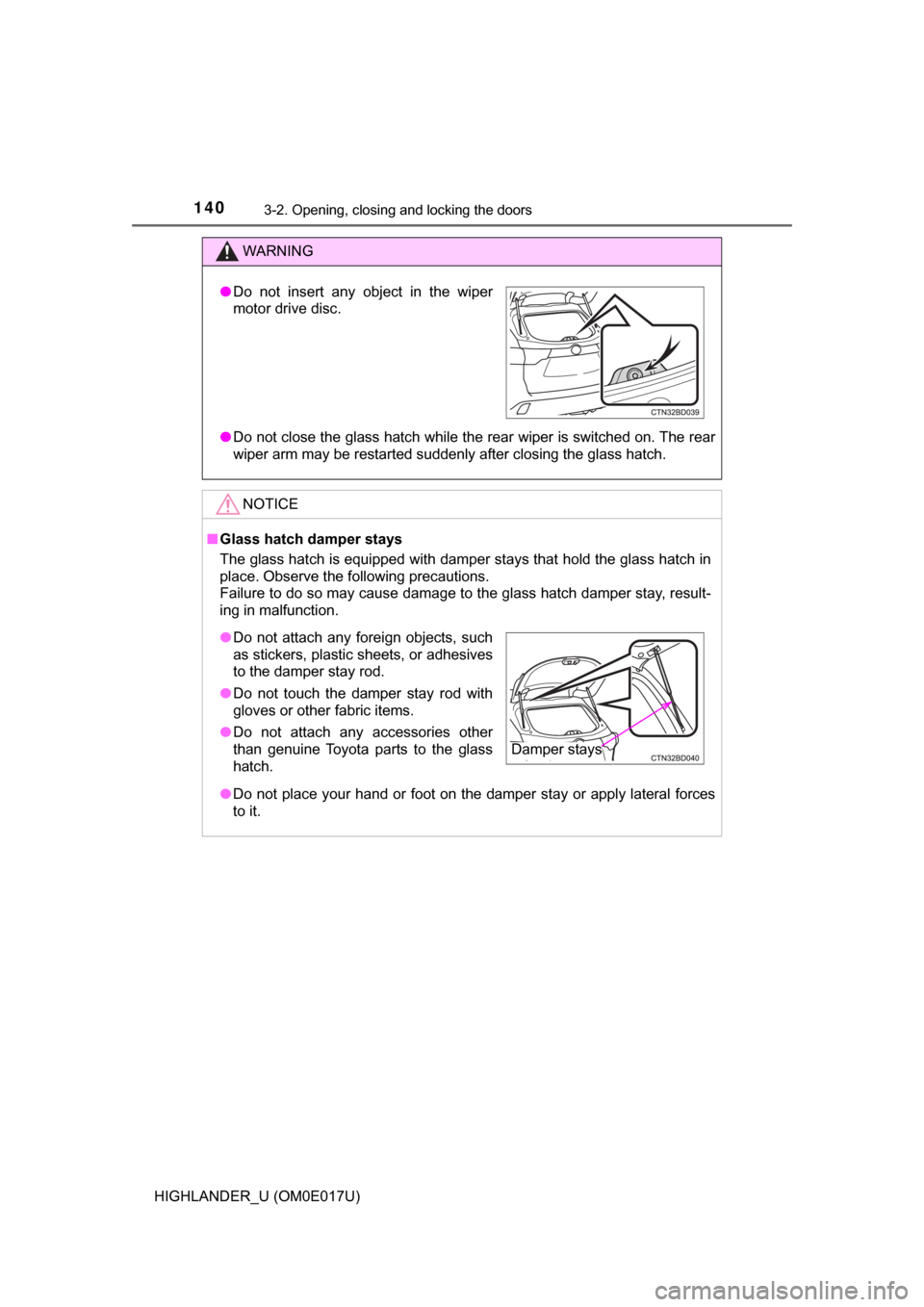
●Do not insert any object in the wiper
motor drive disc.
●Do not attach any foreign objects, such
as stickers, plastic sheets, or adhesives
to the damper stay rod.
● Do not touch the damper stay rod with
gloves or other fabric items.
● Do not attach any accessories other
than genuine Toyota parts to the glass
hatch.
Damper stays
Page 142 of 732
1423-2. Opening, closing and locking the doors
HIGHLANDER_U (OM0E017U)■
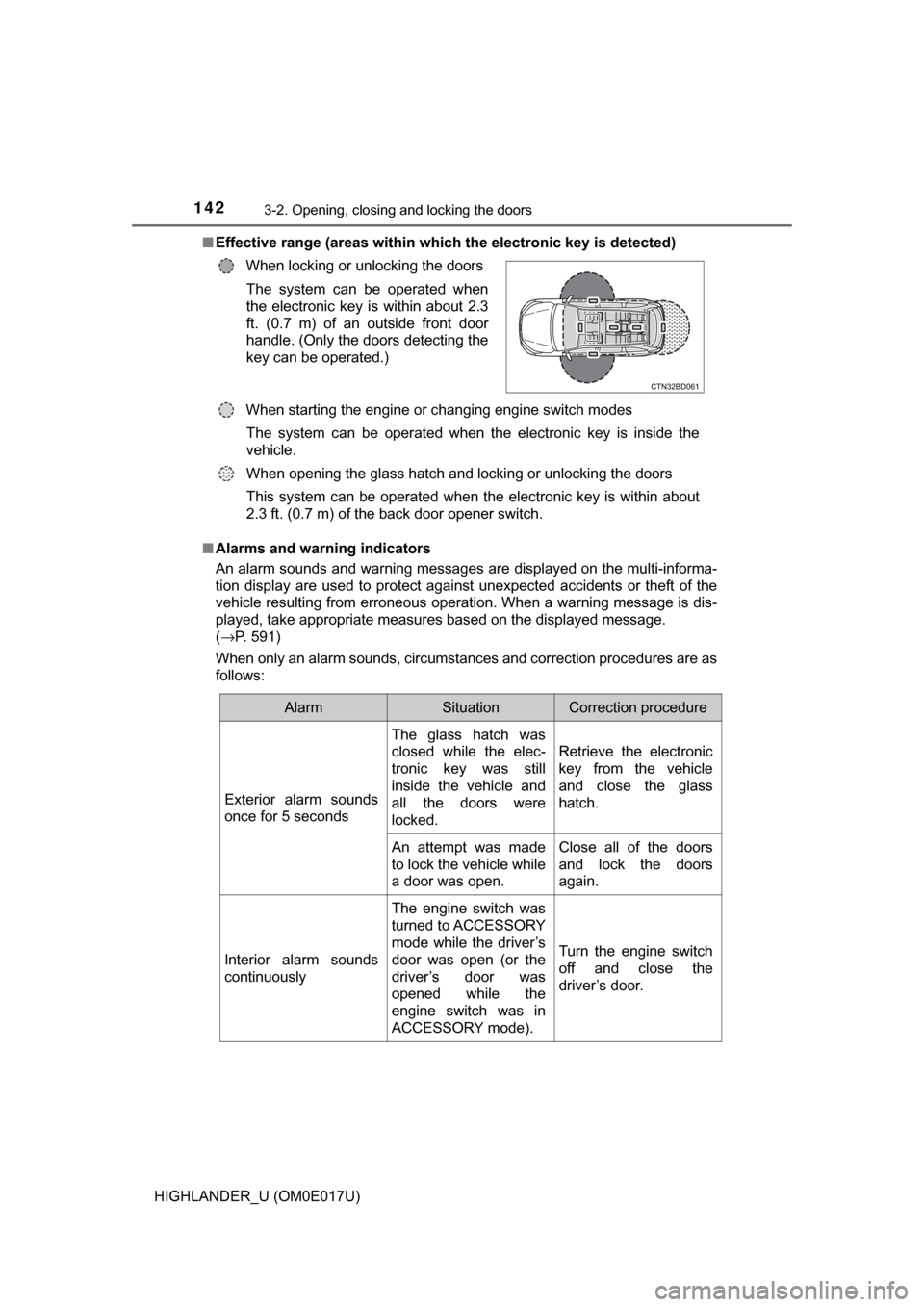
Effective range (areas within whic h the electronic key is detected)
■ Alarms and warning indicators
An alarm sounds and warning messages are displayed on the multi-informa-
tion display are used to protect against unexpected accidents or theft of the
vehicle resulting from erroneous operation. When a warning message is dis-
played, take appropriate measures based on the displayed message.
(→P. 591)
When only an alarm sounds, circumstances and correction procedures are as
follows: When locking or unlocking the doors
The system can be operated when
the electronic key is within about 2.3
ft. (0.7 m) of an outside front door
handle. (Only the doors detecting the
key can be operated.)
When starting the engine or changing engine switch modes The system can be operated when the electronic key is inside the
vehicle.
When opening the glass hatch and locking or unlocking the doors
This system can be operated when the electronic key is within about
2.3 ft. (0.7 m) of the back door opener switch.
AlarmSituationCorrection procedure
Exterior alarm sounds
once for 5 seconds
The glass hatch was
closed while the elec-
tronic key was still
inside the vehicle and
all the doors were
locked.
Retrieve the electronic
key from the vehicle
and close the glass
hatch.
An attempt was made
to lock the vehicle while
a door was open.Close all of the doors
and lock the doors
again.
Interior alarm sounds
continuously
The engine switch was
turned to ACCESSORY
mode while the driver’s
door was open (or the
driver’s door was
opened while the
engine switch was in
ACCESSORY mode).
Turn the engine switch
off and close the
driver’s door.
Page 147 of 732
1473-2. Opening, closing and locking the doors
3
Operation of each component
HIGHLANDER_U (OM0E017U)■
Certification for the smart key system
For vehicles sold in the U.S.A.
FCC ID: HYQ23AAB FCC ID: HYQ14FBA
NOTE:
This device complies with part 15 of the FCC Rules. Operation is subject to
the following two conditions: (1) This device may not cause harmful interfer-
ence, and (2) this device must accept any interference received, including
interference that may cause undesired operation.
FCC WARNING:
Changes or modifications not expressly approved by the party responsible for
compliance could void the user’s authority to operate the equipment.
For vehicles sold in Canada
NOTE:
This device complies with Industry Canada’s licence-exempt RSSs. Opera-
tion is subject to the following two conditions:
(1) This device may not cause interference; and
(2) This device must accept any interference, including interference that may
cause undesired operation of the device.
For vehicles sold in the U.S.A.
FCC ID: NI4TMLF12-1
This device complies with part 15 of the FCC Rules. Operation is subject to
the following two conditions: (1) This device may not cause harmful interfer-
ence; and (2) This device must accept any interference received, including
interference that may cause undesired operation.
Changes or modifications not expressly approved by the party responsible for
compliance could void the user’s authority to operate the equipment.
For vehicles sold in Canada
This device complies with Industry Canada licence-exempt RSSs. Operation
is subject to the following two conditions: (1) This device may not cause inter-
ference; and (2) This device must accept any interference, including interfer-
ence that may cause undesired operation of the device.
NOTE:
Le présent appareil est conforme aux CNR d'lndustrie Canada appli-
cables aux appareils radio exempts de licence. L'exploitation est autori-
sée aux deux conditions suivantes: (1) l'appareil ne doit pas produire de
brouillage; (2) l'utilisateur de l'appareil doit accepter tout brouillage
radioélectrique subi, même si le br ouillage est susceptible d'en compro-
mettre le fonctionnement.
Page 148 of 732

1483-2. Opening, closing and locking the doors
HIGHLANDER_U (OM0E017U)
WARNING
■Caution regarding interfer ence with electronic devices
● People with implantable cardiac pacemakers, cardiac resynchronization
therapy-pacemakers or implantable card ioverter defibrillators should keep
away from the smart key system antennas. ( →P. 141)
The radio waves may affect the operation of such devices. If necessary,
the entry function can be disabled. Ask your Toyota dealer for details, such
as the frequency of radio waves and timing of the emitted radio waves.
Then, consult your doctor to see if you should disable the entry function.
● Users of any electrical medical device other than implantable cardiac
pacemakers, cardiac resynchronization therapy-pacemakers or implant-
able cardioverter defibrillators should consult the manufacturer of the
device for information about its operation under the influence of radio
waves.
Radio waves could have unexpected effects on the operation of such
medical devices.
Ask your Toyota dealer for details on disabling the entry function.
Page 150 of 732
1503-3. Adjusting the seats
HIGHLANDER_U (OM0E017U)
WARNING
■When adjusting the seat position
● Take care when adjusting the seat position to ensure that other passen-
gers are not injured by the moving seat.
● Do not put your hands under the seat or near the moving parts to avoid
injury.
Fingers or hands may become jammed in the seat mechanism.
● Make sure to leave enough space around the feet so they do not get stuck.
■ Seat adjustment
● Be careful that the seat does not hit passengers or luggage.
● To reduce the risk of sliding under the lap belt during a collision, do not
recline the seat more than necessary.
If the seat is too reclined, the lap belt may slide past the hips and apply
restraint forces directly to the abdomen, or your neck may contact the
shoulder belt, increasing the risk of death or serious injury in the event of
an accident.
Adjustments should not be made while driving as the seat may unexpect-
edly move and cause the driver to lose control of the vehicle.
● Manual seat only: After adjusting the seat, make sure that the seat is
locked in position.