Page 424 of 732
4245-9. Bluetooth® phone
HIGHLANDER_U (OM0E017U)
In other situations
Even though all conceivable measures have been taken, the symptom sta-
tus does not change.
The cellular phone is not close enough to this system.
→Bring the cellular phone closer to this system.
The cellular phone is the most likely cause of the symptom.
→Turn the cellular phone off, remo ve and reinstall the battery pack,
and then restart the cellular phone.
→ Enable the cellular phone’s Bluetooth
® connection.
→ Stop the cellular phone’s security software and close all applica-
tions.
→ Before using an appli cation installed on the cellular phone, care-
fully check its source and how its operation might affect this sys-
tem.
Page 474 of 732
4746-4. Using the other interior features
HIGHLANDER_U (OM0E017U)
■The power outlets can be used when
12 V
Vehicles without a smart key system:
The engine switch is in the “ACC” or “ON” position.
Vehicles with a smart key system:
The engine switch is in ACCESSORY or IGNITION ON mode.
120 VAC
The engine switch is in IGNITION ON mode.
■ When the engine restarts after havi ng been stopped by the Stop & Start
system (if equipped)
The power outlets may be temporarily unusable, but this is not a malfunc\
tion.
NOTICE
■ To avoid damaging the power outlets
Close the power outlet lids when the power outlets are not in use.
Foreign objects or liquids that enter the power outlets may cause a short cir-
cuit.
■ To prevent blown fuses
12 V
Do not use an accessory that uses more than 12 V 10 A.
120 VAC
Do not use a 120 VAC appliance that requires more than 100 W.
If a 120 VAC appliance that consumes more than 100 W is used, the protec-
tion circuit will cut the power supply.
■ To prevent battery discharge
Do not use the power outlets longer than necessary when the engine is not
running.
■ Appliances that may not operate properly (120 VAC)
The following 120 VAC appliances may not operate properly even if their
power consumption is under 100 W:
● Appliances with high initial peak wattage
● Measuring devices that process precise data
● Other appliances that require an extremely stable power supply
Page 484 of 732

4846-4. Using the other interior features
HIGHLANDER_U (OM0E017U)
Press and hold the pro-
grammed HomeLink® button
(located inside the vehicle)
for 2 seconds and release it.
Repeat this sequence (press/
hold/release) up to 3 times to
complete programming.
If the garage door opener motor
activates when the HomeLink®
button is pressed, the garage
door opener motor recognizes
the HomeLink
® signal.
■
Enabling 2-way communication with a garage door (only avail-
able for compatible devices)
When enabled, 2-way communication allows you to check the sta-
tus of the opening and closing of the garage door through indicators
in your vehicle.
2-way communication is only available if the garage door opener
motor used is a compatible device. (To check device compatibility,
refer to the owner’s manual supplied with the garage door opener
motor.)
Press a programmed HomeLink
® button to operate a garage
door.
Within 1 minute of pressing the HomeLink
® button, after the
garage door operation has stopped, press the “learn” or “smart”
button on the garage door opener motor. Within 5 seconds of the
establishment of 2-way communication with the garage door
opener, both garage door operati on indicators in the vehicle will
flash rapidly (green).
■Reprogramming a single HomeLink® button
When the following procedure is pe rformed, buttons which already
have devices registered to them can be overwritten:
With one hand, press and hold the desired HomeLink
® button.
When the HomeLink
® indicator starts flashing, continue to hold
the HomeLink® button and perform “Programming HomeLink®”
from (it takes 20 seconds for the HomeLink® indicator to start
flashing).
3
1
2
1
2
1
Page 571 of 732
571
8When trouble arises
HIGHLANDER_U (OM0E017U)8-1. Essential information
Emergency flashers .......... 572
If your vehicle has to be stopped in an
emergency ...................... 573
8-2. Steps to take in an emergency
If your vehicle needs to be towed ..................... 575
If you think something is wrong .......................... 579
Fuel pump shut off system ............................ 580
If a warning light turns on or a warning buzzer
sounds ............................ 581
If a warning message is displayed ..................... 591
If you have a flat tire.......... 608
If the engine will not start ........................... 633
If the electronic key does not operate properly........ 635
If the vehicle battery is discharged ................... 638
If your vehicle overheats ........................ 644
If the vehicle becomes stuck ............................... 647
Page 580 of 732
5808-2. Steps to take in an emergency
HIGHLANDER_U (OM0E017U)
Follow the procedure below to restart the engine after the system is
activated.
Vehicles without a smart key system
Turn the engine switch to the “ACC” or “LOCK” position.
Restart the engine.
Vehicles with a smart key system
Turn the engine switch to ACCESSORY mode or turn it off.
Restart the engine.
Fuel pump shut off system
To minimize the risk of fuel leakage when the engine stalls or
when an airbag inflates upon collision, the fuel pump shut off
system stops the supply of fuel to the engine.
NOTICE
■ Before starting the engine
Inspect the ground under the vehicle.
If you find that fuel has leaked onto the ground, the fuel system has been
damaged and is in need of repair. Do not restart the engine.
1
2
1
2
Page 583 of 732

5838-2. Steps to take in an emergency
8
When trouble arises
HIGHLANDER_U (OM0E017U)
PCS (Pre-Collision System) warning light When the warning light flashes (and a buzzer sounds):
Indicates a malfunction in the PCS (Pre-Collision system)
→ Have the vehicle inspected by your Toyota dealer
immediately.
When the warning light flashes (and a buzzer does not
sound):
Indicates that the PCS (Pre-Collision system) is temporar-
ily unavailable, possibly due to either of the following:
• An area around the radar sensor or camera sensor being dirty or covered with condensation, ice, stickers,
etc.
→ Clear the dirt, condensation, ice, stickers, etc.
(→P. 256)
• Radar sensor or camera sensor operational conditions
(such as temperature etc.) being not met
→ Driving is possible in th is case. The PCS (Pre-Colli-
sion System) will be enabled if the operational condi-
tions (such as temperature etc.) are met again.
When the warning light is illuminated:
Either the VSC (Vehicle Stability Control) system or PCS
(Pre-Collision system) is disabled or both are disabled.
→ To enable the PCS, enable both the VSC system and
PCS. ( →P. 265, 334)
(Amber)
LDA (Lane Departure Alert wit h steering control) indica-
tor The indicator comes on and a warning message is dis-
played to indicate that the LDA (Lane Departure Alert with
steering control) system is not available temporarily or has
detected a malfunction.
→ P. 592
(Flashes)
Stop & Start cancel indicator*3
Indicates a malfunction in the Stop & Start system
(The Stop & Start cancel indicator will come on when the
system is canceled.: →P. 298)
→ Have the vehicle inspected by your Toyota dealer
immediately.
Warning lightWarning light/Details/Actions
Page 589 of 732

5898-2. Steps to take in an emergency
8
When trouble arises
HIGHLANDER_U (OM0E017U)
WARNING
■Maintenance of the tires
Each tire, including the spare (if provided), should be checked monthly
when cold and inflated to the inflation pressure recommended by the
vehicle manufacturer on the vehicle placard or tire inflation pressure
label (tire and load information label). (If your vehicle has tires of a dif-
ferent size than the size indicated on the vehicle placard or tire inflation
pressure label [tire and load information label], you should determine
the proper tire inflation pressure for those tires.)
As an added safety feature, your vehicle has been equipped with a tire
pressure monitoring system (TPMS-ti re pressure warning system) that
illuminates a low tire pre ssure telltale (tire pressure warning light) when
one or more of your tires is significantly under-inflated. Accordingly,
when the low tire pressure telltale (tire pressure warning light) illumi-
nates, you should stop and check your tires as soon as possible, and
inflate them to the proper pressure. Driving on a significantly under-
inflated tire causes the tire to overheat and can lead to tire failure.
Under-inflation also reduces fuel effi ciency and tire tread life, and may
affect the vehicle’s hand ling and stopping ability.
Please note that the TPMS (tire pressure warning system) is not a sub-
stitute for proper ti re maintenance, and it is the driver’s responsibility to
maintain correct tire pressure, even if under-inflation has not reached
the level to trigger illumination of the TPMS low tire pressure telltale (tire
pressure warning light).
Your vehicle has also been equipped with a TPMS (tire pressure warn-
ing system) malfunction indicator to indicate when the system is not
operating properly. The TPMS (tire pressure warning system) malfunc-
tion indicator is combined with the lo w tire pressure telltale (tire pressure
warning light). When the system detects a malfunction, the telltale will
flash for approximately one minute and then remain continuously illumi-
nated. This sequence w ill continue upon subsequ ent vehicle start-ups
as long as the malfunction exists. When the malfunction indicator is illu-
minated, the system may not be able to detect or signal low tire pres-
sure as intended.
TPMS (tire pressure warning system) malfunctions may occur for a vari-
ety of reasons, including the installation of replacement or alternate tires
or wheels on the vehicle that prevent the TPMS (tire pressure warning
system) from functioning properly. Always check the TPMS (tire pres-
sure warning system) malfunction te lltale after replacing one or more
tires or wheels on your vehicle to ensure that the replacement or alter-
nate tires and wheels allow the TPMS (tire pressure warning system) to
continue to function properly.
Page 599 of 732
5998-2. Steps to take in an emergency
8
When trouble arises
HIGHLANDER_U (OM0E017U)
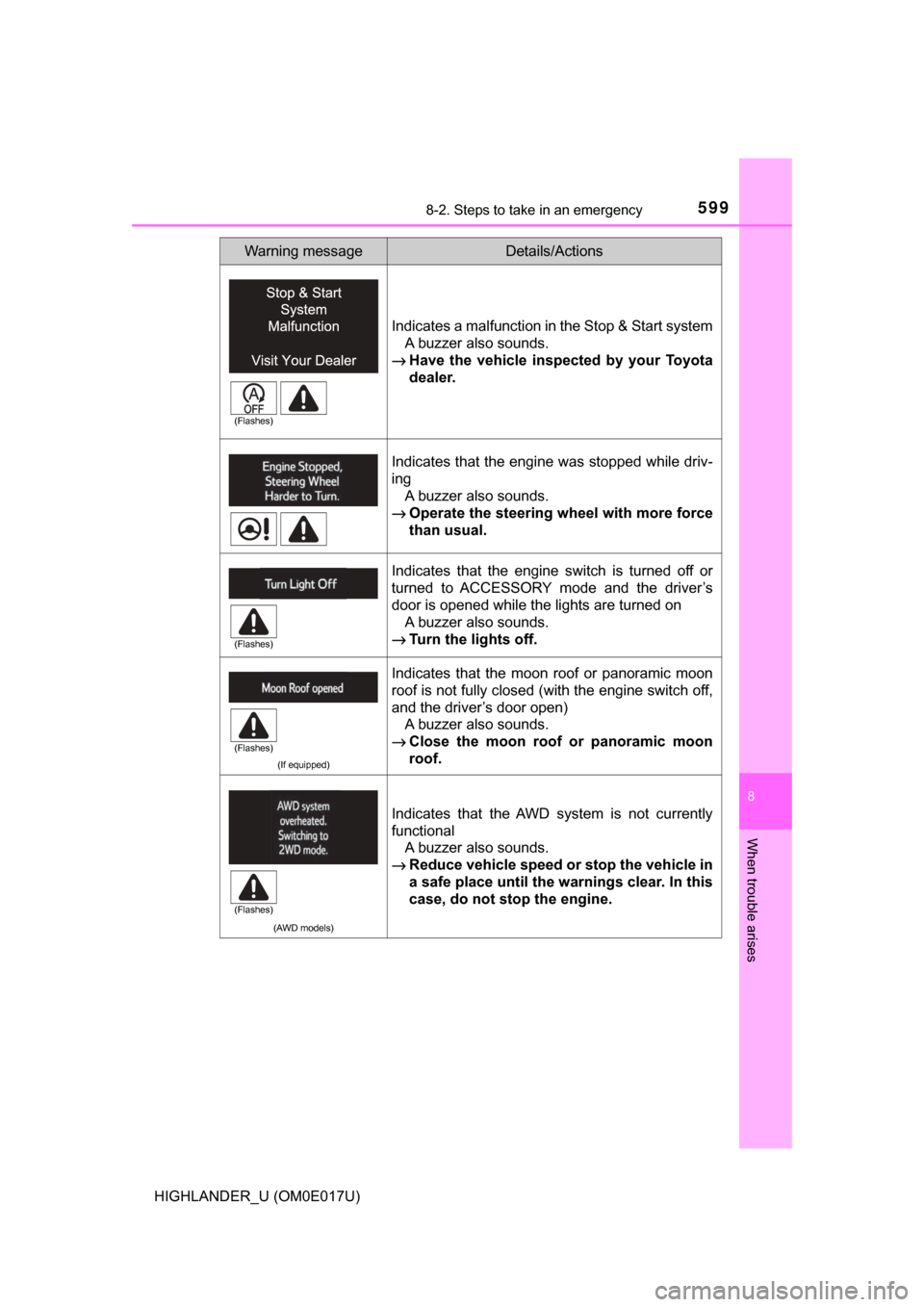
Indicates a malfunction in the Stop & Start systemA buzzer also sounds.
→ Have the vehicle inspect ed by your Toyota
dealer.
Indicates that the engine was stopped while driv-
ing A buzzer also sounds.
→ Operate the steering wheel with more force
than usual.
Indicates that the engine switch is turned off or
turned to ACCESSORY mode and the driver’s
door is opened while the lights are turned on
A buzzer also sounds.
→ Turn the lights off.
(If equipped)
Indicates that the moon roof or panoramic moon
roof is not fully closed (with the engine switch off,
and the driver’s door open)
A buzzer also sounds.
→ Close the moon roof or panoramic moon
roof.
(AWD models)
Indicates that the AWD system is not currently
functional
A buzzer also sounds.
→ Reduce vehicle speed or stop the vehicle in
a safe place until the warnings clear. In this
case, do not stop the engine.
Warning messageDetails/Actions
(Flashes)
(Flashes)
(Flashes)
(Flashes)