Page 514 of 732

514
HIGHLANDER_U (OM0E017U)
7-3. Do-it-yourself maintenance
Do-it-yourself service precautions
If you perform maintenance by yourself, be sure to follow the
correct procedure as given in these sections.
ItemsParts and tools
Battery condition
(→ P. 527)• Warm water• Baking soda• Grease
• Conventional wrench (for terminal clamp bolts)
Brake fluid level
(→ P. 526)• FMVSS No.116 DOT 3 or SAE J1703 brake fluid
• Rag or paper towel
• Funnel (used only for adding brake fluid)
Engine coolant
level ( →P. 524)
• “Toyota Super Long Life Coolant” or a similar high
quality ethylene glycol-based non-silicate, non-
amine, non-nitrite and non-borate coolant with long-
life hybrid organic acid technology
For U.S.A.:
“Toyota Super Long Life Coolant” is pre-mixed with
50% coolant and 50% deionized water.
For Canada:
“Toyota Super Long Life Coolant” is pre-mixed with
55% coolant and 45% deionized water.
• Funnel (used only for adding engine coolant)
Engine oil level
( → P. 521)• “Toyota Genuine Motor Oil” or equivalent
• Rag or paper towel
• Funnel (used only for adding engine oil)
Fuses ( →P. 552)• Fuse with same amperage rating as original
Light bulbs
(→ P. 556)
• Bulb with same number and wattage rating as origi-
nal
• Phillips-head screwdriver
• Flathead screwdriver• Wrench
Radiator and con-
denser (
→P. 525)⎯
Tire inflation
pressure
( → P. 542)• Tire pressure gauge
• Compressed air source
Washer fluid
(→ P. 530)• Water or washer fluid containing antifreeze (for win-
ter use)
• Funnel (used only for adding water or washer fluid)
Page 519 of 732
5197-3. Do-it-yourself maintenance
7
Maintenance and care
HIGHLANDER_U (OM0E017U)■
2.7 L 4-cylinder (1AR-FE) engine
Engine compartment
Washer fluid tank
(→ P. 530)
Fuse boxes ( →P. 552)
Engine oil level dipstick (→ P. 521)
Engine oil filler cap (→ P. 522)
Engine coolant reservoir (→ P. 524) Battery
(→ P. 527)
Brake fluid reservoir (→ P. 526)
Electric cooling fans
Condenser ( →P. 525)
Radiator ( →P. 525)1
2
3
4
5
6
7
8
9
10
Page 520 of 732
5207-3. Do-it-yourself maintenance
HIGHLANDER_U (OM0E017U)■
3.5 L V6 (2GR-FKS) engine
Washer fluid tank
(→ P. 530)
Fuse boxes ( →P. 552)
Engine oil filler cap (→ P. 522)
Engine oil level dipstick (→ P. 521)
Engine coolant reservoir (→ P. 524) Battery
(→ P. 527)
Brake fluid reservoir (→ P. 526)
Electric cooling fans
Condenser ( →P. 525)
Radiator ( →P. 525)1
2
3
4
5
6
7
8
9
10
Page 552 of 732
5527-3. Do-it-yourself maintenance
HIGHLANDER_U (OM0E017U)
Vehicles without a smart key system:
Turn the engine switch to the “LOCK” position.
Vehicles with a smart key system:
Turn the engine switch off.
Open the fuse box cover.
Engine compartment (type A fuse box)
Push the tab in and lift the lid off.
Engine compartment (type B fuse box)
Push the tab in and lift the lid off.
Checking and replacing fuses
If any of the electrical components do not operate, a fuse may
have blown. If this happens, check and replace the fuses as nec-
essary.
1
2
Page 553 of 732
5537-3. Do-it-yourself maintenance
7
Maintenance and care
HIGHLANDER_U (OM0E017U)
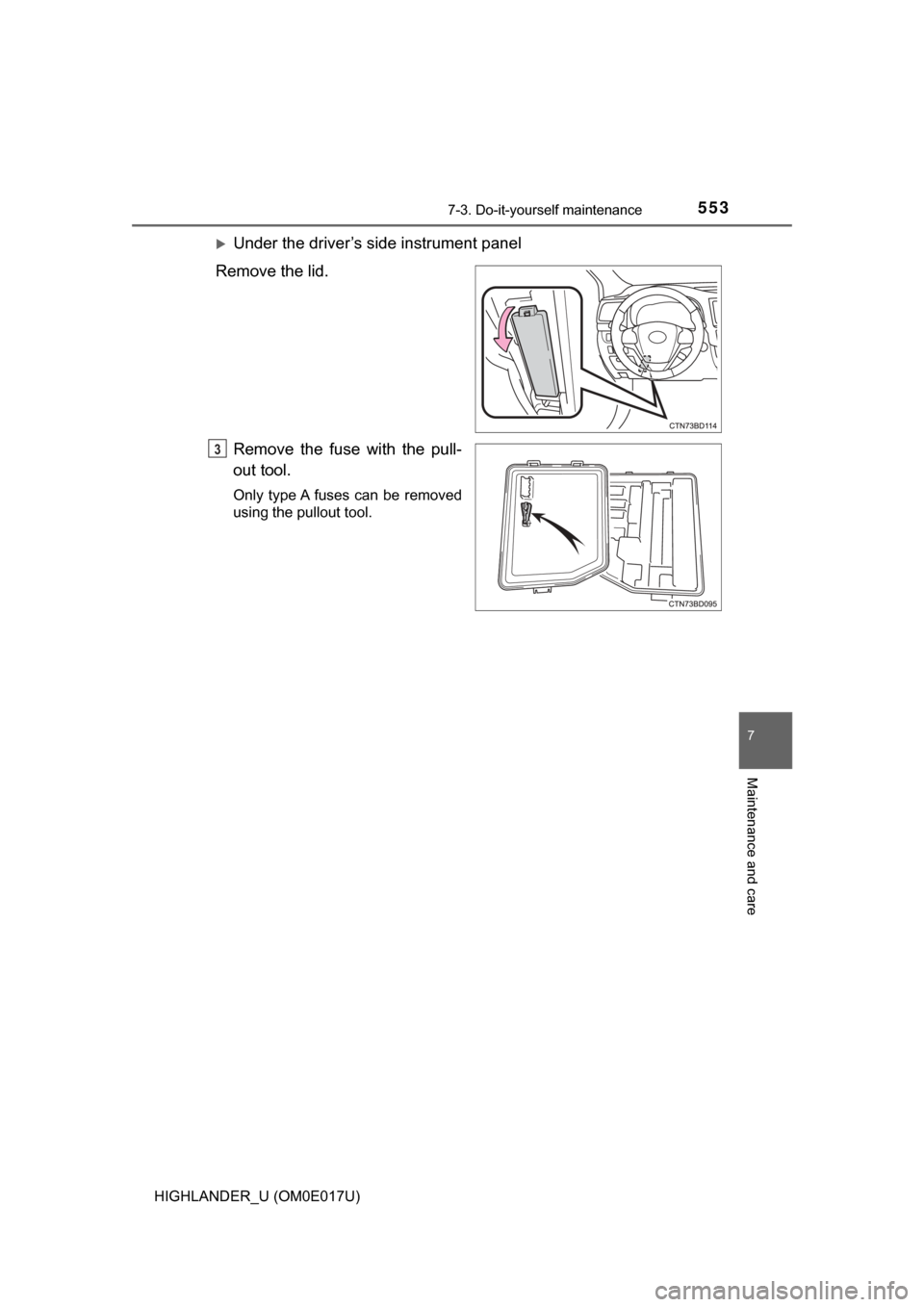
Under the driver’s side instrument panel
Remove the lid.
Remove the fuse with the pull-
out tool.
Only type A fuses can be removed
using the pullout tool.
3
Page 554 of 732
5547-3. Do-it-yourself maintenance
HIGHLANDER_U (OM0E017U)
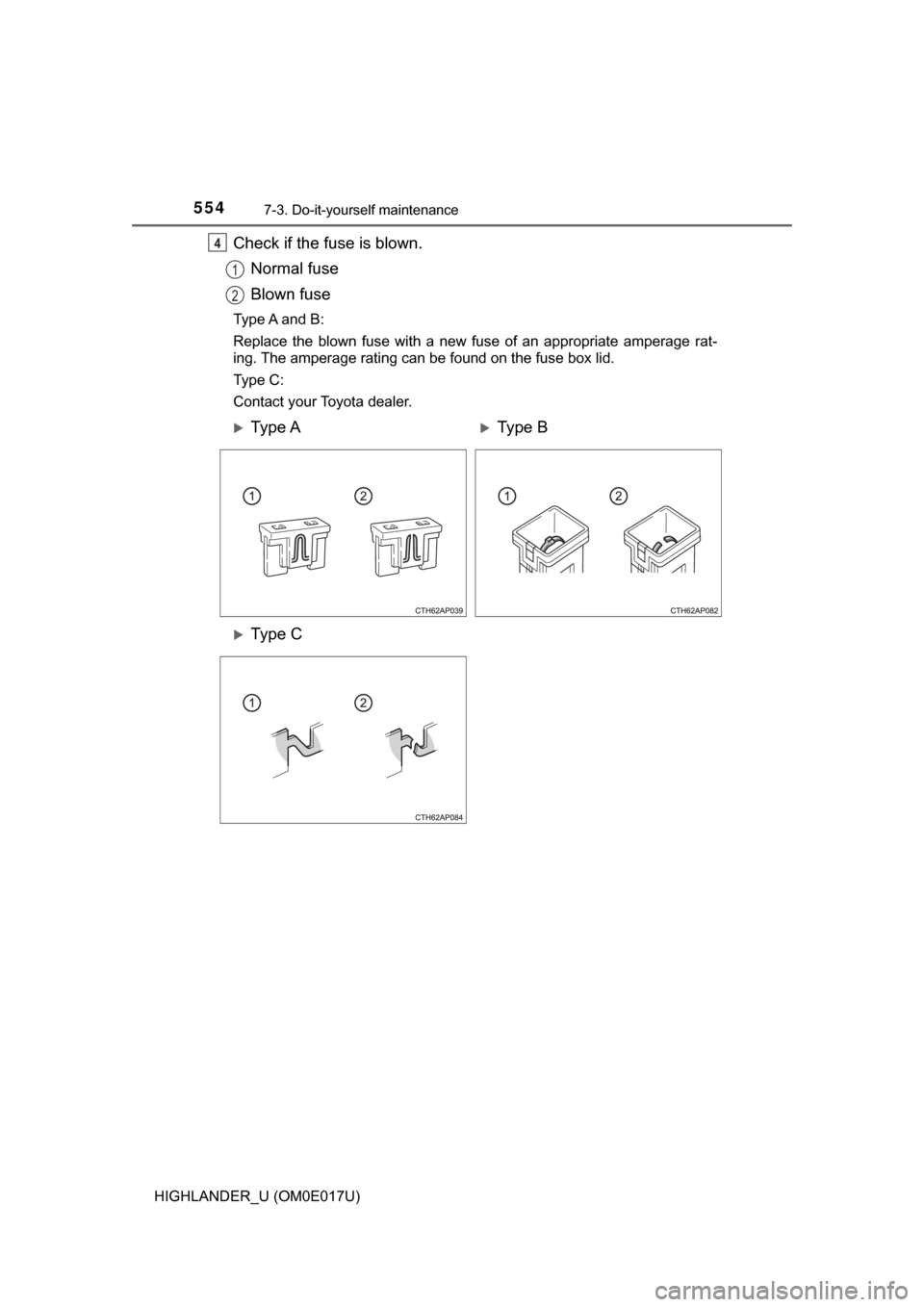
Check if the fuse is blown.Normal fuse
Blown fuse
Type A and B:
Replace the blown fuse with a new fuse of an appropriate amperage rat-
ing. The amperage rating can be found on the fuse box lid.
Type C:
Contact your Toyota dealer.
4
1
2
Ty p e AType B
Ty p e C
Page 555 of 732

5557-3. Do-it-yourself maintenance
7
Maintenance and care
HIGHLANDER_U (OM0E017U)
■After a fuse is replaced
●If the lights do not turn on even after the fuse has been replaced, a bulb may
need replacement. ( →P. 556)
● If the replaced fuse blows again, have the vehicle inspected by your Toyota
dealer.
■ If there is an overload in a circuit
The fuses are designed to blow, protecting the wiring harness from damage.
■ When replacing light bulbs
Toyota recommends that you use genuine Toyota products designed for this
vehicle. Because certain bulbs are connected to circuits designed to prevent
overload, non-genuine parts or parts not designed for this vehicle may be
unusable.
WARNING
■To prevent system breakdowns and vehicle fire
Observe the following precautions.
Failure to do so may cause damage to the vehicle, and possibly a fire or
injury.
● Never use a fuse of a higher amperage rating than that indicated, or use\
any other object in place of a fuse.
● Always use a genuine Toyota fuse or equivalent.
Never replace a fuse with a wire, even as a temporary fix.
● Do not modify the fuses or fuse boxes.
NOTICE
■Before replacing fuses
Have the cause of electrical overload determined and repaired by your
Toyota dealer as soon as possible.
Page 633 of 732
6338-2. Steps to take in an emergency
8
When trouble arises
HIGHLANDER_U (OM0E017U)
One of the following may be the cause of the problem:
●There may not be sufficient fuel in the vehicle’s tank.
Refuel the vehicle.
● The engine may be flooded.
Try to restart the engine again following correct starting procedures.
(→ P. 218, 221)
● There may be a malfunction in the engine immobilizer system.
(→ P. 80)
One of the following may be the cause of the problem:
● The battery may be discharged. ( →P. 638)
● The battery terminal connections may be loose or corroded.
The engine starting system may be malfunctioning due to an electrical
problem such as electronic key battery depletion or a blown fuse.
However, an interim measure is available to start the engine.
( → P. 634)
If the engine w ill not start
If the engine will not start eve n though correct starting proce-
dures are being followed ( →P. 218, 221), consider each of the fol-
lowing points:
The engine will not start even though the starter motor operates
normally.
The starter motor turns over slowly, the interior lights and head-
lights are dim, or the horn does not sound or sounds at a low
volume.
The starter motor does not turn over (vehicles with a smart key
system)