2017 TOYOTA AVALON ECO mode
[x] Cancel search: ECO modePage 391 of 492
3917-2. Steps to take in an emergency
7
When trouble arises
*1: Parking brake engaged warning buzzer: The buzzer sounds to indicatethat the parking brake is still engaged (with the vehicle having reached a
speed of 3 mph [5 km/h]).
*2: Open door warning buzzer:
A buzzer will sound if the vehicle reaches a speed of 3 mph (5 km/h) or
more with any door open.
*3: Driver’s seat belt buzzer:The driver’s seat belt buzzer sounds to alert the driver that his or her seat
belt is not fastened. Once the engine switch is turned to IGNITION ON
mode, the buzzer sounds for 6 seconds. If the vehicle reaches a speed of
12 mph (20 km/h), the buzzer sounds once. If the seat belt is still unfas-
tened after 30 seconds, the buzzer will sound intermittently for 10 seconds.
Then, if the seat belt is still unfastened, the buzzer will sound in a different
tone for 20 more seconds.
Front passenger’s seat belt buzzer:
The front passenger’s seat belt buzzer sounds to alert the front passenger
that his or her seat belt is not fastened. The buzzer sounds once if the
vehicle reaches a speed of 12 mph (20 km/h). If the seat belt is still unfas-
tened after 30 seconds, the buzzer will sound intermittently for 10 seconds.
Then, if the seat belt is still unfastened, the buzzer will sound in a different
tone for 20 more seconds.
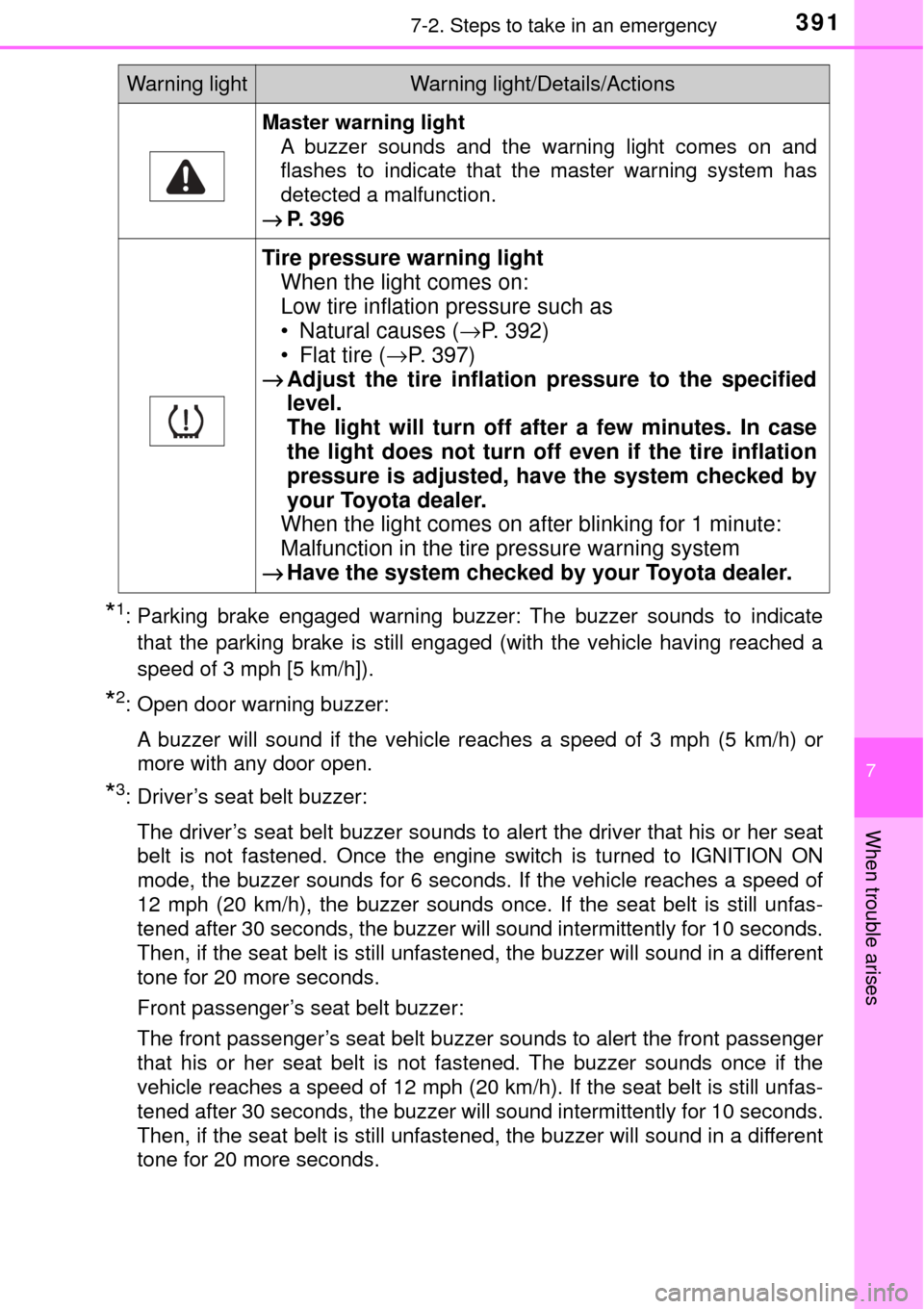
Master warning light A buzzer sounds and the warning light comes on and
flashes to indicate that the master warning system has
detected a malfunction.
→ P. 396
Tire pressure warning light
When the light comes on:
Low tire inflation pressure such as
• Natural causes ( →P. 392)
• Flat tire ( →P. 397)
→ Adjust the tire inflation pressure to the specified
level.
The light will turn off af ter a few minutes. In case
the light does not turn off even if the tire inflation
pressure is adjusted, have the system checked by
your Toyota dealer.
When the light comes on after blinking for 1 minute:
Malfunction in the tire pressure warning system
→ Have the system checked by your Toyota dealer.
Warning lightWarning light/Details/Actions
Page 393 of 492

3937-2. Steps to take in an emergency
7
When trouble arises
■When a tire is replaced with a spare tire
The compact spare tire is not equipped with a tire pressure warning valve
and transmitter. If a tire goes flat, the tire pressure warning light will not
turn off even though the flat tire ha s been replaced with the spare tire.
Replace the spare tire with the repair ed tire and adjust the tire inflation
pressure. The tire pressu re warning light will go off after a few minutes.
■Conditions that the tire pressure warning system may not function
properly
→ P. 3 4 7
■If the tire pressure warning light frequently comes on after blinking
for 1 minute
If the tire pressure warning light frequently comes on after blinking for 1
minute when the engine switch is tu rned to IGNITION ON mode, have it
checked by your Toyota dealer.
■ Warning buzzer
In some cases, the buzzer may not be heard because of noisy place or an
audio sound.
WARNING
■If both the ABS and the brake system warning lights remain on
Stop your vehicle in a safe place immediately and contact your Toyota
dealer. The vehicle will become extremely unstable during braking, and the
ABS system may fail, which could cause an accident resulting in death or
serious injury.
■ When the electric power steerin g system warning light comes on
The steering wheel may become extremely heavy.
When steering wheel operations are heavier than usual, grip the steering
wheel firmly and operate it using more force than usual.
■
If the tire pressure warning light comes on
Be sure to observe the following precautions. Failure to do so could
cause a loss of vehicle control and result in death or serious injury.
●Stop your vehicle in a safe place as soon as possible. Adjust the tire
inflation pressure immediately.
●If the tire pressure warning light co mes on even after tire inflation pres-
sure adjustment, it is probable that you have a flat tire. Check the tires.
If a tire is flat, change it with the spare tire and have the flat tire
repaired by the nearest Toyota dealer.
●Avoid abrupt maneuvering and braking. If the vehicle tires deteriorate,
you could lose control of the steering wheel or the brakes.
■If a blowout or sudden air leakage should occur
The tire pressure warning system may not activate immediately.
Page 410 of 492

4107-2. Steps to take in an emergency
One of the following may be the cause of the problem:
●One or both of the battery terminals may be disconnected.
● The battery may be discharged. ( →P. 414)
● There may be a malfunction in the steering lock system.
Contact your Toyota dealer if the problem cannot be repaired, or if repair
procedures are unknown.
When the engine does not start, the following steps can be used as an
interim measure to start the engine if the engine switch is functioning
normally:
Set the parking brake.
Shift the shift lever to P.
Turn the engine switch to ACCESSORY mode.
Press and hold the engine switch for about 15 seconds while
depressing the brake pedal firmly.
Even if the engine can be started using the above steps, the system
may be malfunctioning. Have the ve hicle inspected by your Toyota
dealer.
The starter motor does not turn over, the interior lights and head-
lights do not turn on, or the horn does not sound.
Emergency start function
1
2
3
4
Page 413 of 492

4137-2. Steps to take in an emergency
7
When trouble arises
■Stopping the engine
Shift the shift lever to P and press the engine switch as you normally do when
stopping the engine.
■ Replacing the key battery
As the above procedure is a temporary measure, it is recommended that the
electronic key battery be replaced immediately when the battery is depleted.
(→P. 360)
■ Changing engine switch modes
Release the brake pedal and press the engine switch in step above.
The engine does not start and modes will be changed each time the switch is
pressed.( →P. 161)
■ When the electronic key does not work properly
●Make sure that the smart key system has not been deactivated in the cus-
tomization setting. If it is off, turn the function on.
(Customizable features →P. 449)
● Check if battery-saving mode is set. If it is set, cancel the function.
(→P. 113)
3
Page 415 of 492

4157-2. Steps to take in an emergency
7
When trouble arises
Connect the jumper cables according to the following procedure:Connect a positive jumper cable clamp to the positive (+) battery
terminal on your vehicle.
Connect the clamp on the other e nd of the positive cable to the
positive (+) battery terminal on the second vehicle.
Connect a negative cable clamp to the negative (-) battery termi-
nal on the second vehicle.
Connect the clamp at the other end of the negative cable to a
solid, stationary, unpainted metallic point away from the battery
and any moving parts, as shown in the illustration.
Start the engine of the second v ehicle. Increase the engine speed
slightly and maintain at that level for approximately 5 minutes to
recharge the batter y of your vehicle.
Open and close any of the doors of your vehicle with the engine
switch off.
Maintain the engine speed of t he second vehicle and start the
engine of your vehicle by turning the engine switch to IGNITION
ON mode.
Once the vehicle’s engine has star ted, remove the jumper cables in
the exact reverse order from which they were connected.
Once the engine starts, have the v ehicle inspected at your Toyota
dealer as soon as possible.4
1
2
3
4
5
6
7
8
Page 416 of 492

4167-2. Steps to take in an emergency
■Starting the engine when the battery is discharged
The engine cannot be started by push-starting.
■ To prevent battery discharge
●Turn off the headlights and the audio system while the engine is off.
● Turn off any unnecessary electrical components when the vehicle is running
at a low speed for an extended period, such as in heavy traffic.
■ Charging the battery
The electricity stored in the battery will discharge gradually even when the
vehicle is not in use, due to natural discharge and the draining effects of cer-
tain electrical appliances. If the vehicle is left for a long time, the battery may
discharge, and the engine may be unable to start. (The battery recharges
automatically during driving.)
■ When recharging or replacing the battery
●In some cases, it may not be possible to unlock the doors using the smart
key system when the battery is discharged. Use the wireless remote control
or the mechanical key to lock or unlock the doors.
● The engine may not start on the first attempt after the battery has recharged
but will start normally after the second attempt. This is not a malfunction.
● The engine switch mode is memorized by the vehicle. When the battery is
reconnected, the system will return to the mode it was in before the battery
was discharged. Before disconnecting the battery, turn the engine switch off.
If you are unsure what mode the engine switch was in before the battery dis-
charged, be especially careful when reconnecting the battery.
Page 481 of 492

481Alphabetical index
Do-it-yourself maintenance .... 326
Door courtesy lightsWattage ................................ 432
Doors .......................................... 97 Automatic door locking
and unlocking system ......... 100
Door glasses ......................... 135
Door lock................................. 99
Open door warning buzzer ... 110
Open door warning light........ 390
Outside rear view mirrors...... 132
Rear door child-protector ...... 100
Driver’s seat position memory .................................. 121
Driving ...................................... 144 Break-in tips .......................... 146
Correct driving posture ........... 26
Driving mode select switch ... 248
Procedures ........................... 144
Winter drive tips .................... 255
Dynamic radar cruise control .................................... 222 Eco Drive Indicator.................... 81
Eco drive mode........................ 248
EDR (Event data recorder)........ 10
Electric Power Steering
(EPS) ...................................... 250
Function ................................ 250
Warning light......................... 389
Electronic key ............................ 92
Battery-saving function ......... 113
If the electronic key does not operate properly ................. 411
Replacing the battery............ 360
Emergency flashers ................ 380
Emergency, in case of If the electronic key does not operate
properly .............................. 411
If the engine will not start ...... 409
If the trunk opener is not actuated ............................. 106
If the vehicle battery is discharged.......................... 414
If the warning buzzer
sounds................................ 388E
Page 482 of 492

482Alphabetical index
If the warning light turns on ....................................... 388
If the warning message is displayed......................... 396
If you have a flat tire ............. 397
If you think something
is wrong .............................. 386
If your vehicle becomes
stuck ................................... 421
If your vehicle has to be stopped in an emergency ... 381
If your vehicle needs to be towed ......................... 382
If your vehicle overheats ....... 418
Engine ACCESSORY mode ............. 161
Compartment ........................ 330
Engine switch........................ 160
Hood ..................................... 328
How to start the engine ......... 160
Identification number ............ 425
If the engine will not start ...... 409
Ignition switch (engine switch) ................... 160
Overheating .......................... 418 Engine coolant......................... 334
Capacity................................ 428
Checking............................... 334
Preparing and checking before winter ...................... 255
Engine coolant temperature gauge ....................................... 79
Engine immobilizer system ...... 68
Engine oil ................................. 331
Capacity................................ 426
Checking............................... 331
Preparing and checking before winter ...................... 255
Engine switch .......................... 160
EPS
(Electronic Power
Steering) ................................ 250 Function ................................ 250
Warning light......................... 389
Event data recorder (EDR)........ 10