Page 171 of 428

1712-2. Instrument cluster
2
When driving ■ Outside temperature display
● In the following situations, the correct outside temperature may not be
displayed.
• When the vehicle is very hot, such as when under the sun.
• When the vehicle is idling or being driven at low speeds such as in a
traffic jam or when the engine is stopped and then restarted immedi-
ately afterward.
• When the actual outside temperature is outside of the indicator range.
● If “ − − ” is displayed for approximately 1 minute or more or if the outside
temperature is not displayed, the system may be malfunctioning. Have
the vehicle inspected by your Toyota dealer.
WARNING■ The information displ ay at low temperatures
Allow the interior of the vehicle to warm up before using the liquid crystal
information display. At extremely low temperatures, the information display
monitor may respond slowly, and display changes may be delayed.
For example, there is a lag between the driver's shifting and the new shift
position number appearing on the display. In this case, wait until the display
changes and take care not to downshift again, causing rapid and excessive
engine braking and possibly an accident resulting in death or serious injury.
Page 184 of 428

1842-4. Using other driving systems
Driving assist systems To help enhance driving safety a nd performance, the following sys-
tems operate automatically in res ponse to various driving situations.
Be aware, however, that these systems are supplementary and
should not be relied upon too h eavily when operating the vehicle.
■ ABS (Anti-lock Brake System) Helps to prevent wheel lock when the brakes are applied suddenly, or if
the brakes are applied while driving on a slippery road surface
■ Brake assist Generates an increased level of braking force after the brake pedal is
depressed when the system detects a panic stop situation
■ VSC (Vehicle Stability Control) Helps the driver to control skidding when swerving suddenly or turning
on slippery road surfaces
■ TRAC (Traction Control) Helps to maintain drive power and prevent the drive wheels from spin-
ning when starting the vehicle or accelerating on slippery roads.
The TRAC system is also equipped with the brake LSD function.
■ Hill-start assist control
→ P. 191
■ EPS (Electric Power Steering) Employs an electric motor to reduce the amount of effort needed to turn
the steering wheel
Page 188 of 428

1882-4. Using other driving systems
■ Sounds and vibrations caused by the ABS, brake assist, TRAC and
VSC systems
● A sound may be heard from the engine compartment when the brake
pedal is depressed repeatedly, when the engine is started or just after the
vehicle begins to move. This sound does not indicate that a malfunction
has occurred in any of these systems.
● Any of the following conditions may occur when the above systems are
operating. None of these indicates that a malfunction has occurred.
• Vibrations may be felt through the vehicle body and steering.
• A motor sound may be heard after the vehicle comes to a stop.
• The brake pedal may pulsate slightly after the ABS is activated.
• The brake pedal may move down slightly after the ABS is activated.
■ EPS operation sound
When the steering wheel is operated, a motor sound (whirring sound) may
be heard. This does not indicate a malfunction.
■ Automatic reactivation of TRAC and VSC systems
After turning the TRAC and VSC systems off, the systems will be automati-
cally reactivated in the following situations:
● When the engine switch is turned to “LOCK” position
● If only the TRAC system is turned off, the TRAC will turn on when vehicle
speed is more than approximately 31 mph (50 km/h).
If both the TRAC and VSC systems are turned off, automatic reactivation
will not occur when vehicle speed increases.
Page 191 of 428
1912-4. Using other driving systems
2
When driving
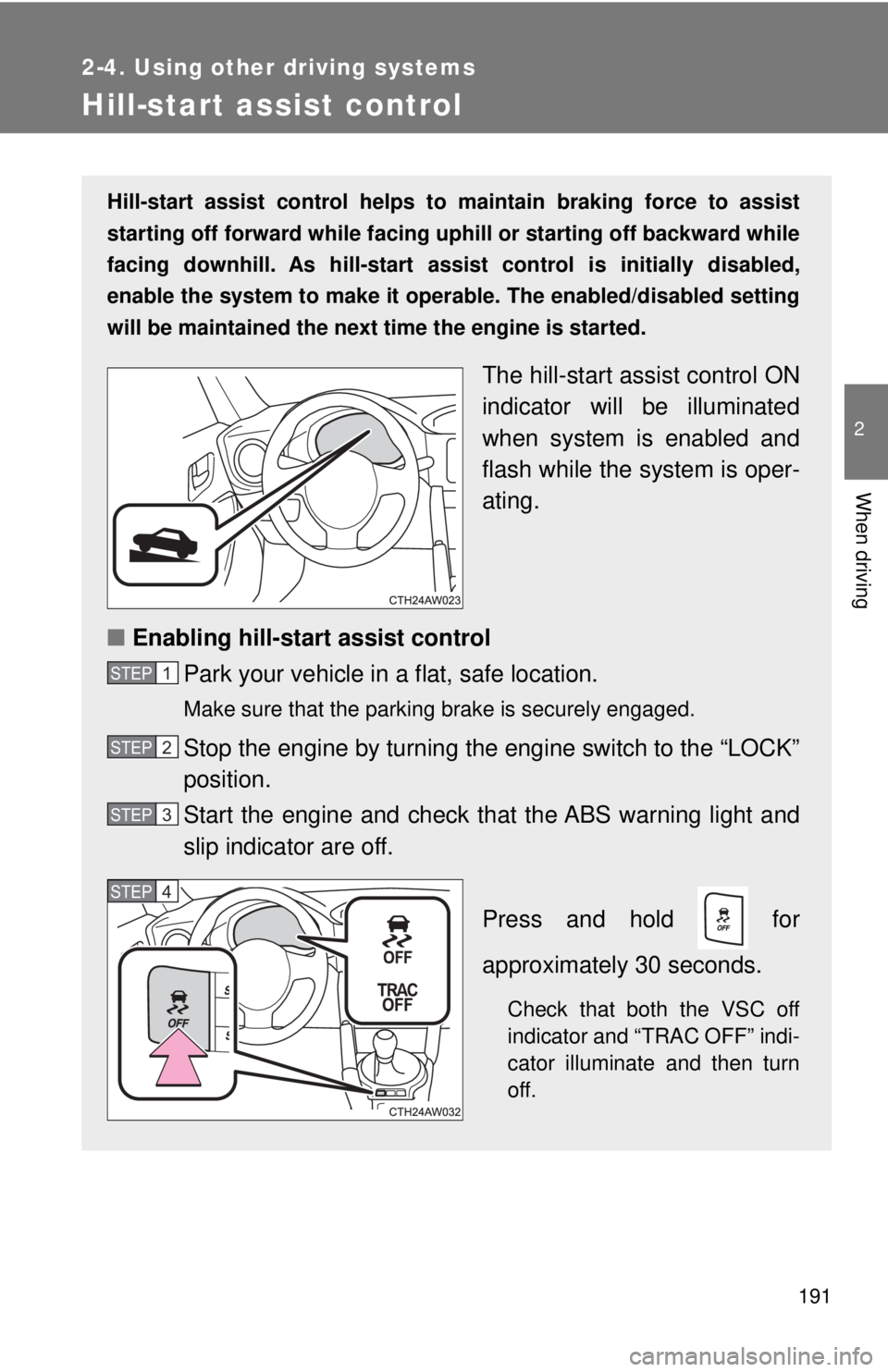
Hill-start assist control Hill-start assist control helps to maintain braking force to assist
starting off forward while facing uphill or starting off backward while
facing downhill. As hill-start assist control is initially disabled,
enable the system to make it op erable. The enabled/disabled setting
will be maintained the next time the engine is started.
The hill-start as sist control ON
indicator will be illuminated
when system is enabled and
flash while the system is oper-
ating.
■ Enabling hill-start assist control
Park your vehicle in a flat, safe location. Make sure that the parking brake is securely engaged.
Stop the engine by turning the engine switch to the “LOCK”
position.
Start the engine and check t hat the ABS warning light and
slip indicator are off.
Press and hold for
approximately 30 seconds.
Check that both the VSC off
indicator and “TRAC OFF” indi-
cator illuminate and then turn
off.STEP 1
STEP 2
STEP 3
STEP 4
Page 193 of 428

1932-4. Using other driving systems
2
When driving ■ Operating conditions of hill-start assist control
When the following conditions are met, the hill-start assist control will oper-
ate:
● Vehicles with an automatic transmission: The shift lever is in D or M
(when starting off forward on while facing uphill) or in R (when starting off
backward while facing downhill).
● Vehicles with a manual transmission: The shift lever is in a position other
than R (when starting off forward while facing uphill) or in R (when start-
ing off backward while facing downhill).
● The vehicle is stopped.
● The accelerator pedal is not depressed.
● The parking brake is not engaged.
■ Hill-start assist control will not operate when
Hill-start assist control will not operate when any of the following conditions
are met:
● Vehicles with an automatic transmission: The shift lever is in a position
other than D or M (when facing uphill) or in a position other than R (when
facing downhill).
● Vehicles with a manual transmission: The shift lever is in R (when facing
uphill) or in a position other than R (when facing downhill).
● Vehicles with an automatic transmission: The accelerator pedal is
depressed.
● The parking brake is applied.
● Vehicles with a manual transmission: The clutch is engaged.
● Approximately 2 seconds have elapsed since the brake pedal was
released.
● The hill-start assist control ON indicator is not illuminated.
● The engine switch is turned to the “ACC” or “LOCK” position.
Page 194 of 428

1942-4. Using other driving systems
■ Notes for hill-start assist control
● A slight jolt may be felt when starting off backward with the shift lever in R
and then moving forward.
● If the braking power of hill-start assist control is insufficient, depress the
brake pedal.
● While the vehicle is stopped, make sure to depress the brake pedal.
■ The system may be malfunctioning when
In the following situations, the system may be malfunctioning. Have the vehi-
cle inspected by your Toyota dealer.
● The slip indicator is illuminated.
● The hill-start assist control ON indicator turns off and a buzzer sounds.
WARNING■ Hill-start assist control precautions
● Do not overly rely on hill-start assist control. Hill-start assist control may
not operate effectively on steep inclines and roads covered with ice.
● Unlike the parking brake, hill-start assist control is not intended to hold the
vehicle stationary for an extended period of time. Do not attempt to use
hill-start assist control to hold the vehicle on an incline, as doing so may
lead to an accident.
● Do not stop the engine while hill-start assist control is operating, as hill-
start assist control will stop operating, possibly leading to an accident.
Page 256 of 428

2564-3. Do-it-yourself maintenance
WARNING■ When raising your vehicle
Make sure to observe the following precautions to reduce the possibility of
death or serious injury:
● When using a floor jack, follow the instructions of the manual provided with
the jack.
● Do not use the jack that was supplied with your vehicle.
● Do not put any part of your body underneath the vehicle when it is sup-
ported only by the floor jack.
● Always use floor jack and/or automotive jack stands on a solid, flat, level
surface.
● Do not start the engine while the vehicle is supported by the floor jack.
● Stop the vehicle on level, firm ground, firmly set the parking brake and shift
the shift lever to P (vehicles with an automatic transmission) or R (vehicles
with a manual transmission).
● Make sure to set the floor jack properly at the jack point.
Raising the vehicle with an improperly positioned floor jack will damage
the vehicle and may cause the vehicle to fall off the floor jack.
● Do not raise the vehicle while someone is in the vehicle.
● When raising the vehicle, do not place any object on top of or underneath
the floor jack.
● When raising the vehicle, ensure that there is sufficient surrounding space.
The vehicle’s position may change slightly when lowered. ● Lift up the vehicle using a floor jack
such as the one shown in the illustra-
tion.
Page 296 of 428
2964-3. Do-it-yourself maintenance
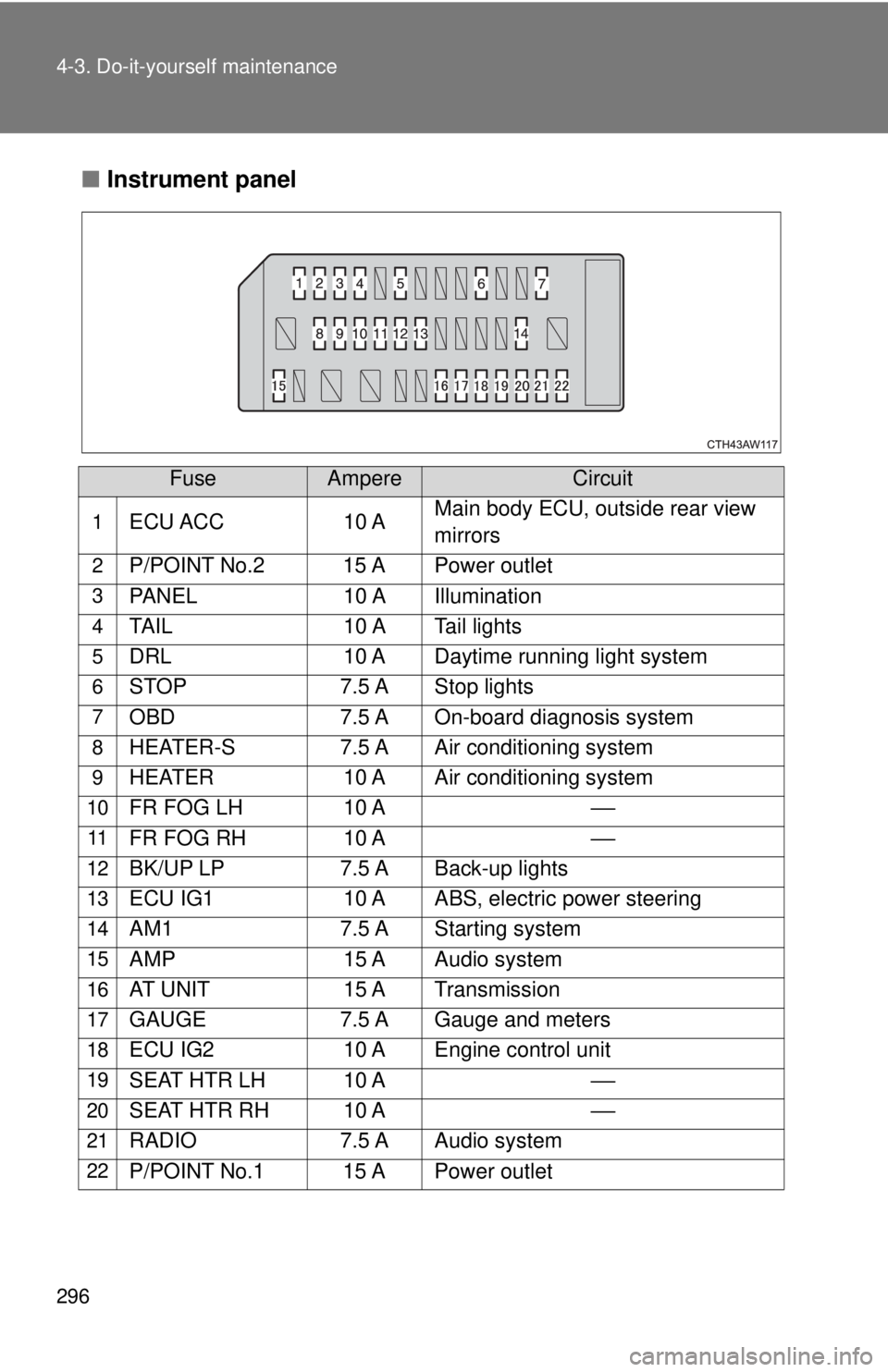
■ Instrument panel
Fuse Ampere Circuit1
ECU ACC 10 A Main body ECU, outside rear view
mirrors2
P/POINT No.2 15 A Power outlet3
PANEL 10 A Illumination4
TAIL 10 A Tail lights5
DRL 10 A Daytime running light system6
STOP 7.5 A Stop lights7
OBD 7.5 A On-board diagnosis system8
HEATER-S 7.5 A Air conditioning system9
HEATER 10 A Air conditioning system
10
FR FOG LH 10 A
⎯11
FR FOG RH 10 A
⎯12
BK/UP LP 7.5 A Back-up lights
13
ECU IG1 10 A ABS, electric power steering
14
AM1 7.5 A Starting system
15
AMP 15 A Audio system
16
AT UNIT 15 A Transmission
17
GAUGE 7.5 A Gauge and meters
18
ECU IG2 10 A Engine control unit
19
SEAT HTR LH 10 A
⎯
20
SEAT HTR RH 10 A
⎯
21
RADIO 7.5 A Audio system
22
P/POINT No.1 15 A Power outlet