Page 305 of 428
When trouble arises
5
3055-1. Essential information
Emergency flashers ......... 306
If your vehicle needs
to be towed .................... 307
If you think something
is wrong ......................... 315
Fuel pump shut off
system ........................... 316 5-2. Steps to take in an
emergency
If a warning light turns
on or a warning
buzzer sounds... ............ 317
If you have a flat tire......... 327
If the engine will not
start ................................ 338
If the shift lever cannot be
shifted from P................. 339
If you lose your keys ........ 340
If the battery is
discharged ..................... 341
If your vehicle
overheats ....................... 345
If the vehicle becomes
stuck .............................. 348
If your vehicle has to be
stopped in an
emergency ..................... 350
Page 316 of 428
3165-1. Essential information
Fuel pump shut off system Follow the procedure below to restar t the engine after the system is
activated.
Turn the engine switch to the “ACC” or “LOCK” position.
Restart the engine.
NOTICE■ Before starting the engine
Inspect the ground under the vehicle.
If you find that fuel has leaked on to the ground, the fuel system has been
damaged and is in need of repair. Do not restart the engine.When the vehicle sustains an impa ct in an accident, etc., the fuel
pump shut off system operates to stop supplying fuel in order to
minimize fuel leakage.STEP 1
STEP 2
Page 325 of 428

5
When trouble arises
3255-2. Steps to take in an emergency
WARNING■
Maintenance of the tires
Each tire, including the spare (if provided), should be checked monthly
when cold and inflated to the inflation pressure recommended by the
vehicle manufacturer on the vehicle placard or tire inflation pressure
label (tire and load information label). (If your vehicle has tires of a differ-
ent size than the size indicated on the vehicle placard or tire inflation
pressure label [tire and load information label], you should determine the
proper tire inflation pr essure for those tires.)
As an added safety feature, your vehicle has been equipped with a tire
pressure monitoring system (TPMS-ti re pressure warning system) that
illuminates a low tire pressure telltal e (tire pressure warning light) when
one or more of your tires is sign ificantly under-inflated. Accordingly,
when the low tire pressu re telltale (tire pressure warning light) illumi-
nates, you should stop and check your tires as soon as possible, and
inflate them to the proper pressure. Driving on a significantly under-
inflated tire causes the tire to overheat and can lead to tire failure.
Under-inflation also reduces fuel effi ciency and tire tread life, and may
affect the vehicle's handling and stopping ability.
Please note that the TPMS (tire pressure warning system) is not a sub-
stitute for proper ti re maintenance, an d it is the driver's responsibility to
maintain correct tire pressure, even if under-inflation has not reached the
level to trigger illumination of the TP MS low tire pressure telltale (tire
pressure warning light).
Your vehicle has also been equipped with a TPMS (tire pressure warning
system) malfunction indicator to indi cate when the system is not operat-
ing properly. The TPMS (tire pressure warning system) malfunction indi-
cator is combined with the low tire pressure telltale (tire pressure
warning light). When the system detects a malfunctio n, the telltale will
flash for approximately one minute an d then remain continuously illumi-
nated. This sequence will continue upon subsequent vehicle start-ups as
long as the malfunction exists. When the malfunction indicator is illumi-
nated, the system may not be able to detect or signal low tire pressure
as intended.
Page 346 of 428
3465-2. Steps to take in an emergency
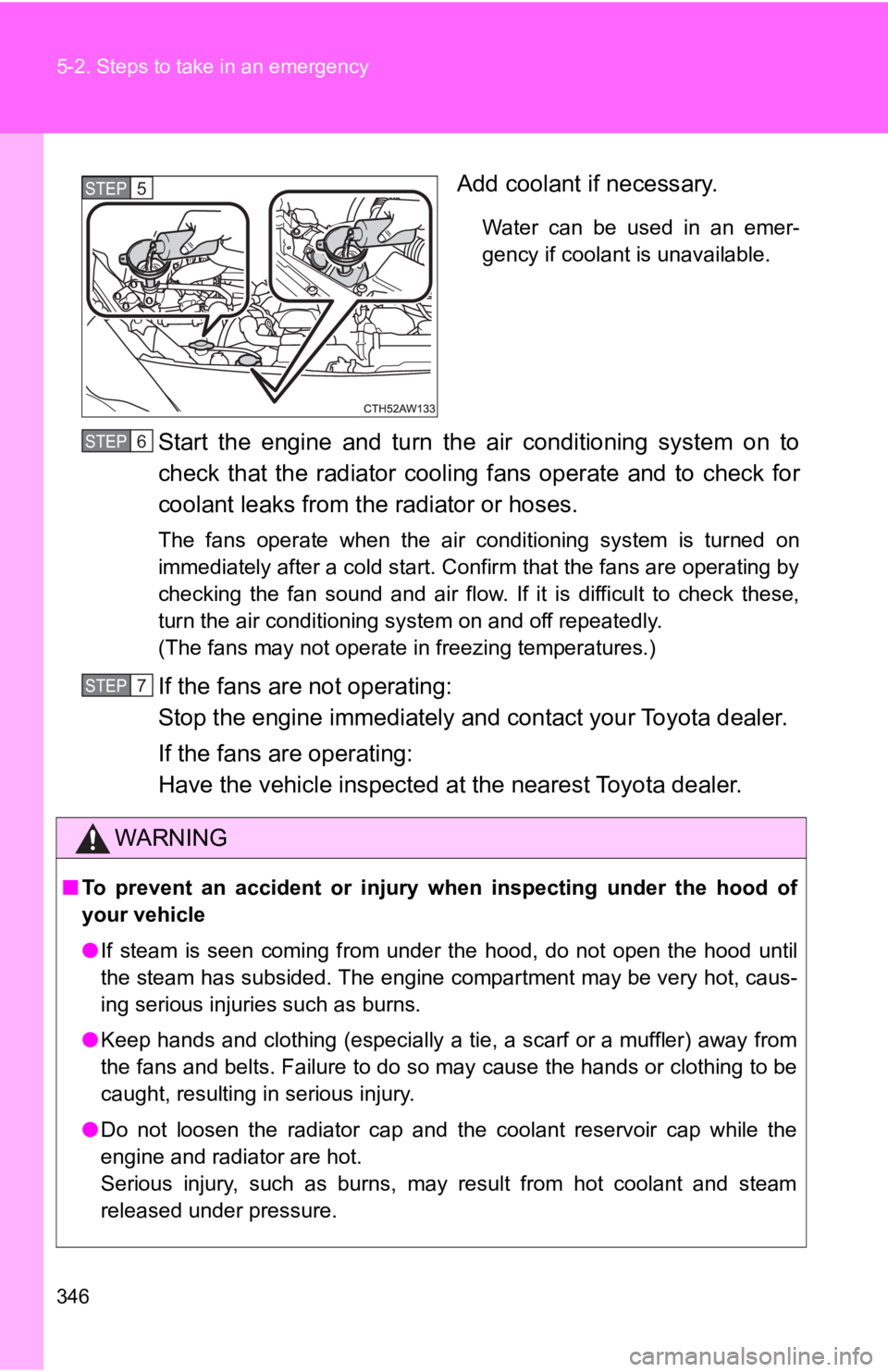
Add coolant if necessary. Water can be used in an emer-
gency if coolant is unavailable.
Start the engine and turn the air conditioning system on to
check that the radiator cooling fans operate and to check for
coolant leaks from the radiator or hoses. The fans operate when the air conditioning system is turned on
immediately after a cold start. Confirm that the fans are operating by
checking the fan sound and air flow. If it is difficult to check these,
turn the air conditioning system on and off repeatedly.
(The fans may not operate in freezing temperatures.)
If the fans are not operating:
Stop the engine immediately and contact your Toyota dealer.
If the fans are operating:
Have the vehicle inspected at the nearest Toyota dealer.STEP 5
WARNING■ To prevent an accident or injury when inspecting under the hood of
your vehicle
● If steam is seen coming from under the hood, do not open the hood until
the steam has subsided. The engine compartment may be very hot, caus-
ing serious injuries such as burns.
● Keep hands and clothing (especially a tie, a scarf or a muffler) away from
the fans and belts. Failure to do so may cause the hands or clothing to be
caught, resulting in serious injury.
● Do not loosen the radiator cap and the coolant reservoir cap while the
engine and radiator are hot.
Serious injury, such as burns, may result from hot coolant and steam
released under pressure. STEP 6
STEP 7
Page 348 of 428
3485-2. Steps to take in an emergency
If the vehicle becomes stuck
■ When it is difficult to free the vehicleCarry out the following procedures if the tires spin or the vehicle
becomes stuck in mud, dirt, or snow:
Stop the engine. Set the park ing brake and shift the shift
lever to P (vehicles with an automatic transmission) or N
(vehicles with a manual transmission).
Remove the mud, snow or sand from around the rear
wheels.
Place wood, stones or some other material under the rear
wheels to help provide traction.
Restart the engine.
Shift the shift lever to the D or R position (vehicles with an
automatic transmission) or 1 or R position (vehicles with a
manual transmission) and release the parking brake. Then,
while exercising caution, depress the accelerator pedal.STEP 1
STEP 2
STEP 3
STEP 4
STEP 5
Press to turn off TRAC.
Page 418 of 428

418Alphabetical index
Electric power steering ........... 184
Emergency flashers
Switch.................................... 306
Emergency, in case of
If the engine will not start ...... 338
If the shift lever cannot
be shifted from P................. 339
If the vehicle has a
discharged battery .............. 341
If the warning buzzer
sounds ................................ 317
If the warning light
turns on ............................... 317
If you have a flat tire ............. 327
If you lose your keys ............. 340
If you think something is
wrong .................................. 315
If your vehicle becomes
stuck ................................... 348
If your vehicle has to be
stopped in an
emergency .......................... 350
If your vehicle needs to
be towed ............................. 307
If your vehicle overheats ....... 345 Engine
Compartment ........................ 257
Engine switch ........................ 142
Hood ..................................... 253
How to start the engine ......... 142
Identification number............. 355
If the engine will not start ...... 338
Ignition switch ....................... 142
Overheating .......................... 345
Engine coolant
Capacity ................................ 360
Checking ............................... 261
Engine coolan t temperature
gauge ...................................... 158
Engine immobilizer system ...... 61
Engine oil
Capacity ................................ 358
Checking ............................... 258
Preparing and checking
before winter ....................... 200
Engine switch........................... 142
Engine switch light .................. 220
EPS............................................ 184
Event data recorder ................... 18E
Page:
< prev 1-8 9-16 17-24