2017 TOYOTA 86 oil pressure
[x] Cancel search: oil pressurePage 4 of 428

TABLE OF CONTENTS Index
44-3. Do-it-yourself
maintenance
Do-it-yourself service
precautions ...................... 250
Hood................................... 253
Positioning a floor jack ....... 255
Engine compartment .......... 257
Tires ................................... 270
Tire inflation pressure......... 277
Wheels ............................... 281
Air conditioning filter ........... 284
Wireless remote control
key battery ....................... 287
Checking and replacing
fuses ................................ 290
Light bulbs .......................... 298
5-1. Essential information
Emergency flashers ........... 306
If your vehicle needs to be
towed ............................... 307
If you think something is
wrong ............................... 315
Fuel pump shut off
system .............................. 316 5-2. Steps to take in an
emergency
If a warning light turns
on or a warning buzzer
sounds... .......................... 317
If you have a flat tire ........... 327
If the engine will not
start .................................. 338
If the shift lever cannot be
shifted from P ................... 339
If you lose your keys ........... 340
If the battery is
discharged ........................ 341
If your vehicle overheats..... 345
If the vehicle becomes
stuck ................................. 348
If your vehicle has to be
stopped in an
emergency........................ 350
6-1. Specifications
Maintenance data
(fuel, oil level, etc.) ........... 354
Fuel information .................. 366
Tire information................... 370
6-2. Customization
Customizable features ........ 3835
When trouble arises 6
Vehicle specifications
Page 261 of 428

2614-3. Do-it-yourself maintenance
4
Maintenance and care
Engine coolant
The coolant level is satisfactory if it is between the “FULL” and “LOW”
lines on the reservoir when the engine is cold.
Reservoir cap
“FULL”
“LOW” If the level is on or below the
“LOW” line, add coolant up to the
“FULL” line.NOTICE■ To prevent serious engine damage
Check the oil level on a regular basis.
■ When replacing the engine oil
● Be careful not to spill engine oil on the vehicle components.
● Avoid overfilling, or the engine could be damaged.
● Check the oil level on the dipstick every time you refill the vehicle.
● Be sure the engine oil filler cap is properly tightened.
■ If the coolant level drops within a short time after replenishing
Visually check the radiator, hoses, engine coolant filler cap, radiator cap,
drain cock and water pump.
If you cannot find a leak, have your Toyota dealer pressure test the cap and
check for leaks in the cooling system.
Page 282 of 428
2824-3. Do-it-yourself maintenance
■
When replacing wheels
The wheels of your Toyota are equipped with tire pressure warning
valves and transmitters that allow the tire pressure warning system to
provide advanced warning in the event of a loss in tire inflation pressure.
Whenever wheels are replaced, the tire pressure warning valves and
transmitters must be installed. ( → P. 271)
WARNING■
When replacing wheels ●
Do not use wheels that are a different size from those recommended in
the Owner’s Manual, as this may result in loss of handling control.●
Never use an inner tube in a leaking wheel which is designed for a
tubeless tire. Doing so may result in an accident, causing death or seri-
ous injury.
■
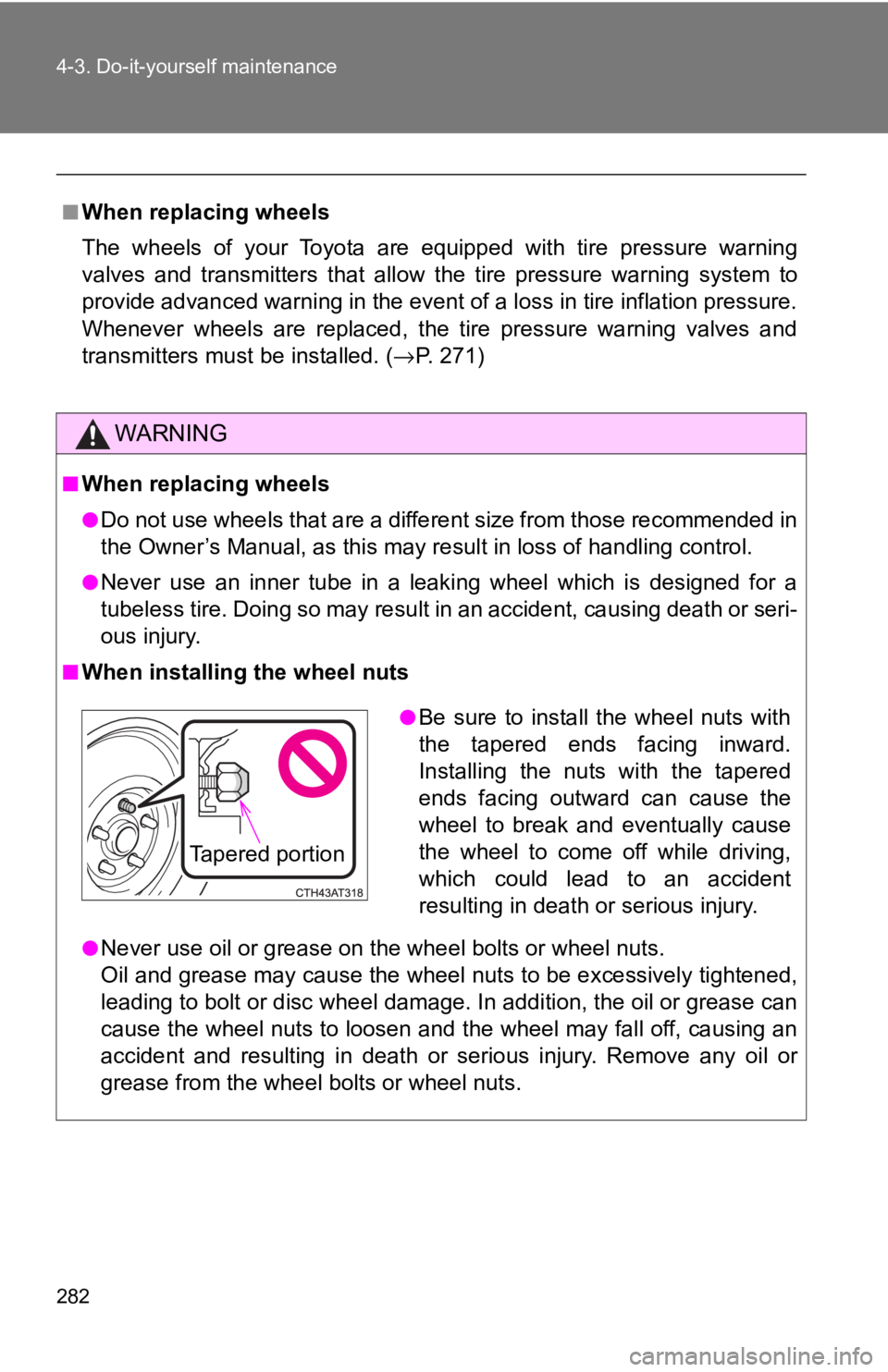
When installing the wheel nuts
●
Never use oil or grease on the wheel bolts or wheel nuts.
Oil and grease may cause the wheel nuts to be excessively tightened,
leading to bolt or disc wheel damage. In addition, the oil or grease can
cause the wheel nuts to loosen and the wheel may fall off, causing an
accident and resulting in death or serious injury. Remove any oil or
grease from the wheel bolts or wheel nuts. ●
Be sure to install the wheel nuts with
the tapered ends facing inward.
Installing the nuts with the tapered
ends facing outward can cause the
wheel to break and eventually cause
the wheel to come off while driving,
which could lead to an accident
resulting in death or serious injury.Tapered portion
Page 317 of 428

5
When trouble arises
3175-2. Steps to take in an emergency
If a warning light turns on or a warning buzzer sounds... Stop the vehicle immediately. Continuing to drive the vehicle
may be dangerous.
The following warning indicates a possible problem in the brake sys-
tem. Immediately stop the vehicl e in a safe place and contact your
Toyota dealer.
Stop the vehicle immediately.
The following warning indicates the possibility of damage to the vehi-
cle that may lead to an accident. Immediately stop the vehicle in a
safe place and contact your Toyota dealer. Warning light Warning light/Details
(U.S.A.)
(Canada) Brake system warning light
• Low brake fluid
• Malfunction in the brake system
This light also comes on when the parking brake is not
released. If the light turns off after the parking brake is fully
released the system is operating normally.
Warning light Warning light/Details
Charging system warning light
Indicates a malfunction in the vehicle’s charging system.
Low engine oil pressure warning light
Indicates that the engine oil pressure is too low.Calmly perform the following actions if any of the warning lights turn
on or flash. If a light turns on or flashes, but then tu rns off, this does
not necessarily indicate a malfunction in the system.
Page 376 of 428

3766-1. Specifications
Warning: The temperature grades of a tire assume that it is properly
inflated and not overloaded.
Excessive speed, underinflation, or excessive loading, either sepa-
rately or in combinatio n, can cause heat buildup and possible tire fail-
ure.
Glossary of tire terminology
Tire related term Meaning
Cold tire inflation
pressure Tire pressure when the vehicle has been
parked for three hours or more, or has not
been driven more than 1 mile or 1.5 km under
that condition
Maximum inflation
pressure The maximum cold inflated pressure to which a
tire may be inflated, s hown on the sidewall of
the tire
Recommended
inflation pressure Cold tire inflation pressure recommended by a
manufacturer.
Accessory weight The combined weight (in excess of those stan-
dard items which may be replaced) of auto-
matic transmission, power steering, power
brakes, power windows, power seats, radio
and heater, to the extent that these items are
available as factory-installed equipment
(whether installed or not)
Curb weight The weight of a motor vehicle with standard
equipment, including the maximum capacity of
fuel, oil and coolant, and if so equipped, air
conditioning and additional weight optional
engine
Maximum loaded
vehicle weight The sum of:
(a) Curb weight
(b) Accessory weight
(c) Vehicle capacity weight
(d) Production options weight
Page 424 of 428

424Alphabetical index
Warning buzzers
Electric power steering .......... 318
Seat belt reminder ................. 320
Warning lights
Automatic headlight
leveling system .... .......... ..... 318
Automatic transmission
fluid temperature
warning light........................ 320
Anti-lock brake
system ................................ 318
Brake assist system .............. 318
Brake system ........................ 317
Charging system .... .......... ..... 317
Cruise control
indicator light....................... 318
Electric power steering
system warning light ........... 318
Electronic engine control
system ................................ 318
Engine oil pressure ............... 317
Low fuel level ........................ 320
Low tire pressure................... 320 Malfunction indicator
lamp .................................... 318
Open door ............................. 320
Pretensioners ........................ 318
Seat belt reminder
light ..................................... 320
Slip indicator light .................. 318
SRS airbags .......................... 318
Tire pressure warning
system ................................ 320
Washer
Checking ............................... 268
Preparing and checking
before winter ....................... 200
Switch ................................... 176
Washing and waxing ............... 236
Weight
Cargo capacity ...................... 195
Load limits ............................. 199
Weight ................................... 354
Wheels ...................................... 281
Window glasses ........................ 54
Window lock switch................... 54
Windows
Power windows ....................... 54
Rear window defogger .......... 215
Washer.................................. 176
Windshield wipers ................... 176
Winter driving tips ................... 200
Wireless remote control key
Locking/Unlocking ................... 24
Replacing the battery ............ 287
Wireless remote control key.... 24W
Page 427 of 428

427What to do if...
■ Warning lights P. 318
or
P. 3 1 7 P. 318
P. 3 1 7 P. 318
P. 3 1 7 P. 320
P. 320
or
P. 3 1 8 P. 320
P. 3 1 8 P. 320
P. 320
or
P. 3 1 8 P. 320
P. 3 1 8
* : The light comes on in yellow to indicate a malfunction. Brake system warning
light Slip indicator
Automatic headlight leveling sys-
tem warning light
Charging system warn-
ing light Cruise control indicator
light
*Low engine oil pressure
warning light Open door warning light
Malfunction indicator
lamp Low fuel level warning
light
Driver’s seat belt
reminder light
SRS warning light Front passenger’s seat belt
reminder light
ABS warning light
Tire pressure warning
light
Automatic transmission fluid tem-
perature warning light
Electric power steering
warning light
Page 428 of 428

428 GAS STATION INFORMATION Auxiliary catch lever
P. 2 5 3Trunk opener
P. 3 0
Hood lock release lever
P. 253Fuel filler door
P. 5 7
Tire inflation pressure
P. 364 Fuel filler door opener
P. 5 7
Fuel tank capacity
(Reference) 13.2 gal. (50 L, 11.0 Imp. gal.)
Fuel type Unleaded gasoline only P. 58, 357
Cold tire inflation
pressure P. 3 6 4Engine oil capacity
(Drain and refill ⎯
reference) qt. (L, Imp. qt.)
Without filter 5.5 (5.2 ,
4.6 )
With filter 5.7 (5.4, 4.8)
Engine oil type P. 358