2017 SUZUKI SWIFT ron
[x] Cancel search: ronPage 43 of 336

2-24
BEFORE DRIVING
74LH0-74E
Ty p e 1
75J003
You can adjust the outside rearview mir-
rors by hand with the knob (1) located on
the driver’s or front passenger’s door
panel.
Ty p e 2
74LHT0207
The switch to control the electric mirrors is
located on the driver’s door panel. You can
adjust the mirrors when the ignition switch
is in the “ACC” or “ON” position, or the igni-
tion mode is “ACC” or “ON”. To adjust the
mirrors:1) Move the selector switch to the left or
right to select the mirror you wish to
adjust.
2) Press the outer part of the switch that
corresponds to the direction in which
you wish to move the mirror.
3) Return the selector switch to the center
position to help prevent unintended
adjustment.
Outside Rearview Mirrors Folding
Switch (if equipped)
79MH0218
You can fold the mirrors when you park the
vehicle in a narrow space. When the igni-
tion switch is in the “ACC” or “ON” position,
or the ignition mode is “ACC” or “ON”, push
the folding switch (1) to fold and unfold the
mirrors. Make sure the mirrors are com-
pletely unfolded before you start driving.
Heated Rear Window Switch
(if equipped)
74LHT0234
When the rear window is misted, push this
switch (1) to clear the window.
An indicator light will be lit when the defog-
ger is on. The defogger will work only
when the engine is running. To turn off the
defogger, push the switch (1) again.
(1)(1)
(4) (4)(2)(2)
(3)(3)
(1)
EXAMPLE
CAUTION
Moving mirrors can pinch and injure
a hand. Do not allow any one’s hand
to get near the mirrors when folding
and unfolding the mirrors.
NOTICE
The heated rear window uses a large
amount of electricity. Be sure to turn
off after the window has become
clear.
(1)
EXAMPLE
Seat Belts and Child Restraint Systems: 3
Page 44 of 336

2-25
BEFORE DRIVING
74LH0-74E
NOTE:
• The defogger will work only when the
engine is running.
• The defogger will automatically turn off
after the defogger remains on for 15 min-
utes to prevent discharging of the bat-
tery.
Front Seats
Seat AdjustmentAdjusting Seat Position
74LHT0208
The adjustment lever for each front seat is
located under the front of the seat. To
adjust the seat position, pull up on the
adjustment lever and slide the seat forward
or rearward.
After adjustment, try to move the seat for-
ward and rearward to ensure that it is
securely latched.
Seat Height Adjuster (if equipped)
74LHT0209
If the driver’s seat is equipped with a seat
height adjuster lever on the outboard side
of the seat, raise or lower the seat by pull-
ing up or down the adjuster lever.
Adjusting Seatbacks
74LHT0210
To adjust the seatback angle of front seats,
pull up the lever on the outboard side of
the seat, move the seatback to the desired
position, and release the lever to lock the
seatback in place.
WA R N I N G
Never attempt to adjust the driver’s
seat or seatback while driving. The
seat or seatback could move unex-
pectedly, causing loss of control.
Make sure that the driver’s seat and
seatback are properly adjusted
before you start driving.
WA R N I N G
To avoid excessive seat belt slack,
which reduces the effectiveness of
the seat belts as a safety device,
make sure that the seats are adjusted
before the seat belts are fastened.
NOTICE
Do not rest your feet on the seat
adjustment lever or push it down.
This may affect the performance of
the seat adjusters.
EXAMPLE
EXAMPLE
WA R N I N G
All seatbacks should always be in an
upright position when driving, or seat
belt effectiveness may be reduced.
Seat belts are designed to offer maxi-
mum protection when seatbacks are
in the upright position.
EXAMPLE
Seat Belts and Child Restraint Systems: 3
Page 45 of 336

2-26
BEFORE DRIVING
74LH0-74E
Adjustable Head Restraints
63J246
Head restraints are designed to help
reduce the risk of neck injuries in the case
of an accident. Adjust the head restraint to
the position which places the center of the
head restraint closest to the top of your
ears. If this is not possible for very tall pas-
sengers, adjust the head restraint as high
as possible.
NOTE:
It may be necessary to recline the seat-
back to provide enough overhead clear-
ance to remove the head restraint.Front
80JS082
To raise the front head restraint, pull
upward on the restraint until it clicks. To
lower the restraint, push down on the
restraint while holding in the lock lever. If a
head restraint must be removed (for clean-
ing, replacement, etc.), push in the lock
lever and pull the head restraint all the way
out.
Rear Seats
Adjustable Head Restraints
(if equipped)
Head restraints are designed to help
reduce the risk of neck injuries in the case
of an accident.NOTE:
It may be necessary to fold forward the
seatback to provide enough overhead
clearance to remove the head restraint.
Adjust the head restraint to the position
which places the center of the head
restraint closest to the top of your ears. If
this is not possible for very tall passengers,
adjust the head restraint as high as possi-
ble.
Rear (If equipped)
74LHT0211
To raise the rear head restraint, pull upward
on the restraint until it clicks. To lower the
restraint, push down on the restraint while
holding in the lock lever. If a head restraint
must be removed (for cleaning, replace-
ment, etc.), push in the lock lever and pull
the head restraint all the way out.
When installing a child restraint system,
raise the head restraint to the most upper
position.
WA R N I N G
• Never drive the vehicle with the
head restraints removed.
• Do not attempt to adjust the head
restraint while driving.
WA R N I N G
• Never drive the vehicle with the
head restraints removed.
• Do not attempt to adjust the head
restraint while driving.
EXAMPLE
EXAMPLE
Seat Belts and Child Restraint Systems: 3
Page 47 of 336

2-28
BEFORE DRIVING
74LH0-74E
76MH0A030
Raise the seatback(s) until it locks into
place.
After returning the seat(s), try moving the
seatback(s) to make sure they are securely
latched.
Seat Belts and Child Restraint
Systems
65D231S
CAUTION
Do not put your hand into the rear
seatback(s) lock opening, or your fin-
ger may get caught and be injured.
EXAMPLENOTICE
• When returning the rear seat-
back(s) to the normal position, do
not allow any foreign material to
enter the lock opening. This may
prevent the seatback(s) from being
locked securely.
• When returning the rear seat-
back(s) to the normal position, be
sure to handle it carefully by hand
to avoid any damage to the lock
itself. Do not push it by using some
material or by applying excessive
force.
• As the lock is designed exclusively
for securing the rear seatback(s),
do not use it for any other purpose.
Incorrect use of it may cause dam-
age to the inside of the lock and
prevent the seatback(s) from being
locked securely.
WA R N I N G
Wear Your Seat Belts at All Times.
WA R N I N G
An air bag supplements, or adds to,
the frontal crash protection offered
by seat belts. The driver and all pas-
sengers must be properly restrained
by wearing seat belts at all times,
whether or not an air bag is mounted
at their seating position, to minimize
the risk of severe injury or death in
the event of a crash.
Seat Belts and Child Restraint Systems: 3
Page 51 of 336

2-32
BEFORE DRIVING
74LH0-74E
NOTE:
The word “CENTER” is molded on the
buckle and latch plate of the center lap
belt. The buckles are designed so a latch
plate can not be inserted into the wrong
buckle.
Driver’s Seat Belt Reminder
(if equipped)
74LHT0214
When the driver does not buckle his or her
seat belt, the driver’s seat belt reminder
light in the instrument cluster will come on
or blink and a buzzer (if equipped) will
sound as a reminder to the driver to buckle
his or her seat belt. For more details, refer
to the explanation below.
If the driver’s seat belt remains unbuckled
when the ignition switch is turned to the
“ON” position or the engine switch is
pressed to change the ignition mode to
“ON”. The reminder works as follows:1) The driver’s seat belt reminder light will
come on.
2) After the vehicle’s speed has reached
about 15 km/h, the driver’s seat belt
reminder light will blink and a buzzer
(if equipped) will sound for about 95
seconds.
3) After step 2) has finished, the reminder
light will remain on until the driver’s seat
belt is buckled.
If the driver has buckled his or her seat belt
and later unbuckles the seat belt, the
reminder system will be activated from
step 1) or step 2) according to the vehicle’s
speed. When the vehicle’s speed is below
about 15 km/h, the reminder will start from
step 1). When the vehicle’s speed is above
about 15 km/h, the reminder will start from
step 2).
The reminder will be automatically can-
celed when the driver’s seat belt is buckled
or the ignition switch is turned off, or the
engine switch is pressed to change the
ignition mode to “LOCK” (OFF).
Shoulder Anchor Height Adjuster
(if equipped)
64J198
Adjust the shoulder anchor height so that
the shoulder belt rides on the center of the
outboard shoulder. To upward, slide the
anchor up by pushing through the Sash
guide. To downward, slide the anchor
down while pulling the lock knob out. After
adjustment, make sure that the anchor is
securely locked.
EXAMPLE
WA R N I N G
It is absolutely essential that the
driver and passengers wear their seat
belts at all times. Persons who are
not wearing seat belts have a much
greater risk of injury if an accident
occurs. Make a regular habit of buck-
ling your seat belt before putting the
key in the ignition.
WA R N I N G
Be sure that the shoulder belt is posi-
tioned on the center of the outside
shoulder. The belt should be away
from your face and neck, but not fall-
ing off your shoulder. Misadjustment
of the belt could reduce the effective-
ness of the safety belt in a crash.
EXAMPLE
Sash guide
Page 52 of 336
2-33
BEFORE DRIVING
74LH0-74E
Seat Belt Hanger (if equipped)
74LHT0212
Seat Belt Inspection
65D209S
Periodically inspect the seat belts to make
sure they work properly and are not dam-
aged. Check the webbing, buckles, latch
plates, retractors, anchorages, and guide
loops. Replace any seat belts which do not
work properly or are damaged.
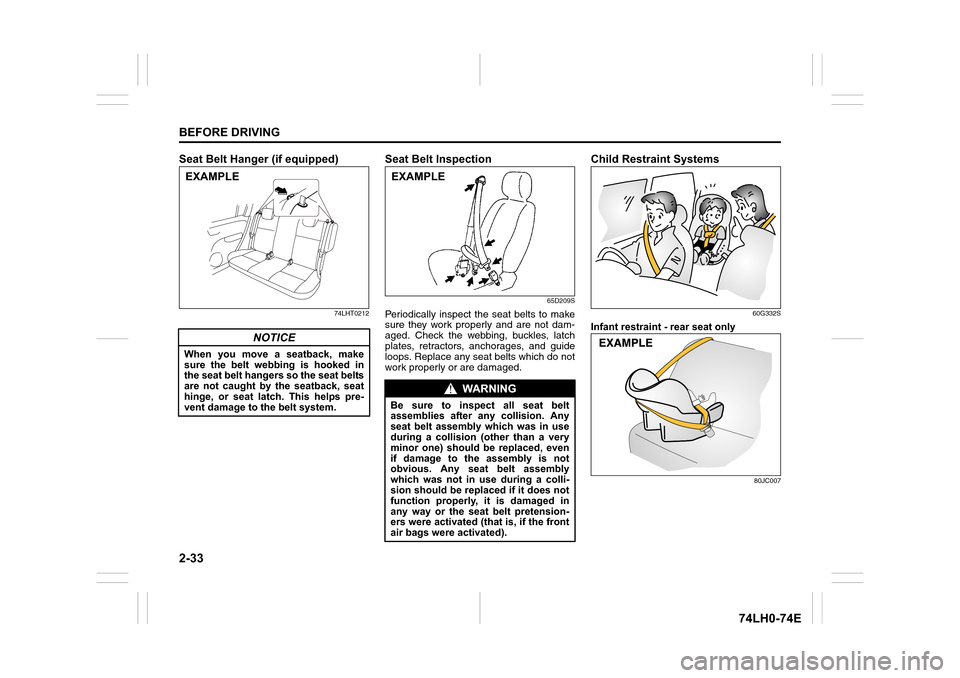
Child Restraint Systems
60G332S
Infant restraint - rear seat only
80JC007
NOTICE
When you move a seatback, make
sure the belt webbing is hooked in
the seat belt hangers so the seat belts
are not caught by the seatback, seat
hinge, or seat latch. This helps pre-
vent damage to the belt system.
EXAMPLE
WA R N I N G
Be sure to inspect all seat belt
assemblies after any collision. Any
seat belt assembly which was in use
during a collision (other than a very
minor one) should be replaced, even
if damage to the assembly is not
obvious. Any seat belt assembly
which was not in use during a colli-
sion should be replaced if it does not
function properly, it is damaged in
any way or the seat belt pretension-
ers were activated (that is, if the front
air bags were activated).
EXAMPLE
Page 53 of 336

2-34
BEFORE DRIVING
74LH0-74E
Child restraint
80JC016
Booster seat
80JC008
MARUTI SUZUKI highly recommends that
you use a child restraint system to restrain
infants and small children. Many different
types of child restraint systems are avail-
able; make sure that the restraint system
you select meets applicable safety stan-
dards.
All child restraint systems are designed to
be secured in vehicle seats by either seat
belts (lap belts or the lap portion of lap-
shoulder belts). Whenever possible, MAR-
UTI SUZUKI recommends that child
restraint systems be installed on the rear
seat. According to accident statistics, chil-
dren are safer when properly restrained in
rear seating positions than in front seating
positions.
If you must use a front-facing child restraint
in the front passenger’s seat, adjust the
passenger’s seat as far back as possible.
NOTE:
Observe any statutory regulation about
child restraints.
65D60765D608
WA R N I N G
If your vehicle is equipped with a
front passenger air bag, do not install
a rear-facing child restraint in the
front passenger’s seat. If the passen-
ger’s air bag inflates, a child in a rear-
facing child restraint could be killed
or seriously injured. The back of a
rear-facing child restraint would be
too close to the inflating air bag.
WA R N I N G
If you install a child restraint system
in the rear seat, slide the front seat
for enough forward so that the child’s
feet do not contact the front seat-
back. This will help avoid injury to
the child in the event of an accident.
Page 54 of 336

2-35
BEFORE DRIVING
74LH0-74E
65D609
Installation with Lap-Shoulder Seat
Belts
ELR type belt
65D233
Install your child restraint system accord-
ing to the instructions provided by the child
restraint system manufacturer.
Make sure that the seat belt is securely
latched.
Try to move the child restraint system in all
directions to make sure it is securely
installed.
Seat Belt Pretensioner System
(if equipped)
63J269
To determine if your vehicle is equipped
with a seat belt pretensioner system at the
front seating positions, check the label on
the front seat belt at the bottom part. If the
letters “p” and/or “PRE” appear as illus-
trated, your vehicle is equipped with the
seat belt pretensioner system. You can use
the pretensioner seat belts in the same
manner as ordinary seat belts.
WA R N I N G
Children could be endangered in a
crash if their child restraint systems
are not properly secured in the vehi-
cle. Be sure to secure the child in the
restraint system according to the
manufacturer’s instructions.
NOTICE
Before installing a child restraint sys-
tem in the rear seat, raise the head
restraint (if equipped) to the most
upper position.
WA R N I N G
This section of the owner’s manual
describes your MARUTI SUZUKI’s
SEAT BELT PRETENSIONER SYS-
TEM. Please read and follow ALL
these instructions carefully to mini-
mize your risk of severe injury or
death.
and/or
Label
EXAMPLE