Page 580 of 634

Specifications..................................................... 12-2Dimensions........................................................ 12-2
Engine ............................................................... 12-3
Fuel ................................................................... 12-3
Engine oil .......................................................... 12-4
Manual transmission, front differential and rear differential gear oil ........................................... 12-7
Fluids ................................................................ 12-9
Engine coolant ................................................... 12-9
Electrical system .............................................. 12-10
Tires ................................................................ 12-10 Temporary spare tires
...................................... 12-10
Brake disc ....................................................... 12-11Fuses and circuits ........................................... 12-12Fuse panel located in the passenger
compartment ................................................. 12-12
Fuse panel located in the engine compartment ................................................. 12-14
Bulb chart......................................................... 12-16
Vehicle identification ....................................... 12-19
Specifications
12
Page 583 of 634
Specifications/Specifications
&Engine oil
For the checking, adding and replacing procedure or other details, refer to “Engine oil ”F 11-10.
NOTEThe procedure for changing the engine oil and oil filter should be performed by a properly-trained expert. It is recommended
that you have this service performed by your SUBARU dealer.
! Approved engine oil
We recommend that you always use the SUBARU approved engine oil. For further details, please contact your SUBARU dealer.
If the approved engine oil is unavailable, use the alternative engine oil described on the next page.
12-4
Page 584 of 634
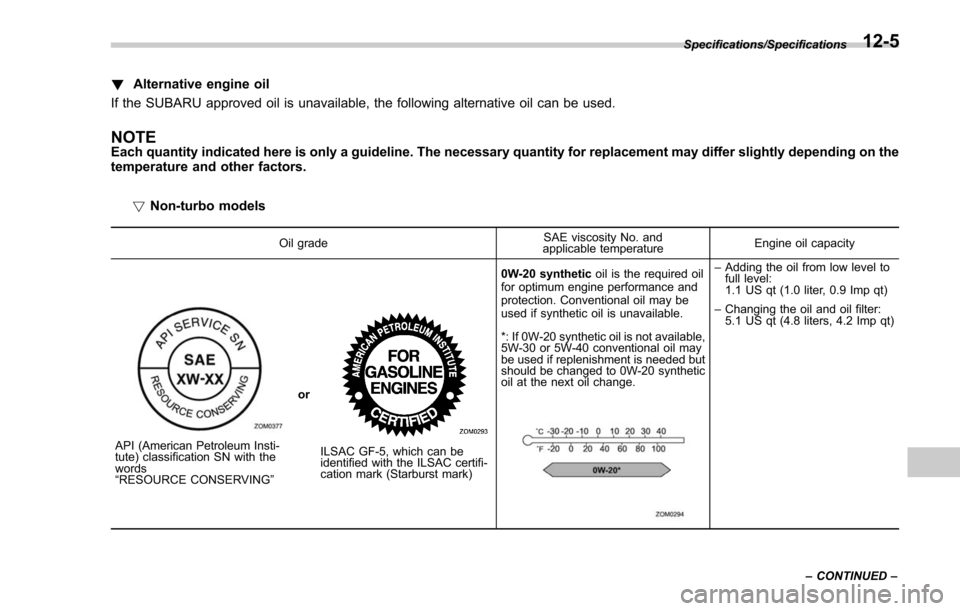
!Alternative engine oil
If the SUBARU approved oil is unavailable, the following alternative oil can be used.
NOTEEach quantity indicated here is only a guideline. The necessary quantity for replacement may differ slightly depending on the
temperature and other factors.
!Non-turbo models
Oil grade SAE viscosity No. and
applicable temperature Engine oil capacity
API (American Petroleum Insti-
tute) classification SN with the
words
“
RESOURCE CONSERVING ”orILSAC GF-5, which can be
identified with the ILSAC certifi-
cation mark (Starburst mark) 0W-20 synthetic
oil is the required oil
for optimum engine performance and
protection. Conventional oil may be
used if synthetic oil is unavailable.
*: If 0W-20 synthetic oil is not available,
5W-30 or 5W-40 conventional oil may
be used if replenishment is needed but
should be changed to 0W-20 synthetic
oil at the next oil change.
– Adding the oil from low level to
full level:
1.1 US qt (1.0 liter, 0.9 Imp qt)
– Changing the oil and oil filter:
5.1 US qt (4.8 liters, 4.2 Imp qt)
Specifications/Specifications
–CONTINUED –
12-5
Page 585 of 634
Specifications/Specifications
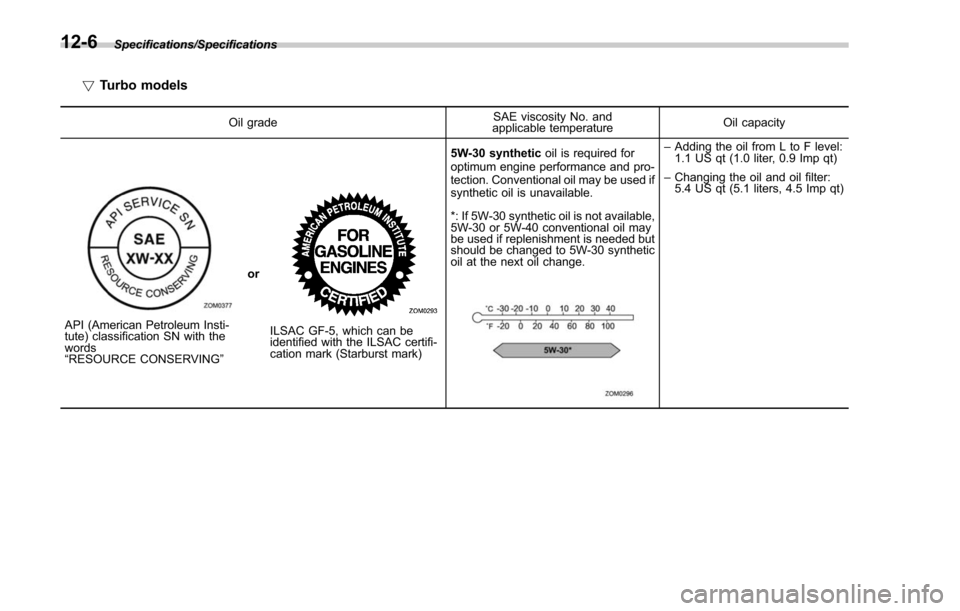
!Turbo models
Oil grade SAE viscosity No. and
applicable temperature Oil capacity
API (American Petroleum Insti-
tute) classification SN with the
words
“
RESOURCE CONSERVING ”orILSAC GF-5, which can be
identified with the ILSAC certifi-
cation mark (Starburst mark) 5W-30 synthetic
oil is required for
optimum engine performance and pro-
tection. Conventional oil may be used if
synthetic oil is unavailable.
*: If 5W-30 synthetic oil is not available,
5W-30 or 5W-40 conventional oil may
be used if replenishment is needed but
should be changed to 5W-30 synthetic
oil at the next oil change.
– Adding the oil from L to F level:
1.1 US qt (1.0 liter, 0.9 Imp qt)
– Changing the oil and oil filter:
5.4 US qt (5.1 liters, 4.5 Imp qt)
12-6
Page 586 of 634
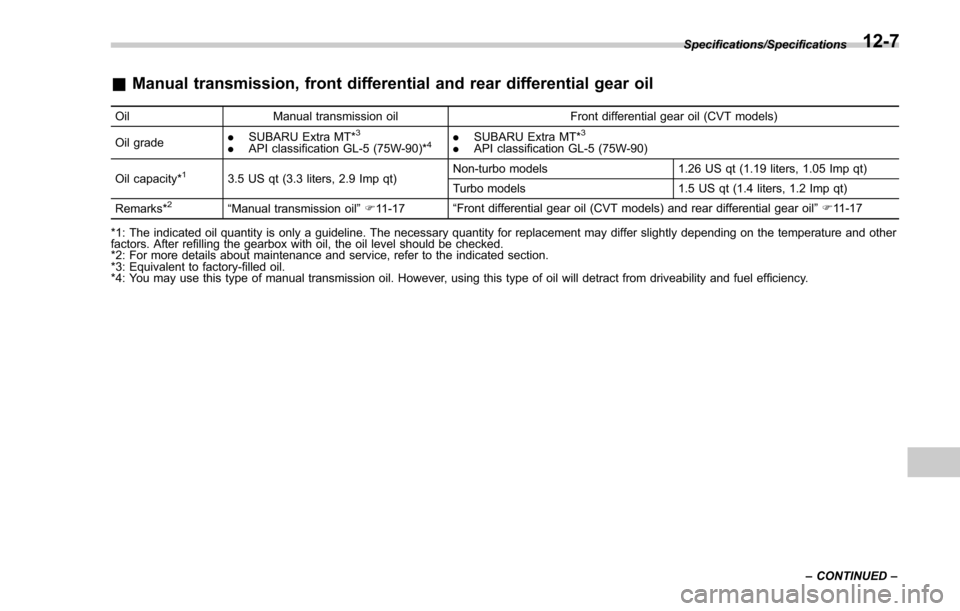
&Manual transmission, front differential and rear differential gear oil
Oil Manual transmission oil Front differential gear oil (CVT models)
Oil grade .
SUBARU Extra MT*3
.API classification GL-5 (75W-90)*4.SUBARU Extra MT*3
.API classification GL-5 (75W-90)
Oil capacity*
13.5 US qt (3.3 liters, 2.9 Imp qt) Non-turbo models 1.26 US qt (1.19 liters, 1.05 Imp qt)
Turbo models 1.5 US qt (1.4 liters, 1.2 Imp qt)
Remarks*
2“ Manual transmission oil ”F 11-17 “
Front differential gear oil (CVT models) and rear differential gear oil ”F 11-17
*1: The indicated oil quantity is only a guideline. The necessary quantity for replacement may differ slightly depending on the temperature and other
factors. After refilling the gearbox with oil, the oil level should be checked.
*2: For more details about maintenance and service, refer to the indicated section.
*3: Equivalent to factory-filled oil.
*4: You may use this type of manual transmission oil. However, using this type of oil will detract from driveability and fuel efficiency. Specifications/Specifications
–CONTINUED –
12-7
Page 587 of 634
Specifications/Specifications
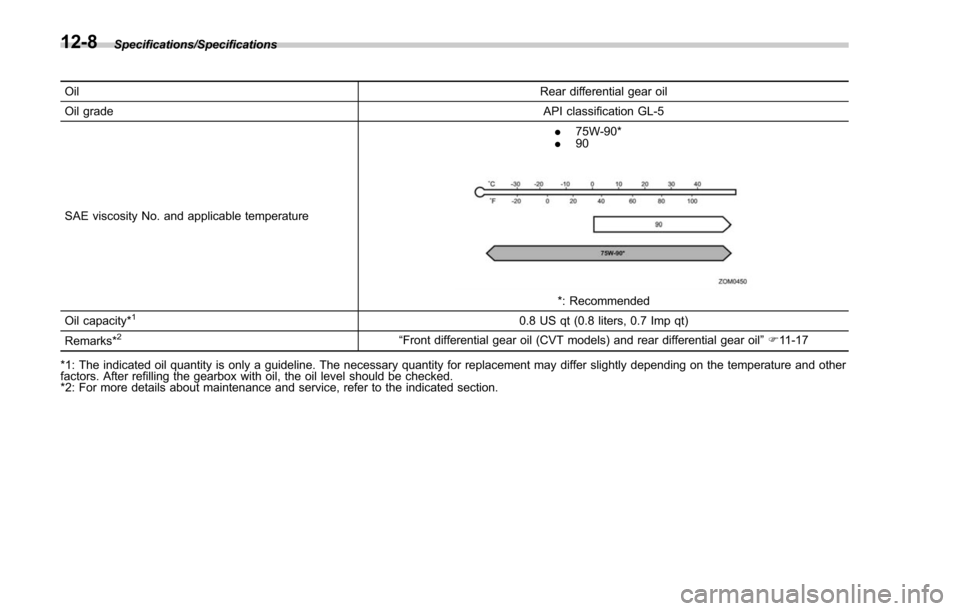
OilRear differential gear oil
Oil grade API classification GL-5
SAE viscosity No. and applicable temperature .
75W-90*
. 90
*: Recommended
Oil capacity*10.8 US qt (0.8 liters, 0.7 Imp qt)
Remarks*2“ Front differential gear oil (CVT models) and rear differential gear oil ”F 11-17
*1: The indicated oil quantity is only a guideline. The necessary quantity for replacement may differ slightly depending on the temperature and other
factors. After refilling the gearbox with oil, the oil level should be checked.
*2: For more details about maintenance and service, refer to the indicated section.
12-8
Page 592 of 634
Fuse
panel Fuse
rating Circuit
15 10A .Luggage light
. Keyless unit
16 7.5A .Illumination
17 15A .Seat heaters
18 10A .Backup light
19 7.5A .Wiper relay
20 10A .Accessory power outlet
(instrument panel)
21 10A .Starter relay
22 7.5A .Air conditioner
. Rear window defogger
relay coil
23 Empty
24 10A .Audio unit
. Navigation system (if
equipped)
25 15A .SRS airbag system
26 Empty
27 15A .Blower fan
28 15A .Blower fan
29 15A .Fog light
30 Empty Fuse
panel Fuse
rating Circuit
31 7.5A .Auto air conditioner unit
. Integrated unit
32 7.5A .Clutch switch
. Steering lock control
unit
33 7.5A .Vehicle Dynamics Con-
trol unit Specifications/Fuses and circuits
–CONTINUED –
12-13
Page 604 of 634

crease in temperature could cause
tread separation, and failure of the
tire(s). Possible resulting loss of
vehicle control could lead to an
accident.
!Measuring and adjusting air
pressure to achieve proper in-
flation
Check and, if necessary, adjust the
pressure of each tire (including the
spare) at least once a month and
before any long journey. Check the
tire pressures when the tires are
cold. Use a pressure gauge to
adjust the tire pressures to the
specific values. Driving even a
short distance warms up the tires
and increases the tire pressures.
Also, the tire pressures are affected
by the outside temperature. It is
best to check tire pressure out-
doors before driving the vehicle.
When a tire becomes warm, the air
inside it expands, causing the tire
pressure to increase. Be careful not
to mistakenly release air from a
warm tire to reduce its pressure.
&Glossary of tire terminology
.Accessory weight
The combined weight (in excess of
those standard items which may be
replaced) of automatic transmis-
sion, power steering, power brakes,
power windows, power seats, radio,
and heater, to the extent that these
items are available as factory-in-
stalled equipment (whether in-
stalled or not).
.Bead
The part of the tire that is made of
steel wires, wrapped or reinforced
by ply cords and that is shaped to fit
the rim.
.Bead separation
A breakdown of the bond between
components in the bead.
.Bias ply tire
A pneumatic tire in which the ply
cords that extend to the beads are
laid at alternate angles substantially
less than 90 degrees to the center-
line of the tread.
.Carcass
The tire structure, except tread and sidewall rubber which, when in-
flated, bears the load.
.Chunking
The breaking away of pieces of the
tread or sidewall.
.Cold tire pressure
The pressure in a tire that has been
driven less than 1 mile or has been
standing for three hours or more.
.Cord
The strands forming the plies in the
tire.
.Cord separation
The parting of cords from adjacent
rubber compounds.
.Cracking
Any parting within the tread, side-
wall, or inner liner of the tire
extending to cord material.
.Curb weight
The weight of a motor vehicle with
standard equipment including the
maximum capacity of fuel, oil and
coolant, and if so equipped, air
conditioning and additional weight
optional engine.
Consumer information and Reporting safety defects/Tire information
–CONTINUED –13-5