2017 SUBARU FORESTER cruise control
[x] Cancel search: cruise controlPage 405 of 634

Starting and operating
Vehicle Dynamics Control OFF switch................. 7-41
X-mode (if equipped).......................................... 7-42To activate/deactivate the X-mode ....................... 7-43
Hill descent control function ............................... 7-44
Tire pressure monitoring system (TPMS)
(U.S.-spec. models) ......................................... 7-46
Parking your vehicle .......................................... 7-47
Parking brake..................................................... 7-47
Parking tips ....................................................... 7-48
Hill start assist system ...................................... 7-49To activate/deactivate the Hill start assist
system ............................................................. 7-50
Hill start assist warning light/Hill start assist OFF indicator light ................................................... 7-52
Cruise control (if equipped). .............................. 7-53To set cruise control.......................................... 7-53
To temporarily cancel the cruise control ............. 7-55
To turn off the cruise control .............................. 7-55
To change the cruising speed ............................. 7-55
Cruise control indicator light .............................. 7-57
Cruise control set indicator light ......................... 7-57
BSD/RCTA (if equipped).................................... 7-58System features................................................. 7-58
System operation ............................................... 7-60
BSD/RCTA approach indicator light/warning buzzer ............................................................. 7-61
BSD/RCTA warning indicator .............................. 7-63
BSD/RCTA OFF switch ....................................... 7-64
Certification for the BSD/RCTA ........................... 7-65
Handling of radar sensors .................................. 7-65
Reverse Automatic Braking System (if
equipped) ........................................................ 7-66
Reverse Automatic Braking System overview .....7-67
Operating conditions ......................................... 7-67
Reverse Automatic Braking System operation ......................................................... 7-69
Canceling the Reverse Automatic Braking system operation ......................................................... 7-72
Reverse Automatic Braking system ON/OFF setting ............................................................. 7-72
RAB warning indicator ....................................... 7-73
Handling of the sonar sensors ........................... 7-73
Page 456 of 634

Cruise control (if equipped)
NOTE
For models with the EyeSight system:
Refer to the Owner’s Manual supple-
ment for the EyeSight system.
Cruise control enables you to maintain a
constant vehicle speed without holding
your foot on the accelerator pedal and it is
operative when the vehicle speed is 25
mph (40 km/h) or more.
WARNING
Do not use the cruise control under
any of the following conditions.
These may cause loss of vehicle
control.
. driving up or down a steep grade
. driving on slippery or winding
roads
. driving in heavy traffic
. towing a trailer
NOTE
.On uphill and downhill slopes, de-
pending on the degree of the slope and
the load of the vehicle, there may be
cases when a constant speed cannot
be guaranteed.
. If the cruise control indicator light
does not illuminate even after pressing
the cruise control main button, it is
possible that there is a malfunction in
the system. We recommend that you
contact your SUBARU dealer for an
inspection.
. Make sure the cruise control system
is turned off when the cruise control is
not in use to avoid unintentionally
setting the cruise control.& To set cruise control
Cruise control main button
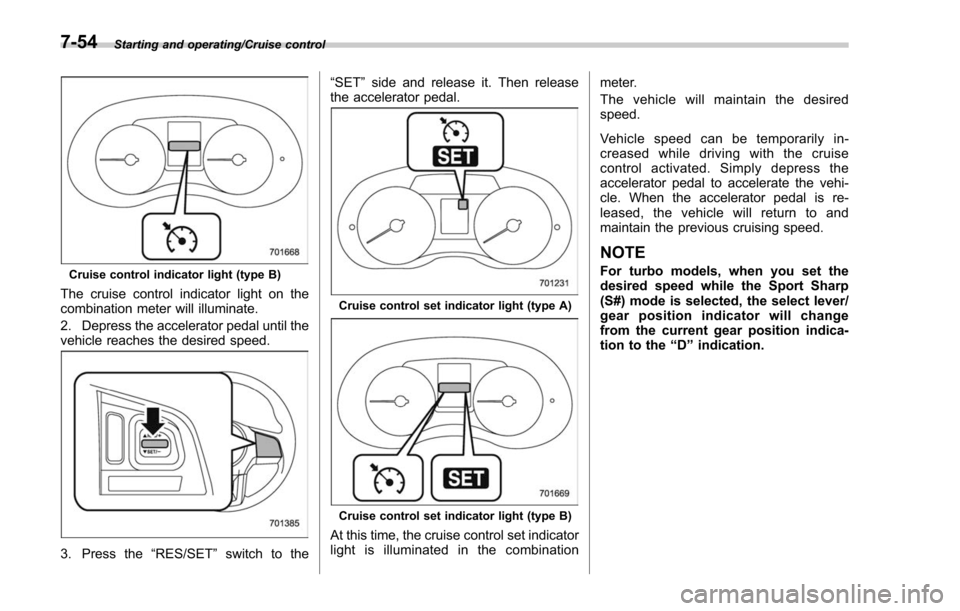
1. Press the cruise control main button.
Cruise control indicator light (type A)
Starting and operating/Cruise control
–CONTINUED –
7-53
Page 457 of 634
Starting and operating/Cruise control
Cruise control indicator light (type B)
The cruise control indicator light on the
combination meter will illuminate.
2. Depress the accelerator pedal until the
vehicle reaches the desired speed.
3. Press the“RES/SET”switch to the “SET
”side and release it. Then release
the accelerator pedal.
Cruise control set indicator light (type A)
Cruise control set indicator light (type B)
At this time, the cruise control set indicator
light is illuminated in the combination meter.
The vehicle will maintain the desired
speed.
Vehicle speed can be temporarily in-
creased while driving with the cruise
control activated. Simp
ly depress the
accelerator pedal to accelerate the vehi-
cle. When the accelerator pedal is re-
leased, the vehicle will return to and
maintain the previous cruising speed.
NOTE
For turbo models, when you set the
desired speed while the Sport Sharp
(S#) mode is selected, the select lever/
gear position indicator will change
from the current gear position indica-
tion to the “D”indication.
7-54
Page 458 of 634
&To temporarily cancel the
cruise control
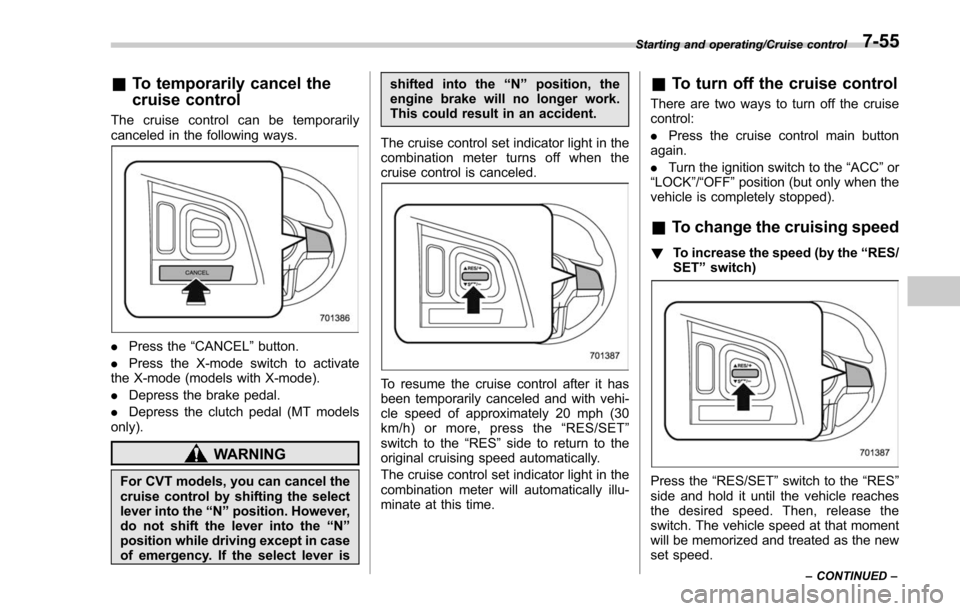
The cruise control can be temporarily
canceled in the following ways.
. Press the “CANCEL”button.
. Press the X-mode switch to activate
the X-mode (models with X-mode).
. Depress the brake pedal.
. Depress the clutch pedal (MT models
only).
WARNING
For CVT models, you can cancel the
cruise control by shifting the select
lever into the “N ” position. However,
do not shift the lever into the “N ”
position while driving except in case
of emergency. If the select lever is shifted into the
“N ” position, the
engine brake will no longer work.
This could result in an accident.
The cruise control set indicator light in the
combination meter turns off when the
cruise control is canceled.
To resume the cruise control after it has
been temporarily canceled and with vehi-
cle speed of approximately 20 mph (30
km/h) or more, press the “RES/SET ”
switch to the “RES ”side to return to the
original cruising speed automatically.
The cruise control set indicator light in the
combination meter will automatically illu-
minate at this time.
& To turn off the cruise control
There are two ways to turn off the cruise
control:
. Press the cruise control main button
again.
. Turn the ignition switch to the “ACC”or
“ LOCK ”/“OFF ”position (but only when the
vehicle is completely stopped).
& To change the cruising speed
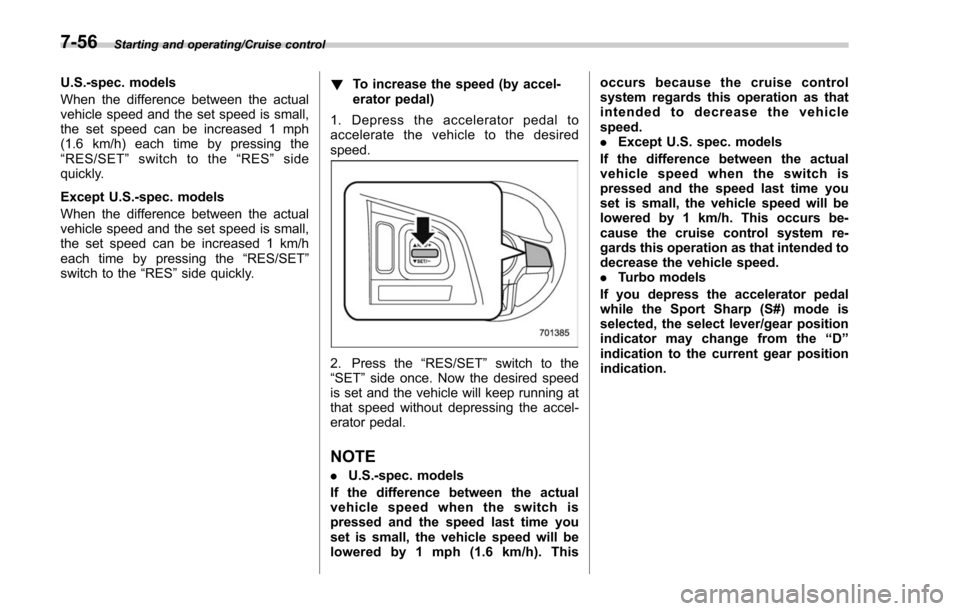
! To increase the speed (by the “RES/
SET ”switch)
Press the “RES/SET ”switch to the “RES”
side and hold it until the vehicle reaches
the desired speed. Then, release the
switch. The vehicle speed at that moment
will be memorized and treated as the new
set speed.
Starting and operating/Cruise control
–CONTINUED –7-55
Page 459 of 634
Starting and operating/Cruise control
U.S.-spec. models
When the difference between the actual
vehicle speed and the set speed is small,
the set speed can be increased 1 mph
(1.6 km/h) each time by pressing the
“RES/SET ”switch to the “RES ”side
quickly.
Except U.S.-spec. models
When the difference between the actual
vehicle speed and the set speed is small,
the set speed can be increased 1 km/h
each time by pressing the “RES/SET”
switch to the “RES”side quickly. !
To increase the speed (by accel-
erator pedal)
1. Depress the accelerator pedal to
accelerate the vehicle to the desired
speed.
2. Press the “RES/SET”switch to the
“SET ”side once. Now the desired speed
is set and the vehicle will keep running at
that speed without depressing the accel-
erator pedal.
NOTE
. U.S.-spec. models
If the difference between the actual
vehicle speed when the switch is
pressed and the speed last time you
set is small, the vehicle speed will be
lowered by 1 mph (1.6 km/h). This occurs because the cruise control
system regards this operation as that
intended to decrease the vehicle
speed.
.
Except U.S. spec. models
If the difference between the actual
vehicle speed when the switch is
pressed and the speed last time you
set is small, the vehicle speed will be
lowered by 1 km/h. This occurs be-
cause the cruise control system re-
gards this operation as that intended to
decrease the vehicle speed.
. Turbo models
If you depress the accelerator pedal
while the Sport Sharp (S#) mode is
selected, the select lever/gear position
indicator may change from the “D ”
indication to the current gear position
indication.
7-56
Page 460 of 634
!To decrease the speed (by the
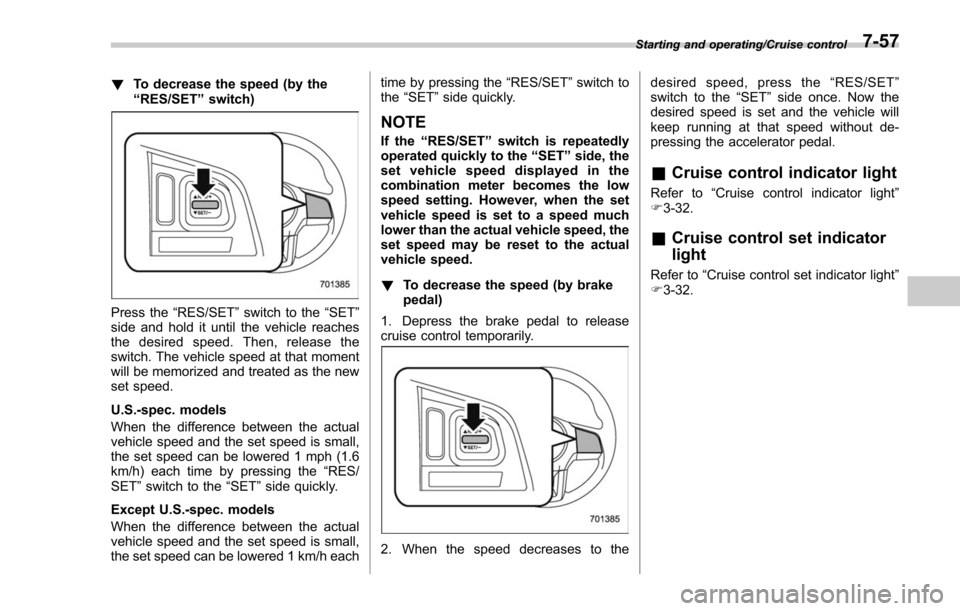
“RES/SET ”switch)
Press the “RES/SET”switch to the “SET”
side and hold it until the vehicle reaches
the desired speed. Then, release the
switch. The vehicle speed at that moment
will be memorized and treated as the new
set speed.
U.S.-spec. models
When the difference between the actual
vehicle speed and the set speed is small,
the set speed can be lowered 1 mph (1.6
km/h) each time by pressing the “RES/
SET ”switch to the “SET”side quickly.
Except U.S.-spec. models
When the difference between the actual
vehicle speed and the set speed is small,
the set speed can be lowered 1 km/h each time by pressing the
“RES/SET”switch to
the “SET ”side quickly.
NOTE
If the “RES/SET ”switch is repeatedly
operated quickly to the “SET ”side, the
set vehicle speed displayed in the
combination meter becomes the low
speed setting. However, when the set
vehicle speed is set to a speed much
lower than the actual vehicle speed, the
set speed may be reset to the actual
vehicle speed.
! To decrease the speed (by brake
pedal)
1. Depress the brake pedal to release
cruise control temporarily.
2. When the speed decreases to the desired speed, press the
“RES/SET ”
switch to the “SET”side once. Now the
desired speed is set and the vehicle will
keep running at that speed without de-
pressing the accelerator pedal.
& Cruise control indicator light
Refer to “Cruise control indicator light ”
F 3-32.
& Cruise control set indicator
light
Refer to “Cruise control set indicator light ”
F 3-32.
Starting and operating/Cruise control7-57
Page 487 of 634
Driving tips/Winter driving
frost or snow etc. on the power rear
gate, remove it. If you forcibly
operate the power rear gate with
frost or snow, it may cause a mal-
function.
&Driving on snowy and icy
roads
To prevent skidding and slipping, avoid
sudden braking, abrupt acceleration, high-
speed driving, and sharp turning when
driving on snowy or icy roads.
Always maintain ample distance between
your vehicle and the vehicle ahead of you
to avoid the need for sudden braking.
To supplement the foot brake, use the
engine brake effectively to control the
vehicle speed. (Shift into a lower gear
when necessary.)
Avoid shifting down abruptly. Such beha-
vior can cause the wheels to lock, possibly
leading to loss of vehicle control.
An anti-lock brake system (ABS) en-
hances your vehicle’ s braking perfor-
mance on snowy and icy roads. For
information on braking on slippery sur-
faces, refer to “ABS (Anti-lock Brake
System) ”F 7-37 and “Vehicle Dynamics
Control system ”F 7-39.
WARNING
Do not use the cruise control on
slippery roads such as snowy or icy
roads. This may cause loss of
vehicle control.
CAUTION
Avoid prolonged continuous driving
in snowstorms. Snow will enter the
engine ’sintakesystemandmay
hinder the airflow, which could re-
sult in engine shutdown or even
breakdown.
! Wiper operation when snowing
Before driving in cold weather, make sure
the wiper blades are not frozen to the
windshield or rear window.
If the wiper blades are frozen to the
windshield or rear window, perform the
following procedure.
. To thaw the windshield wiper blades,
use the defroster with the airflow selection
in “
”and the temperature set for
maximum warmth until the wiper blades
are completely thawed. Refer to “Climate
control ”F 4-1.
. If your vehicle is equipped with a wiper deicer, use it. It is helpful to thaw the
windshield wiper blades. Refer to
“Defog-
ger and deicer ”F 3-116.
. To thaw the rear wiper blade, use the
rear window defogger. Refer to “Defogger
and deicer ”F 3-116.
When driving in snow, if frozen snow starts
to stick on the surface of the windshield
despite wiper operation, use the defroster
with the airflow selection in “
”and the
temperature set for maximum warmth.
After the windshield gets warmed enough
to melt the frozen snow on it, wash it away
using the windshield washer. Refer to
“Windshield washer ”F 3-106.
Snow stuck on the wiper arm prevents the
wiper from working effectively. If snow is
stuck on the wiper arm, pull off the road to
a safe place, then remove it. If you stop
the vehicle at road side, use the hazard
warning flasher to alert other drivers.
Refer to “Hazard warning flasher ”F 3-8.
We recommend use of non-freezing type
wiper blades (winter blades) during the
seasons you could have snow and freez-
ing temperatures. Blades of this type give
superior wiping performance in snowy
conditions. Be sure to use blades that
are suitable for your vehicle.
8-10
Page 619 of 634

14-4Index
Seatbelt................................................................ 3-14
Cigarette lighter ......................................................... 6-11
Cleaning
Aluminum wheels ................................................... 10-3
Interior .................................................................. 10-5
Ventilation grille ..................................................... 4-12
Climate control system ................................................. 4-3
Automatic ................................................................ 4-7
Manual ................................................................... 4-8
Clock ........................................................ 3-38, 3-59, 3-73
Clutch Fluid ............................................................ 11-19, 12-9
Pedal .................................................................. 11-21
Compass ....................................................... 3- 108, 3-109
Continuously variable transmission (CVT) ..................... 7-24
Fluid ............................................................ 11-17, 12-9
Coolant ............................................................ 11-13, 12-9
Temperature high warning light ................................ 3-17
Temperature low indicator light. ................................ 3-17
Cooling system ......................................................... 11-12
Corrosion protection ................................................... 10-4
Cruise control ............................................................ 7-53
Indicator light ......................................................... 3-32
Set indicator light ................................................... 3-32
Cup holder .................................................................. 6-7
Front passenger ’s .................................................... 6-7
Rear passenger ’s..................................................... 6-8
D
Daytime running light system ....................................... 3-98
Defogger .................................................................. 3-116 Defrosting
.................................................................. 4-11
Deicer ..................................................................... 3-116
Differential gear oil
Front ........................................................... 11-17, 12-7
Rear ........................................................... 11-17, 12-7
Dimensions ................................................................ 12-2
Disarming the alarm system ......................................... 2-29
Disc brake pad wear warning indicators ........................ 7-36
Dome light .................................................................. 6-2
Door Locks ..................................................................... 2-5
Open warning light. ................................................. 3-23
Double trip meter ........................................................ 3-10
Drive belts ............................................................... 11-16
Driving All-Wheel Drive warning light ................................... 3-23
AWD models ........................................................... 8-5
Car phone/cell phone .................................................. 7
Drinking. .................................................................... 6
Drugs ........................................................................\
6
Foreign countries ..................................................... 8-4
Pets ........................................................................\
.. 7
Snowy and icy roads ..............................................
8-10
Tips ................................................. 7-24, 7-31, 8-2, 8-5
Tired or sleepy ........................................................... 6
Winter .................................................................... 8-8
E
ECO gauge ............................................................... 3-12
Electrical system ...................................................... 12-10
Electronic Brake Force Distribution (EBD) system ........... 7-38