Page 573 of 634
Maintenance and service/Replacing bulbs
Front turn signal light (models with LED
headlight)
Front side marker light and parking light
(models with halogen headlight)
1) Front side marker light
2) Parking light
Front side marker light (models with LED
headlight)
1) Front side marker light
2. Turn the socket counterclockwise and
pull it out.
3. Pull out the bulb from the socket and
replace the bulb with a new one.
4. To install the socket to the headlight
assembly, turn it clockwise until it clicks.
5. Install the electrical connector to the
clip.
&Front fog light (if equipped)
It may be difficult to replace the bulbs.
Have the bulbs replaced by your SUBARU
dealer if necessary.
&Rear combination lights
NOTE
The stop light is an LED (Light Emitting
Diode) type. Consult your SUBARU
dealer for replacement.
1. Using a Phillips screwdriver, remove
the upper and lower screws that secure
the rear combination light assembly.
11-42
Page 575 of 634
Maintenance and service/Replacing key battery
7. Tighten the upper and lower screws.
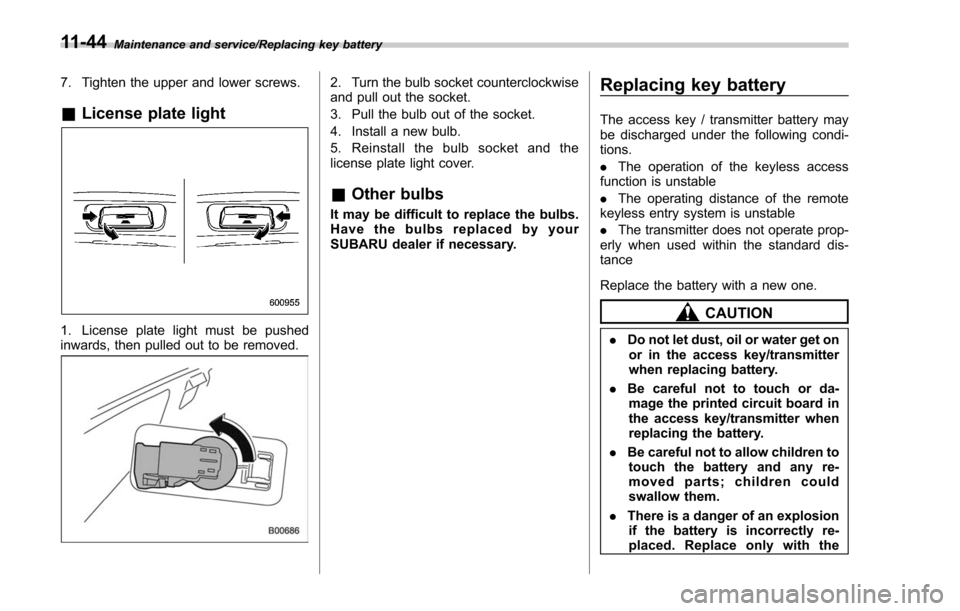
&License plate light
1. License plate light must be pushed
inwards, then pulled out to be removed.
2. Turn the bulb socket counterclockwise
and pull out the socket.
3. Pull the bulb out of the socket.
4. Install a new bulb.
5. Reinstall the bulb socket and the
license plate light cover.
&Other bulbs
It may be difficult to replace the bulbs.
Have the bulbs replaced by your
SUBARU dealer if necessary.
Replacing key battery
The access key / transmitter battery may
be discharged under the following condi-
tions.
. The operation of the keyless access
function is unstable
. The operating distance of the remote
keyless entry system is unstable
. The transmitter does not operate prop-
erly when used within the standard dis-
tance
Replace the battery with a new one.
CAUTION
. Do not let dust, oil or water get on
or in the access key/transmitter
when replacing battery.
. Be careful not to touch or da-
mage the printed circuit board in
the access key/transmitter when
replacing the battery.
. Be careful not to allow children to
touch the battery and any re-
moved parts; children could
swallow them.
. There is a danger of an explosion
if the battery is incorrectly re-
placed. Replace only with the
11-44
Page 582 of 634
&Engine
Engine model
FB25
(2.5 L, DOHC, non-turbo) FA20
(2.0 L, DOHC, turbo)
Engine type Horizontally opposed, liquid cooled 4 cylinder, 4-stroke petrol engine
Displacement cu-in (cc) 152 (2,498) 122 (1,998)
Bore 6Stroke in (mm) 3.70 63.54 (94.0 690.0) 3.39 63.39 (86.0 686.0)
Compression ratio 10.3 : 1 10.6 : 1
Firing order 1
–3 –2–4
& Fuel
Model Fuel Fuel tank capacity
Non-turbo models Unleaded gasolinewith87 AKI (90 RON) or higher
15.9 US gal (60 liters, 13.2 Imp gal)
Turbo models Unleaded gasolinewith91 AKI (95 RON) or higher
For more details, refer to “Fuel ”F 7-3. Specifications/Specifications
–CONTINUED –
12-3
Page 586 of 634
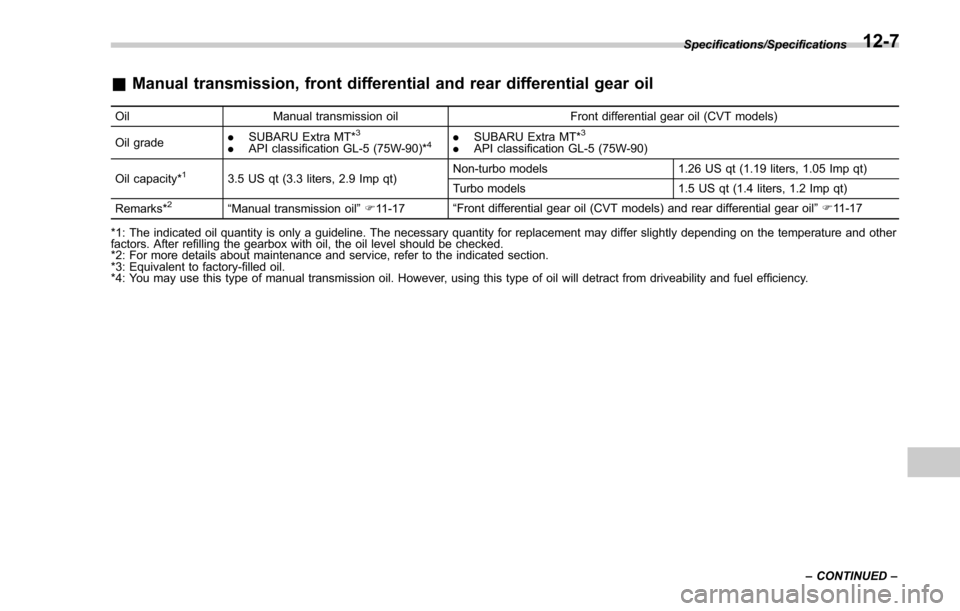
&Manual transmission, front differential and rear differential gear oil
Oil Manual transmission oil Front differential gear oil (CVT models)
Oil grade .
SUBARU Extra MT*3
.API classification GL-5 (75W-90)*4.SUBARU Extra MT*3
.API classification GL-5 (75W-90)
Oil capacity*
13.5 US qt (3.3 liters, 2.9 Imp qt) Non-turbo models 1.26 US qt (1.19 liters, 1.05 Imp qt)
Turbo models 1.5 US qt (1.4 liters, 1.2 Imp qt)
Remarks*
2“ Manual transmission oil ”F 11-17 “
Front differential gear oil (CVT models) and rear differential gear oil ”F 11-17
*1: The indicated oil quantity is only a guideline. The necessary quantity for replacement may differ slightly depending on the temperature and other
factors. After refilling the gearbox with oil, the oil level should be checked.
*2: For more details about maintenance and service, refer to the indicated section.
*3: Equivalent to factory-filled oil.
*4: You may use this type of manual transmission oil. However, using this type of oil will detract from driveability and fuel efficiency. Specifications/Specifications
–CONTINUED –
12-7
Page 595 of 634
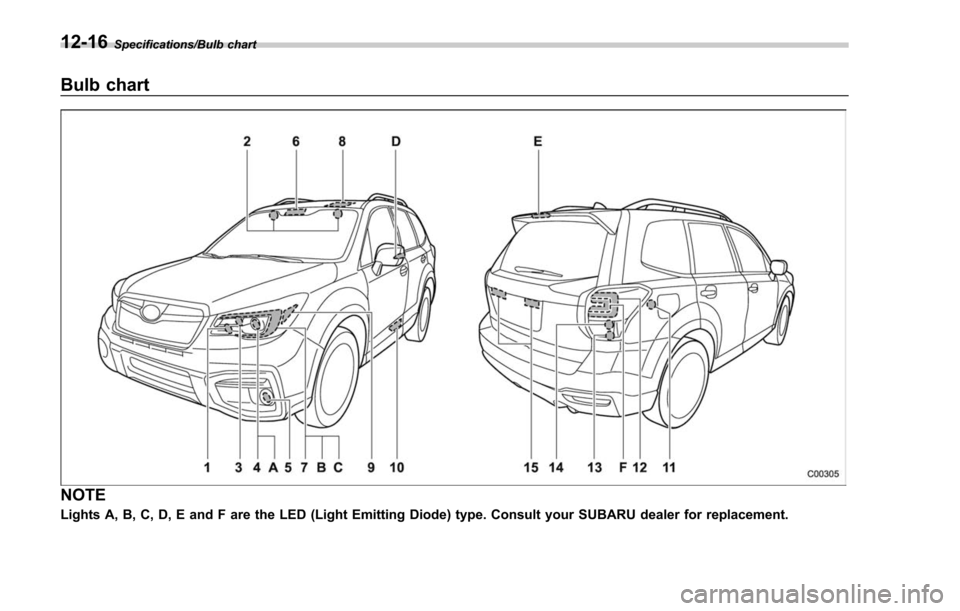
Specifications/Bulb chart
Bulb chart
NOTE
Lights A, B, C, D, E and F are the LED (Light Emitting Diode) type. Consult your SUBARU dealer for replacement.
12-16
Page 597 of 634
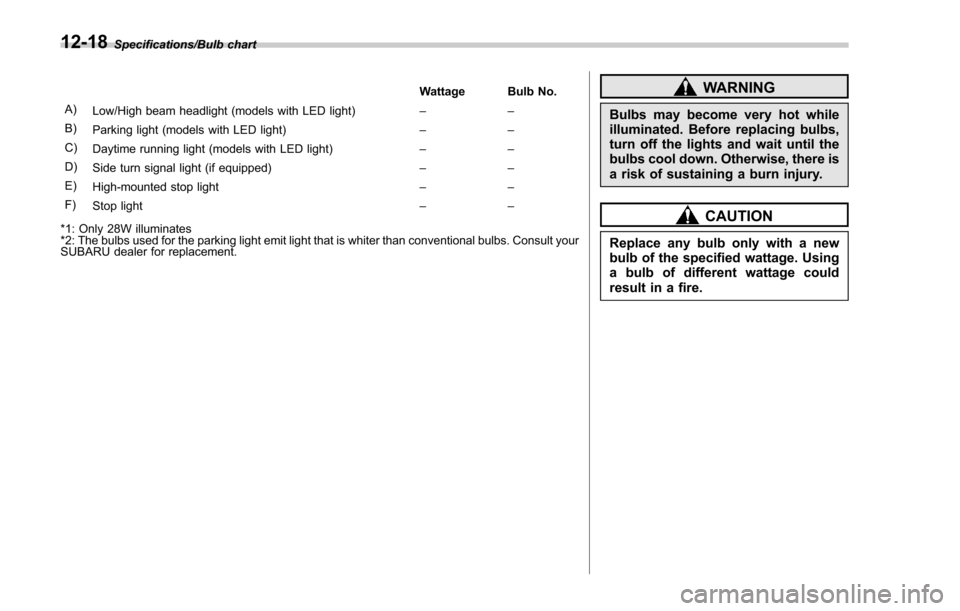
Specifications/Bulb chart
Wattage Bulb No.
A) Low/High beam headlight (models with LED light) ––
B) Parking light (models with LED light) ––
C) Daytime running light (models with LED light) ––
D) Side turn signal light (if equipped) ––
E) High-mounted stop light ––
F) Stop light ––
*1: Only 28W illuminates
*2: The bulbs used for the parking light emit light that is whiter than conventional bulbs. Consult your
SUBARU dealer for replacement.WARNING
Bulbs may become very hot while
illuminated. Before replacing bulbs,
turn off the lights and wait until the
bulbs cool down. Otherwise, there is
a risk of sustaining a burn injury.
CAUTION
Replace any bulb only with a new
bulb of the specified wattage. Using
a bulb of different wattage could
result in a fire.
12-18
Page 601 of 634
Consumer information and Reporting safety defects/For U.S.A.
For U.S.A.
The following information has been
compiled according to Code of
Federal Regulations“Title 49, Part
575 ”.
Tire information
& Tire labeling
Many markings (e.g. Tire size, Tire
Identification Number or TIN) are
placed on the sidewall of a tire by
tire manufacturers. These markings
can provide you with useful infor-
mation on the tire.
! Tire size
Your vehicle comes equipped with
P-Metric tire size. It is important to
understand the sizing system in
selecting the proper tire for your
vehicles. Here is a brief review of
the tire sizing system with a break-
down of its individual elements.
!P Metric
With the P-Metric system, Section
Width is measured in millimeters.
To convert millimeters into inches,
divide by 25.4. The Aspect Ratio
(Section Height divided by Section
Width) helps provide more dimen-
sional information about the tire
size.
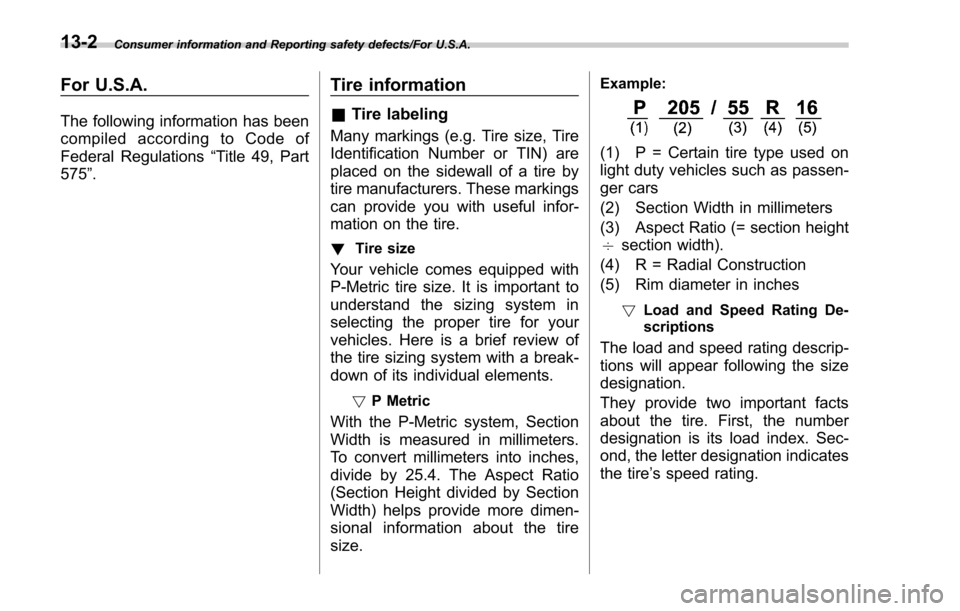
Example:
(1) P = Certain tire type used on
light duty vehicles such as passen-
ger cars
(2) Section Width in millimeters
(3) Aspect Ratio (= section height
7 section width).
(4) R = Radial Construction
(5) Rim diameter in inches
! Load and Speed Rating De-
scriptions
The load and speed rating descrip-
tions will appear following the size
designation.
They provide two important facts
about the tire. First, the number
designation is its load index. Sec-
ond, the letter designation indicates
the tire’ s speed rating.
13-2
Page 604 of 634

crease in temperature could cause
tread separation, and failure of the
tire(s). Possible resulting loss of
vehicle control could lead to an
accident.
!Measuring and adjusting air
pressure to achieve proper in-
flation
Check and, if necessary, adjust the
pressure of each tire (including the
spare) at least once a month and
before any long journey. Check the
tire pressures when the tires are
cold. Use a pressure gauge to
adjust the tire pressures to the
specific values. Driving even a
short distance warms up the tires
and increases the tire pressures.
Also, the tire pressures are affected
by the outside temperature. It is
best to check tire pressure out-
doors before driving the vehicle.
When a tire becomes warm, the air
inside it expands, causing the tire
pressure to increase. Be careful not
to mistakenly release air from a
warm tire to reduce its pressure.
&Glossary of tire terminology
.Accessory weight
The combined weight (in excess of
those standard items which may be
replaced) of automatic transmis-
sion, power steering, power brakes,
power windows, power seats, radio,
and heater, to the extent that these
items are available as factory-in-
stalled equipment (whether in-
stalled or not).
.Bead
The part of the tire that is made of
steel wires, wrapped or reinforced
by ply cords and that is shaped to fit
the rim.
.Bead separation
A breakdown of the bond between
components in the bead.
.Bias ply tire
A pneumatic tire in which the ply
cords that extend to the beads are
laid at alternate angles substantially
less than 90 degrees to the center-
line of the tread.
.Carcass
The tire structure, except tread and sidewall rubber which, when in-
flated, bears the load.
.Chunking
The breaking away of pieces of the
tread or sidewall.
.Cold tire pressure
The pressure in a tire that has been
driven less than 1 mile or has been
standing for three hours or more.
.Cord
The strands forming the plies in the
tire.
.Cord separation
The parting of cords from adjacent
rubber compounds.
.Cracking
Any parting within the tread, side-
wall, or inner liner of the tire
extending to cord material.
.Curb weight
The weight of a motor vehicle with
standard equipment including the
maximum capacity of fuel, oil and
coolant, and if so equipped, air
conditioning and additional weight
optional engine.
Consumer information and Reporting safety defects/Tire information
–CONTINUED –13-5