2017 SUBARU FORESTER ECU
[x] Cancel search: ECUPage 510 of 634

12. Before putting the spare tire on, clean
the mounting surface of the wheel and hub
with a cloth.
13. Put on the spare tire. Replace the
wheel nuts. Tighten them by hand.
WARNING
Do not use oil or grease on the
wheel studs or nuts when the spare
tire is installed. This could cause the
nuts to become loose and lead to an
accident.
14. Turn the jack handle counterclockwise
to lower the vehicle.
15. Use the wheel nut wrench to securely
tighten the wheel nuts to the specified
torque, following the tightening order in the
illustration.
For the wheel nut tightening torque, refer
to “Tires ”F 12-10. Never use your foot on
the wheel nut wrench or a pipe extension
on the wrench because you may exceed
the specified torque. Have the wheel nut torque checked at the nearest automotive
service facility.
16. Store the flat tire in the spare tire
compartment. Be sure to place the spacer
in the manner shown in the illustration,
and then tighten the bolt in the front side of
the bracket.
In case of emergency/Flat tires
–CONTINUED –9-7
Page 517 of 634
In case of emergency/Towing
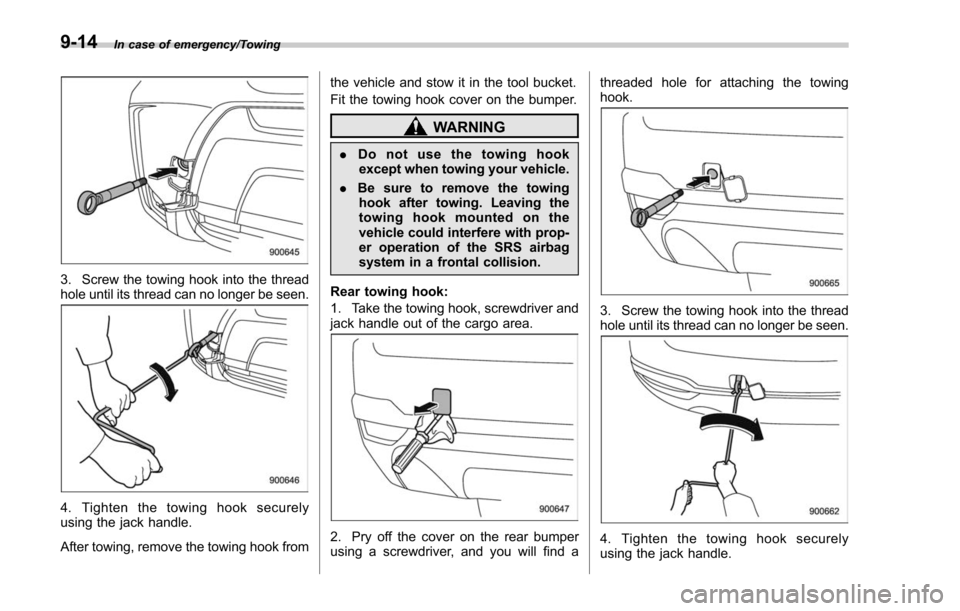
3. Screw the towing hook into the thread
hole until its thread can no longer be seen.
4. Tighten the towing hook securely
using the jack handle.
After towing, remove the towing hook fromthe vehicle and stow it in the tool bucket.
Fit the towing hook cover on the bumper.
WARNING
.
Do not use the towing hook
except when towing your vehicle.
. Be sure to remove the towing
hook after towing. Leaving the
towing hook mounted on the
vehicle could interfere with prop-
er operation of the SRS airbag
system in a frontal collision.
Rear towing hook:
1. Take the towing hook, screwdriver and
jack handle out of the cargo area.
2. Pry off the cover on the rear bumper
using a screwdriver, and you will find a threaded hole for attaching the towing
hook.
3. Screw the towing hook into the thread
hole until its thread can no longer be seen.
4. Tighten the towing hook securely
using the jack handle.
9-14
Page 519 of 634

In case of emergency/Towing
position for CVT models. Shift the shift
lever into the“1st ”position for MT models.
2. Apply the parking brake firmly.
3. Secure the vehicle onto the carrier
properly with safety chains. Each safety
chain should be equally tightened and
care must be taken not to pull the chains
so tightly that the suspension bottoms out.
CAUTION
If your vehicle has a front under-
spoiler and rear underspoiler (both
optional), be careful not to scrape
them when placing the vehicle on
the carrier and when removing the
vehicle from the carrier.
& Towing with all wheels on the
ground
1. Release the parking brake and put the
transmission in the “N”/neutral position.
2. The ignition switch should be in the
“ON ”position while the vehicle is being
towed.
3. Take up slack in the towline slowly to
prevent damage to the vehicle.
WARNING
. Never turn the ignition switch to
the “LOCK ”/“OFF ”position while
the vehicle is being towed be-
cause the steering wheel and the
direction of the wheels will be
locked. .
Remember that the brake booster
and power steering do not func-
tion when the engine is not
running. Because the engine is
turned off, it will take greater
effort to operate the brake pedal
and steering wheel.
CAUTION
. If transmission failure occurs,
transport your vehicle on a flat-
bed truck.
. For CVT models, the traveling
speed must be limited to less
than 20 mph (30 km/h) and the
traveling distance to less than 31
miles (50 km). For greater speeds
and distances, transport your
vehicle on a flat-bed truck.
9-16
Page 538 of 634
Engine hood
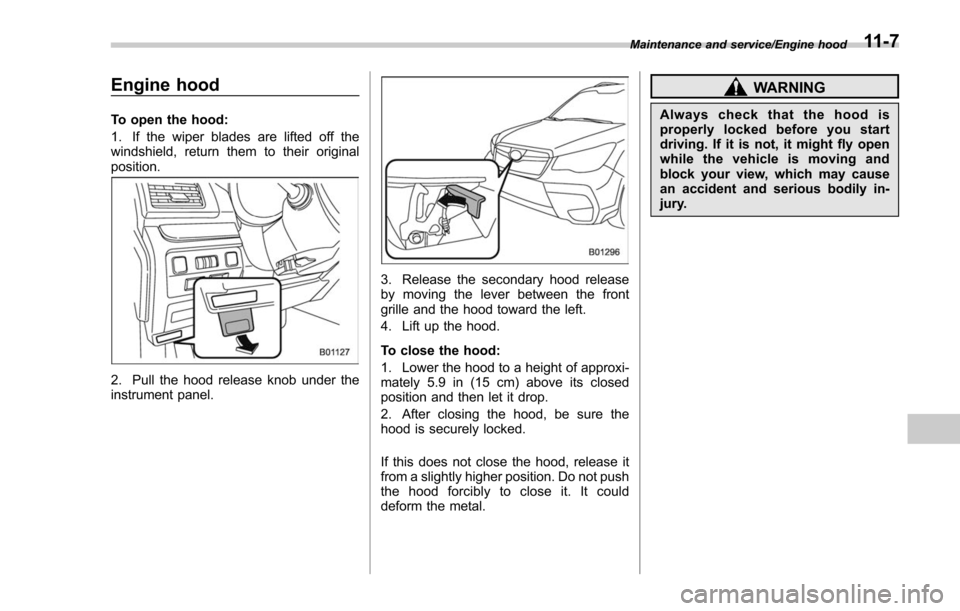
To open the hood:
1. If the wiper blades are lifted off the
windshield, return them to their original
position.
2. Pull the hood release knob under the
instrument panel.
3. Release the secondary hood release
by moving the lever between the front
grille and the hood toward the left.
4. Lift up the hood.
To close the hood:
1. Lower the hood to a height of approxi-
mately 5.9 in (15 cm) above its closed
position and then let it drop.
2. After closing the hood, be sure the
hood is securely locked.
If this does not close the hood, release it
from a slightly higher position. Do not push
the hood forcibly to close it. It could
deform the metal.
WARNING
Always check that the hood is
properly locked before you start
driving. If it is not, it might fly open
while the vehicle is moving and
block your view, which may cause
an accident and serious bodily in-
jury.
Maintenance and service/Engine hood11-7
Page 566 of 634
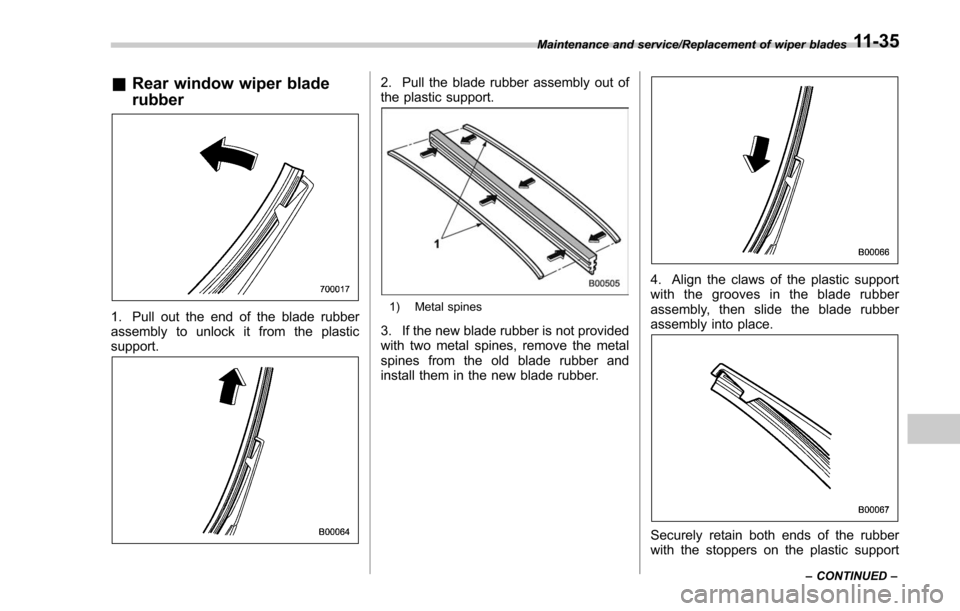
&Rear window wiper blade
rubber
1. Pull out the end of the blade rubber
assembly to unlock it from the plastic
support.
2. Pull the blade rubber assembly out of
the plastic support.
1) Metal spines
3. If the new blade rubber is not provided
with two metal spines, remove the metal
spines from the old blade rubber and
install them in the new blade rubber.
4. Align the claws of the plastic support
with the grooves in the blade rubber
assembly, then slide the blade rubber
assembly into place.
Securely retain both ends of the rubber
with the stoppers on the plastic support
Maintenance and service/Replacement of wiper blades
–CONTINUED –11-35
Page 573 of 634

Maintenance and service/Replacing bulbs
Front turn signal light (models with LED
headlight)
Front side marker light and parking light
(models with halogen headlight)
1) Front side marker light
2) Parking light
Front side marker light (models with LED
headlight)
1) Front side marker light
2. Turn the socket counterclockwise and
pull it out.
3. Pull out the bulb from the socket and
replace the bulb with a new one.
4. To install the socket to the headlight
assembly, turn it clockwise until it clicks.
5. Install the electrical connector to the
clip.
&Front fog light (if equipped)
It may be difficult to replace the bulbs.
Have the bulbs replaced by your SUBARU
dealer if necessary.
&Rear combination lights
NOTE
The stop light is an LED (Light Emitting
Diode) type. Consult your SUBARU
dealer for replacement.
1. Using a Phillips screwdriver, remove
the upper and lower screws that secure
the rear combination light assembly.
11-42
Page 607 of 634
Consumer information and Reporting safety defects/Tire information
.Tread rib
A tread section running circumfer-
entially around a tire.
.Tread separation
Pulling away of the tread from the
tire carcass.
.Treadwear indicators (TWI)
The projections within the principal
grooves designed to give a visual
indication of the degrees of wear of
the tread.
.Vehicle capacity weight
The rated cargo and luggage load
plus 150 lbs (68 kg) times the
vehicle’s designated seating capa-
city.
.Vehicle maximum load on the
tire
Load on an individual tire that is
determined by distributing to each
axle its share of the maximum
loaded vehicle weight and dividing
by two.
.Vehicle normal load on the tire
Load on an individual tire that is
determined by distributing to each
axle its share of the curb weight, accessory weight, and normal oc-
cupant weight (distributed in accor-
dance with Table 1 that is ap-
pended to the end of this section)
and dividing by 2.
.Wheel-holding fixture
The fixture used to hold the wheel
and tire assembly securely during
testing.
13-8
Page 621 of 634

14-6Index
Rear seat.............................................................. 1-12
Headlight Beam leveler ....................................................... 3-102
Bulb replacement .................................................. 11-39
Bulb wattage ....................................................... 12-16
Control switch ........................................................ 3-93
Flasher ................................................................. 3-98
Indicator light ......................................................... 3-33
OFF delay function ................................................. 3-94
Welcome lighting function ....................................... 3-94
HID headlights .......................................................... 11-39
High beam assist function ........................................... 3-95
Indicator light ......................................................... 3-32
High beam indicator light ............................................ 3-32
High/low beam change (dimmer) .................................. 3-95
Hill descent control ..................................................... 7-42
Indicator light ......................................................... 3-33
Hill start assist .................................................. 7-50, 11-21
OFF indicator light .................................................. 3-23
To activate/deactivate ............................................. 7-50
Warning light ......................................................... 3-23
HomeLink
®.............................................................. 3-109
Hook Cargo tie-down ...................................................... 6-16
Convenient ............................................................ 6-13
Shopping bag ........................................................ 6-13
Towing and tie-down ............................................... 9-13
Horn ........................................................................\
3-118
Hose and connections ............................................... 11-12 I
Ignition switch
............................................................. 3-4
Light ...................................................................... 3-6
Illumination brightness control .................................... 3-101
Immobilizer ................................................................. 2-3
Indicator light (security indicator light) ........................ 3-30
Indicator light BSD/RCTA OFF ............................................. 3-34, 7-64
BSD/RCTA warning ........................................ 3-33, 7-63
Coolant temperature low .......................................... 3-17
Cruise control ........................................................ 3-32
Cruise control set ................................................... 3-32
Front fog light ......................................................... 3-33
Headlight ............................................................... 3-33
High beam ............................................................. 3-32
High beam assist .................................................... 3-32
Hill descent control ................................................. 3-33
Hill start assist OFF ................................................ 3-23
Immobilizer ............................................................ 3-30
Security ................................................................. 3-30
Select lever/Gear position ........................................ 3-31
SI-DRIVE .............................................................. 3-31
Steering responsive fog lights OFF ... ........................ 3-33
Turn signal ............................................................ 3-32
Vehicle Dynamics Control OFF ................................. 3-25
Vehicle Dynamics Control operation .......................... 3-25
X-mode ................................................................. 3-33
Information display ...................................................... 3-34
Inside mirror ............................................................ 3-107
Interior lights ............................................................... 6-2