Page 207 of 540
205
2-2. Instrument cluster
2
When driving
Multi-infor mation display (monochrome display)
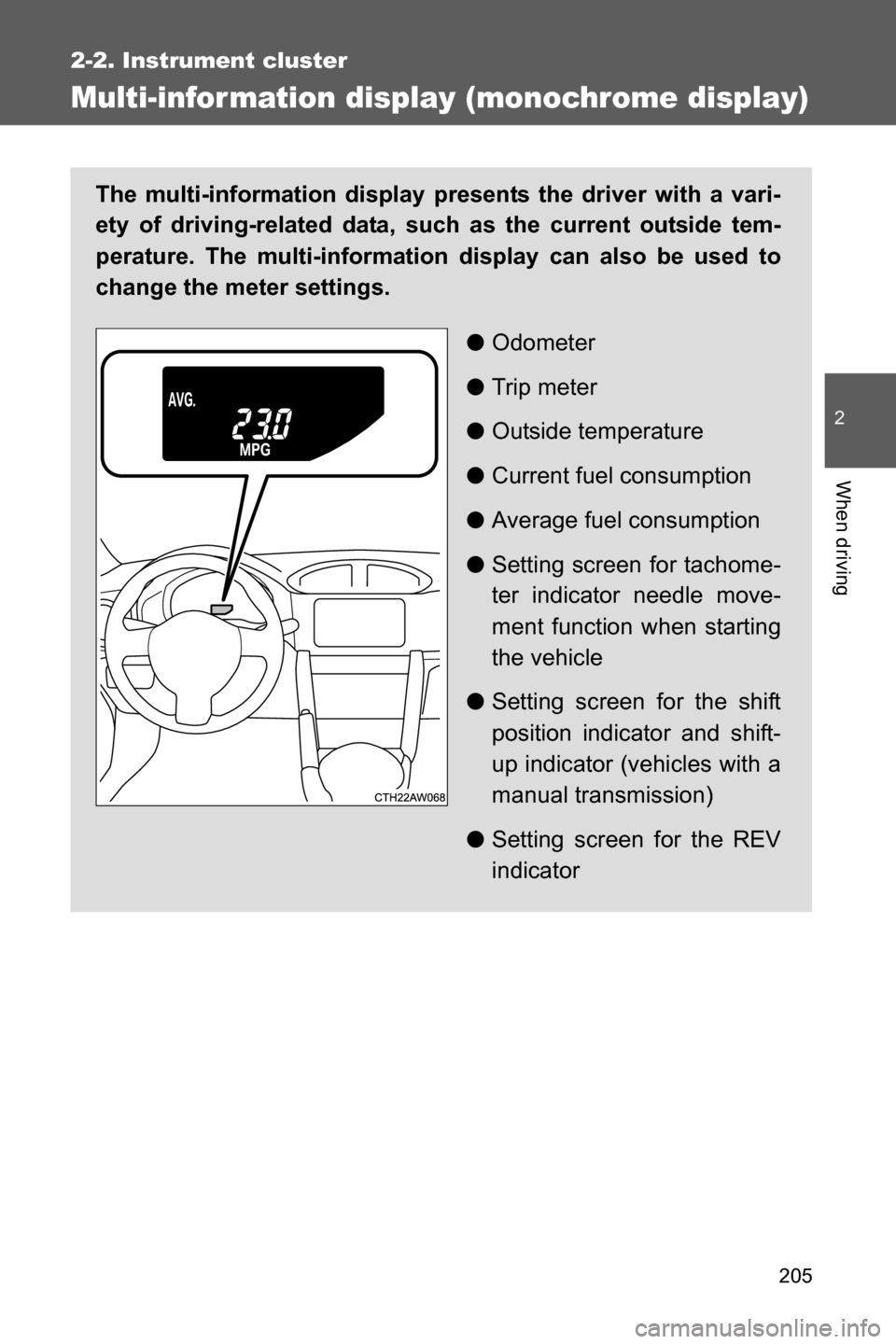
The multi-information display presents the driver with a vari-
ety of driving-related data, such as the current outside tem-
perature. The multi-information display can also be used to
change the meter settings.
●Odometer
●Trip meter
●Outside temperature
●Current fuel consumption
●Average fuel consumption
●Setting screen for tachome-
ter indicator needle move-
ment function when starting
the vehicle
●Setting screen for the shift
position indicator and shift-
up indicator (vehicles with a
manual transmission)
●Setting screen for the REV
indicator
Page 208 of 540
206 2-2. Instrument cluster
Switch the display
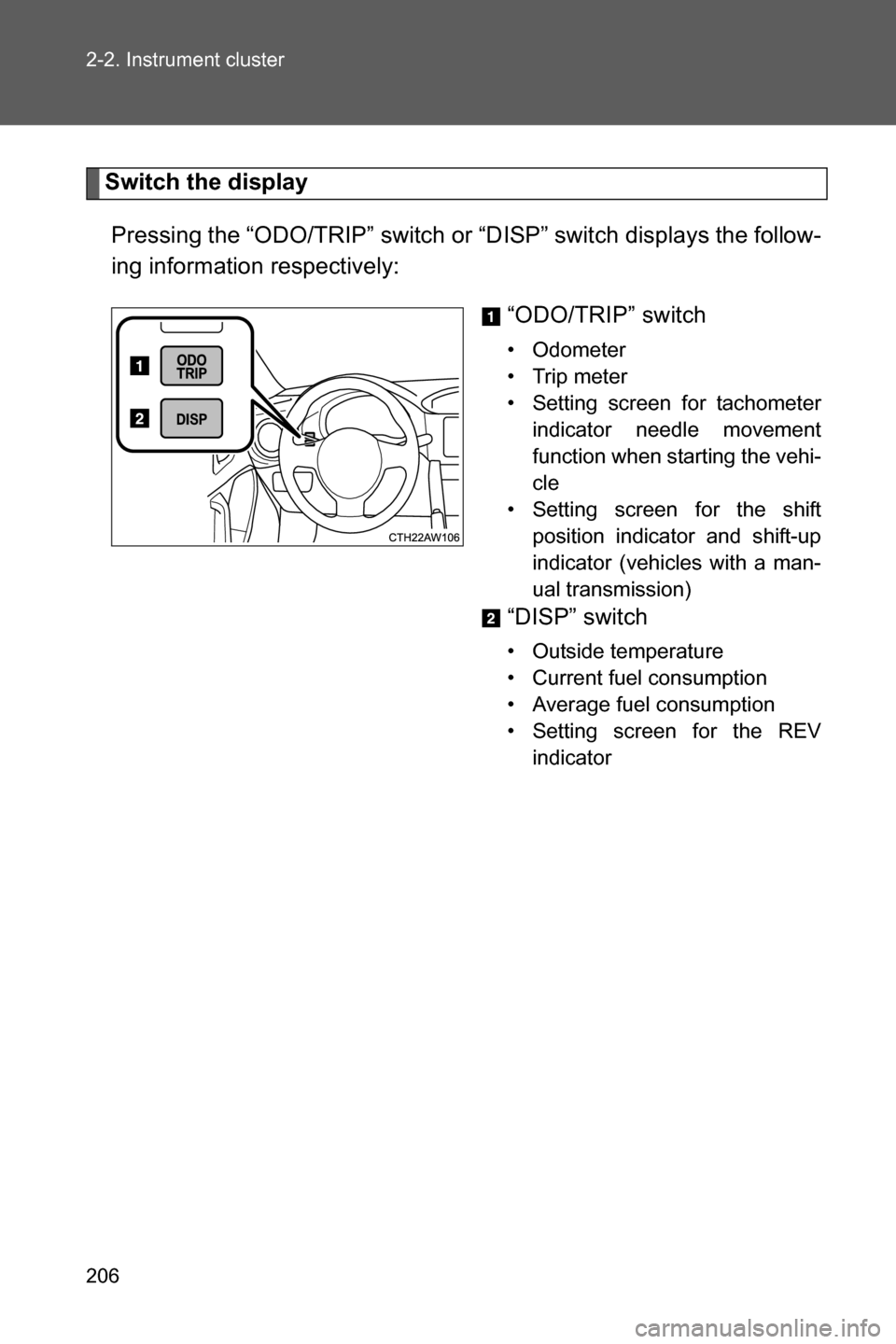
Pressing the “ODO/TRIP” switch or “DISP” switch displays the follow-
ing information respectively:
“ODO/TRIP” switch
• Odometer
• Trip meter
• Setting screen for tachometer
indicator needle movement
function when starting the vehi-
cle
• Setting screen for the shift
position indicator and shift-up
indicator (vehicles with a man-
ual transmission)
“DISP” switch
• Outside temperature
• Current fuel consumption
• Average fuel consumption
• Setting screen for the REV
indicator
Page 210 of 540
208 2-2. Instrument cluster
■Changing the display using the “DISP” switch
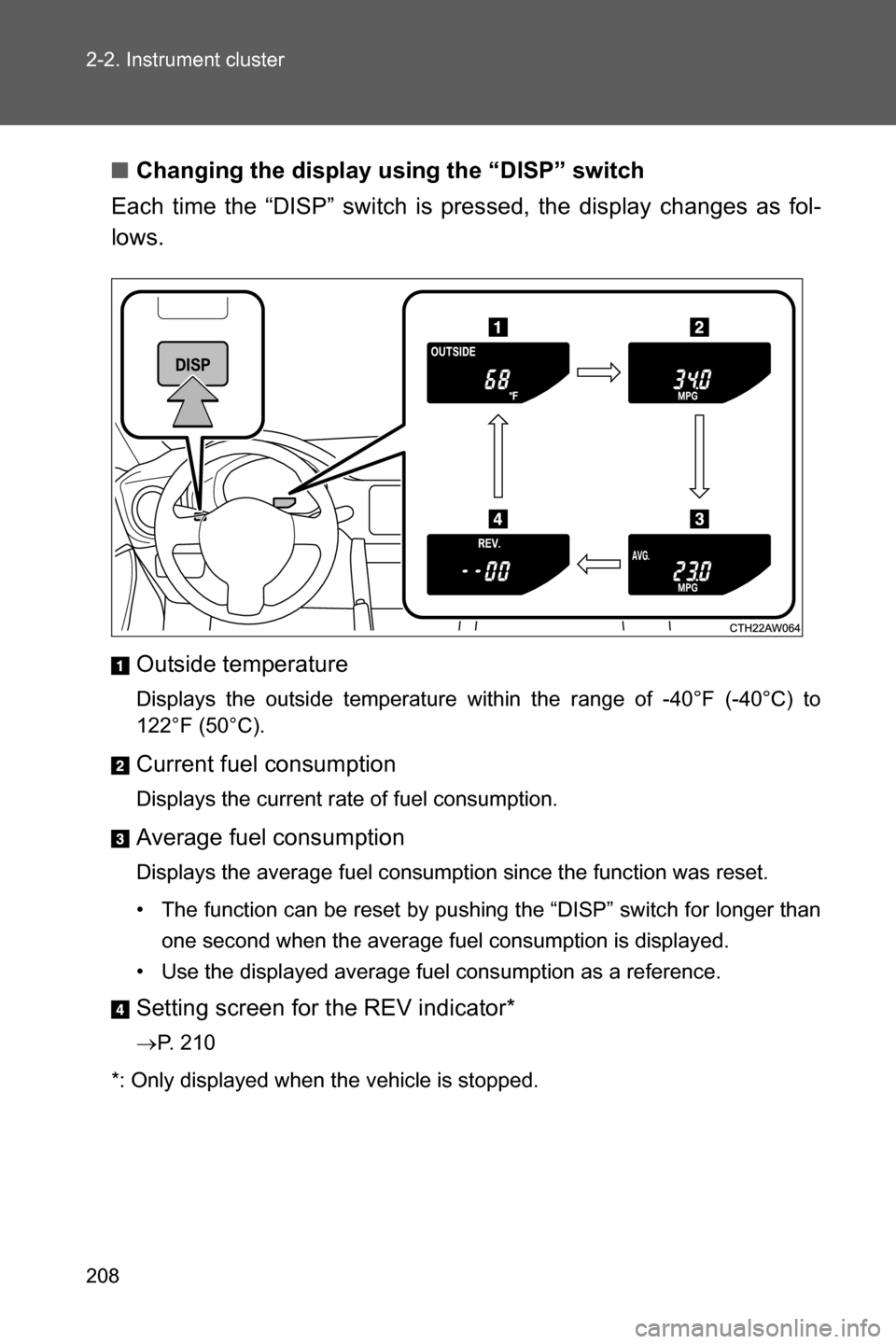
Each time the “DISP” switch is pressed, the display changes as fol-
lows.
Outside temperature
Displays the outside temperature within the range of -40°F (-40°C) to
122°F (50°C).
Current fuel consumption
Displays the current rate of fuel consumption.
Average fuel consumption
Displays the average fuel consumption since the function was reset.
• The function can be reset by pushing the “DISP” switch for longer than
one second when the average fuel consumption is displayed.
• Use the displayed average fuel consumption as a reference.
Setting screen for the REV indicator*
oP. 210
*: Only displayed when the vehicle is stopped.
Page 218 of 540
216 2-2. Instrument cluster
Drive information ( )
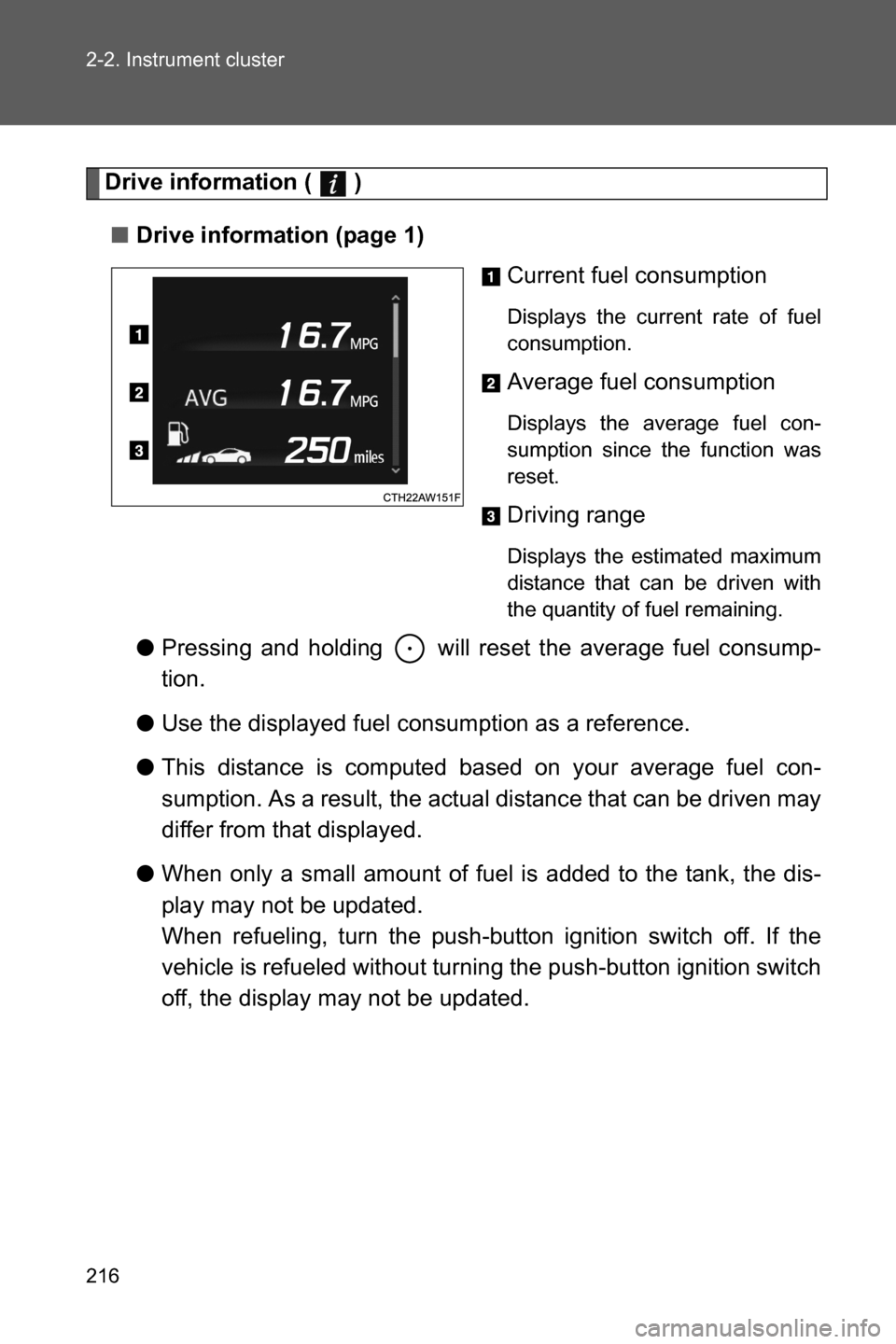
■Drive information (page 1)
Current fuel consumption
Displays the current rate of fuel
consumption.
Average fuel consumption
Displays the average fuel con-
sumption since the function was
reset.
Driving range
Displays the estimated maximum
distance that can be driven with
the quantity of fuel remaining.
●Pressing and holding will reset the average fuel consump-
tion.
●Use the displayed fuel consumption as a reference.
●This distance is computed based on your average fuel con-
sumption. As a result, the actual distance that can be driven may
differ from that displayed.
●When only a small amount of fuel is added to the tank, the dis-
play may not be updated.
When refueling, turn the push-button ignition switch off. If the
vehicle is refueled without turning the push-button ignition switch
off, the display may not be updated.
Page 232 of 540

230 2-3. Operating the lights and windshield wipers
■Daytime running light system
●Vehicles with an automatic transmission: To make your vehicle more visi-
ble to other drivers during daytime driving, the daytime running lights turn
on automatically whenever the engine is started, the select lever is
shifted out of P and the parking brake is released with the headlight
switch off or in the “AUTO” position. (Illuminate brighter than the parking
lights.) Daytime running lights are not designed for use at night.
●Vehicles with a manual transmission: To make your vehicle more visible
to other drivers during daytime driving, the daytime running lights turn on
automatically whenever the engine is started and the parking brake is
released with the headlight switch off or in the “AUTO” position. (Illumi-
nate brighter than the parking lights.) Daytime running lights are not
designed for use at night.
●When the turn signal indicators are flashing, the daytime running light on
the side that the turn signals are flashing will turn off.
●When the hazard warning flashers are flashing, both daytime running
lights will turn off.
●Compared to turning on the headlights, the daytime running light system
offers greater durability and consumes less electricity, so it can help
improve fuel economy.
■Headlight control sensor
Headlight control sensor is located on the
passenger's side.
The sensor may not function properly if
an object is placed on the sensor, or any-
thing that blocks the sensor is affixed to
the windshield.
Doing so interferes with the sensor
detecting the level of ambient light and
may cause the automatic headlight sys-
tem to malfunction.
Page 265 of 540
263
2
When driving
2-5. Driving information
Cargo and luggage
Capacity and distribution
Cargo capacity depends on the total weight of the occupants.
(Cargo capacity) = (Total load capacity) - (Total weight of occupants)
Steps for Determining Correct Load Limit
(1)Locate the statement “The combined weight of occupants and
cargo should never exceed XXX kg or XXX lbs.” on your vehicle's
placard.
(2)Determine the combined weight of the driver and passengers that
will be riding in your vehicle.
(3)Subtract the combined weight of the driver and passengers from
XXX kg or XXX lbs.
(4)The resulting figure equals the available amount of cargo and lug-
gage load capacity.
For example, if the “XXX” amount equals 1400 lbs. and there will
be five 150 lb passengers in your vehicle, the amount of available
cargo and luggage load capacity is 650 lbs. (1400 - 750 (5 u 150) =
650 lbs.)
(5)Determine the combined weight of luggage and cargo being
loaded on the vehicle. That weight may not safely exceed the avail-
able cargo and luggage load capacity calculated in Step 4.
Take notice of the following information about storage precau-
tions, cargo capacity and load:
●Stow cargo and luggage in the trunk whenever possible.
●Be sure all items are secured in place.
●To maintain vehicle balance while driving, position luggage
evenly within the luggage compartment.
●For better fuel economy, do not carry unnecessary weight.
Page 273 of 540
271 2-5. Driving information
2
When driving
■Refueling in cold weather
To help prevent moisture from forming in the fuel system and the risk of its
freezing, use of an antifreeze additive in the fuel tank is recommended dur-
ing cold weather.
Use only additives that are specifically designed for this purpose. When an
antifreeze additive is used, its effect lasts longer if the tank is refilled when-
ever the fuel level reaches half empty.
WARNING
■Driving with snow tires
Observe the following precautions to reduce the risk of accidents.
Failure to do so may result in a loss of vehicle control and cause death or
serious injury.
●Use tires of the specified size, and that are the same for the following
items:
•Size
• Circumference
• Speed symbol
• Load index
• Construction
• Manufacturer
• Brand (tread pattern)
• Degrees of wear
●Maintain the recommended level of air pressure.
●Use snow tires on all, not just some wheels.
Page 317 of 540

315 4-1. Maintenance and care
4
Maintenance and care
■Automatic car washes
●Fold the mirrors before washing the vehicle. Start washing from the front
of the vehicle. Make sure to and extend the mirrors before driving.
●When having your vehicle washed in an automatic car wash, make sure
beforehand that the car wash is of suitable type to avoid scratches to the
vehicle surface and harm to your vehicle’s paint.
●Vehicles with a rear spoiler: In certain automatic car washes, the rear
spoiler may interfere with machine operation. This may prevent the vehi-
cle from being cleaned properly or result in damage to the rear spoiler.
■High pressure car washes
●Do not allow the nozzles of the car wash to come within close proximity
of the windows and door frames as water may enter the cabin.
●Before using the car wash, check that the fuel filler lid on your vehicle is
closed properly.
■Aluminum wheels
●Remove any dirt immediately by using a neutral detergent. Do not use
hard brushes or abrasive cleaners. Do not use strong or harsh chemical
cleaners. Use the same mild detergent and wax as used on the paint.
●Do not use detergent on the wheels when they are hot, for example after
driving for long distance in the hot weather.
●Wash detergent from the wheels immediately after use.
■Parts containing resin such as the bumper
Do not scrub with abrasive cleaners.
■When washing the vehicle
Wear rubber gloves and use a hand brush when washing down underbody,
inner fenders and suspension to effectively remove mud and dirt off.