Page 14 of 540
12
A
Vehicles with a manual air conditioning system
Air conditioning
system
P. 276
Vehicles with an automatic air conditioning system
Rear window and outside rear
view mirror defoggers
P. 292
Air conditioning
system
P. 283
Rear window and outside rear view mirror defoggers
switch
/rear window defogger switch
P. 292
Pictorial indexInstrument panel
Page 16 of 540
14
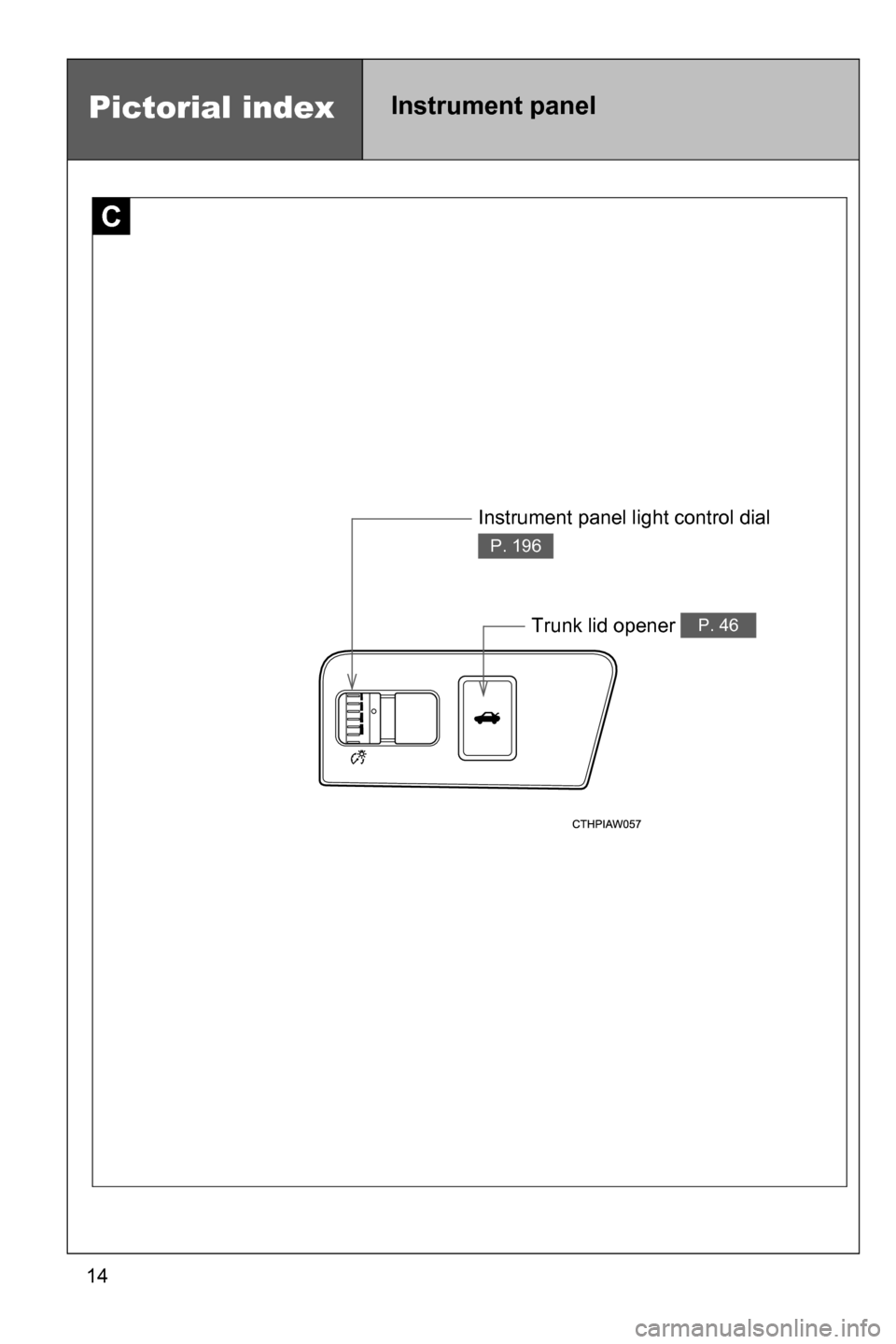
C
Instrument panel light control dial
P. 196
Trunk lid opener P. 46
Pictorial indexInstrument panel
Page 270 of 540

268
2-5. Driving information
Winter driving tips
Carry out the necessary preparations and inspections before driving
the vehicle in winter. Always drive the vehicle in a manner appropri-
ate to the prevailing weather conditions.
■Pre-winter preparations
●Use fluids that are appropriate to the prevailing outside tem-
peratures.
• Engine oil
• Washer fluid
●Have a service technician inspect the condition of the battery.
●Have the vehicle fitted with four snow tires.
Make sure to install 4 tires that are of the specified size, and that
all 4 tires are the same for the following items:
•Size
• Circumference
• Speed symbol
• Load index
• Construction
• Manufacturer
• Brand (tread pattern)
• Degrees of wear
Also, make sure to use tire chains that match the size of the tires.
■Before driving the vehicle
Perform the following according to the driving conditions.
●Do not try to forcibly open a window or move a wiper that is
frozen. Pour warm water over the frozen area to melt the ice.
Wipe away the water immediately to prevent it from freezing.
●To ensure proper operation of the climate control system fan,
remove any snow that has accumulated on the air inlet vents
in front of the windshield.
Page 273 of 540
271 2-5. Driving information
2
When driving
■Refueling in cold weather
To help prevent moisture from forming in the fuel system and the risk of its
freezing, use of an antifreeze additive in the fuel tank is recommended dur-
ing cold weather.
Use only additives that are specifically designed for this purpose. When an
antifreeze additive is used, its effect lasts longer if the tank is refilled when-
ever the fuel level reaches half empty.
WARNING
■Driving with snow tires
Observe the following precautions to reduce the risk of accidents.
Failure to do so may result in a loss of vehicle control and cause death or
serious injury.
●Use tires of the specified size, and that are the same for the following
items:
•Size
• Circumference
• Speed symbol
• Load index
• Construction
• Manufacturer
• Brand (tread pattern)
• Degrees of wear
●Maintain the recommended level of air pressure.
●Use snow tires on all, not just some wheels.
Page 357 of 540

355 4-3. Do-it-yourself maintenance
4
Maintenance and care
WARNING
■Tire pressure monitoring system operation (if equipped)
The tire pressure monitoring system may not provide warning immedi-
ately if a tire bursts or if sudden air leakage occurs.
■When inspecting or replacing tires
Observe the following precautions to prevent accidents.
Failure to do so may cause damage to parts of the drive train, as well as
dangerous handling characteristics, which may lead to an accident
resulting in death or serious injury.
●Make sure to install 4 tires that are of the specified size, and that all 4
tires are the same for the following items:
•Size
• Circumference
• Speed symbol
• Load index
• Construction
• Manufacturer
• Brand (tread pattern)
• Degrees of wear
You must obey the specification printed on the tire placard. The tire plac-
ard is located on the driver's door pillar.
If all four tires are not the same in items listed above, there is a possibil-
ity that it may lead to serious mechanical damage to the drive train of
your car and affect the following.
•Ride
• Handling
•Braking
• Speedometer/Odometer calibration
• Clearance between the body and the tires
It also may be dangerous and lead to loss of vehicle control as well as an
accident.
●Only use radial tires.
●Do not mix summer, all season and snow tires.
●Do not use tires that have been used on another vehicle.
Do not use tires if you do not know how they were used previously.
Page 478 of 540
476
6-1. Specifications
Fuel infor mation
■Fuel tank opening for unleaded gasoline
To help prevent incorrect fueling, your SUBARU has a fuel tank opening that
only accommodates the special nozzle on unleaded fuel pumps.
■If your engine knocks
●Consult your SUBARU dealer.
●You may occasionally notice light knocking for a short time while acceler-
ating or driving uphill. This is normal and there is no need for concern.
■Gasoline quality
In very few cases, driveability problems may be caused by the brand of gas-
oline you are using. If driveability problems persist, try changing the brand of
gasoline. If this does not correct the problem, consult your SUBARU dealer.
■Fuel octane rating
Using a gasoline with a lower octane rating can cause persistent and heavy
knocking, which can damage the engine. Do not be concerned if your vehi-
cle sometimes knocks lightly when you drive up a hill or when you acceler-
ate. Contact your SUBARU dealer if you use a fuel with the specified octane
rating and your vehicle knocks heavily or persistently.
RON
This octane rating is the Research Octane Number.
AKI
This octane rating is the average of the Research Octane and Motor Octane
numbers and is commonly referred to as the Anti Knock Index (AKI). The engine is designed to operate at maximum performance using
unleaded gasoline with an octane rating of 93 AKI (98 RON) or
higher. If 93 AKI (98 RON) fuel is not readily available in your area,
unleaded gasoline with an octane rating of 91 AKI (95 RON) may be
used with no detriment to engine durability or driveability. However,
you may notice a slight decrease in maximum engine performance
and you may hear some knocking (pinging) from the engine while
using 91 AKI (95 RON) fuel. Use of 91 AKI (95 RON) fuel will not affect
your warranty coverage.
Page 485 of 540
483 6-1. Specifications
6
Vehicle specifications
Tire size
■Typical tire size information
The illustration indicates typical
tire size.
Tire use
(P = Passenger car,
T = Temporary use)
Section width (millimeters)
Aspect ratio
(tire height to section width)
Tire construction code
(R = Radial, D = Diagonal)
Wheel diameter (inches)
Load index (2 or 3 digits)
Speed symbol
(alphabet with one letter)
■Tire dimensions
Section width
Tire height
Wheel diameter
Page 493 of 540
491 6-1. Specifications
6
Vehicle specifications
*:Table 1 Occupant loading and distribution for vehicle normal load
for various designated seating capacities
Tire related termMeaning
Snow tireA tire that attains a traction index equal to or
greater than 110, compared to the ASTM E-
1136 Standard Reference Test Tire, when
using the snow traction test as described in
ASTM F-1805-00, Standard Test Method for
Single Wheel Driving Traction in a Straight Line
on Snow-and Ice-Covered Surfaces, and which
is marked with an Alpine Symbol ( ) on at
least one sidewall
Te s t r i mThe rim on which a tire is fitted for testing, and
may be any rim listed as appropriate for use
with that tire
TreadThat portion of a tire that comes into contact
with the road
Tread ribA tread section running circumferentially
around a tire
Tread separation Pulling away of the tread from the tire carcass
Treadwear indicators
(TWI)The projections within the principal grooves
designed to give a visual indication of the
degrees of wear of the tread
Wheel-holding fixtureThe fixture used to hold the wheel and tire
assembly securely during testing