Page 184 of 252

146
Fitting the spare wheel
When using a non-uniform spare wheel,
do not exceed 50 mph (80 km/h).
The spare wheel is not designed to
be used over long distances. Have
the tightening of the bolts and the tyre
pressure of the spare wheel checked by a
PEUGEOT dealer or a qualified workshop
as soon as possible.
Also, have the original wheel repaired
and refitted by a PEUGEOT dealer or a
qualified workshop as soon as possible.
F
P
osition the wheel on the hub and start
tightening the bolts by hand.
Ensure that the jack is stable. The foot
of the jack must be in contact with the
ground and directly below the jacking
point used.
If the ground is slippery or loose, the jack
may slip or drop – Risk of injury!
Ensure that the jack is positioned only at
one of jacking points under the vehicle,
making sure that the vehicle's contact
sur face is centred on the head of the jack.
Other wise, there is a risk of damage to the
vehicle and/or of the jack collapsing – Risk
of injury!
Do not extend the jack until you have
started unscrewing the bolts on the wheel
to be changed and have placed the chock
under the wheel diagonally opposite.
F
C
arry out an initial tightening of the bolts
using the wheelbrace.
F
L
ower the vehicle completely by folding the
jack, then remove the jack.
F
T
ighten the wheel bolts again using the
wheelbrace; tighten them fully without
forcing them.
F
P
lace the wheel to be repaired in the carrier.
In the event of a breakdown
Page 185 of 252
147
Never go underneath a vehicle that is
supported only by a jack (use an axle stand).
Never use an electric screwdriver instead of
the wheelbrace.
Refitting the repaired wheel
The wheel is refitted in the same way as the
spare wheel; do not forget to refit the wheel
trim.For more information on Identification
markings
, including the tyre label, refer to
the corresponding section.
For more information on Tyre under-
inflation detection , including
recommendations after changing a wheel
with a tyre under-inflation detection
sensor, refer to the corresponding section.
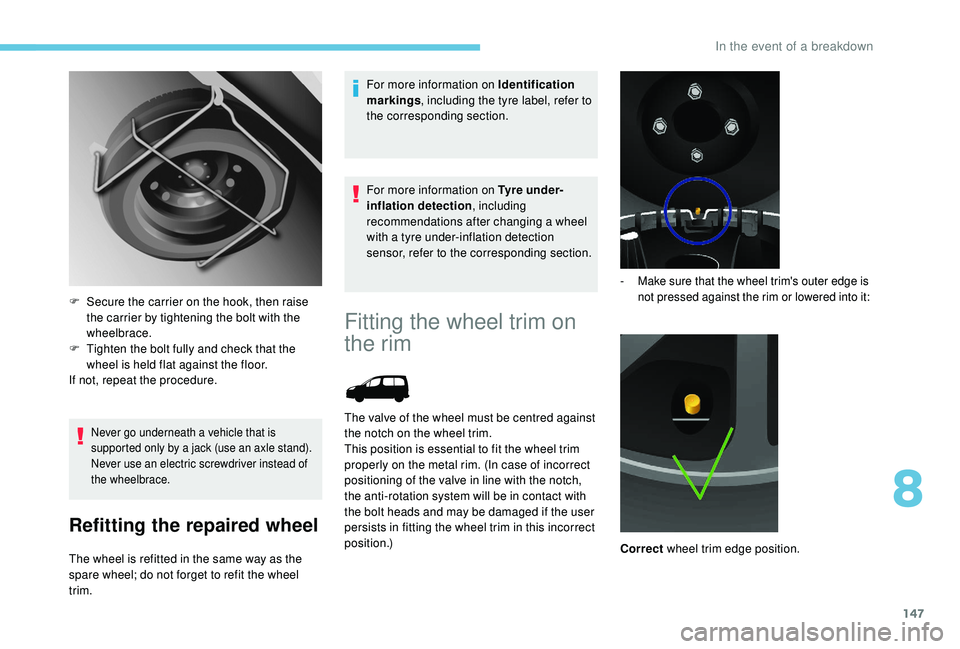
F
S
ecure the carrier on the hook, then raise
the carrier by tightening the bolt with the
wheelbrace.
F
T
ighten the bolt fully and check that the
wheel is held flat against the floor.
If not, repeat the procedure.
Fitting the wheel trim on
the rim
The valve of the wheel must be centred against
the notch on the wheel trim.
This position is essential to fit the wheel trim
properly on the metal rim. (In case of incorrect
positioning of the valve in line with the notch,
the anti-rotation system will be in contact with
the bolt heads and may be damaged if the user
persists in fitting the wheel trim in this incorrect
position.)
- Make sure that the wheel trim's outer edge is not pressed against the rim or lowered into it:
Correct wheel trim edge position.
8
In the event of a breakdown
Page 212 of 252
174
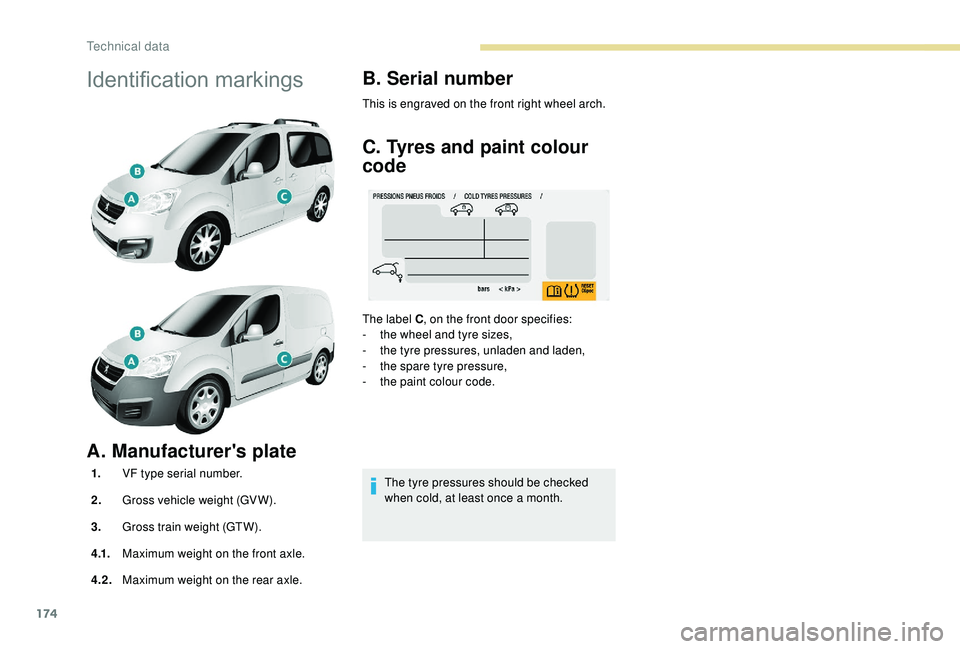
Identification markings
A. Manufacturer's plate
1.VF type serial number.
2. Gross vehicle weight (GV W).
3. Gross train weight (GTW).
4 .1. Maximum weight on the front axle.
4.2. Maximum weight on the rear axle.
B. Serial number
This is engraved on the front right wheel arch.
C. Tyres and paint colour
code
The tyre pressures should be checked
when cold, at least once a month.
The label C
, on the front door specifies:
-
t
he wheel and tyre sizes,
-
t
he tyre pressures, unladen and laden,
-
t
he spare tyre pressure,
-
t
he paint colour code.
Technical data