2017 PEUGEOT 5008 seats
[x] Cancel search: seatsPage 83 of 404

81
Before moving the seat backwards,
ensure that there is nothing that might
prevent the full travel of the seat.
There is a risk of trapping or pinching
passengers if present in the rear seats
or jamming the seat if large objects are
placed on the floor behind the seat.
Storing driving positions
Associated with adjustments of the electrical
driver’s seat, this function allows two driving
positions to be memorised, to make these
adjustments easier if there are frequent driver
changes.
It takes account of the electric adjustments of
the seat and the door mirrors.
Storing a position
Using buttons M / 1 / 2
F S it in the driver’s seat.
F
S
witch on the ignition.
F
A
djust your seat and the door mirrors.
F
P
ress button M , then press button 1
or
2
within four seconds.
An audible signal indicates that the position has
been stored.
Storing a new position cancels the
previous position.
Recalling a stored position
Ignition on or engine running
F P ress button 1 or 2 to recall the
corresponding position.
An audible signal confirms that adjustment is
complete.
You can interrupt the current movement by
pressing button M , 1
or 2 or by using one
of the seat controls.
A stored position cannot be recalled while
driving.
Recalling stored positions is deactivated
45
seconds after switching off the ignition.
Heated seats
The function is active only with the engine
running.
Switching on
F Press the button corresponding to your seat.
F
E
ach press changes the level of heating; the
corresponding number of indicator lamps
come on:
•
1
indicator lamp = low.
•
2
indicator lamps = medium.
•
3
indicator lamps = high.
Switching off
F Press the button again until all the indicator lamps are off.
The state of the system is not kept in memory
when the ignition is switched off.
Do not use the function when the seat is
not occupied.
Reduce the intensity of the heating as
soon as possible.
When the seat and passenger
compartment have reached an adequate
temperature, you can stop the function;
reducing the consumption of electrical
current reduces fuel consumption.
3
Ease of use and comfort
Page 84 of 404
82
Prolonged use is not recommended for
those with sensitive skin.
There is a risk of burns for people whose
perception of heat is impaired (illness,
taking medication, etc.).
There is a risk of overheating the system if
material with insulating properties is used,
such as cushions or seat covers.
Do not use the system:
-
i
f wearing damp clothing,
-
i
f child seats are fitted.
To avoid breaking the heating element in
the seat:
-
d
o not place heavy objects on the seat,
-
d
o not kneel or stand on the seat,
-
d
o not place sharp objects on the seat,
-
d
o not spill liquids onto the seat.
To avoid the risk of short-circuit:
-
d
o not use liquid products for cleaning
the seat,
-
n
ever use the heating function when
the seat is damp.Multipoint massage
System with a choice of type of massage and
adjustment of its intensity.
This system operates with the engine running,
as well as in STOP mode of Stop & Start.
Activation / Settings
The massage settings are adjusted in the touch
screen.
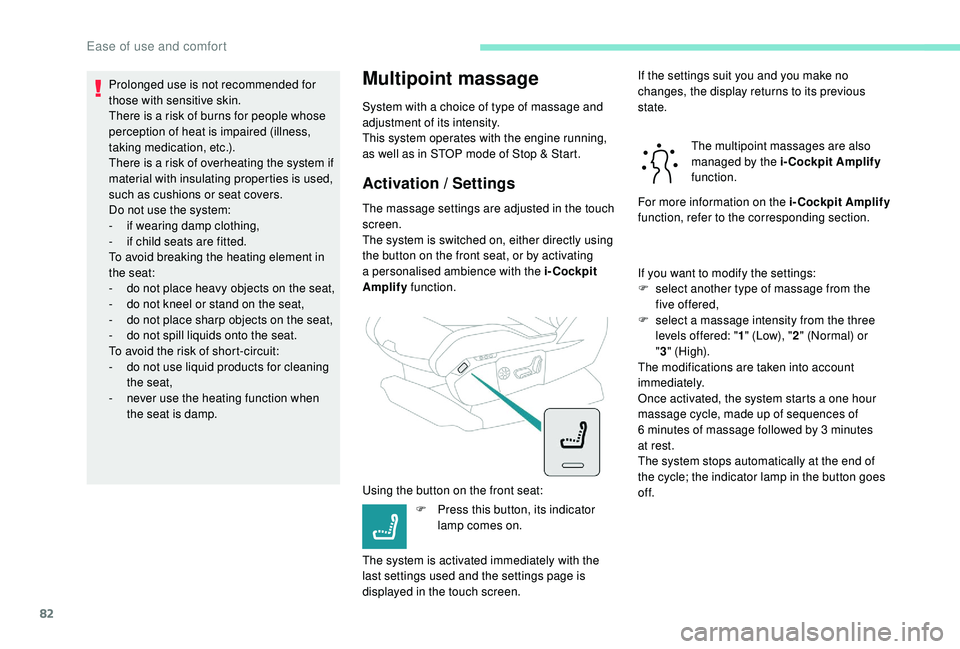
The system is switched on, either directly using
the button on the front seat, or by activating
a personalised ambience with the i-Cockpit
Amplify function.
Using the button on the front seat: F
P
ress this button, its indicator
lamp comes on.
The system is activated immediately with the
last settings used and the settings page is
displayed in the touch screen. If the settings suit you and you make no
changes, the display returns to its previous
state.
The multipoint massages are also
managed by the i-Cockpit Amplify
function.
For more information on the i-Cockpit Amplify
function, refer to the corresponding section.
If you want to modify the settings:
F
s
elect another type of massage from the
five offered,
F
s
elect a massage intensity from the three
levels offered: " 1" (Low), " 2" (Normal) or
" 3 " (High).
The modifications are taken into account
immediately.
Once activated, the system starts a one hour
massage cycle, made up of sequences of
6
minutes of massage followed by 3 minutes
at rest.
The system stops automatically at the end of
the cycle; the indicator lamp in the button goes
of f.
Ease of use and comfort
Page 87 of 404
85
Second row seats
Rear head restraints
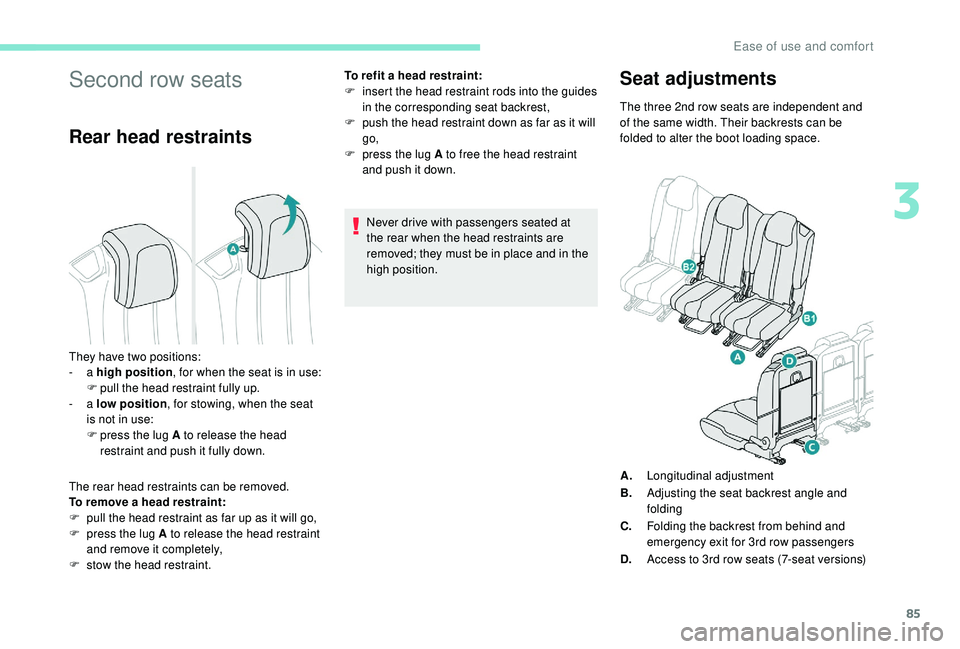
The rear head restraints can be removed.
To remove a head restraint:
F
p
ull the head restraint as far up as it will go,
F
p
ress the lug A to release the head restraint
and remove it completely,
F
s
tow the head restraint. To refit a head restraint:
F
i
nsert the head restraint rods into the guides
in the corresponding seat backrest,
F
p
ush the head restraint down as far as it will
go,
F
p
ress the lug A to free the head restraint
and push it down.
Never drive with passengers seated at
the rear when the head restraints are
removed; they must be in place and in the
high position.
Seat adjustments
They have two positions:
- a high position , for when the seat is in use:
F
p
ull the head restraint fully up.
-
a low position , for stowing, when the seat
is not in use:
F
p
ress the lug A to release the head
restraint and push it fully down. The three 2nd row seats are independent and
of the same width. Their backrests can be
folded to alter the boot loading space.
A. Longitudinal adjustment
B. Adjusting the seat backrest angle and
folding
C. Folding the backrest from behind and
emergency exit for 3rd row passengers
D. Access to 3rd row seats (7-seat versions)
3
Ease of use and comfort
Page 88 of 404
86
Adjusting the seat backrest angleLateral seats
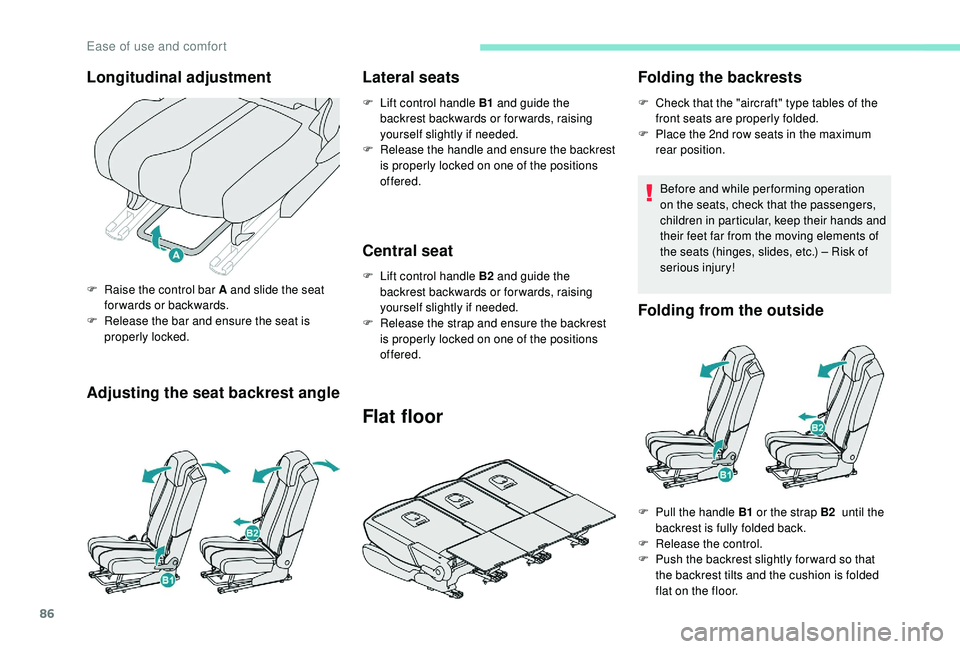
F Lift control handle B1
and guide the
backrest backwards or for wards, raising
yourself slightly if needed.
F
R
elease the handle and ensure the backrest
is properly locked on one of the positions
offered.
Central seat
F Lift control handle B2 and guide the
backrest backwards or for wards, raising
yourself slightly if needed.
F
R
elease the strap and ensure the backrest
is properly locked on one of the positions
offered.
Flat floor
Folding the backrests
F Check that the "aircraft" type tables of the front seats are properly folded.
F
P
lace the 2nd row seats in the maximum
rear position.
Before and while per forming operation
on the seats, check that the passengers,
children in particular, keep their hands and
their feet far from the moving elements of
the seats (hinges, slides, etc.) – Risk of
serious injury!
Folding from the outside
Longitudinal adjustment
F Raise the control bar A and slide the seat
forwards or backwards.
F
R
elease the bar and ensure the seat is
properly locked.
F
P
ull the handle B1 or the strap B2 until the
backrest is fully folded back.
F
R
elease the control.
F
P
ush the backrest slightly for ward so that
the backrest tilts and the cushion is folded
flat on the floor.
Ease of use and comfort
Page 89 of 404
87
Folding from the bootReplacing the seat
Before performing any operations on
the rear seats, to avoid damage to the
seat belts check that the lateral belts are
properly tensioned. The central safety belt
must be stored in the headlining.
Continuity panels
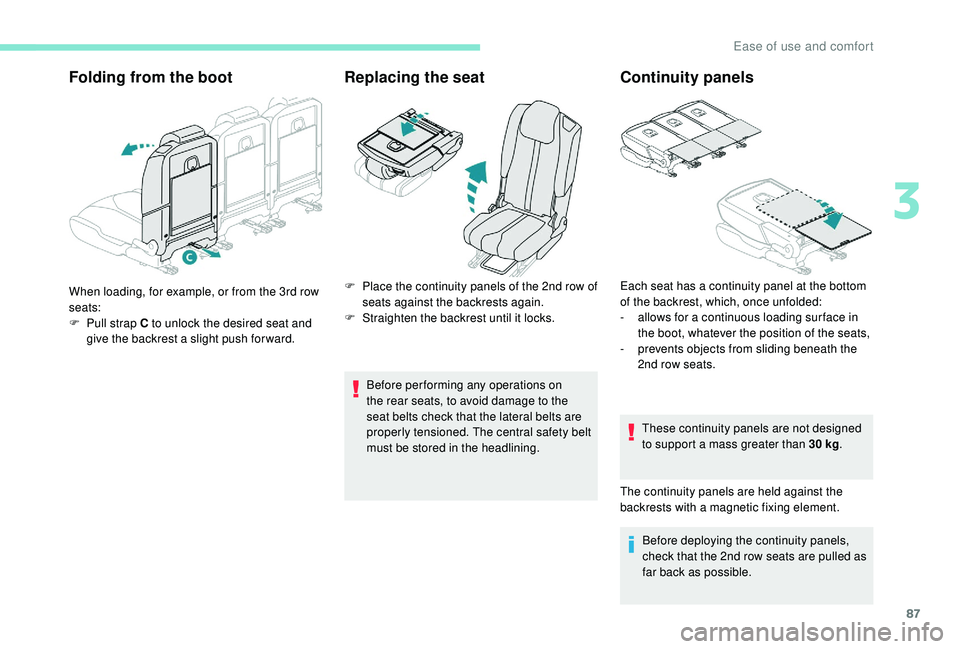
When loading, for example, or from the 3rd row
seats:
F
P
ull strap C to unlock the desired seat and
give the backrest a slight push for ward. F
P lace the continuity panels of the 2nd row of
seats against the backrests again.
F
S
traighten the backrest until it locks.Each seat has a continuity panel at the bottom
of the backrest, which, once unfolded:
-
a
llows for a continuous loading sur face in
the boot, whatever the position of the seats,
-
p
revents objects from sliding beneath the
2nd row seats.
These continuity panels are not designed
to support a mass greater than 30
kg.
The continuity panels are held against the
backrests with a magnetic fixing element. Before deploying the continuity panels,
check that the 2nd row seats are pulled as
far back as possible.
3
Ease of use and comfort
Page 90 of 404
88
Access to third row seatsThird row seats
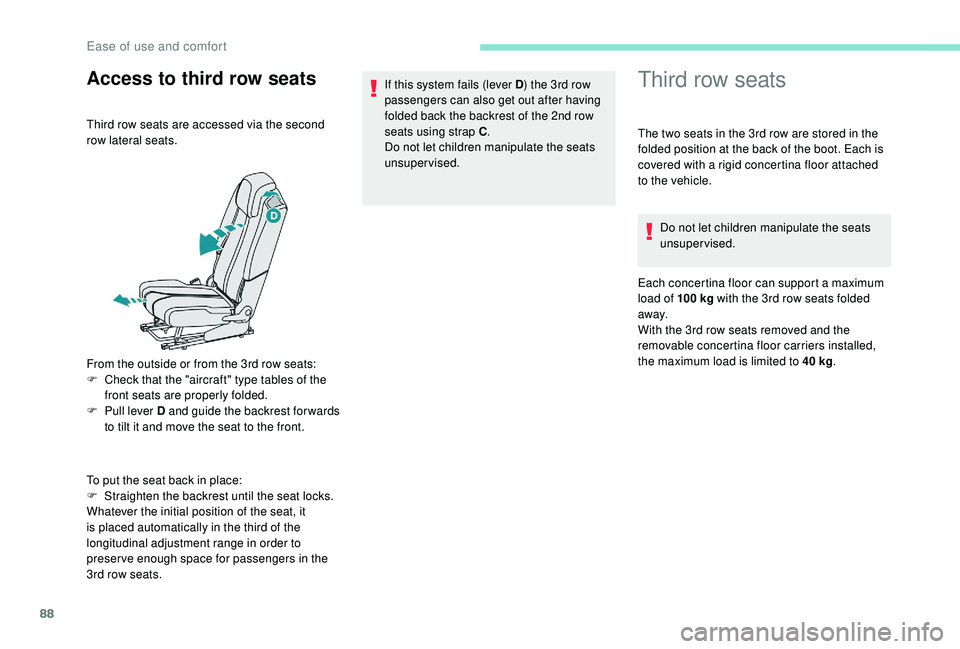
Third row seats are accessed via the second
row lateral seats.
From the outside or from the 3rd row seats:
F
C
heck that the "aircraft" type tables of the
front seats are properly folded.
F
P
ull lever D and guide the backrest for wards
to tilt it and move the seat to the front.
To put the seat back in place:
F
S
traighten the backrest until the seat locks.
Whatever the initial position of the seat, it
is placed automatically in the third of the
longitudinal adjustment range in order to
preserve enough space for passengers in the
3rd row seats. If this system fails (lever D
) the 3rd row
passengers can also get out after having
folded back the backrest of the 2nd row
seats using strap C .
Do not let children manipulate the seats
unsupervised. The two seats in the 3rd row are stored in the
folded position at the back of the boot. Each is
covered with a rigid concertina floor attached
to the vehicle.
Do not let children manipulate the seats
unsupervised.
Each concertina floor can support a maximum
load of 100
kg with the 3rd row seats folded
away.
With the 3rd row seats removed and the
removable concertina floor carriers installed,
the maximum load is limited to 40
kg.
Ease of use and comfort
Page 91 of 404
89
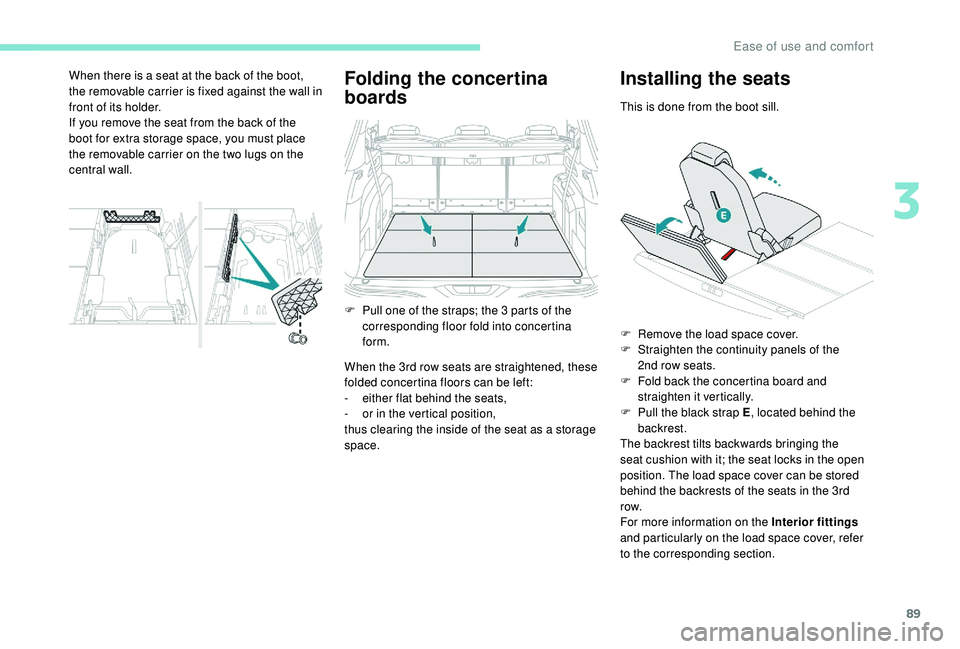
Folding the concertina
boards
When the 3rd row seats are straightened, these
folded concertina floors can be left:
-
ei
ther flat behind the seats,
-
o
r in the vertical position,
thus clearing the inside of the seat as a storage
space.
Installing the seats
This is done from the boot sill.
When there is a seat at the back of the boot,
the removable carrier is fixed against the wall in
front of its holder.
If you remove the seat from the back of the
boot for extra storage space, you must place
the removable carrier on the two lugs on the
central wall.
F
P
ull one of the straps; the 3
parts of the
corresponding floor fold into concertina
form. F
R
emove the load space cover.
F
S
traighten the continuity panels of the
2nd row seats.
F
F
old back the concertina board and
straighten it vertically.
F
P
ull the black strap E , located behind the
backrest.
The backrest tilts backwards bringing the
seat cushion with it; the seat locks in the open
position. The load space cover can be stored
behind the backrests of the seats in the 3rd
row.
For more information on the Interior fittings
and particularly on the load space cover, refer
to the corresponding section.
3
Ease of use and comfort
Page 92 of 404
90
Rear head restraints
The rear head restraints can be removed.
To remove a head restraint:
F
p
ull the head restraint as far up as it will go,
F
p
ress the lug A to release the head restraint
and remove it completely,
F
s
tow the head restraint.
Never drive with passengers seated at
the rear when the head restraints are
removed; they must be in place and in the
high position.
Removal of the seats
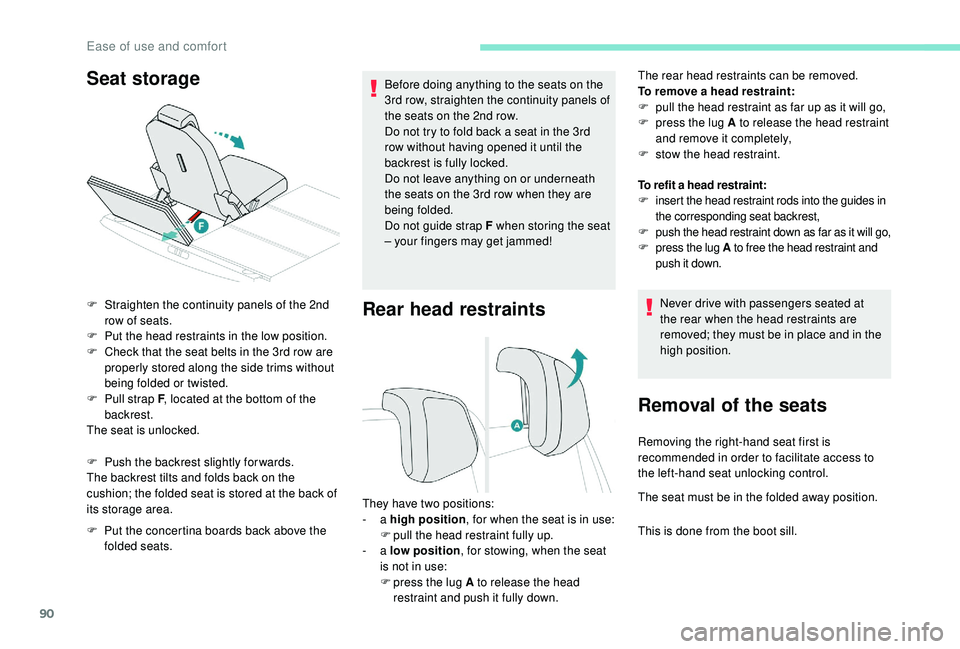
Seat storage
F Straighten the continuity panels of the 2nd
row of seats.
F
P
ut the head restraints in the low position.
F
C
heck that the seat belts in the 3rd row are
properly stored along the side trims without
being folded or twisted.
F
P
ull strap F , located at the bottom of the
backrest.
The seat is unlocked.
F
P
ush the backrest slightly for wards.
The backrest tilts and folds back on the
cushion; the folded seat is stored at the back of
its storage area.
F
P
ut the concertina boards back above the
folded seats. Before doing anything to the seats on the
3rd row, straighten the continuity panels of
the seats on the 2nd row.
Do not try to fold back a seat in the 3rd
row without having opened it until the
backrest is fully locked.
Do not leave anything on or underneath
the seats on the 3rd row when they are
being folded.
Do not guide strap F when storing the seat
– your fingers may get jammed!
They have two positions:
- a high position , for when the seat is in use:
F
p
ull the head restraint fully up.
-
a low position , for stowing, when the seat
is not in use:
F
p
ress the lug A to release the head
restraint and push it fully down. To refit a head restraint:
F
i
nsert the head restraint rods into the guides in
the corresponding seat backrest,
F
p
ush the head restraint down as far as it will go,
F
p
ress the lug A
to free the head restraint and
push it down.
Removing the right-hand seat first is
recommended in order to facilitate access to
the left-hand seat unlocking control.
The seat must be in the folded away position.
This is done from the boot sill.
Ease of use and comfort