2017 NISSAN QUEST steering
[x] Cancel search: steeringPage 473 of 520
9-6Maintenance and schedules
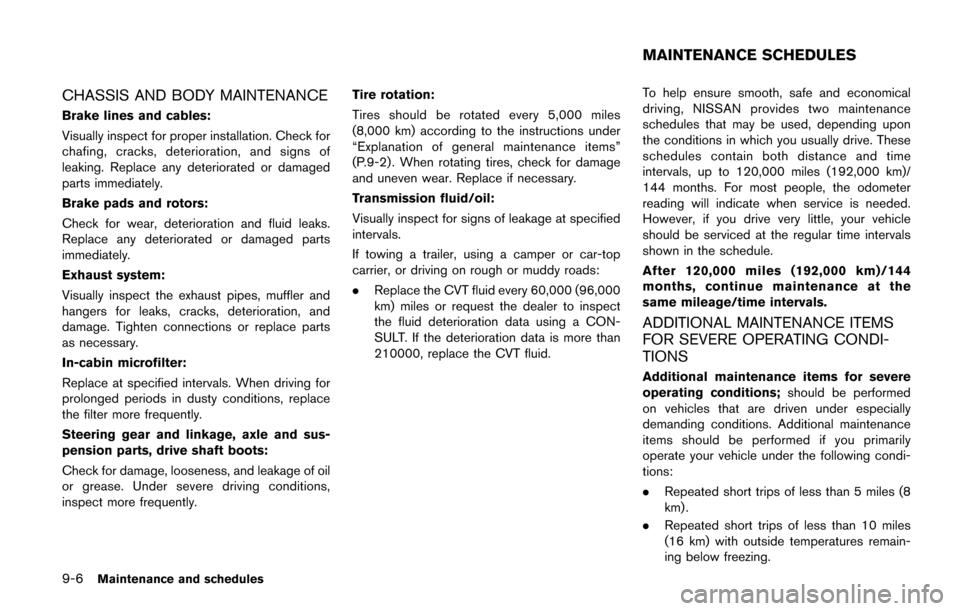
CHASSIS AND BODY MAINTENANCE
Brake lines and cables:
Visually inspect for proper installation. Check for
chafing, cracks, deterioration, and signs of
leaking. Replace any deteriorated or damaged
parts immediately.
Brake pads and rotors:
Check for wear, deterioration and fluid leaks.
Replace any deteriorated or damaged parts
immediately.
Exhaust system:
Visually inspect the exhaust pipes, muffler and
hangers for leaks, cracks, deterioration, and
damage. Tighten connections or replace parts
as necessary.
In-cabin microfilter:
Replace at specified intervals. When driving for
prolonged periods in dusty conditions, replace
the filter more frequently.
Steering gear and linkage, axle and sus-
pension parts, drive shaft boots:
Check for damage, looseness, and leakage of oil
or grease. Under severe driving conditions,
inspect more frequently.Tire rotation:
Tires should be rotated every 5,000 miles
(8,000 km) according to the instructions under
“Explanation of general maintenance items”
(P.9-2) . When rotating tires, check for damage
and uneven wear. Replace if necessary.
Transmission fluid/oil:
Visually inspect for signs of leakage at specified
intervals.
If towing a trailer, using a camper or car-top
carrier, or driving on rough or muddy roads:
.
Replace the CVT fluid every 60,000 (96,000
km) miles or request the dealer to inspect
the fluid deterioration data using a CON-
SULT. If the deterioration data is more than
210000, replace the CVT fluid. To help ensure smooth, safe and economical
driving, NISSAN provides two maintenance
schedules that may be used, depending upon
the conditions in which you usually drive. These
schedules contain both distance and time
intervals, up to 120,000 miles (192,000 km)/
144 months. For most people, the odometer
reading will indicate when service is needed.
However, if you drive very little, your vehicle
should be serviced at the regular time intervals
shown in the schedule.
After 120,000 miles (192,000 km)/144
months, continue maintenance at the
same mileage/time intervals.
ADDITIONAL MAINTENANCE ITEMS
FOR SEVERE OPERATING CONDI-
TIONS
Additional maintenance items for severe
operating conditions;
should be performed
on vehicles that are driven under especially
demanding conditions. Additional maintenance
items should be performed if you primarily
operate your vehicle under the following condi-
tions:
. Repeated short trips of less than 5 miles (8
km) .
. Repeated short trips of less than 10 miles
(16 km) with outside temperatures remain-
ing below freezing.
MAINTENANCE SCHEDULES
Page 478 of 520
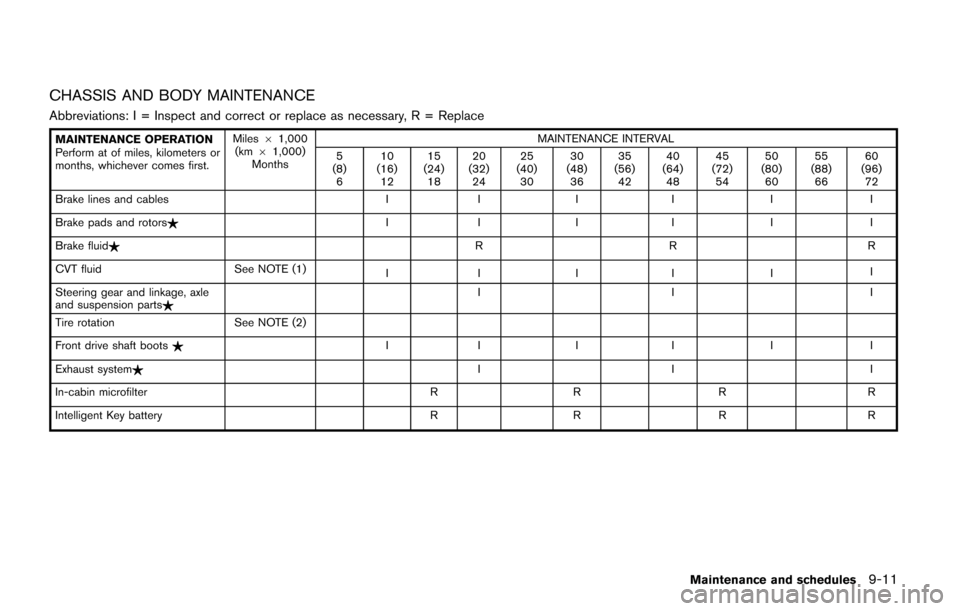
CHASSIS AND BODY MAINTENANCE
Abbreviations: I = Inspect and correct or replace as necessary, R = Replace
MAINTENANCE OPERATION
Perform at of miles, kilometers or
months, whichever comes first.Miles
61,000
(km 61,000)
Months MAINTENANCE INTERVAL
5
(8) 6 10
(16) 12 15
(24) 18 20
(32) 24 25
(40) 30 30
(48) 36 35
(56) 42 40
(64) 48 45
(72) 54 50
(80) 60 55
(88) 66 60
(96) 72
Brake lines and cables II II I I
Brake pads and rotors$ II I I I I
Brake fluid$ RR R
CVT fluid See NOTE (1)
II I I I I
Steering gear and linkage, axle
and suspension parts$ II I
Tire rotation See NOTE (2)
Front drive shaft boots $ II I I I I
Exhaust system$ II I
In-cabin microfilter RR R R
Intelligent Key battery RR R R
Maintenance and schedules9-11
Page 479 of 520
9-12Maintenance and schedules
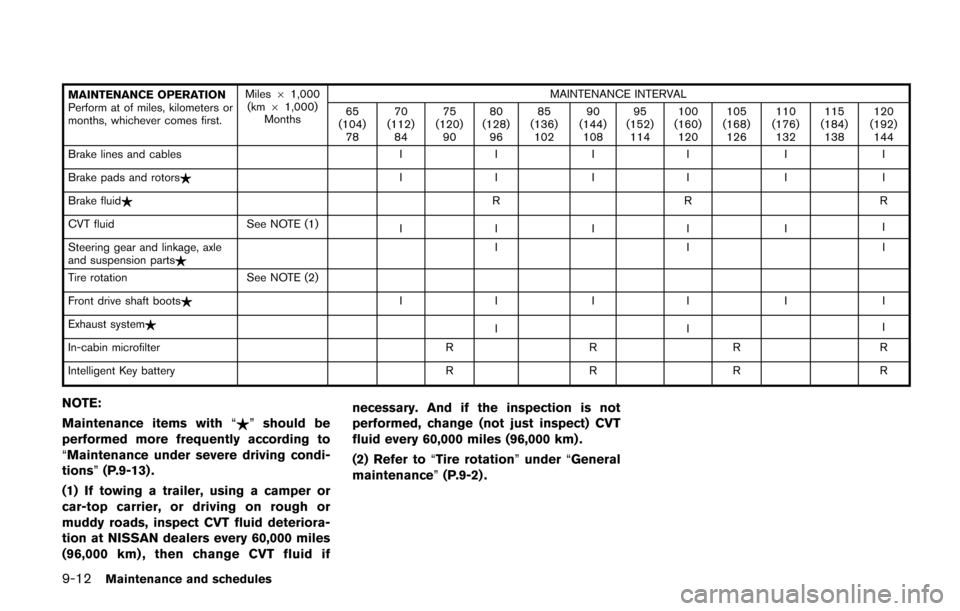
MAINTENANCE OPERATION
Perform at of miles, kilometers or
months, whichever comes first.Miles
61,000
(km 61,000)
Months MAINTENANCE INTERVAL
65
(104) 78 70
(112) 84 75
(120) 90 80
(128) 96 85
(136) 102 90
(144) 108 95
(152) 114 100
(160) 120 105
(168) 126 110
(176) 132 115
(184) 138 120
(192) 144
Brake lines and cables II II I I
Brake pads and rotors$ II II I I
Brake fluid$ RR R
CVT fluid See NOTE (1)
II II I I
Steering gear and linkage, axle
and suspension parts$ II I
Tire rotation See NOTE (2)
Front drive shaft boots$ II II I I
Exhaust system$ III
In-cabin microfilter RRR R
Intelligent Key battery RRR R
NOTE:
Maintenance items with “$”should be
performed more frequently according to
“Maintenance under severe driving condi-
tions” (P.9-13) .
(1) If towing a trailer, using a camper or
car-top carrier, or driving on rough or
muddy roads, inspect CVT fluid deteriora-
tion at NISSAN dealers every 60,000 miles
(96,000 km) , then change CVT fluid if necessary. And if the inspection is not
performed, change (not just inspect) CVT
fluid every 60,000 miles (96,000 km) .
(2) Refer to
“Tire rotation” under“General
maintenance” (P.9-2) .
Page 480 of 520
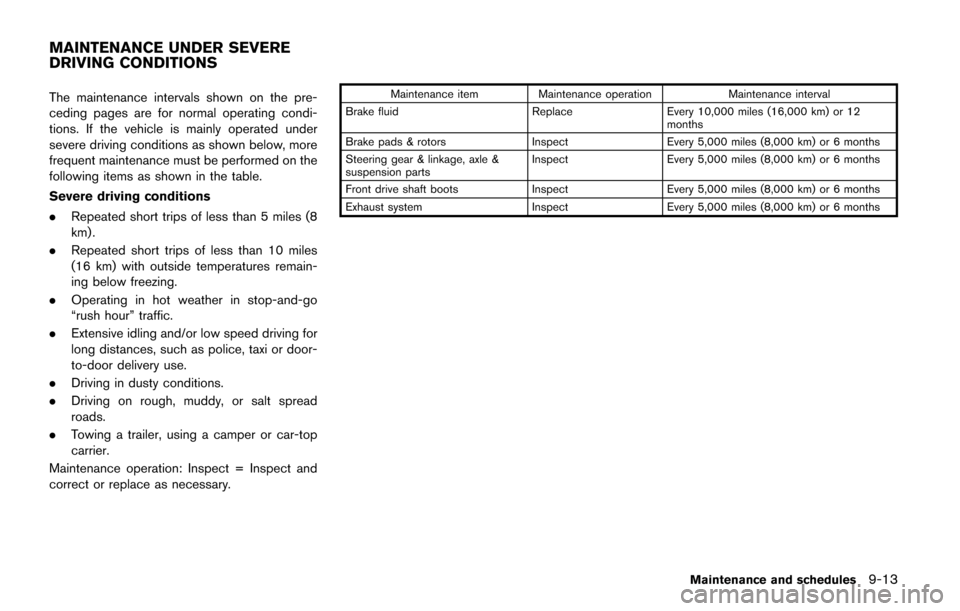
The maintenance intervals shown on the pre-
ceding pages are for normal operating condi-
tions. If the vehicle is mainly operated under
severe driving conditions as shown below, more
frequent maintenance must be performed on the
following items as shown in the table.
Severe driving conditions
.Repeated short trips of less than 5 miles (8
km) .
. Repeated short trips of less than 10 miles
(16 km) with outside temperatures remain-
ing below freezing.
. Operating in hot weather in stop-and-go
“rush hour” traffic.
. Extensive idling and/or low speed driving for
long distances, such as police, taxi or door-
to-door delivery use.
. Driving in dusty conditions.
. Driving on rough, muddy, or salt spread
roads.
. Towing a trailer, using a camper or car-top
carrier.
Maintenance operation: Inspect = Inspect and
correct or replace as necessary.Maintenance item Maintenance operation Maintenance interval
Brake fluid ReplaceEvery 10,000 miles (16,000 km) or 12
months
Brake pads & rotors InspectEvery 5,000 miles (8,000 km) or 6 months
Steering gear & linkage, axle &
suspension parts Inspect
Every 5,000 miles (8,000 km) or 6 months
Front drive shaft boots InspectEvery 5,000 miles (8,000 km) or 6 months
Exhaust system InspectEvery 5,000 miles (8,000 km) or 6 months
Maintenance and schedules9-13
MAINTENANCE UNDER SEVERE
DRIVING CONDITIONS
Page 485 of 520
10-2Technical and consumer information
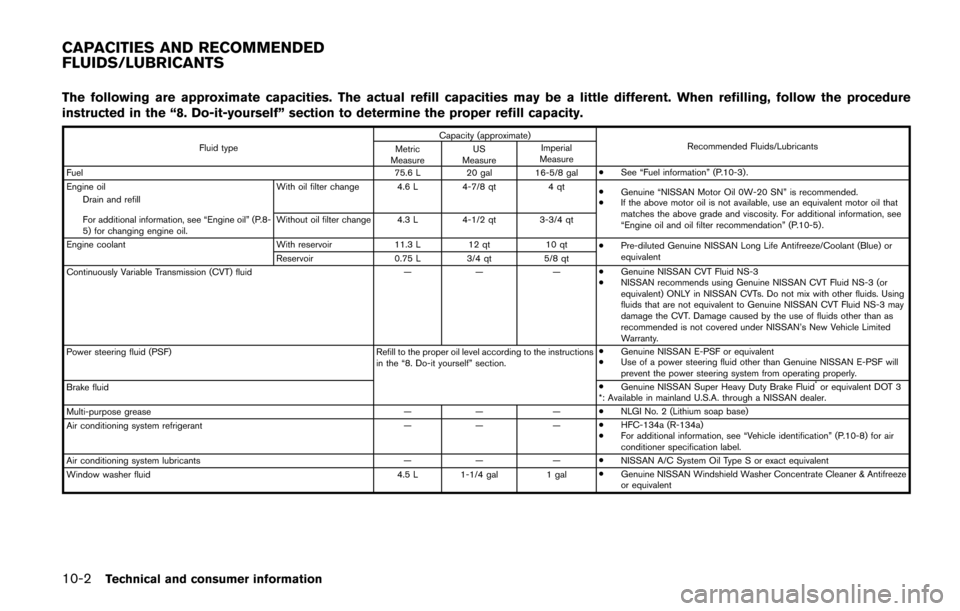
The following are approximate capacities. The actual refill capacities may be a little different. When refilling, follow the procedure
instructed in the “8. Do-it-yourself” section to determine the proper refill capacity.
Fluid typeCapacity (approximate)
Recommended Fluids/Lubricants
Metric
Measure US
Measure Imperial
Measure
Fuel 75.6 L 20 gal 16-5/8 gal.
See “Fuel information” (P.10-3).
Engine oil With oil filter change 4.6 L 4-7/8 qt 4 qt
.Genuine “NISSAN Motor Oil 0W-20 SN” is recommended.
. If the above motor oil is not available, use an equivalent motor oil that
matches the above grade and viscosity. For additional information, see
“Engine oil and oil filter recommendation” (P.10-5) .
Drain and refill
For additional information, see “Engine oil” (P.8-
5) for changing engine oil.
Without oil filter change 4.3 L 4-1/2 qt 3-3/4 qt
Engine coolant With reservoir11.3 L12 qt 10 qt
.
Pre-diluted Genuine NISSAN Long Life Antifreeze/Coolant (Blue) or
equivalent
Reservoir 0.75 L 3/4 qt 5/8 qt
Continuously Variable Transmission (CVT) fluid —— —.
Genuine NISSAN CVT Fluid NS-3
. NISSAN recommends using Genuine NISSAN CVT Fluid NS-3 (or
equivalent) ONLY in NISSAN CVTs. Do not mix with other fluids. Using
fluids that are not equivalent to Genuine NISSAN CVT Fluid NS-3 may
damage the CVT. Damage caused by the use of fluids other than as
recommended is not covered under NISSAN’s New Vehicle Limited
Warranty.
Power steering fluid (PSF) Refill to the proper oil level according to the instructions
in the “8. Do-it yourself” section..
Genuine NISSAN E-PSF or equivalent
. Use of a power steering fluid other than Genuine NISSAN E-PSF will
prevent the power steering system from operating properly.
Brake fluid .
Genuine NISSAN Super Heavy Duty Brake Fluid
*or equivalent DOT 3
*: Available in mainland U.S.A. through a NISSAN dealer.
Multi-purpose grease —— —.
NLGI No. 2 (Lithium soap base)
Air conditioning system refrigerant —— —.
HFC-134a (R-134a)
. For additional information, see “Vehicle identification” (P.10-8) for air
conditioner specification label.
Air conditioning system lubricants —— —.
NISSAN A/C System Oil Type S or exact equivalent
Window washer fluid 4.5 L 1-1/4 gal1 gal.
Genuine NISSAN Windshield Washer Concentrate Cleaner & Antifreeze
or equivalent
CAPACITIES AND RECOMMENDED
FLUIDS/LUBRICANTS
Page 505 of 520
10-22Technical and consumer information
.Check your hitch, trailer tire pressure,
vehicle tire pressure, trailer light operation,
and trailer wheel lug nuts every time you
attach a trailer to the vehicle.
. Be certain your rearview mirrors conform to
all federal, state or local regulations. If not,
install any mirrors required for towing before
driving the vehicle.
. Determine the overall height of the vehicle
and trailer so the required clearance is
known.
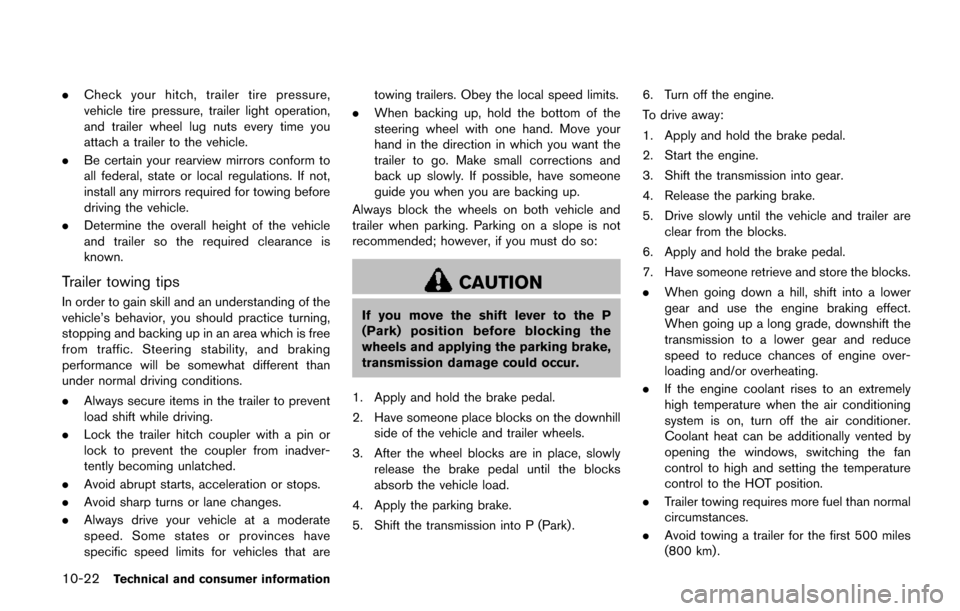
Trailer towing tips
In order to gain skill and an understanding of the
vehicle’s behavior, you should practice turning,
stopping and backing up in an area which is free
from traffic. Steering stability, and braking
performance will be somewhat different than
under normal driving conditions.
.Always secure items in the trailer to prevent
load shift while driving.
. Lock the trailer hitch coupler with a pin or
lock to prevent the coupler from inadver-
tently becoming unlatched.
. Avoid abrupt starts, acceleration or stops.
. Avoid sharp turns or lane changes.
. Always drive your vehicle at a moderate
speed. Some states or provinces have
specific speed limits for vehicles that are towing trailers. Obey the local speed limits.
. When backing up, hold the bottom of the
steering wheel with one hand. Move your
hand in the direction in which you want the
trailer to go. Make small corrections and
back up slowly. If possible, have someone
guide you when you are backing up.
Always block the wheels on both vehicle and
trailer when parking. Parking on a slope is not
recommended; however, if you must do so:
CAUTION
If you move the shift lever to the P
(Park) position before blocking the
wheels and applying the parking brake,
transmission damage could occur.
1. Apply and hold the brake pedal.
2. Have someone place blocks on the downhill side of the vehicle and trailer wheels.
3. After the wheel blocks are in place, slowly release the brake pedal until the blocks
absorb the vehicle load.
4. Apply the parking brake.
5. Shift the transmission into P (Park) . 6. Turn off the engine.
To drive away:
1. Apply and hold the brake pedal.
2. Start the engine.
3. Shift the transmission into gear.
4. Release the parking brake.
5. Drive slowly until the vehicle and trailer are
clear from the blocks.
6. Apply and hold the brake pedal.
7. Have someone retrieve and store the blocks.
. When going down a hill, shift into a lower
gear and use the engine braking effect.
When going up a long grade, downshift the
transmission to a lower gear and reduce
speed to reduce chances of engine over-
loading and/or overheating.
. If the engine coolant rises to an extremely
high temperature when the air conditioning
system is on, turn off the air conditioner.
Coolant heat can be additionally vented by
opening the windows, switching the fan
control to high and setting the temperature
control to the HOT position.
. Trailer towing requires more fuel than normal
circumstances.
. Avoid towing a trailer for the first 500 miles
(800 km) .
Page 506 of 520
.Have your vehicle serviced more often than
at intervals specified in the recommended
maintenance schedule shown in the “9.
Maintenance and schedules” section.
. When making a turn, your trailer wheels will
be closer to the inside of the turn than your
vehicle wheels. To compensate for this,
make a larger than normal turning radius
during the turn.
. Crosswinds and rough roads will adversely
affect vehicle/trailer handling, possibly caus-
ing vehicle sway. When being passed by
larger vehicles, be prepared for possible
changes in crosswinds that could affect
vehicle handling. If swaying does occur,
firmly grip the steering wheel, steer straight
ahead, and immediately (but gradually)
reduce vehicle speed. This combination will
help stabilize the vehicle. Never increase
speed.
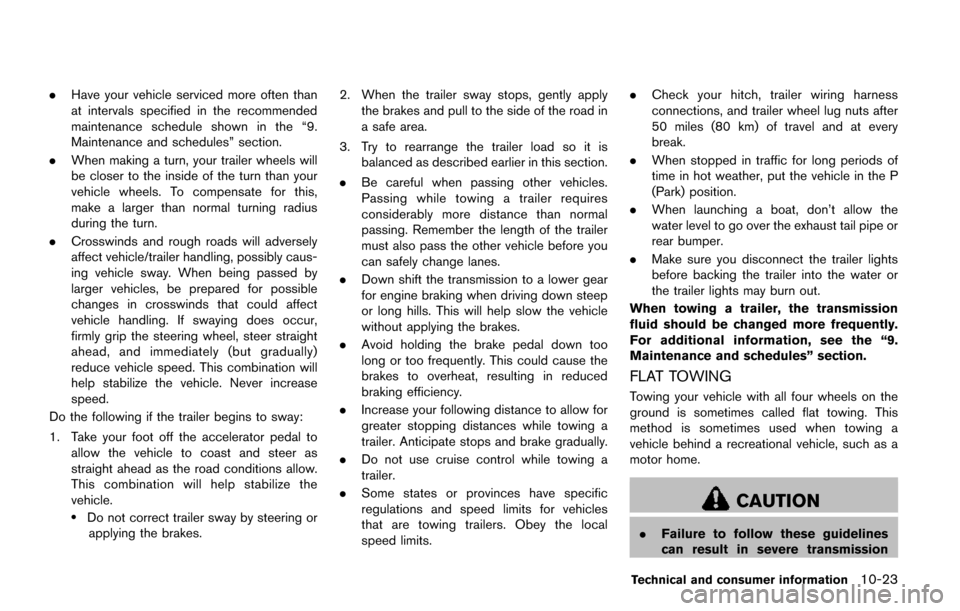
Do the following if the trailer begins to sway:
1. Take your foot off the accelerator pedal to allow the vehicle to coast and steer as
straight ahead as the road conditions allow.
This combination will help stabilize the
vehicle.
.Do not correct trailer sway by steering orapplying the brakes. 2. When the trailer sway stops, gently apply
the brakes and pull to the side of the road in
a safe area.
3. Try to rearrange the trailer load so it is balanced as described earlier in this section.
. Be careful when passing other vehicles.
Passing while towing a trailer requires
considerably more distance than normal
passing. Remember the length of the trailer
must also pass the other vehicle before you
can safely change lanes.
. Down shift the transmission to a lower gear
for engine braking when driving down steep
or long hills. This will help slow the vehicle
without applying the brakes.
. Avoid holding the brake pedal down too
long or too frequently. This could cause the
brakes to overheat, resulting in reduced
braking efficiency.
. Increase your following distance to allow for
greater stopping distances while towing a
trailer. Anticipate stops and brake gradually.
. Do not use cruise control while towing a
trailer.
. Some states or provinces have specific
regulations and speed limits for vehicles
that are towing trailers. Obey the local
speed limits. .
Check your hitch, trailer wiring harness
connections, and trailer wheel lug nuts after
50 miles (80 km) of travel and at every
break.
. When stopped in traffic for long periods of
time in hot weather, put the vehicle in the P
(Park) position.
. When launching a boat, don’t allow the
water level to go over the exhaust tail pipe or
rear bumper.
. Make sure you disconnect the trailer lights
before backing the trailer into the water or
the trailer lights may burn out.
When towing a trailer, the transmission
fluid should be changed more frequently.
For additional information, see the “9.
Maintenance and schedules” section.
FLAT TOWING
Towing your vehicle with all four wheels on the
ground is sometimes called flat towing. This
method is sometimes used when towing a
vehicle behind a recreational vehicle, such as a
motor home.
CAUTION
. Failure to follow these guidelines
can result in severe transmission
Technical and consumer information10-23
Page 512 of 520
11 Index
A
A/C (Air Conditioner) operation ............................. 4-49
ABS (Anti-lock Braking System) ............................ 5-31
Advanced air bag system ......................................... 1-54
Aiming control, Headlights ....................................... 2-37
Air bag systemAdvanced air bag system .................................. 1-54
Front passenger air bag and status light ...... 1-55
Front-seat mounted side-impact
supplemental air bag system ............................ 1-61
Roof-mounted curtain side-impact
supplemental air bag system ............................ 1-61
Air bag warning labels .............................................. 1-63
Air bag warning light ..................................... 1-64, 2-15
Air cleaner housing filter ........................................... 8-14
Air conditioner Air conditioner operation ................................... 4-47
Air conditioner service ....................................... 4-60
Air conditioner specification label ................. 10-10
Air conditioning system refrigerant and
lubricant recommendations .................... 4-60, 10-6
In-cabin microfilter ............................................... 4-60
Alarm, How to stop alarm (see vehicle
security system) .......................................................... 2-30
Alcohol, drugs and driving ......................................... 5-8
Antenna ...................................................................... 4-109
Anti-lock Braking System (ABS) ............................ 5-31
Anti-lock braking system (ABS) warning light .... 2-12
Appearance care Exterior appearance care ..................................... 7-2
Interior appearance care ....................................... 7-4
Armrests .......................................................................... 1-7
Around view
Šmonitor ............................................... 4-32
Audible reminders ...................................................... 2-18 Audio operation precautions ................................... 4-61
Audio system ............................................................... 4-61
Steering wheel audio controls ....................... 4-108
Auto closure ................................................................. 3-29
Autolight system ......................................................... 2-34
Automatic Air conditioner ...................................................... 4-54
Door locks ................................................................ 3-7
Drive positioner .................................................... 3-36
Moonroof ............................................................... 2-54
Seat positioner ..................................................... 3-36
AUX (Auxiliary) input .................................................. 4-85
Avoiding collision and rollover .................................. 5-6
B
Back door (See liftgate) ........................................... 3-26
Battery ........................................................................... 8-10 Battery saver system .......................................... 2-36
Intelligent Key ....................................................... 8-20
Variable voltage control system ....................... 8-12
Before starting the engine ....................................... 5-11
Blind Spot Warning (BSW) system ...................... 5-17
Blind Spot Warning (BSW) system
warning light ................................................................ 2-12
Bluetooth
Šhands-free phone system
(Type A) ..................................................................... 4-122
Bluetooth
Šhands-free phone system
(Type B) ..................................................................... 4-133
Bluetooth
Šhands-free phone system
(Type C) ..................................................................... 4-146
Bluetooth
Šstreaming audio .................................. 4-101
Booster seats .............................................................. 1-45
Brake
Anti-lock Braking System (ABS) ..................... 5-31
Brake fluid ................................................................ 8-9 Brake system ........................................................ 5-30
Parking brake operation ..................................... 5-16
Warning light ........................................................ 2-12
Break-in schedule ....................................................... 5-27
Brightness control Display ON/OFF button ..................................... 4-10
Instrument panel .................................................. 2-38
Bulb replacement ....................................................... 8-22
C
Cabin air filter .............................................................. 4-60
Capacities and
recommended fluids/lubricants ............................... 10-2
Car phone or CB radio .......................................... 4-121
Cargo floor box ........................................................... 2-48
Cargo lights ................................................................. 2-60
Catalytic converter, Three way catalyst .................. 5-3
CD/DVD/USB memory care and cleaning ....... 4-107
Center multi-function control panel ......................... 4-5
Chassis and body maintenance ............................. 9-11
Checking lights ........................................................... 2-12
Child restraints ............................................................ 1-27 Booster seats ....................................................... 1-45
LATCH system ..................................................... 1-29
Precautions on child restraints ........................ 1-27
Top tether strap ................................................... 1-32
Child safety .................................................................. 1-24
Chimes Audible reminders ............................................... 2-18
Seat belt warning light and chime .................. 2-15
Circuit breaker, Fusible link ..................................... 8-18
Cleaning exterior and interior ........................... 7-2, 7-4
Coat hooks ................................................................... 2-51
Cockpit ............................................................................ 2-3
Cold weather driving ................................................. 5-34