2017 NISSAN QUEST brake
[x] Cancel search: brakePage 503 of 520
10-20Technical and consumer information
TOWING SAFETY
Trailer hitch
Choose a proper hitch for your vehicle and
trailer. A genuine NISSAN trailer hitch is
available from a NISSAN dealer. Make sure the
trailer hitch is securely attached to the vehicle to
help avoid personal injury or property damage
due to sway caused by crosswinds, rough road
surfaces or passing trucks.
WARNING
Trailer hitch components have specific
weight ratings. Your vehicle may be
capable of towing a trailer heavier than
the weight rating of the hitch compo-
nents. Never exceed the weight rating
of the hitch components. Doing so can
cause serious personal injury or prop-
erty damage.
Hitch ball
Choose a hitch ball of the proper size and
weight rating for your trailer:
.The required hitch ball size is stamped on
most trailer couplers. Most hitch balls also
have the size printed on top of the ball. .
Choose the proper class hitch ball based on
the trailer weight.
. The diameter of the threaded shank of the
hitch ball must be matched to the ball mount
hole diameter. The hitch ball shank should
be no more than 1/16´´ smaller than the hole
in the ball mount.
. The threaded shank of the hitch ball must be
long enough to be properly secured to the
ball mount. There should be at least 2
threads showing beyond the lock washer
and nut.
Sway control device
Sudden maneuvers, wind gusts and buffeting
caused by other vehicles can affect trailer
handling. Sway control devices may be used to
help control these affects. If you choose to use
one, contact a reputable trailer hitch supplier to
make sure the sway control device will work with
the vehicle, hitch, trailer and the trailer’s brake
system. Follow the instructions provided by the
manufacturer for installing and using the sway
control device.
Class I hitch
Class I trailer hitch equipment (receiver, ball
mount and hitch ball) can be used to tow trailers
of a maximum weight of 2,000 lb (907 kg) .
Class II hitch
Class II trailer hitch equipment (receiver, ball
mount and hitch ball) can be used to tow trailers
of a maximum weight of 3,500 lb (1,588 kg).
CAUTION
.Use hitches designed for your vehi-
cle when towing. Check with your
NISSAN dealer for availability of
suitable genuine NISSAN hitches.
. The hitch should not be attached to
or affect the operation of the im-
pact-absorbing bumper.
. Do not use axle-mounted hitches.
. Do not modify the vehicle exhaust
system, brake system, etc. to install
a trailer hitch.
. To reduce the possibility of addi-
tional damage if your vehicle is
struck from the rear, where practi-
cal, remove the hitch and/or recei-
ver when not in use. After the hitch
Page 504 of 520
is removed, seal the bolt holes to
prevent exhaust fumes, water or
dust from entering the passenger
compartment.
. Regularly check that all trailer hitch
mounting bolts are securely
mounted.
Tire pressures
.When towing a trailer, inflate the
vehicle tires to the recommended
cold tire pressure indicated on the
Tire and Loading Information label.
.Trailer tire condition, size, load rating
and proper inflation pressure should
be in accordance with the trailer and
tire manufacturers’ specifications.
Safety chains
Always use a suitable chain between your
vehicle and the trailer. The safety chains should
be crossed and should be attached to the hitch,
not to the vehicle bumper or axle. The safety
chains can be attached to the bumper if the
hitch ball is mounted to the bumper. Be sure to
leave enough slack in the chains to permit
turning corners.
Trailer lights
CAUTION
When splicing into the vehicle electrical
system, a commercially available
power-type module/converter must be
used to provide power for all trailer
lighting. This unit uses the vehicle
battery as a direct power source for all
trailer lights while using the vehicle tail
light, stoplight and turn signal circuits
as a signal source. The module/con-
verter must draw no more than 15
milliamps from the stop and tail lamp
circuits. Using a module/converter that
exceeds these power requirements may
damage the vehicle’s electrical system.
See a reputable trailer dealer to obtain
the proper equipment and to have it
installed.
Trailer lights should comply with federal and/or
local regulations. For assistance in hooking up
trailer lights, it is recommended you contact a
NISSAN dealer or reputable trailer dealer.
Trailer brakes
If your trailer is equipped with a braking system,
make sure it conforms to federal and/or local
regulations and that it is properly installed.
WARNING
Never connect a trailer brake system
directly to the vehicle brake system.
Pre-towing tips
. Be certain your vehicle maintains a level
position when a loaded or unloaded trailer is
hitched. Do not drive the vehicle if it has an
abnormal nose-up or nose-down condition;
check for improper tongue load, overload,
worn suspension or other possible causes
of either condition.
. Always secure items in the trailer to prevent
load shift while driving.
. Keep the cargo load as low as possible in
the trailer to keep the trailer center of gravity
low.
. Load the trailer so approximately 60% of the
trailer load is in the front half and 40% is in
the back half. Also make sure the load is
balanced side to side.
Technical and consumer information10-21
Page 505 of 520
10-22Technical and consumer information
.Check your hitch, trailer tire pressure,
vehicle tire pressure, trailer light operation,
and trailer wheel lug nuts every time you
attach a trailer to the vehicle.
. Be certain your rearview mirrors conform to
all federal, state or local regulations. If not,
install any mirrors required for towing before
driving the vehicle.
. Determine the overall height of the vehicle
and trailer so the required clearance is
known.
Trailer towing tips
In order to gain skill and an understanding of the
vehicle’s behavior, you should practice turning,
stopping and backing up in an area which is free
from traffic. Steering stability, and braking
performance will be somewhat different than
under normal driving conditions.
.Always secure items in the trailer to prevent
load shift while driving.
. Lock the trailer hitch coupler with a pin or
lock to prevent the coupler from inadver-
tently becoming unlatched.
. Avoid abrupt starts, acceleration or stops.
. Avoid sharp turns or lane changes.
. Always drive your vehicle at a moderate
speed. Some states or provinces have
specific speed limits for vehicles that are towing trailers. Obey the local speed limits.
. When backing up, hold the bottom of the
steering wheel with one hand. Move your
hand in the direction in which you want the
trailer to go. Make small corrections and
back up slowly. If possible, have someone
guide you when you are backing up.
Always block the wheels on both vehicle and
trailer when parking. Parking on a slope is not
recommended; however, if you must do so:
CAUTION
If you move the shift lever to the P
(Park) position before blocking the
wheels and applying the parking brake,
transmission damage could occur.
1. Apply and hold the brake pedal.
2. Have someone place blocks on the downhill side of the vehicle and trailer wheels.
3. After the wheel blocks are in place, slowly release the brake pedal until the blocks
absorb the vehicle load.
4. Apply the parking brake.
5. Shift the transmission into P (Park) . 6. Turn off the engine.
To drive away:
1. Apply and hold the brake pedal.
2. Start the engine.
3. Shift the transmission into gear.
4. Release the parking brake.
5. Drive slowly until the vehicle and trailer are
clear from the blocks.
6. Apply and hold the brake pedal.
7. Have someone retrieve and store the blocks.
. When going down a hill, shift into a lower
gear and use the engine braking effect.
When going up a long grade, downshift the
transmission to a lower gear and reduce
speed to reduce chances of engine over-
loading and/or overheating.
. If the engine coolant rises to an extremely
high temperature when the air conditioning
system is on, turn off the air conditioner.
Coolant heat can be additionally vented by
opening the windows, switching the fan
control to high and setting the temperature
control to the HOT position.
. Trailer towing requires more fuel than normal
circumstances.
. Avoid towing a trailer for the first 500 miles
(800 km) .
Page 506 of 520
.Have your vehicle serviced more often than
at intervals specified in the recommended
maintenance schedule shown in the “9.
Maintenance and schedules” section.
. When making a turn, your trailer wheels will
be closer to the inside of the turn than your
vehicle wheels. To compensate for this,
make a larger than normal turning radius
during the turn.
. Crosswinds and rough roads will adversely
affect vehicle/trailer handling, possibly caus-
ing vehicle sway. When being passed by
larger vehicles, be prepared for possible
changes in crosswinds that could affect
vehicle handling. If swaying does occur,
firmly grip the steering wheel, steer straight
ahead, and immediately (but gradually)
reduce vehicle speed. This combination will
help stabilize the vehicle. Never increase
speed.
Do the following if the trailer begins to sway:
1. Take your foot off the accelerator pedal to allow the vehicle to coast and steer as
straight ahead as the road conditions allow.
This combination will help stabilize the
vehicle.
.Do not correct trailer sway by steering orapplying the brakes. 2. When the trailer sway stops, gently apply
the brakes and pull to the side of the road in
a safe area.
3. Try to rearrange the trailer load so it is balanced as described earlier in this section.
. Be careful when passing other vehicles.
Passing while towing a trailer requires
considerably more distance than normal
passing. Remember the length of the trailer
must also pass the other vehicle before you
can safely change lanes.
. Down shift the transmission to a lower gear
for engine braking when driving down steep
or long hills. This will help slow the vehicle
without applying the brakes.
. Avoid holding the brake pedal down too
long or too frequently. This could cause the
brakes to overheat, resulting in reduced
braking efficiency.
. Increase your following distance to allow for
greater stopping distances while towing a
trailer. Anticipate stops and brake gradually.
. Do not use cruise control while towing a
trailer.
. Some states or provinces have specific
regulations and speed limits for vehicles
that are towing trailers. Obey the local
speed limits. .
Check your hitch, trailer wiring harness
connections, and trailer wheel lug nuts after
50 miles (80 km) of travel and at every
break.
. When stopped in traffic for long periods of
time in hot weather, put the vehicle in the P
(Park) position.
. When launching a boat, don’t allow the
water level to go over the exhaust tail pipe or
rear bumper.
. Make sure you disconnect the trailer lights
before backing the trailer into the water or
the trailer lights may burn out.
When towing a trailer, the transmission
fluid should be changed more frequently.
For additional information, see the “9.
Maintenance and schedules” section.
FLAT TOWING
Towing your vehicle with all four wheels on the
ground is sometimes called flat towing. This
method is sometimes used when towing a
vehicle behind a recreational vehicle, such as a
motor home.
CAUTION
. Failure to follow these guidelines
can result in severe transmission
Technical and consumer information10-23
Page 510 of 520
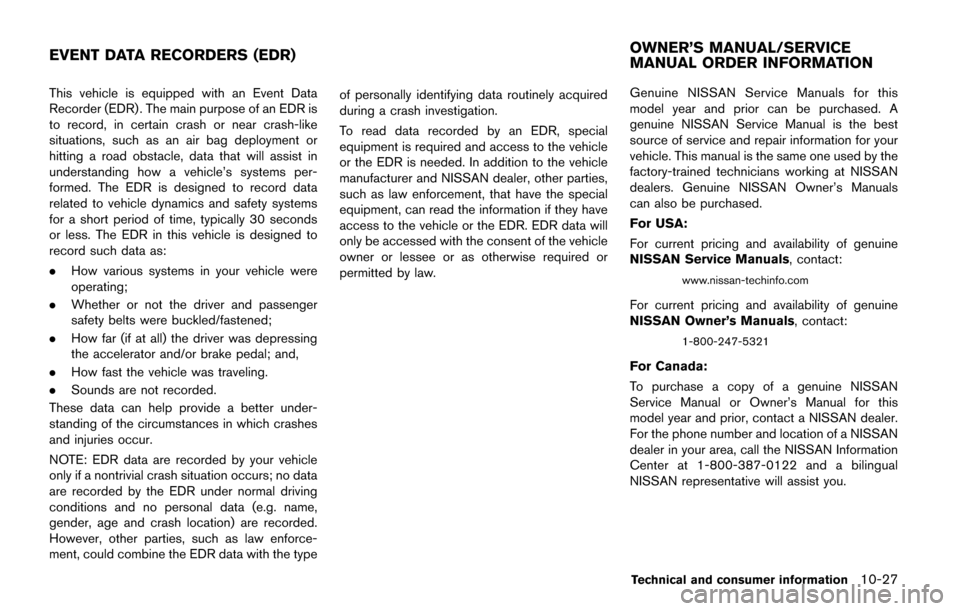
This vehicle is equipped with an Event Data
Recorder (EDR) . The main purpose of an EDR is
to record, in certain crash or near crash-like
situations, such as an air bag deployment or
hitting a road obstacle, data that will assist in
understanding how a vehicle’s systems per-
formed. The EDR is designed to record data
related to vehicle dynamics and safety systems
for a short period of time, typically 30 seconds
or less. The EDR in this vehicle is designed to
record such data as:
.How various systems in your vehicle were
operating;
. Whether or not the driver and passenger
safety belts were buckled/fastened;
. How far (if at all) the driver was depressing
the accelerator and/or brake pedal; and,
. How fast the vehicle was traveling.
. Sounds are not recorded.
These data can help provide a better under-
standing of the circumstances in which crashes
and injuries occur.
NOTE: EDR data are recorded by your vehicle
only if a nontrivial crash situation occurs; no data
are recorded by the EDR under normal driving
conditions and no personal data (e.g. name,
gender, age and crash location) are recorded.
However, other parties, such as law enforce-
ment, could combine the EDR data with the type of personally identifying data routinely acquired
during a crash investigation.
To read data recorded by an EDR, special
equipment is required and access to the vehicle
or the EDR is needed. In addition to the vehicle
manufacturer and NISSAN dealer, other parties,
such as law enforcement, that have the special
equipment, can read the information if they have
access to the vehicle or the EDR. EDR data will
only be accessed with the consent of the vehicle
owner or lessee or as otherwise required or
permitted by law.
Genuine NISSAN Service Manuals for this
model year and prior can be purchased. A
genuine NISSAN Service Manual is the best
source of service and repair information for your
vehicle. This manual is the same one used by the
factory-trained technicians working at NISSAN
dealers. Genuine NISSAN Owner’s Manuals
can also be purchased.
For USA:
For current pricing and availability of genuine
NISSAN Service Manuals, contact:
www.nissan-techinfo.com
For current pricing and availability of genuine
NISSAN Owner’s Manuals, contact:
1-800-247-5321
For Canada:
To purchase a copy of a genuine NISSAN
Service Manual or Owner’s Manual for this
model year and prior, contact a NISSAN dealer.
For the phone number and location of a NISSAN
dealer in your area, call the NISSAN Information
Center at 1-800-387-0122 and a bilingual
NISSAN representative will assist you.
Technical and consumer information10-27
EVENT DATA RECORDERS (EDR)
OWNER’S MANUAL/SERVICE
MANUAL ORDER INFORMATION
Page 512 of 520
11 Index
A
A/C (Air Conditioner) operation ............................. 4-49
ABS (Anti-lock Braking System) ............................ 5-31
Advanced air bag system ......................................... 1-54
Aiming control, Headlights ....................................... 2-37
Air bag systemAdvanced air bag system .................................. 1-54
Front passenger air bag and status light ...... 1-55
Front-seat mounted side-impact
supplemental air bag system ............................ 1-61
Roof-mounted curtain side-impact
supplemental air bag system ............................ 1-61
Air bag warning labels .............................................. 1-63
Air bag warning light ..................................... 1-64, 2-15
Air cleaner housing filter ........................................... 8-14
Air conditioner Air conditioner operation ................................... 4-47
Air conditioner service ....................................... 4-60
Air conditioner specification label ................. 10-10
Air conditioning system refrigerant and
lubricant recommendations .................... 4-60, 10-6
In-cabin microfilter ............................................... 4-60
Alarm, How to stop alarm (see vehicle
security system) .......................................................... 2-30
Alcohol, drugs and driving ......................................... 5-8
Antenna ...................................................................... 4-109
Anti-lock Braking System (ABS) ............................ 5-31
Anti-lock braking system (ABS) warning light .... 2-12
Appearance care Exterior appearance care ..................................... 7-2
Interior appearance care ....................................... 7-4
Armrests .......................................................................... 1-7
Around view
Šmonitor ............................................... 4-32
Audible reminders ...................................................... 2-18 Audio operation precautions ................................... 4-61
Audio system ............................................................... 4-61
Steering wheel audio controls ....................... 4-108
Auto closure ................................................................. 3-29
Autolight system ......................................................... 2-34
Automatic Air conditioner ...................................................... 4-54
Door locks ................................................................ 3-7
Drive positioner .................................................... 3-36
Moonroof ............................................................... 2-54
Seat positioner ..................................................... 3-36
AUX (Auxiliary) input .................................................. 4-85
Avoiding collision and rollover .................................. 5-6
B
Back door (See liftgate) ........................................... 3-26
Battery ........................................................................... 8-10 Battery saver system .......................................... 2-36
Intelligent Key ....................................................... 8-20
Variable voltage control system ....................... 8-12
Before starting the engine ....................................... 5-11
Blind Spot Warning (BSW) system ...................... 5-17
Blind Spot Warning (BSW) system
warning light ................................................................ 2-12
Bluetooth
Šhands-free phone system
(Type A) ..................................................................... 4-122
Bluetooth
Šhands-free phone system
(Type B) ..................................................................... 4-133
Bluetooth
Šhands-free phone system
(Type C) ..................................................................... 4-146
Bluetooth
Šstreaming audio .................................. 4-101
Booster seats .............................................................. 1-45
Brake
Anti-lock Braking System (ABS) ..................... 5-31
Brake fluid ................................................................ 8-9 Brake system ........................................................ 5-30
Parking brake operation ..................................... 5-16
Warning light ........................................................ 2-12
Break-in schedule ....................................................... 5-27
Brightness control Display ON/OFF button ..................................... 4-10
Instrument panel .................................................. 2-38
Bulb replacement ....................................................... 8-22
C
Cabin air filter .............................................................. 4-60
Capacities and
recommended fluids/lubricants ............................... 10-2
Car phone or CB radio .......................................... 4-121
Cargo floor box ........................................................... 2-48
Cargo lights ................................................................. 2-60
Catalytic converter, Three way catalyst .................. 5-3
CD/DVD/USB memory care and cleaning ....... 4-107
Center multi-function control panel ......................... 4-5
Chassis and body maintenance ............................. 9-11
Checking lights ........................................................... 2-12
Child restraints ............................................................ 1-27 Booster seats ....................................................... 1-45
LATCH system ..................................................... 1-29
Precautions on child restraints ........................ 1-27
Top tether strap ................................................... 1-32
Child safety .................................................................. 1-24
Chimes Audible reminders ............................................... 2-18
Seat belt warning light and chime .................. 2-15
Circuit breaker, Fusible link ..................................... 8-18
Cleaning exterior and interior ........................... 7-2, 7-4
Coat hooks ................................................................... 2-51
Cockpit ............................................................................ 2-3
Cold weather driving ................................................. 5-34
Page 513 of 520
11-2
Compact Disc (CD) player (See
audio system) .............................................................. 4-90
Compass ........................................................................ 2-8
Console box ................................................................. 2-47
Continuously Variable Transmission (CVT) fluid ... 8-8
Controls, Control panel ............................................... 4-5
CoolantCapacities and
recommended fluids/lubricants ........................ 10-2
Changing engine coolant ..................................... 8-5
Checking engine coolant level ............................ 8-5
Corrosion protection .................................................... 7-7
Cruise control .............................................................. 5-25
Cup holders ................................................................. 2-44
CVT, Driving with CVT (Continuously
Variable Transmission) .............................................. 5-13
D
Daytime running light system .................................. 2-37
Defroster switch, Rear window and outside
mirror defroster switch .............................................. 2-33
Dimensions and weights .......................................... 10-8
DISP button ................................................................. 4-10
Drive belt ...................................................................... 8-12
Drive positioner ........................................................... 3-36
Driving Cold weather driving .......................................... 5-34
Driving with CVT (Continuously
Variable Transmission) ....................................... 5-13
Precautions when starting and driving ............. 5-2
DVD player, NISSAN Mobile Entertainment ..... 4-110
E
ECON button .............................................................. 4-11
Economy, Fuel ............................................................. 5-28 Elapsed time ................................................................ 2-25
Emission control information label ...................... 10-10
Emission control system maintenance .................... 9-8
Emission control system warranty ....................... 10-25
Engine
Before starting the engine ................................ 5-11
Break-in schedule ................................................ 5-27
Capacities and
recommended fluids/lubricants ........................ 10-2
Changing engine coolant ..................................... 8-5
Changing engine oil and filter ............................. 8-6
Checking engine coolant level ............................ 8-5
Checking engine oil level ..................................... 8-5
Coolant temperature gauge ................................. 2-7
Emergency engine shut off ............................... 5-10
Engine block heater ............................................ 5-35
Engine compartment check locations ............... 8-3
Engine cooling system .......................................... 8-4
Engine oil .................................................................. 8-5
Engine oil and oil filter recommendation ....... 10-5
Engine oil replacement indicator ..................... 2-23
Engine oil viscosity .............................................. 10-6
Engine serial number .......................................... 10-9
Engine specifications .......................................... 10-7
Engine start operation indicator ...................... 2-21
If your vehicle overheats .................................... 6-12
Starting the engine ............................................. 5-12
Entry/exit function, Automatic drive positioner .... 3-36
Event Data Recorders (EDR) ............................... 10-27
Exhaust gas (carbon monoxide) ............................... 5-2
Explanation of scheduled maintenance items ....... 9-5
Extended storage fuse warning .............................. 2-22
F
F.M.V.S.S./C.M.V.S.S. certification label ............... 10-9 Filter
Air cleaner housing filter .................................... 8-14
Changing engine oil and filter ............................. 8-6
Flashers (See hazard warning flasher switch) ...... 6-2
Flat tire ............................................................................ 6-3
Flat towing ................................................................. 10-23
Flexible seating .............................................................. 1-8
Floor mat cleaning ........................................................ 7-5
Fluid Brake fluid ................................................................ 8-9
Capacities and
recommended fluids/lubricants ........................ 10-2
Continuously Variable Transmission
(CVT) fluid ................................................................ 8-8
Engine coolant ........................................................ 8-4
Engine oil .................................................................. 8-5
Power steering fluid ............................................... 8-8
Window washer fluid .......................................... 8-10
FM-AM radio with Compact Disc (CD) player .... 4-74
FM-AM-SAT radio with Compact Disc
(CD) player ....................................................... 4-77, 4-87
Fog light switch .......................................................... 2-39
Front manual seat adjustment ................................... 1-3
Front passenger air bag and status light ............. 1-55
Front power seat adjustment .................................... 1-4
Front seat, Front seat adjustment ............................ 1-3
Front-seat active head restraint .............................. 1-14
Fuel Capacities and
recommended fluids/lubricants ........................ 10-2
Fuel economy ....................................................... 5-28
Fuel economy information (display) ................ 4-12
Fuel octane rating ............................................... 10-3
Fuel recommendation ......................................... 10-3
Fuel-filler cap ........................................................ 3-30
Fuel-filler door ...................................................... 3-30
Gauge ........................................................................ 2-8
Page 515 of 520
11-4
Vanity mirror lights ............................................... 2-59
Warning/indicator lights and
audible reminders ................................................ 2-12
Xenon headlights ................................................. 2-33
Lights, Exterior and interior light replacement .... 8-24
Loading information (See vehicle
loading information) ................................................ 10-12
Lock Automatic door locks ............................................ 3-7
Door locks ................................................................ 3-5
Liftgate lock .......................................................... 3-26
Power door lock ..................................................... 3-5
Locking with mechanical key ..................................... 3-5
Loose fuel cap warning ................................ 2-22, 3-30
Low outside temperature warning ......................... 2-22
Low tire pressure warning light .............................. 2-14
Low tire pressure warning system (See tire pressure
monitoring system (TPMS)) ....................................... 5-3
M
Maintenance Battery .................................................................... 8-10
General maintenance ............................................ 9-2
Inside the vehicle .................................................... 9-3
Maintenance indicators ...................................... 2-23
Maintenance log .................................................. 9-14
Maintenance precautions ..................................... 8-2
Maintenance requirements ................................... 9-2
Maintenance schedules ........................................ 9-6
Maintenance under severe
driving conditions ................................................ 9-13
Outside the vehicle ................................................ 9-2
Seat belt maintenance ....................................... 1-24
Standard maintenance .......................................... 9-7
Maintenance schedules .............................................. 9-6
Malfunction indicator light (MIL) ............................. 2-17 Manual air conditioner ............................................... 4-49
Manual front seat adjustment .................................... 1-3
Map lights ..................................................................... 2-57
Master warning light .................................................. 2-15
Mechanical key (Intelligent Key system) ................. 3-4
Memory storage, Automatic drive positioner ....... 3-37
Meter
Trip computer ....................................................... 2-24
Meters and gauges ...................................................... 2-5 Instrument brightness control ........................... 2-38
Mirror Inside mirror .......................................................... 3-33
Outside mirrors .................................................... 3-35
Vanity mirror .......................................................... 3-36
Monitor, RearView Monitor ...................................... 4-25
Mood lights .................................................................. 2-59
Moonroof ...................................................................... 2-54
Moving Object Detection (MOD) ........................... 4-42
Multi-function controller .............................................. 4-7N
New vehicle break-in ................................................. 5-27
NISSAN Mobile Entertainment
System (MES) .......................................................... 4-110
NISSAN Vehicle Immobilizer System .................... 2-30
NISSAN Voice Recognition system .................... 4-154
O
Odometer ....................................................................... 2-6
Off-road recovery ......................................................... 5-7
Oil Capacities and
recommended fluids/lubricants ........................ 10-2
Changing engine oil and filter ............................. 8-6
Checking engine oil level ..................................... 8-5 Engine oil .................................................................. 8-5
Engine oil viscosity .............................................. 10-6
Oil filter replacement indicator ......................... 2-23
Operation, Operational indicators .......................... 2-21
Outside air temperature display.............................. 2-26
Outside mirrors ........................................................... 3-35
Overdrive OFF switch ............................................... 5-15
Overheat, If your vehicle overheats ....................... 6-12
Owner’s Manual/Service Manual
order information ...................................................... 10-27
P
Panic alarm .................................................................. 3-23
Parking Brake break-in ...................................................... 5-31
Parking brake operation ..................................... 5-16
Parking on hills ..................................................... 5-29
Phone Bluetooth
Šhands-free phone system
(Type A) ............................................................... 4-122
Bluetooth
Šhands-free phone system
(Type B) ............................................................... 4-133
Bluetooth
Šhands-free phone system
(Type C) ............................................................... 4-146
Car phone or CB radio .................................... 4-121
Power Front seat adjustment ............................................ 1-4
Power door lock ..................................................... 3-5
Power outlet .......................................................... 2-42
Power sliding door .............................................. 3-10
Power steering fluid ............................................... 8-8
Power windows .................................................... 2-52
Precautions Audio operation .................................................... 4-61
Braking precautions ............................................ 5-30
Child restraints ..................................................... 1-27