2017 NISSAN QUEST brake
[x] Cancel search: brakePage 471 of 520
9-4Maintenance and schedules
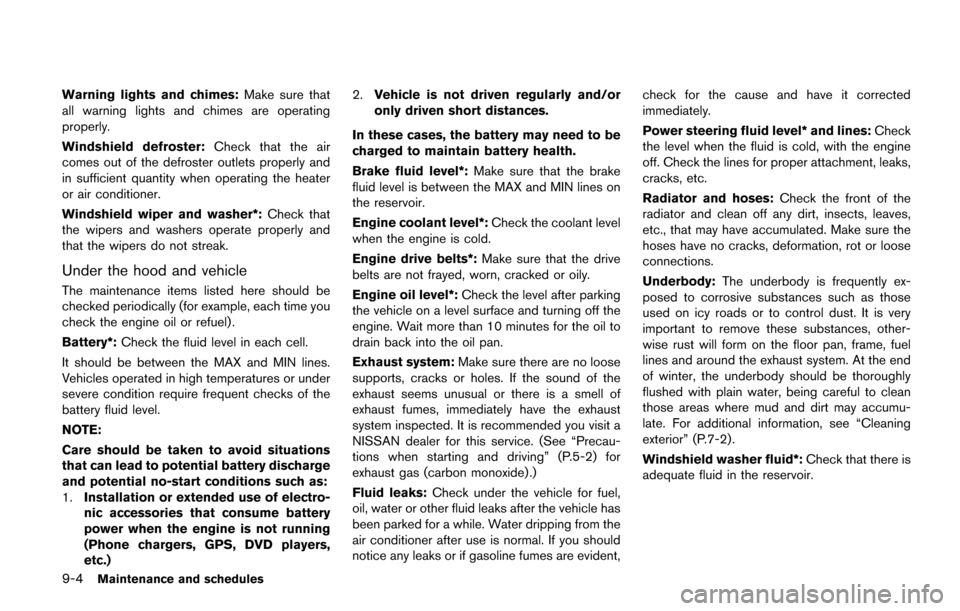
Warning lights and chimes:Make sure that
all warning lights and chimes are operating
properly.
Windshield defroster: Check that the air
comes out of the defroster outlets properly and
in sufficient quantity when operating the heater
or air conditioner.
Windshield wiper and washer*: Check that
the wipers and washers operate properly and
that the wipers do not streak.
Under the hood and vehicle
The maintenance items listed here should be
checked periodically (for example, each time you
check the engine oil or refuel) .
Battery*: Check the fluid level in each cell.
It should be between the MAX and MIN lines.
Vehicles operated in high temperatures or under
severe condition require frequent checks of the
battery fluid level.
NOTE:
Care should be taken to avoid situations
that can lead to potential battery discharge
and potential no-start conditions such as:
1. Installation or extended use of electro-
nic accessories that consume battery
power when the engine is not running
(Phone chargers, GPS, DVD players,
etc.) 2.
Vehicle is not driven regularly and/or
only driven short distances.
In these cases, the battery may need to be
charged to maintain battery health.
Brake fluid level*: Make sure that the brake
fluid level is between the MAX and MIN lines on
the reservoir.
Engine coolant level*: Check the coolant level
when the engine is cold.
Engine drive belts*: Make sure that the drive
belts are not frayed, worn, cracked or oily.
Engine oil level*: Check the level after parking
the vehicle on a level surface and turning off the
engine. Wait more than 10 minutes for the oil to
drain back into the oil pan.
Exhaust system: Make sure there are no loose
supports, cracks or holes. If the sound of the
exhaust seems unusual or there is a smell of
exhaust fumes, immediately have the exhaust
system inspected. It is recommended you visit a
NISSAN dealer for this service. (See “Precau-
tions when starting and driving” (P.5-2) for
exhaust gas (carbon monoxide) .)
Fluid leaks: Check under the vehicle for fuel,
oil, water or other fluid leaks after the vehicle has
been parked for a while. Water dripping from the
air conditioner after use is normal. If you should
notice any leaks or if gasoline fumes are evident, check for the cause and have it corrected
immediately.
Power steering fluid level* and lines:
Check
the level when the fluid is cold, with the engine
off. Check the lines for proper attachment, leaks,
cracks, etc.
Radiator and hoses: Check the front of the
radiator and clean off any dirt, insects, leaves,
etc., that may have accumulated. Make sure the
hoses have no cracks, deformation, rot or loose
connections.
Underbody: The underbody is frequently ex-
posed to corrosive substances such as those
used on icy roads or to control dust. It is very
important to remove these substances, other-
wise rust will form on the floor pan, frame, fuel
lines and around the exhaust system. At the end
of winter, the underbody should be thoroughly
flushed with plain water, being careful to clean
those areas where mud and dirt may accumu-
late. For additional information, see “Cleaning
exterior” (P.7-2).
Windshield washer fluid*: Check that there is
adequate fluid in the reservoir.
Page 473 of 520
9-6Maintenance and schedules
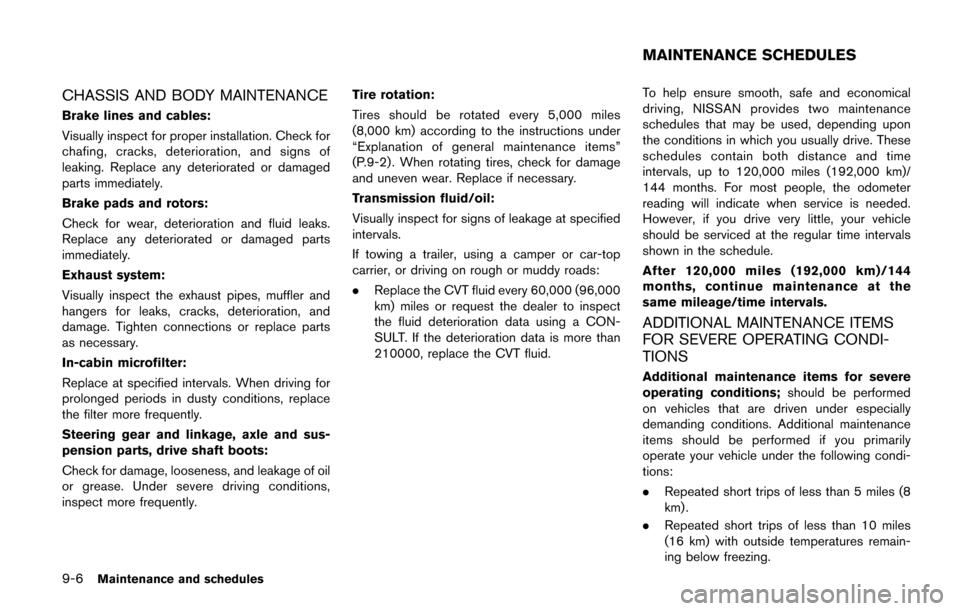
CHASSIS AND BODY MAINTENANCE
Brake lines and cables:
Visually inspect for proper installation. Check for
chafing, cracks, deterioration, and signs of
leaking. Replace any deteriorated or damaged
parts immediately.
Brake pads and rotors:
Check for wear, deterioration and fluid leaks.
Replace any deteriorated or damaged parts
immediately.
Exhaust system:
Visually inspect the exhaust pipes, muffler and
hangers for leaks, cracks, deterioration, and
damage. Tighten connections or replace parts
as necessary.
In-cabin microfilter:
Replace at specified intervals. When driving for
prolonged periods in dusty conditions, replace
the filter more frequently.
Steering gear and linkage, axle and sus-
pension parts, drive shaft boots:
Check for damage, looseness, and leakage of oil
or grease. Under severe driving conditions,
inspect more frequently.Tire rotation:
Tires should be rotated every 5,000 miles
(8,000 km) according to the instructions under
“Explanation of general maintenance items”
(P.9-2) . When rotating tires, check for damage
and uneven wear. Replace if necessary.
Transmission fluid/oil:
Visually inspect for signs of leakage at specified
intervals.
If towing a trailer, using a camper or car-top
carrier, or driving on rough or muddy roads:
.
Replace the CVT fluid every 60,000 (96,000
km) miles or request the dealer to inspect
the fluid deterioration data using a CON-
SULT. If the deterioration data is more than
210000, replace the CVT fluid. To help ensure smooth, safe and economical
driving, NISSAN provides two maintenance
schedules that may be used, depending upon
the conditions in which you usually drive. These
schedules contain both distance and time
intervals, up to 120,000 miles (192,000 km)/
144 months. For most people, the odometer
reading will indicate when service is needed.
However, if you drive very little, your vehicle
should be serviced at the regular time intervals
shown in the schedule.
After 120,000 miles (192,000 km)/144
months, continue maintenance at the
same mileage/time intervals.
ADDITIONAL MAINTENANCE ITEMS
FOR SEVERE OPERATING CONDI-
TIONS
Additional maintenance items for severe
operating conditions;
should be performed
on vehicles that are driven under especially
demanding conditions. Additional maintenance
items should be performed if you primarily
operate your vehicle under the following condi-
tions:
. Repeated short trips of less than 5 miles (8
km) .
. Repeated short trips of less than 10 miles
(16 km) with outside temperatures remain-
ing below freezing.
MAINTENANCE SCHEDULES
Page 478 of 520
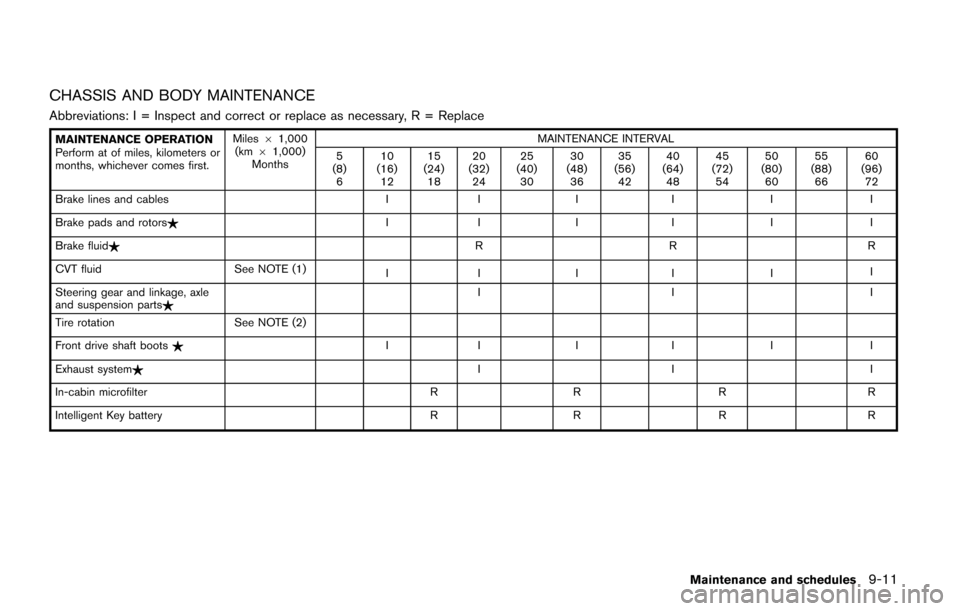
CHASSIS AND BODY MAINTENANCE
Abbreviations: I = Inspect and correct or replace as necessary, R = Replace
MAINTENANCE OPERATION
Perform at of miles, kilometers or
months, whichever comes first.Miles
61,000
(km 61,000)
Months MAINTENANCE INTERVAL
5
(8) 6 10
(16) 12 15
(24) 18 20
(32) 24 25
(40) 30 30
(48) 36 35
(56) 42 40
(64) 48 45
(72) 54 50
(80) 60 55
(88) 66 60
(96) 72
Brake lines and cables II II I I
Brake pads and rotors$ II I I I I
Brake fluid$ RR R
CVT fluid See NOTE (1)
II I I I I
Steering gear and linkage, axle
and suspension parts$ II I
Tire rotation See NOTE (2)
Front drive shaft boots $ II I I I I
Exhaust system$ II I
In-cabin microfilter RR R R
Intelligent Key battery RR R R
Maintenance and schedules9-11
Page 479 of 520
9-12Maintenance and schedules
MAINTENANCE OPERATION
Perform at of miles, kilometers or
months, whichever comes first.Miles
61,000
(km 61,000)
Months MAINTENANCE INTERVAL
65
(104) 78 70
(112) 84 75
(120) 90 80
(128) 96 85
(136) 102 90
(144) 108 95
(152) 114 100
(160) 120 105
(168) 126 110
(176) 132 115
(184) 138 120
(192) 144
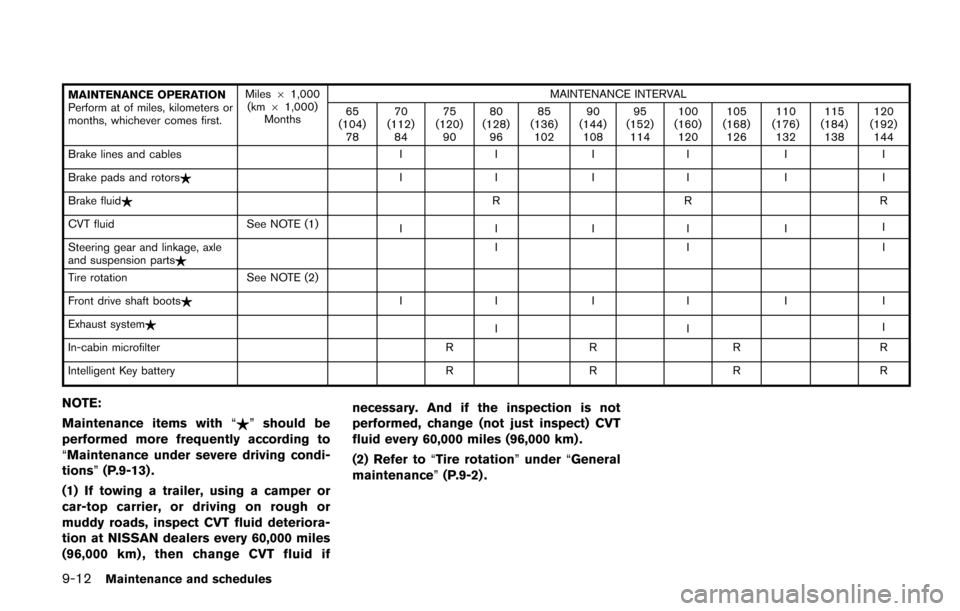
Brake lines and cables II II I I
Brake pads and rotors$ II II I I
Brake fluid$ RR R
CVT fluid See NOTE (1)
II II I I
Steering gear and linkage, axle
and suspension parts$ II I
Tire rotation See NOTE (2)
Front drive shaft boots$ II II I I
Exhaust system$ III
In-cabin microfilter RRR R
Intelligent Key battery RRR R
NOTE:
Maintenance items with “$”should be
performed more frequently according to
“Maintenance under severe driving condi-
tions” (P.9-13) .
(1) If towing a trailer, using a camper or
car-top carrier, or driving on rough or
muddy roads, inspect CVT fluid deteriora-
tion at NISSAN dealers every 60,000 miles
(96,000 km) , then change CVT fluid if necessary. And if the inspection is not
performed, change (not just inspect) CVT
fluid every 60,000 miles (96,000 km) .
(2) Refer to
“Tire rotation” under“General
maintenance” (P.9-2) .
Page 480 of 520
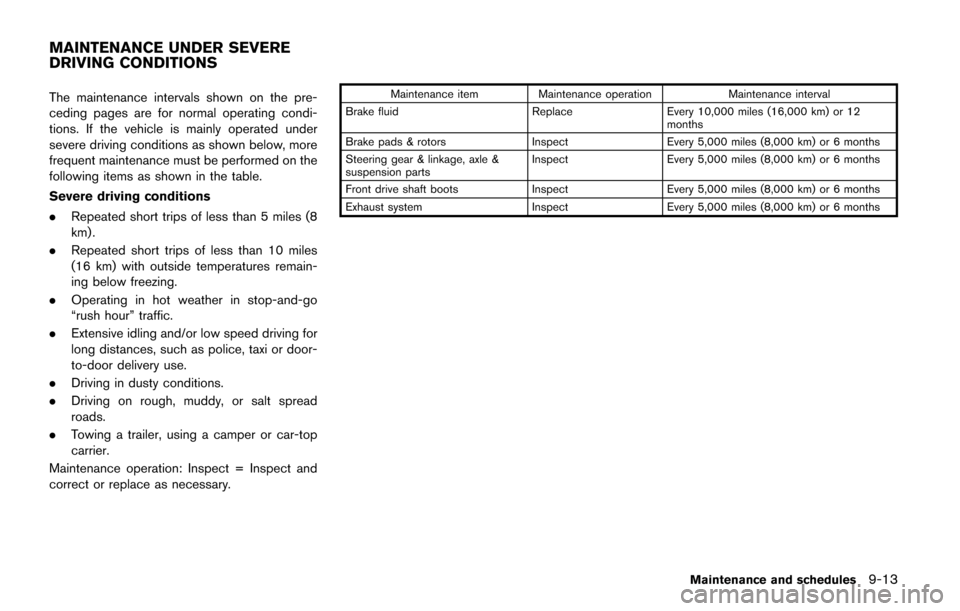
The maintenance intervals shown on the pre-
ceding pages are for normal operating condi-
tions. If the vehicle is mainly operated under
severe driving conditions as shown below, more
frequent maintenance must be performed on the
following items as shown in the table.
Severe driving conditions
.Repeated short trips of less than 5 miles (8
km) .
. Repeated short trips of less than 10 miles
(16 km) with outside temperatures remain-
ing below freezing.
. Operating in hot weather in stop-and-go
“rush hour” traffic.
. Extensive idling and/or low speed driving for
long distances, such as police, taxi or door-
to-door delivery use.
. Driving in dusty conditions.
. Driving on rough, muddy, or salt spread
roads.
. Towing a trailer, using a camper or car-top
carrier.
Maintenance operation: Inspect = Inspect and
correct or replace as necessary.Maintenance item Maintenance operation Maintenance interval
Brake fluid ReplaceEvery 10,000 miles (16,000 km) or 12
months
Brake pads & rotors InspectEvery 5,000 miles (8,000 km) or 6 months
Steering gear & linkage, axle &
suspension parts Inspect
Every 5,000 miles (8,000 km) or 6 months
Front drive shaft boots InspectEvery 5,000 miles (8,000 km) or 6 months
Exhaust system InspectEvery 5,000 miles (8,000 km) or 6 months
Maintenance and schedules9-13
MAINTENANCE UNDER SEVERE
DRIVING CONDITIONS
Page 485 of 520
10-2Technical and consumer information
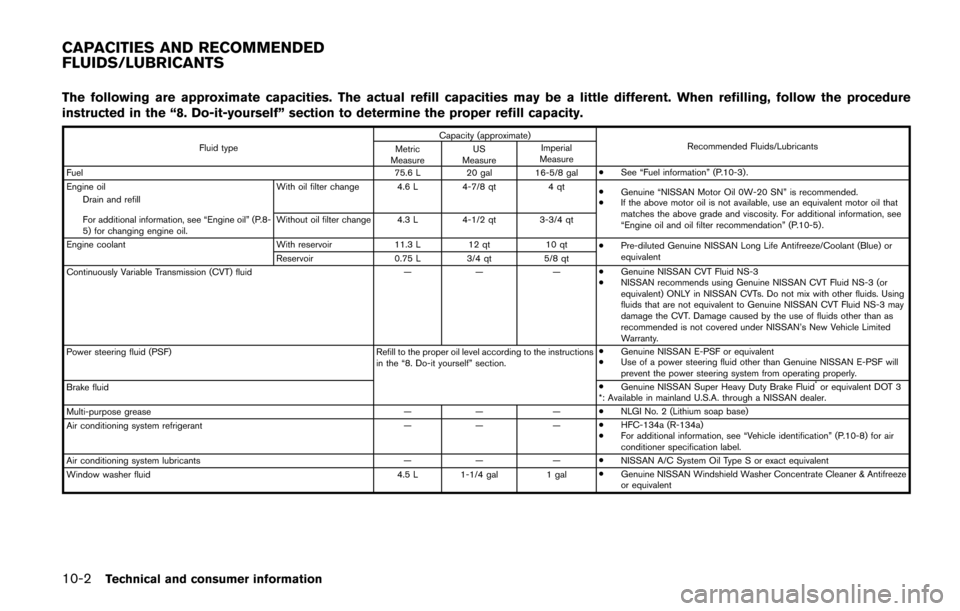
The following are approximate capacities. The actual refill capacities may be a little different. When refilling, follow the procedure
instructed in the “8. Do-it-yourself” section to determine the proper refill capacity.
Fluid typeCapacity (approximate)
Recommended Fluids/Lubricants
Metric
Measure US
Measure Imperial
Measure
Fuel 75.6 L 20 gal 16-5/8 gal.
See “Fuel information” (P.10-3).
Engine oil With oil filter change 4.6 L 4-7/8 qt 4 qt
.Genuine “NISSAN Motor Oil 0W-20 SN” is recommended.
. If the above motor oil is not available, use an equivalent motor oil that
matches the above grade and viscosity. For additional information, see
“Engine oil and oil filter recommendation” (P.10-5) .
Drain and refill
For additional information, see “Engine oil” (P.8-
5) for changing engine oil.
Without oil filter change 4.3 L 4-1/2 qt 3-3/4 qt
Engine coolant With reservoir11.3 L12 qt 10 qt
.
Pre-diluted Genuine NISSAN Long Life Antifreeze/Coolant (Blue) or
equivalent
Reservoir 0.75 L 3/4 qt 5/8 qt
Continuously Variable Transmission (CVT) fluid —— —.
Genuine NISSAN CVT Fluid NS-3
. NISSAN recommends using Genuine NISSAN CVT Fluid NS-3 (or
equivalent) ONLY in NISSAN CVTs. Do not mix with other fluids. Using
fluids that are not equivalent to Genuine NISSAN CVT Fluid NS-3 may
damage the CVT. Damage caused by the use of fluids other than as
recommended is not covered under NISSAN’s New Vehicle Limited
Warranty.
Power steering fluid (PSF) Refill to the proper oil level according to the instructions
in the “8. Do-it yourself” section..
Genuine NISSAN E-PSF or equivalent
. Use of a power steering fluid other than Genuine NISSAN E-PSF will
prevent the power steering system from operating properly.
Brake fluid .
Genuine NISSAN Super Heavy Duty Brake Fluid
*or equivalent DOT 3
*: Available in mainland U.S.A. through a NISSAN dealer.
Multi-purpose grease —— —.
NLGI No. 2 (Lithium soap base)
Air conditioning system refrigerant —— —.
HFC-134a (R-134a)
. For additional information, see “Vehicle identification” (P.10-8) for air
conditioner specification label.
Air conditioning system lubricants —— —.
NISSAN A/C System Oil Type S or exact equivalent
Window washer fluid 4.5 L 1-1/4 gal1 gal.
Genuine NISSAN Windshield Washer Concentrate Cleaner & Antifreeze
or equivalent
CAPACITIES AND RECOMMENDED
FLUIDS/LUBRICANTS
Page 499 of 520
10-16Technical and consumer information
guide includes information on trailer towing
capability and the special equipment required
for proper towing.
MAXIMUM LOAD LIMITS
Maximum trailer loads
Never allow the total trailer load to exceed the
value specified in the “Towing Load/Specifica-
tion” chart. The total trailer load equals trailer
weight plus its cargo weight.
.When towing a trailer load of 1,000 lbs
(454 kg) or more, trailers with a brake
system MUST be used.
The maximum GCWR (Gross Combined Weight
Rating) should not exceed the value specified in
the following “Towing Load/Specification” chart.
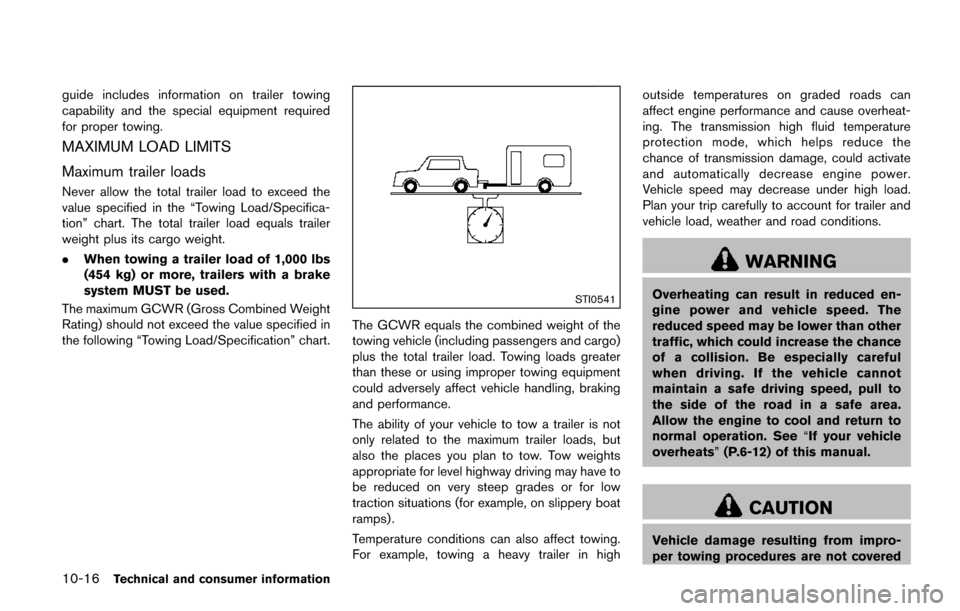
STI0541
The GCWR equals the combined weight of the
towing vehicle (including passengers and cargo)
plus the total trailer load. Towing loads greater
than these or using improper towing equipment
could adversely affect vehicle handling, braking
and performance.
The ability of your vehicle to tow a trailer is not
only related to the maximum trailer loads, but
also the places you plan to tow. Tow weights
appropriate for level highway driving may have to
be reduced on very steep grades or for low
traction situations (for example, on slippery boat
ramps) .
Temperature conditions can also affect towing.
For example, towing a heavy trailer in high outside temperatures on graded roads can
affect engine performance and cause overheat-
ing. The transmission high fluid temperature
protection mode, which helps reduce the
chance of transmission damage, could activate
and automatically decrease engine power.
Vehicle speed may decrease under high load.
Plan your trip carefully to account for trailer and
vehicle load, weather and road conditions.
WARNING
Overheating can result in reduced en-
gine power and vehicle speed. The
reduced speed may be lower than other
traffic, which could increase the chance
of a collision. Be especially careful
when driving. If the vehicle cannot
maintain a safe driving speed, pull to
the side of the road in a safe area.
Allow the engine to cool and return to
normal operation. See
“If your vehicle
overheats” (P.6-12) of this manual.
CAUTION
Vehicle damage resulting from impro-
per towing procedures are not covered
Page 502 of 520
Always verify that available capacities are within
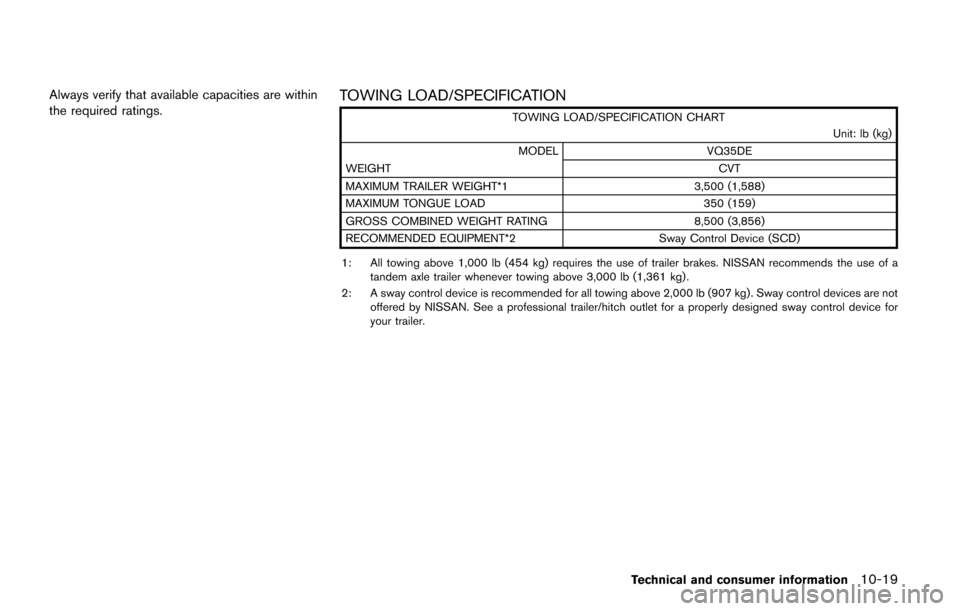
the required ratings.TOWING LOAD/SPECIFICATION
TOWING LOAD/SPECIFICATION CHARTUnit: lb (kg)
MODEL VQ35DE
WEIGHT CVT
MAXIMUM TRAILER WEIGHT*1 3,500 (1,588)
MAXIMUM TONGUE LOAD 350 (159)
GROSS COMBINED WEIGHT RATING 8,500 (3,856)
RECOMMENDED EQUIPMENT*2 Sway Control Device (SCD)
1: All towing above 1,000 lb (454 kg) requires the use of trailer brakes. NISSAN recommends the use of a tandem axle trailer whenever towing above 3,000 lb (1,361 kg) .
2: A sway control device is recommended for all towing above 2,000 lb (907 kg) . Sway control devices are not offered by NISSAN. See a professional trailer/hitch outlet for a properly designed sway control device for
your trailer.
Technical and consumer information10-19