2017 NISSAN QUEST headrest
[x] Cancel search: headrestPage 45 of 520
1-26Safety — Seats, seat belts and supplemental restraint system
placed in child restraints that comply with
Federal Motor Vehicle Safety Standards or
Canadian Motor Vehicle Safety Standards. You
should choose a child restraint that fits your
vehicle and always follow the manufacturer’s
instructions for installation and use.
LARGER CHILDREN
Children should remain in a forward-facing child
restraint with a harness until they reach the
maximum height or weight limit allowed by the
child restraint manufacturer.
Once a child outgrows the height or weight limit
of the harness-equipped forward-facing child
restraint, NISSAN recommends that the child be
placed in a commercially available booster seat
to obtain proper seat belt fit. For a seat belt to fit
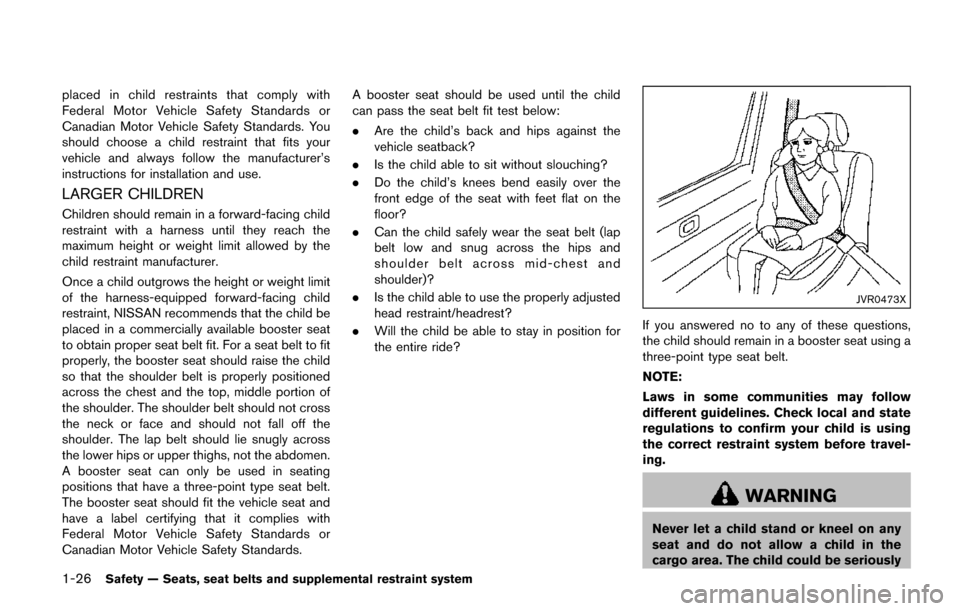
properly, the booster seat should raise the child
so that the shoulder belt is properly positioned
across the chest and the top, middle portion of
the shoulder. The shoulder belt should not cross
the neck or face and should not fall off the
shoulder. The lap belt should lie snugly across
the lower hips or upper thighs, not the abdomen.
A booster seat can only be used in seating
positions that have a three-point type seat belt.
The booster seat should fit the vehicle seat and
have a label certifying that it complies with
Federal Motor Vehicle Safety Standards or
Canadian Motor Vehicle Safety Standards.A booster seat should be used until the child
can pass the seat belt fit test below:
.
Are the child’s back and hips against the
vehicle seatback?
. Is the child able to sit without slouching?
. Do the child’s knees bend easily over the
front edge of the seat with feet flat on the
floor?
. Can the child safely wear the seat belt (lap
belt low and snug across the hips and
shoulder belt across mid-chest and
shoulder)?
. Is the child able to use the properly adjusted
head restraint/headrest?
. Will the child be able to stay in position for
the entire ride?
JVR0473X
If you answered no to any of these questions,
the child should remain in a booster seat using a
three-point type seat belt.
NOTE:
Laws in some communities may follow
different guidelines. Check local and state
regulations to confirm your child is using
the correct restraint system before travel-
ing.
WARNING
Never let a child stand or kneel on any
seat and do not allow a child in the
cargo area. The child could be seriously
Page 58 of 520
SSS1088
2nd row seat
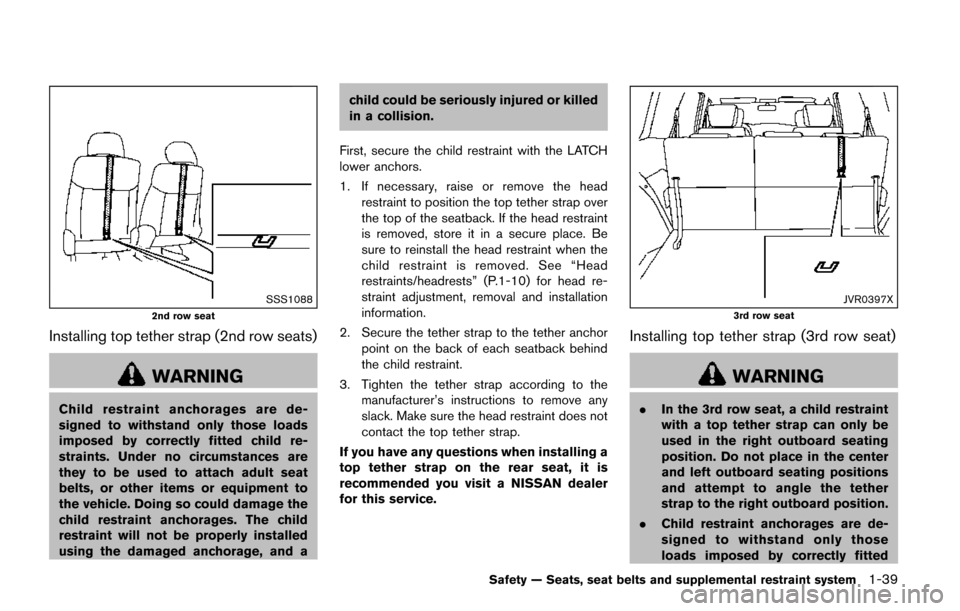
Installing top tether strap (2nd row seats)
WARNING
Child restraint anchorages are de-
signed to withstand only those loads
imposed by correctly fitted child re-
straints. Under no circumstances are
they to be used to attach adult seat
belts, or other items or equipment to
the vehicle. Doing so could damage the
child restraint anchorages. The child
restraint will not be properly installed
using the damaged anchorage, and achild could be seriously injured or killed
in a collision.
First, secure the child restraint with the LATCH
lower anchors.
1. If necessary, raise or remove the head restraint to position the top tether strap over
the top of the seatback. If the head restraint
is removed, store it in a secure place. Be
sure to reinstall the head restraint when the
child restraint is removed. See “Head
restraints/headrests” (P.1-10) for head re-
straint adjustment, removal and installation
information.
2. Secure the tether strap to the tether anchor point on the back of each seatback behind
the child restraint.
3. Tighten the tether strap according to the manufacturer’s instructions to remove any
slack. Make sure the head restraint does not
contact the top tether strap.
If you have any questions when installing a
top tether strap on the rear seat, it is
recommended you visit a NISSAN dealer
for this service.
JVR0397X
3rd row seat
Installing top tether strap (3rd row seat)
WARNING
. In the 3rd row seat, a child restraint
with a top tether strap can only be
used in the right outboard seating
position. Do not place in the center
and left outboard seating positions
and attempt to angle the tether
strap to the right outboard position.
. Child restraint anchorages are de-
signed to withstand only those
loads imposed by correctly fitted
Safety — Seats, seat belts and supplemental restraint system1-39
Page 60 of 520

Follow these steps to install a forward-facing
child restraint using the vehicle seat belt in the
rear seats or in the front passenger seat:
1.If you must install a child restraint in
the front seat, it should be placed in a
forward-facing direction only. Move the
seat to the rearmost position. Child
restraints for infants must be used in
the rear-facing direction and, therefore,
must not be used in the front seat.
2. Position the child restraint on the seat. Always follow the child restraint manufac-
turer’s instructions.
The back of the child restraint should be
secured against the vehicle seatback.
If necessary, adjust or remove the head
restraint or headrest to obtain the correct
child restraint fit. If the head restraint or
headrest is removed, store it in a secure
place. Be sure to reinstall the head
restraint or headrest when the child
restraint is removed. See “Head re-
straints/headrests” (P.1-10) for head re-
straint or headrest adjustment, removal and
installation information.
If the seating position does not have an
adjustable head restraint or headrest and it
is interfering with the proper child restraint
fit, try another seating position or a different child restraint.
SSS0360B
Forward-facing — step 3
3. Route the seat belt tongue through the child
restraint and insert it into the buckle until you
hear and feel the latch engage. Be sure to
follow the child restraint manufacturer’s
instructions for belt routing.
If the child restraint is equipped with a top
tether strap, route the top tether strap and
secure the tether strap to the tether anchor
point (rear seat installation only) . See
“Installing top tether strap (2nd row seats)”
(P.1-44) and “Installing top tether strap (3rd
row seat)” (P.1-44) . Do not install child
restraints that require the use of a top tether
strap in seating positions that do not have a
top tether anchor.
Safety — Seats, seat belts and supplemental restraint system1-41
Page 63 of 520
1-44Safety — Seats, seat belts and supplemental restraint system
SSS1088
2nd row seat
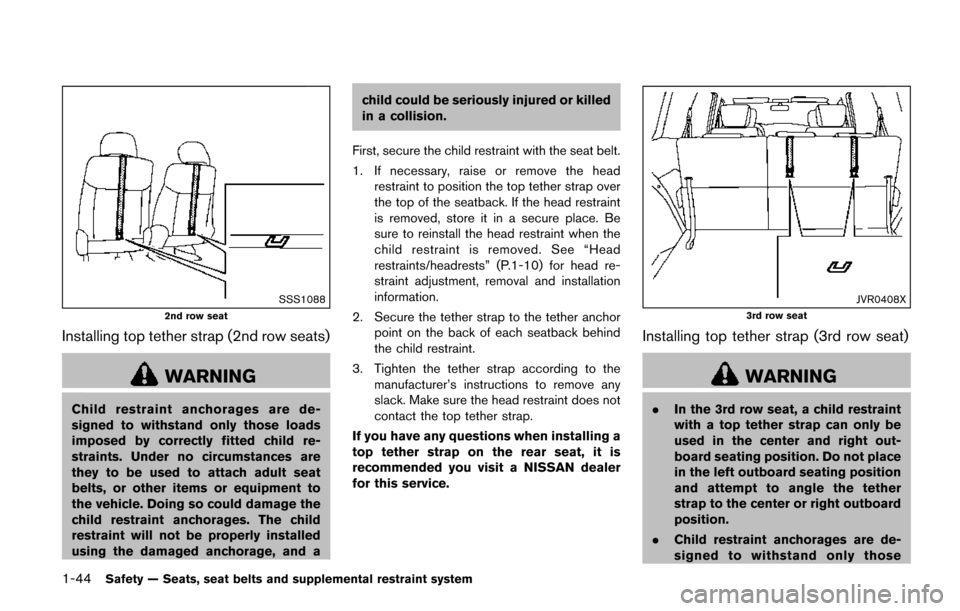
Installing top tether strap (2nd row seats)
WARNING
Child restraint anchorages are de-
signed to withstand only those loads
imposed by correctly fitted child re-
straints. Under no circumstances are
they to be used to attach adult seat
belts, or other items or equipment to
the vehicle. Doing so could damage the
child restraint anchorages. The child
restraint will not be properly installed
using the damaged anchorage, and achild could be seriously injured or killed
in a collision.
First, secure the child restraint with the seat belt.
1. If necessary, raise or remove the head restraint to position the top tether strap over
the top of the seatback. If the head restraint
is removed, store it in a secure place. Be
sure to reinstall the head restraint when the
child restraint is removed. See “Head
restraints/headrests” (P.1-10) for head re-
straint adjustment, removal and installation
information.
2. Secure the tether strap to the tether anchor point on the back of each seatback behind
the child restraint.
3. Tighten the tether strap according to the manufacturer’s instructions to remove any
slack. Make sure the head restraint does not
contact the top tether strap.
If you have any questions when installing a
top tether strap on the rear seat, it is
recommended you visit a NISSAN dealer
for this service.
JVR0408X
3rd row seat
Installing top tether strap (3rd row seat)
WARNING
. In the 3rd row seat, a child restraint
with a top tether strap can only be
used in the center and right out-
board seating position. Do not place
in the left outboard seating position
and attempt to angle the tether
strap to the center or right outboard
position.
. Child restraint anchorages are de-
signed to withstand only those
Page 66 of 520
SSS0640
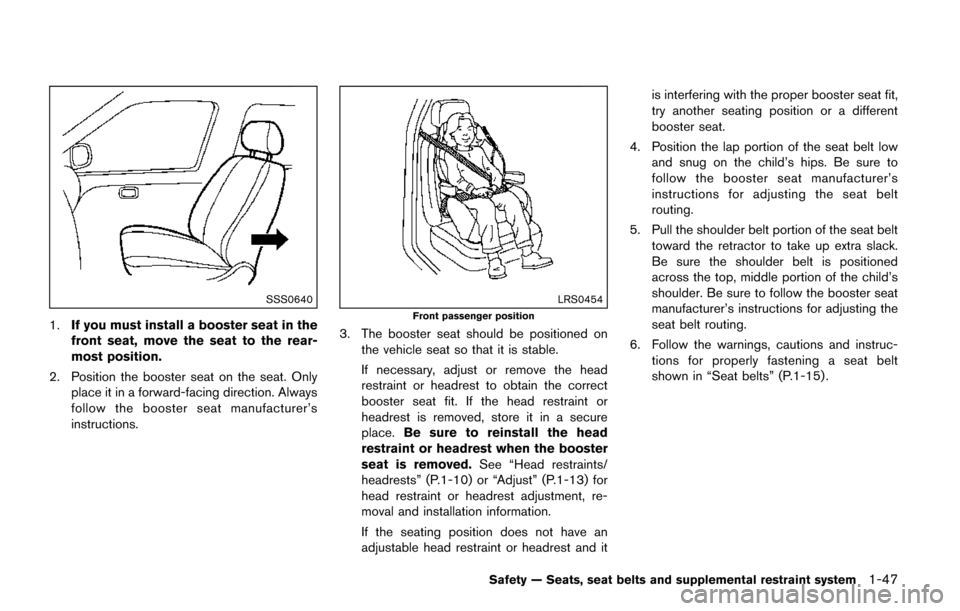
1.If you must install a booster seat in the
front seat, move the seat to the rear-
most position.
2. Position the booster seat on the seat. Only place it in a forward-facing direction. Always
follow the booster seat manufacturer’s
instructions.
LRS0454
Front passenger position
3. The booster seat should be positioned onthe vehicle seat so that it is stable.
If necessary, adjust or remove the head
restraint or headrest to obtain the correct
booster seat fit. If the head restraint or
headrest is removed, store it in a secure
place. Be sure to reinstall the head
restraint or headrest when the booster
seat is removed. See “Head restraints/
headrests” (P.1-10) or “Adjust” (P.1-13) for
head restraint or headrest adjustment, re-
moval and installation information.
If the seating position does not have an
adjustable head restraint or headrest and it is interfering with the proper booster seat fit,
try another seating position or a different
booster seat.
4. Position the lap portion of the seat belt low and snug on the child’s hips. Be sure to
follow the booster seat manufacturer’s
instructions for adjusting the seat belt
routing.
5. Pull the shoulder belt portion of the seat belt toward the retractor to take up extra slack.
Be sure the shoulder belt is positioned
across the top, middle portion of the child’s
shoulder. Be sure to follow the booster seat
manufacturer’s instructions for adjusting the
seat belt routing.
6. Follow the warnings, cautions and instruc- tions for properly fastening a seat belt
shown in “Seat belts” (P.1-15) .
Safety — Seats, seat belts and supplemental restraint system1-47
Page 380 of 520
SSD0944
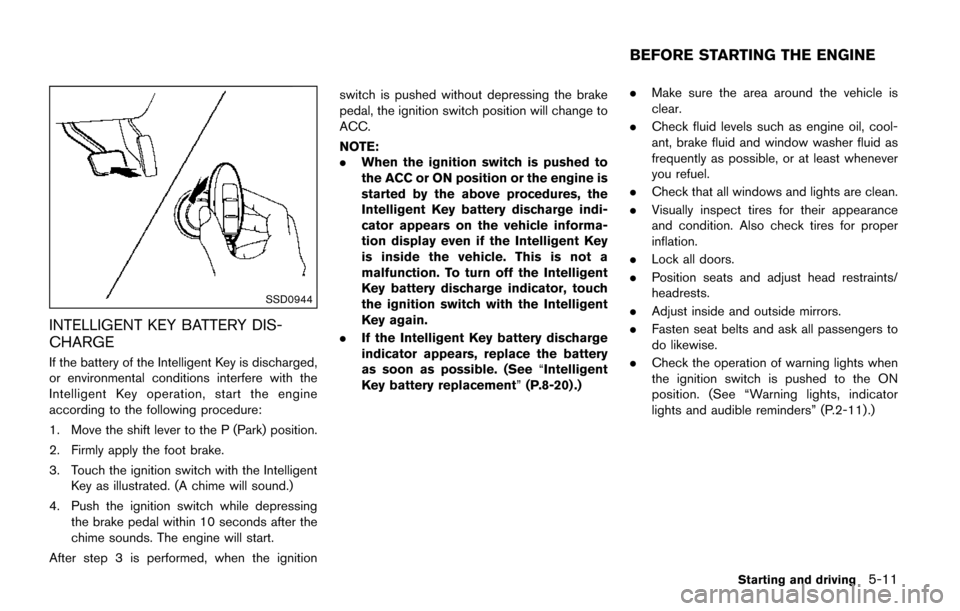
INTELLIGENT KEY BATTERY DIS-
CHARGE
If the battery of the Intelligent Key is discharged,
or environmental conditions interfere with the
Intelligent Key operation, start the engine
according to the following procedure:
1. Move the shift lever to the P (Park) position.
2. Firmly apply the foot brake.
3. Touch the ignition switch with the IntelligentKey as illustrated. (A chime will sound.)
4. Push the ignition switch while depressing the brake pedal within 10 seconds after the
chime sounds. The engine will start.
After step 3 is performed, when the ignition switch is pushed without depressing the brake
pedal, the ignition switch position will change to
ACC.
NOTE:
.
When the ignition switch is pushed to
the ACC or ON position or the engine is
started by the above procedures, the
Intelligent Key battery discharge indi-
cator appears on the vehicle informa-
tion display even if the Intelligent Key
is inside the vehicle. This is not a
malfunction. To turn off the Intelligent
Key battery discharge indicator, touch
the ignition switch with the Intelligent
Key again.
. If the Intelligent Key battery discharge
indicator appears, replace the battery
as soon as possible. (See “Intelligent
Key battery replacement” (P.8-20) .).
Make sure the area around the vehicle is
clear.
. Check fluid levels such as engine oil, cool-
ant, brake fluid and window washer fluid as
frequently as possible, or at least whenever
you refuel.
. Check that all windows and lights are clean.
. Visually inspect tires for their appearance
and condition. Also check tires for proper
inflation.
. Lock all doors.
. Position seats and adjust head restraints/
headrests.
. Adjust inside and outside mirrors.
. Fasten seat belts and ask all passengers to
do likewise.
. Check the operation of warning lights when
the ignition switch is pushed to the ON
position. (See “Warning lights, indicator
lights and audible reminders” (P.2-11) .)
Starting and driving5-11
BEFORE STARTING THE ENGINE
Page 514 of 520
LOOSE FUEL CAP warning ............................. 3-32
Fuel efficient driving tips ........................................... 5-27
Fuses ............................................................................. 8-18
Fusible links ................................................................. 8-18
G
Garage door opener, HomeLinkŠ
Universal Transceiver ................................................. 2-60
Gas cap ........................................................................ 3-30
Gauge .............................................................................. 2-5 Engine coolant temperature gauge ................... 2-7
Fuel gauge ............................................................... 2-8
Odometer ................................................................. 2-6
Speedometer ........................................................... 2-6
Tachometer ............................................................... 2-7
Trip computer ....................................................... 2-24
General maintenance .................................................. 9-2
Glove box ..................................................................... 2-47
H
Hands-free phone system, BluetoothŠ
(Type A) ..................................................................... 4-122
Hands-free phone system, BluetoothŠ
(Type B) ..................................................................... 4-133
Hands-free phone system, BluetoothŠ
(Type C) ..................................................................... 4-146
Hazard warning flasher switch .................................. 6-2
Head restraints/headrests ........................................ 1-10
Headlights Aiming control ...................................................... 2-37
Bulb replacement ................................................ 8-22
Headlight switch .................................................. 2-34
Xenon headlights ................................................. 2-33
Heated seats ............................................................... 2-39 Heater
Engine block heater ............................................ 5-35
Heater and air conditioner operation ............. 4-47
HomeLink
ŠUniversal Transceiver .......................... 2-60
Hood release ............................................................... 3-25
Hook, Coat hooks ...................................................... 2-51
Horn ............................................................................... 2-39
Hydraulic pump electric power steering .............. 5-30
I
Ignition switch (Push-button) .................................... 5-8
Immobilizer system ..................................................... 2-30
In-cabin microfilter ...................................................... 4-60
Indicator Lights ...................................................................... 2-16
Vehicle information display ................................ 2-19
INFO button ................................................................. 4-11
Inside mirror ................................................................. 3-33
Inspection/maintenance (I/M) test ....................... 10-26
Instrument brightness control .................................. 2-38
Instrument panel ................................................ 2-4, 2-44
Intelligent Key system ....................................... 3-3, 3-13 Battery replacement ............................................ 8-20
Intelligent Key system warning light ............... 2-14
Key operating range ........................................... 3-15
Key operation ........................................................ 3-16
Warning signals ................................................... 3-19
Interior light control switch ...................................... 2-58
Interior light replacement .......................................... 8-24
Interior lights ................................................................ 2-57
iPod
Šplayer operation .............................................. 4-99
ISOFIX child restraint ................................................ 1-29
J
Jump starting ............................................................... 6-10
K
Keyless entry (See remote keyless
entry system) ............................................................... 3-21
Keys ................................................................................. 3-3 For Intelligent Key system ........................ 3-3, 3-13
L
LabelsAir bag warning labels ....................................... 1-63
Air conditioner specification label ................. 10-10
Emission control information label ................ 10-10
Engine serial number .......................................... 10-9
F.M.V.S.S./C.M.V.S.S. certification label ........ 10-9
Tire and Loading Information label .... 8-29, 10-10
Vehicle identification number (VIN) ................ 10-8
LATCH system ............................................................ 1-29
License plate, Installing front license plate ....... 10-11
Liftgate .......................................................................... 3-26
Light Air bag warning light .......................................... 1-64
Bulb replacement ................................................ 8-22
Cargo lights .......................................................... 2-60
Fog light switch ................................................... 2-39
Headlight switch .................................................. 2-34
Headlights bulb replacement ........................... 8-22
Indicator lights ...................................................... 2-16
Interior light control switch ............................... 2-58
Interior lights ......................................................... 2-57
Map lights .............................................................. 2-57
Mood lights ........................................................... 2-59
Replacement ......................................................... 8-22
11-3