2017 NISSAN MURANO engine oil
[x] Cancel search: engine oilPage 433 of 466
Incorrect ignition timing may result in spark
knock, after-run and/or overheating, which may
cause excessive fuel consumption or engine
damage. If any of the above symptoms are en-
countered, have your vehicle checked. It is rec-
ommended that you visit a NISSAN dealer for
servicing.
However, now and then you may notice
light spark knock for a short time while
accelerating or driving up hills. This is not a
cause for concern, because you get the
greatest fuel benefit when there is light
spark knock for a short time under heavy
engine load.
ENGINE OIL AND OIL FILTER
RECOMMENDATIONS
Selecting the correct oil
It is essential to choose the correct grade, quality
and viscosity engine oil to ensure satisfactory
engine life and performance. For additional infor-
mation, refer to “Recommended fluids/lubricants
and capacities” in this section. NISSAN recom-
mends the use of an energy conserving oil in
order to improve fuel economy.
Select only engine oils that meet the American
Petroleum Institute (API) certification or Interna-
tional Lubricant Standardization and ApprovalCommittee (ILSAC) certification and SAE vis-
cosity standard. These oils have the API certifica-
tion mark on the front of the container. Oils which
do not have the specified quality label should not
be used as they could cause engine damage.Oil additives
NISSAN does not recommend the use of oil
additives. The use of an oil additive is not neces-
sary when the proper oil type is used and main-
tenance intervals are followed.
Oil which may contain foreign matter or has been
previously used should not be used.
LTI2051
10-6Technical and consumer information
Page 434 of 466
Oil viscosity
The engine oil viscosity or thickness changes
with temperature. Because of this, it is important
to select the engine oil viscosity based on the
temperatures at which the vehicle will be oper-
ated before the next oil change. Choosing an oil
viscosity other than that recommended could
cause serious engine damage.
Selecting the correct oil filter
Your new NISSAN vehicle is equipped with a
high-quality Genuine NISSAN oil filter. When
replacing, use a Genuine NISSAN oil filter or its
equivalent for the reason described in “Change
intervals.”
Change intervals
The oil and oil filter change intervals for your
engine are based on the use of the specified
quality oils and filters. Using engine oil and filters
that are not of the specified quality, or exceeding
recommended oil and filter change intervals
could reduce engine life. Damage to the engine
caused by improper maintenance or use of incor-
rect oil and filter quality and/or viscosity is not
covered by the NISSAN New Vehicle Limited
Warranty.Your engine was filled with a high-quality engine
oil when it was built. You do not have to change
the oil before the first recommended change
interval. Oil and filter change intervals depend
upon how you use your vehicle.
Operation under the following conditions may
require more frequent oil and filter changes:
● repeated short distance driving at cold out-
side temperatures
● driving in dusty conditions
● extensive idling
● towing a trailer
● stop and go commuting
For additional information, refer to the “Mainte-
nance and schedules” section of this manual.
AIR CONDITIONER SYSTEM
REFRIGERANT AND OIL
RECOMMENDATIONS
The air conditioner system in your NISSAN
vehicle must be charged with the refriger-
ant HFC-134a (R-134a) and NISSAN A/C
System Oil Type ND-OIL8 or the exact
equivalents.
CAUTION
The use of any other refrigerant or oil will
cause severe damage to the air condition-
ing system and will require the replace-
ment of all air conditioner system
components.
The refrigerant HFC-134a (R-134a) in your
NISSAN vehicle does not harm the earth’s ozone
layer. Although this refrigerant does not affect the
earth’s atmosphere, certain government regula-
tions require the recovery and recycling of any
refrigerant during automotive air conditioner sys-
tem service. A NISSAN dealer has the trained
technicians and equipment needed to recover
and recycle your air conditioner system refriger-
ant.
It is recommended that you visit a NISSAN dealer
when servicing your air conditioner system.
Technical and consumer information10-7
Page 458 of 466
11 Index
A
Air bag (See supplemental restraint
system) .....................1-48
Air bag system Front (See supplemental front impact
air bag system) ...............1-55
Airbagwarninglabels.............1-66
Airbagwarninglight...........1-67,2-11
Air bag warning light, supplemental . .1-67, 2-11
Aircleaner....................8-15
Air cleaner housing filter ............8-15
Air conditioner Air conditioner specification label ....10-12
Air conditioner system refrigerant and
oil recommendations ............10-7
Air conditioner system refrigerant
recommendations ..............10-7
Heater and air conditioner (automatic)
(if so equipped) ...............4-26
Heater and air conditioner controls ....4-27
Servicing air conditioner ..........4-29
Alarm system
(See vehicle security system) .........2-27
Anchor point locations .............1-32
Antenna .....................4-50
Antifreeze ....................5-88
Anti-lock brake warning light ..........2-7
Anti-lock Braking System (ABS) ........5-83
Armrests .....................1-7
Around View® Monitor .............4-10
Audible reminders ...............2-14 Audio system
..................4-29
AMradioreception.............4-30
Bluetooth® streaming audio ........4-47
Compact disc (CD) player .........4-41
FM/AM/SAT radio with compact disc (CD)
player ....................4-38
FMradioreception.............4-30
iPod® Player ................4-45
iPod® player operation ...........4-45
Radio ....................4-29
USB interface ................4-42
USB (Universal Serial Bus) Connection
Port .....................4-42
Autolight switch .................2-33
Automatic Automatic drive positioner . .3-35, 3-36, 3-37
Automatic power window switch .....2-53
Automatic anti-glare inside mirror .......3-33
Automatic door locks ..............3-7
Automatic drive positioner ....3-35,3-36,3-37
B
Battery ..................5-88,8-12
Chargewarninglight.............2-8
Battery replacement ..............8-21
Keyfob ...................8-21
NISSAN Intelligent Key® ..........8-22
Before starting the engine ...........5-14
Belt (See drive belt) ..............8-14
Blind Spot Warning (BSW) warning
system ......................5-22 Block heater
Engine ....................5-89
Bluetooth® Hands-Free Phone System without
Navigation System ...............4-54
Bluetooth® streaming audio without Navigation
System (if so equipped) ............4-47
Boosterseats..................1-44
Brake Anti-lock Braking System (ABS) ......5-83
Brake fluid ..................8-10
Brakelight(Seestoplight).........8-25
Brake system ................5-82
Brakewarninglight..............2-8
Brakewearindicators........2-14,8-18
Parking brake operation ..........5-21
Self-adjusting brakes ............8-18
Brake assist ...................5-84
Brake fluid ....................8-10
Brakes ......................8-18
Brake system ..................
5-82
Break-inschedule ...............5-76
Brightness control Instrument panel ..............2-35
Bulb check/instrument panel ..........2-7
Bulbreplacement................8-25
C
Capacities and recommended
fuel/lubricants ..................10-2
Cargo (See vehicle loading information). . .10-13
Car phone or CB radio .............4-54
Page 459 of 466
CD care and cleaning..............4-48
CD player (See audio system) .........4-41
Check tire pressure ...............2-25
Child restraints .......1-25,1-25,1-27,1-29
LATCH (Lower Anchors and Tethers for
CHildren) System ..............1-29
Precautions on child
restraints.........1-27,1-34,1-40,1-45
Top tether strap anchor point locations . .1-32
Child restraint with top tether strap .......1-32
Child safety rear door lock ............3-7
Chimes, audible reminders ...........2-14
Cleaningexteriorandinterior........7-2,7-4
Clock setting
(models without Navigation System) ......4-39
C.M.V.S.S. certification label .........10-11
Cold weather driving ...............5-88
Compact disc (CD) player ...........4-41
Consolebox...................2-47
Continuously Variable Transmission (CVT) . . .5-16 Continuously Variable Transmission (CVT)
fluid .......................8-9
Driving with Continuously Variable
Transmission (CVT) .............5-16
Controls Heater and air conditioner controls .....4-27
Coolant Capacities and recommended
fuel/lubricants ................10-2
Changing engine coolant ...........8-5
Checking engine coolant level ........8-5
Engine coolant temperature gauge .....2-5
Corrosionprotection ...............7-6
Cruisecontrol..................5-39
Cupholders...................2-48 D
Daytime running light system (Canada only) . .2-35
Defroster switch Rear window and outside mirror defroster
switch.....................2-32
Dimensionsandweights ............10-9
Dimmer switch for instrument panel ......2-35
Door locks .....................3-5
Doors ........................3-5
Drive belt .....................8-14
Drive positioner, Automatic ....3-35,3-36,3-37
Driver Attention Alert ..............5-74
Driving Cold weather driving .............5-88
Driving with Continuously Variable
Transmission (CVT) .............5-16
Precautions when starting and
driving ...................5-2,5-9
Driving the vehicle ................5-16
E
Economy - fuel ..................5-78
Emergency engine shutoff .........5-13,6-2
Emission control information label ......10-11
Emission control system warranty .......10-27
Engine Before starting the engine ..........5-14
Block heater .................5-89
Capacities and recommended
fuel/lubricants ................10-2
Changingenginecoolant...........8-5
Changingengineoil..............8-7 Changing engine oil filter
...........8-8
Checking engine coolant level ........8-5
Checking engine oil level ...........8-6
Engine compartment check locations ....8-3
Engine coolant temperature gauge .....2-5
Engine cooling system ............8-4
Engineoil ...................8-6
Engine oil and oil filter recommendation . .10-6
Engine
oil pressure warning light .......2-9
Engine oil viscosity ..............10-7
Engine serial number ............10-11
Engine specifications ............10-8
Starting the engine .............5-15
Engine coolant temperature gauge .......2-5
Event Data recorders .............10-29
Exhaust gas (Carbon monoxide) .........5-2
Explanation of maintenance items ........9-2
Explanation of scheduled maintenance items . .9-5
Extended storage switch ............2-43
F
Flashers (See hazard warning flasher switch) . .6-2
Flat tire .......................6-3
Floor mat positioning aid .............7-5
Fluid Brake fluid ..................8-10
Capacities and recommended
fuel/lubricants ................10-2
Continuously Variable Transmission (CVT)
fluid.......................8-9
Enginecoolant.................8-4
Engineoil ...................8-6
Power steering fluid .............8-10
Windshield-washer fluid ...........8-11
11-2
Page 462 of 466
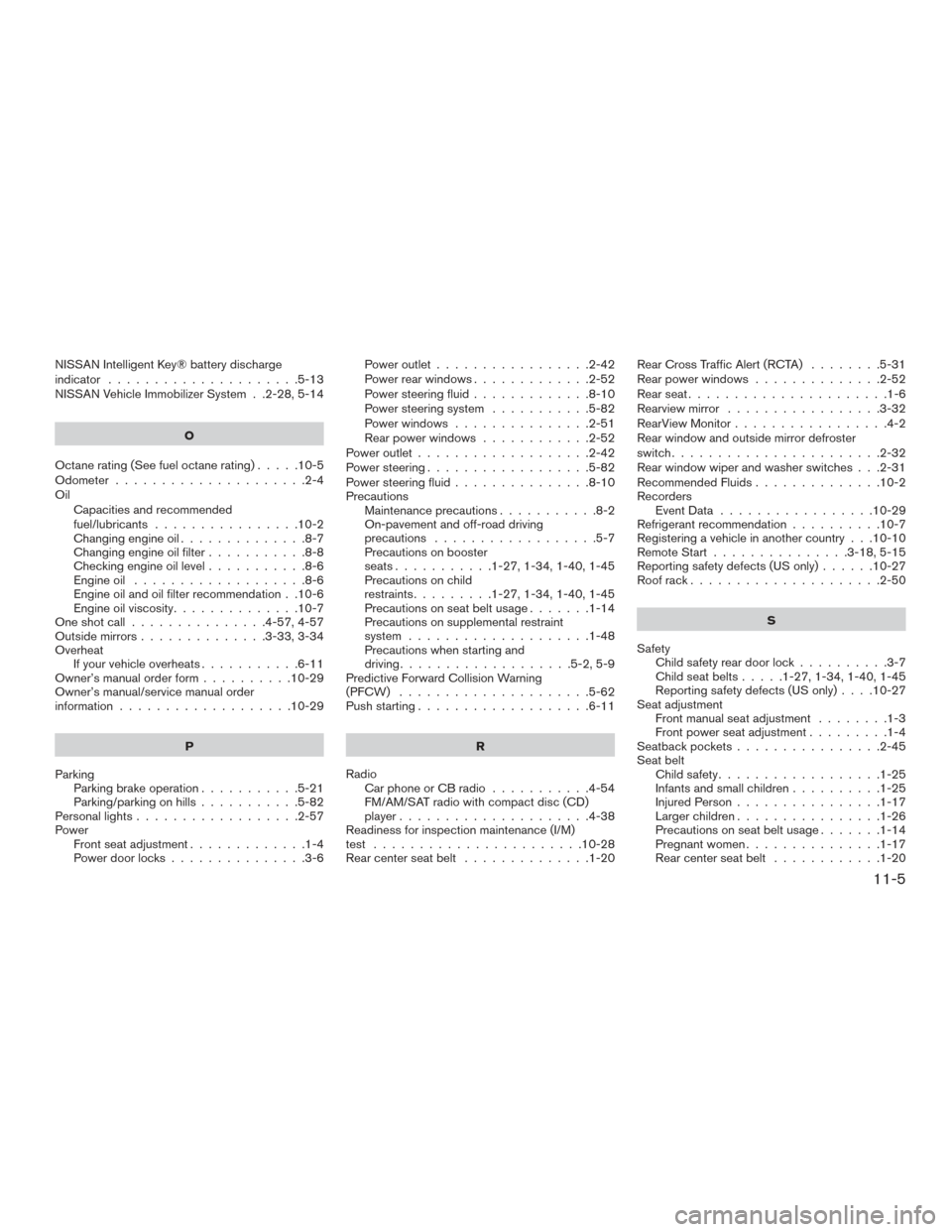
NISSAN Intelligent Key® battery discharge
indicator .....................5-13
NISSAN Vehicle Immobilizer System . .2-28, 5-14O
Octanerating(Seefueloctanerating).....10-5
Odometer .....................2-4
Oil Capacities and recommended
fuel/lubricants ................10-2
Changing engine oil ..............8-7
Changing engine oil filter ...........8-8
Checking engine oil level ...........8-6
Engine oil ...................8-6
Engine oil and oil filter recommendation . .10-6
Engine oil viscosity ..............10-7
Oneshotcall...............4-57,4-57
Outside mirrors ..............3-33,3-34
Overheat Ifyourvehicleoverheats...........6-11
Owner’s manual order form ..........10-29
Owner’s manual/service manual order
information ...................10-29
P
Parking Parking brake operation ...........5-21
Parking/parking on hills ...........5-82
Personallights..................2-57
Power Front seat adjustment .............1-4
Power door locks ...............3-6 Power outlet
.................2-42
Power rear windows .............2-52
Power steering fluid .............8-10
Power steering system ...........5-82
Power windows ...............2-51
Rear power windows ............2-52
Power outlet ...................2-42
Power steering ..................5-82
Power steering fluid ...............8-10
Precautions Maintenance precautions ...........8-2
On-pavement and off-road driving
precautions ..................5-7
Precautions on booster
seats...........1-27,1-34,1-40,1-45
Precautions on child
restraints .........1-27,1-34,1-40,1-45
Precautions on seat belt usage .......1-14
Precautions on supplemental restraint
system ....................1-48
Precautions when starting and
driving ...................5-2,5-9
Predictive Forward Collision Warning
(PFCW) .....................5-62
Push starting ...................6-11
R
Radio Car phone or CB radio ...........4-54
FM/AM/SAT radio with compact disc (CD)
player .....................4-38
Readiness for inspection maintenance (I/M)
test .......................10-28
Rear center seat belt ..............1-20 Rear Cross Traffic Alert (RCTA)
........5-31
Rear power windows ..............2-52
Rearseat......................1-6
Rearview mirror .................3-32
RearView Monitor .................4-2
Rear window and outside mirror defroster
switch.......................2-32
Rear window wiper and washer switches . . .2-31
Recommended Fluids ..............10-2
Recorders EventData .................10-29
Refrigerant recommendation ..........10-7
Registering a vehicle in another country . . .10-10
Remote Start ...............3-18,5-15
Reporting safety defects (US only) ......10-27
Roof
rack .....................2-50
S
Safety Child safety rear door lock ..........3-7
Child seat belts .....1-27,1-34,1-40,1-45
Reporting safety defects (US only) ....10-27
Seat adjustment Front manual seat adjustment ........1-3
Front power seat adjustment .........1-4
Seatbackpockets................2-45
Seat belt Child safety ..................1-25
Infants and small children ..........1-25
Injured Person ................1-17
Largerchildren................1-26
Precautions on seat belt usage .......1-14
Pregnant women ...............1-17
Rear center seat belt ............1-20
11-5
Page 464 of 466
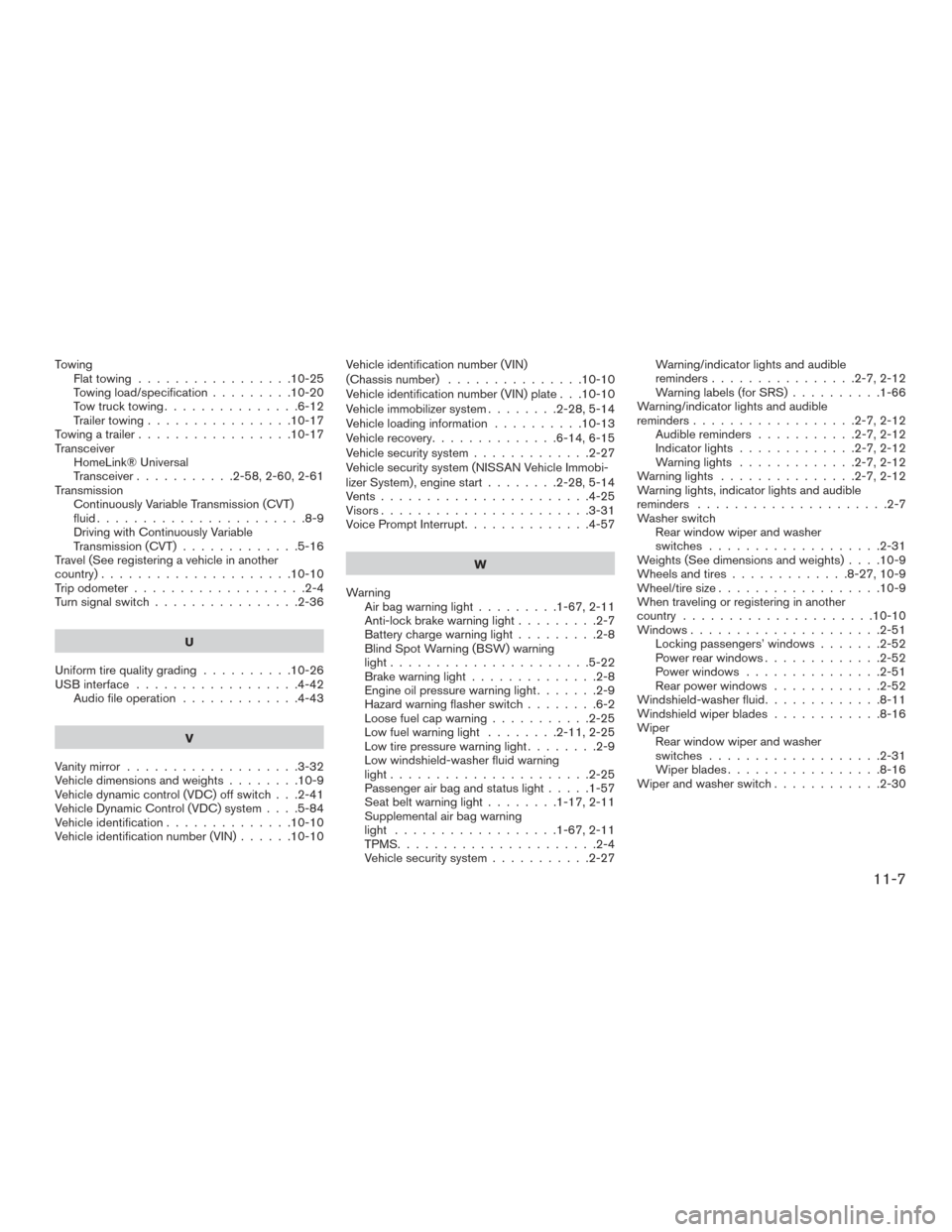
TowingFlattowing.................10-25
Towing load/specification .........10-20
Towtrucktowing...............6-12
Trailer towing ................10-17
Towing a trailer .................10-17
Transceiver HomeLink® Universal
Transceiver...........2-58,2-60,2-61
Transmission Continuously Variable Transmission (CVT)
fluid.......................8-9
Driving with Continuously Variable
Transmission (CVT) .............5-16
Travel (See registering a vehicle in another
country) .....................10-10
Trip odometer ...................2-4
Turn signal switch ................2-36
U
Uniform tire quality grading ..........10-26
USB interface ..................4-42
Audio file operation .............4-43
V
Vanity mirror ...................3-32
Vehicledimensionsandweights........10-9
Vehicle dynamic control (VDC) off switch . . .2-41
Vehicle Dynamic Control (VDC) system ....5-84
Vehicle identification ..............10-10
Vehicle identification number (VIN) ......10-10Vehicle identification number (VIN)
(Chassis number)
...............10-10
Vehicle identification number (VIN) plate . . .10-10
Vehicle immobilizer system ........2-28,5-14
Vehicle loading information ..........10-13
Vehicle recovery ..............6-14,6-15
Vehicle security system .............2-27
Vehicle security system (NISSAN Vehicle Immobi-
lizer System) , engine start ........2-28,5-14
Vents.......................4-25
Visors.......................3-31
Voice Prompt Interrupt ..............4-57
W
Warning Airbagwarninglight.........1-67,2-11
Anti-lock brake warning light .........2-7
Battery charge warning light .........2-8
Blind Spot Warning (BSW) warning
light......................5-22
Brake warning light ..............2-8
Engine oil pressure warning light .......2-9
Hazard warning flasher switch ........6-2
Loose fuel cap warning ...........2-25
Lowfuelwarninglight ........2-11,2-25
Low tire pressure warning light ........2-9
Low windshield-washer fluid warning
light......................2-25
Passenger air bag and status light .....1-57
Seatbeltwarninglight........1-17,2-11
Supplemental air bag warning
light ..................1-67,2-11
TPMS ......................2-4
Vehicle security system ...........2-27 Warning/indicator lights and audible
reminders
................2-7,2-12
Warning labels (for SRS) ..........1-66
Warning/indicator lights and audible
reminders..................2-7,2-12 Audiblereminders ...........2-7,2-12
Indicatorlights.............2-7,2-12
Warning lights .............2-7,2-12
Warning lights ...............2-7,2-12
Warning lights, indicator lights and audible
reminders .....................2-7
Washer switch Rear window wiper and washer
switches...................2-31
Weights (See dimensions and weights) ....10-9
Wheels and tires .............8-27,10-9
Wheel/tire size ..................10-9
When traveling or registering in another
country .....................10-10
Windows .....................2-51
Locking passengers’ windows .......2-52
Power rear windows .............2-52
Power windows ...............2-51
Rear power windows ............2-52
Windshield-washerfluid.............8-11
W
indshieldwiperblades............8-16
Wiper Rear window wiper and washer
switches...................2-31
Wiperblades.................8-16
Wiper and washer switch ............2-30
11-7
Page 465 of 466
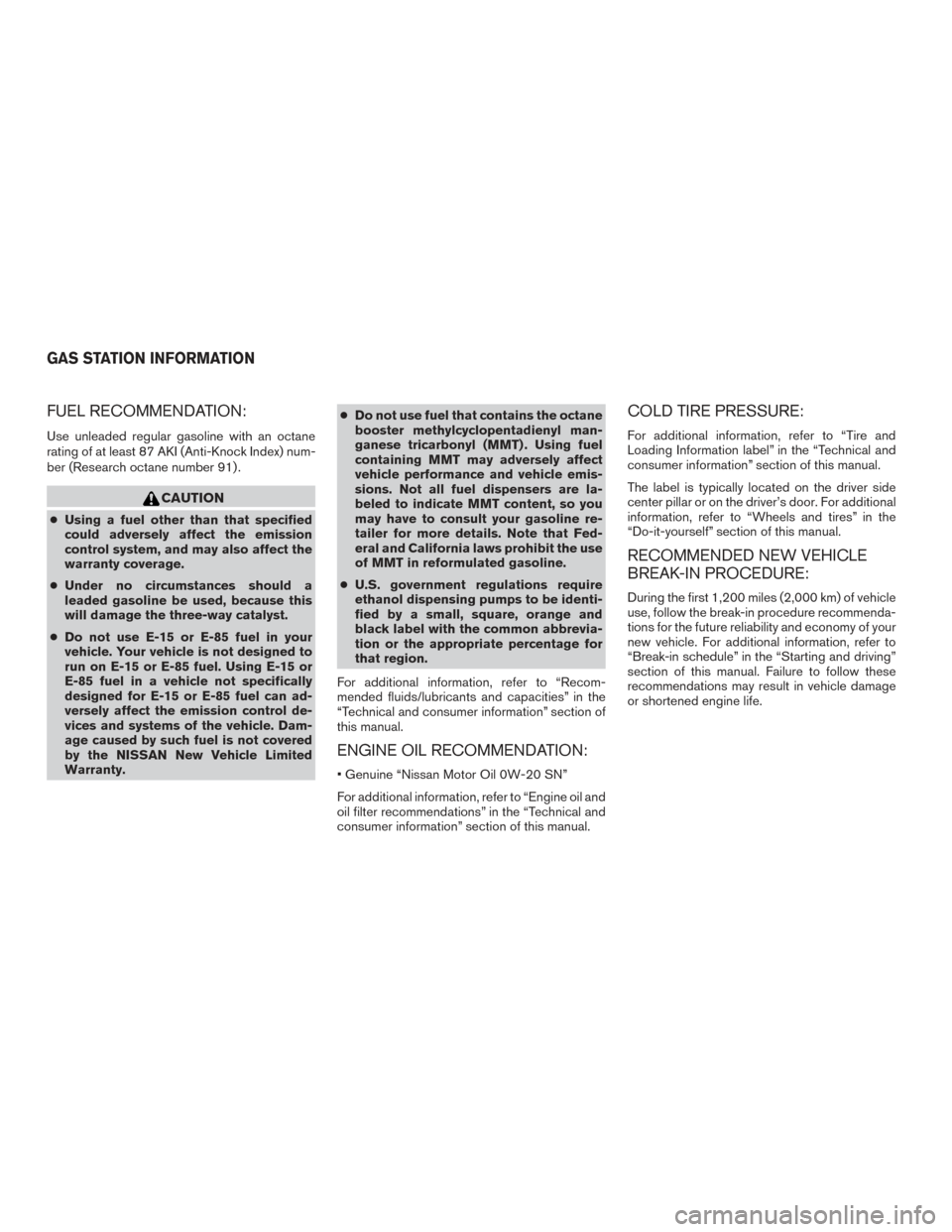
FUEL RECOMMENDATION:
Use unleaded regular gasoline with an octane
rating of at least 87 AKI (Anti-Knock Index) num-
ber (Research octane number 91) .
CAUTION
●Using a fuel other than that specified
could adversely affect the emission
control system, and may also affect the
warranty coverage.
● Under no circumstances should a
leaded gasoline be used, because this
will damage the three-way catalyst.
● Do not use E-15 or E-85 fuel in your
vehicle. Your vehicle is not designed to
run on E-15 or E-85 fuel. Using E-15 or
E-85 fuel in a vehicle not specifically
designed for E-15 or E-85 fuel can ad-
versely affect the emission control de-
vices and systems of the vehicle. Dam-
age caused by such fuel is not covered
by the NISSAN New Vehicle Limited
Warranty. ●
Do not use fuel that contains the octane
booster methylcyclopentadienyl man-
ganese tricarbonyl (MMT) . Using fuel
containing MMT may adversely affect
vehicle performance and vehicle emis-
sions. Not all fuel dispensers are la-
beled to indicate MMT content, so you
may have to consult your gasoline re-
tailer for more details. Note that Fed-
eral and California laws prohibit the use
of MMT in reformulated gasoline.
● U.S. government regulations require
ethanol dispensing pumps to be identi-
fied by a small, square, orange and
black label with the common abbrevia-
tion or the appropriate percentage for
that region.
For additional information, refer to “Recom-
mended fluids/lubricants and capacities” in the
“Technical and consumer information” section of
this manual.
ENGINE OIL RECOMMENDATION:
• Genuine “Nissan Motor Oil 0W-20 SN”
For additional information, refer to “Engine oil and
oil filter recommendations” in the “Technical and
consumer information” section of this manual.
COLD TIRE PRESSURE:
For additional information, refer to “Tire and
Loading Information label” in the “Technical and
consumer information” section of this manual.
The label is typically located on the driver side
center pillar or on the driver’s door. For additional
information, refer to “Wheels and tires” in the
“Do-it-yourself” section of this manual.
RECOMMENDED NEW VEHICLE
BREAK-IN PROCEDURE:
During the first 1,200 miles (2,000 km) of vehicle
use, follow the break-in procedure recommenda-
tions for the future reliability and economy of your
new vehicle. For additional information, refer to
“Break-in schedule” in the “Starting and driving”
section of this manual. Failure to follow these
recommendations may result in vehicle damage
or shortened engine life.
GAS STATION INFORMATION